

The cheapest SIM card on the market is often your most expensive mistake. While a low per-megabyte rate looks good on a spreadsheet, the true total cost of ownership iot connectivity is found in the operational friction of manual resets and fragmented carrier contracts. You likely already feel the strain of unpredictable data overages and the high cost of field maintenance. A single truck roll can cost hundreds of dollars. It’s an unsustainable drain on your margins. Growth requires a different approach.
This 2026 strategy guide will help you master the financial framework of IoT scaling. We’ll show you how to uncover hidden operational costs and leverage centralized management to slash your TCO. Predictable billing. Remote Network Reset. Total visibility. You’ll learn how to use the CAMP™ platform to unify global deployments into a single dashboard. We’re moving beyond commodity data rates. It’s time to build a connectivity strategy that prioritizes automation, security, and long-term profitability.
Key Takeaways
- Look beyond the monthly data plan to identify the “IoT cost iceberg,” where hidden provisioning and downtime expenses often outweigh visible SIM hardware costs.
- Master the total cost of ownership iot connectivity by shifting from reactive troubleshooting to proactive management using centralized operational tools.
- Drastically reduce field maintenance expenses by leveraging Remote Network Reset to fix unresponsive devices without costly technician truck rolls.
- Protect your margins with Intelligent Alerts that provide real-time visibility into data consumption and stop overage charges before they impact your bottom line.
- Accelerate your time-to-market and ensure hardware reliability by utilizing carrier device certification as part of a unified scaling strategy.
Defining IoT TCO: Beyond the Monthly Data Plan
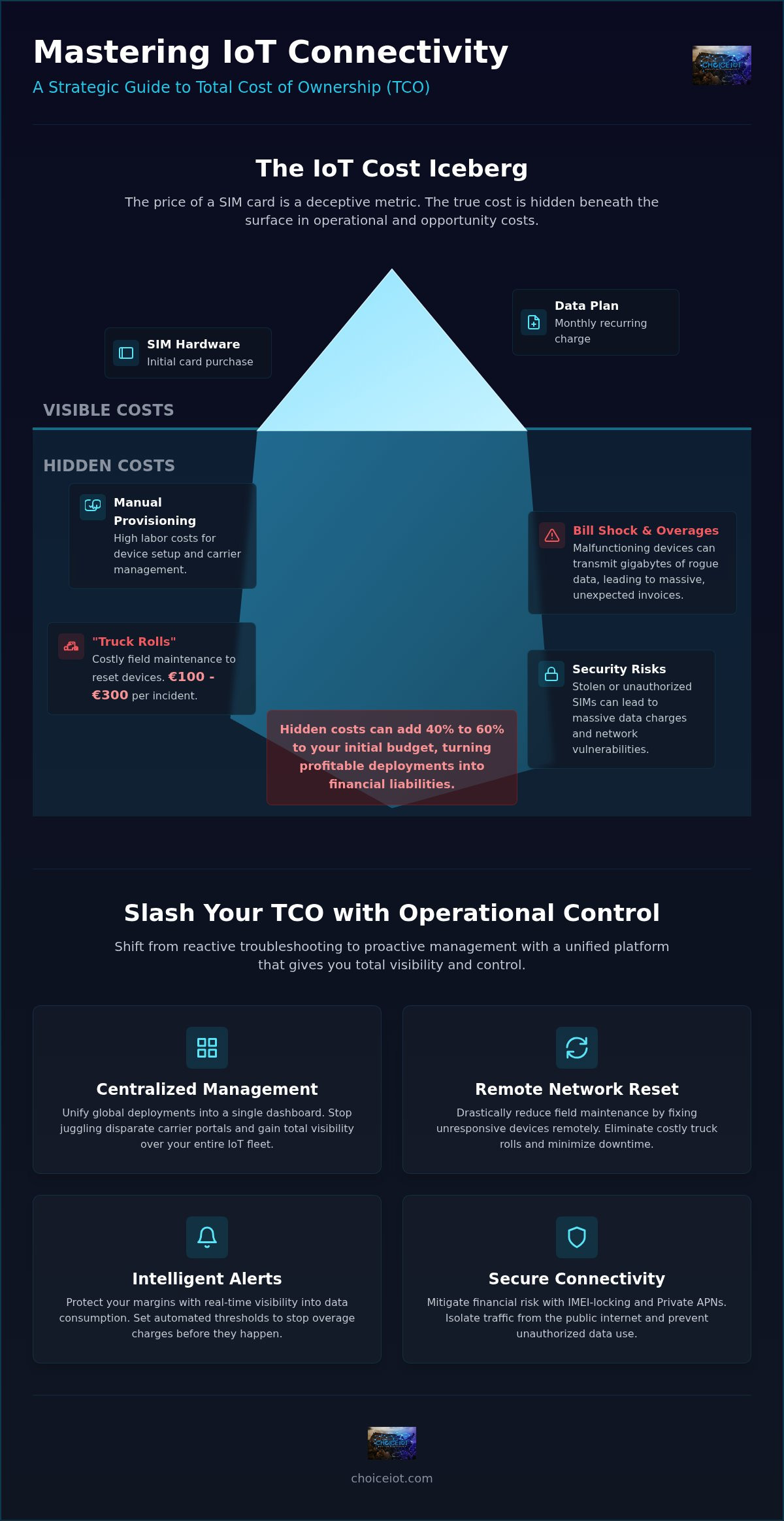
The sticker price of a SIM card is a deceptive metric. It represents only the tip of the IoT cost iceberg. While hardware and data plans are visible, the true total cost of ownership iot connectivity is hidden beneath the surface. Provisioning labor, support tickets, and system downtime are the silent margin killers that break budgets at scale. If you’re only looking at the monthly recurring charge, you’re missing the bigger picture.
A comprehensive Total Cost of Ownership (TCO) analysis accounts for every dollar spent across the device lifecycle. It’s the sum of acquisition, ongoing operation, and risk mitigation. High-performance deployments require a framework that balances these variables. Cutting corners on the front end often leads to exponential costs during the operational phase.
Buying “cheap” SIMs often backfires. These low-cost options typically lack the management tools necessary for enterprise-grade control. Without a centralized platform, your team is forced into manual workflows. Lower margins. Higher stress. Zero visibility. True profitability is found in operational efficiency, not commodity data rates.
The Three Pillars of IoT Connectivity Costs
- Direct Costs: These include the initial SIM hardware, activation fees, and the monthly recurring charges (MRC) for data usage.
- Operational Costs: This covers the labor required for device provisioning, troubleshooting connectivity issues, and managing multiple carrier contracts.
- Opportunity Costs: This is the lost revenue resulting from device downtime or slow deployment cycles that delay time-to-market.
The Multi-Carrier Advantage
Redundancy is a financial safeguard. Utilizing multi carrier iot sim cards allows your devices to switch networks based on signal strength. This prevents costly site visits for signal issues and eliminates “carrier lock-in.” You gain the flexibility to deploy anywhere without negotiating separate regional contracts. Multi-carrier SIMs act as a critical hedge against regional network outages by providing immediate, automated failover to an alternative network provider.
Hidden Drivers of IoT Connectivity Overhead
Scaling an IoT fleet reveals costs that don’t appear on a standard quote. Many organizations focus exclusively on data rates, ignoring the massive overhead of manual management. This oversight is dangerous. Research indicates that hidden costs can add 40 to 60 percent to the initial development budget. These expenses inflate the total cost of ownership iot connectivity and can quickly turn a profitable deployment into a financial liability.
Bill shock is the most immediate risk. A single malfunctioning sensor or a misconfigured firmware update can transmit gigabytes of rogue data in hours. Without automated thresholds, you only discover the error when the invoice arrives. This isn’t just a billing issue. It’s a lack of operational control. Managing manual provisioning and juggling disparate carrier portals adds a “hidden tax” on your team’s time. Inefficient workflows. Fragmented data. Eroded margins.
The High Cost of Technical Friction
The “truck roll” is the ultimate margin killer. Sending a technician to a remote site to reset an unresponsive device is the most expensive way to fix a connectivity glitch. Industry data suggests these on-site repairs cost between €100 and €300 per incident. Lost time. Wasted fuel. Scheduling delays. Without real-time visibility, your support team remains reactive. They wait for a device to fail and then guess at the cause. This cycle is unsustainable. Centralizing your operations onto a single platform allows you to identify issues before they require physical intervention.
Financial Risks of Unsecured SIMs
Security is a financial imperative, not just a technical one. Stolen SIMs used in unauthorized devices can rack up massive data charges before detection. If your system cannot detect a device-change or lock a SIM to a specific IMEI, you are exposed. Utilizing a private apn for iot mitigates these risks by isolating your traffic from the public internet. It prevents costly cyberattacks and ensures your data remains under your control. To see how a unified platform eliminates these overhead drivers, consider the advantages of centralized connectivity management.
Calculating and Reducing TCO with Operational Control
Operational control is the antidote to the hidden costs discussed in the previous sections. Managing a global fleet requires more than just a connection. It requires a command center. The path to a lower total cost of ownership iot connectivity begins with centralized visibility and automated intervention. By moving from reactive firefighting to proactive management, you reclaim your margins and eliminate technical friction. The CAMP™ platform serves as this essential foundation, providing “One Platform” control over every device in your deployment.
Efficiency thrives on automation. Manual intervention is a scalability bottleneck. Integrating your connectivity data directly into your CRM or ERP via API streamlines billing and inventory management. This reduces administrative labor and ensures that your financial records match your real-time usage. Automated workflows. Reduced human error. Maximum scalability.
Automated Cost Mitigation Strategies
Proactive monitoring prevents bill shock before it happens. Using Intelligent Alerts, you can define custom data-usage thresholds for individual devices or groups. When a device exceeds its limit, the system triggers an immediate notification or automated suspension. This stops rogue data consumption in its tracks. Additionally, SIM Lock security automatically bonds each SIM to its authorized hardware. This prevents unauthorized usage and protects your investment from theft. Leveraging a sophisticated iot connectivity management platform ensures these safeguards are always active without requiring manual oversight.
Diagnostics and Troubleshooting Efficiency
Remote diagnostics eliminate the need for physical intervention. Remote Network Reset allows your team to reboot unresponsive devices from the dashboard, effectively solving the “truck roll” problem remotely. This feature alone can save thousands in labor and travel expenses. Built-in diagnostic tools provide real-time status updates, allowing you to resolve issues without waiting for carrier support. Maintaining a full history of support notes within the platform further reduces repetitive troubleshooting labor by providing a clear audit trail for every device. Real-time visibility turns raw connectivity data into an actionable roadmap for continuous TCO reduction. To see how these tools can transform your operations, explore the CAMP™ platform features today.
Strategic Scaling: Optimizing Your IoT Investment
Scaling isn’t just about adding more SIMs. It’s about the architecture of growth. To master the total cost of ownership iot connectivity, you must shift from tactical management to strategic orchestration. This requires a partner that functions as a foundation, not just a vendor. It’s the difference between managing a fleet and optimizing an enterprise asset. Your strategy should prioritize long-term stability over short-term savings.
Selecting the Right Connectivity Model
Your network architecture dictates your long-term margins. Multi-carrier models provide the essential redundancy needed to bypass localized outages and avoid the high costs of downtime. In many industrial applications, Fixed Wireless Connectivity offers a streamlined, cost-effective alternative to fiber. It’s faster to deploy. Easier to manage. For remote access, Static IP addresses and Private APNs reduce maintenance overhead by providing secure, direct tunnels to your hardware without the complexity of traditional VPNs. These tools turn connectivity into a predictable utility.
The Path to Positive ROI
Technical friction often starts in the lab. Carrier Device Certification is a mandatory step for streamlining deployment costs and ensuring hardware reliability from day one. As you look toward 2026, future-proof your investment with 5G RedCap. This standard fills the gap between low-power sensors and high-bandwidth video, balancing throughput with power efficiency to keep operational costs low. It’s the smart move for mid-tier applications that demand longevity and performance without the premium price tag of full-scale 5G.
Transitioning to scalable iot connectivity solutions means moving beyond basic SIM management. It requires operational orchestration. Solution providers choose Choice IoT for the white-label efficiency and granular control that only a “Complete Connectivity Partner” can provide. We solve the industry’s most complex hurdles so you can focus on growth. Maximize your margins. Simplify your scale. Contact Choice IoT to audit your current TCO and optimize your deployment.
Master Your Connectivity Margins
Profitability in IoT depends on your ability to look beneath the surface. We’ve defined the total cost of ownership iot connectivity as a balance of direct fees, operational labor, and risk mitigation. Success in 2026 requires moving beyond the “price per MB” mindset. True growth is fueled by efficiency. Centralize your management. Automate your defenses. By leveraging the CAMP™ platform, you gain One Platform with complete operational control. This is the essential foundation for any enterprise deployment.
Remote Network Reset eliminates the need for expensive truck rolls by fixing unresponsive devices from your dashboard. Intelligent Alerts ensure you never face another surprise overage by providing proactive cost management. The logistical stress of managing global deployments shouldn’t be your burden. It’s a hurdle we’ve already cleared. Build on a system that’s inherently robust and intuitive. Your scale is ready. Let’s maximize your ROI together.
Optimize your IoT TCO with the CAMP™ platform. Contact Choice IoT today.
Frequently Asked Questions
What is the biggest hidden cost in IoT connectivity?
The most significant hidden cost is the “truck roll,” which is the expense of sending a technician to a remote site for manual troubleshooting. Industry data suggests these incidents can cost hundreds of dollars each. Labor. Fuel. Scheduling delays. These operational expenses often exceed the cumulative cost of the data plan itself. Without remote diagnostics, a single hardware reset can devastate your project’s annual maintenance budget and erode scaling margins.
How does a connectivity management platform like CAMP™ reduce TCO?
The CAMP™ platform reduces the total cost of ownership iot connectivity by centralizing every device into a single, unified dashboard. It eliminates the “hidden tax” of manual provisioning and disparate carrier portal management. Automation and API integration streamline activations and plan changes, reducing administrative labor. This operational orchestration turns raw usage data into actionable insights, ensuring your team spends time on growth rather than technical friction and fragmented data sets.
Can remote SIM resets actually save money?
Remote Network Reset saves money by eliminating physical on-site visits to fix unresponsive devices. Instead of dispatching a technician, your team reboots SIM connectivity directly from the dashboard. Immediate resolution. Zero travel costs. This feature dramatically reduces downtime and avoids the high labor rates associated with technical field support. It’s a high-impact tool for maintaining uptime in global deployments without inflating your ongoing operational budget or wasting internal resources.
How do Intelligent Alerts prevent bill shock?
Intelligent Alerts prevent bill shock by allowing you to define custom data-usage thresholds for every device in your fleet. When a device reaches a specific limit, the system triggers proactive notifications or automated suspensions. This stops rogue data consumption immediately. You don’t have to wait for the monthly invoice to discover a malfunctioning sensor. Real-time visibility ensures your billing remains predictable and protected from unmonitored, expensive overage charges across your entire deployment.
Why is multi-carrier connectivity more cost-effective than single-carrier?
Multi-carrier connectivity is more cost-effective because it provides automated failover to alternative networks during regional outages. This redundancy prevents the massive opportunity costs associated with device downtime. You avoid “carrier lock-in” and the need to negotiate separate regional contracts. It also simplifies global scaling. One SIM provides reliable coverage across major networks, ensuring high-performance data transmission without the expense of managing multiple vendor relationships or complex logistics.
What is the financial impact of SIM Lock and security features?
SIM Lock and security features protect your margins by preventing unauthorized data usage and theft. By bonding a SIM to a specific device, you eliminate the risk of runaway data charges if a SIM is removed or stolen. The system automatically suspends service or alerts your team when a device change is detected. This proactive risk mitigation lowers the total cost of ownership iot connectivity by securing your assets and preventing fraudulent billing spikes.