

Connectivity isn’t just about signal strength. It’s about total operational control. In the fast-moving world of transit, a single dead zone can derail an entire fleet’s data stream. Reliability is the baseline, but the real challenge lies in managing iot connectivity for public transportation across fragmented networks and unpredictable environments. You need a system that doesn’t just connect. It needs to actively manage itself. Maximum uptime. Zero friction.
Managing a fleet means dealing with carrier dead zones, security vulnerabilities, and the high cost of manual resets. We know the logistical stress of “truck rolls” and the frustration of bill shock from data overages. This guide shows you how to master these complexities with multi-carrier resilience and centralized control. One dashboard. Total visibility. Complete control. You’ll learn to achieve seamless roaming, real-time visibility, and hardened network protection for smarter urban mobility. We’ll break down the strategies for reducing maintenance costs while ensuring your infrastructure stays secure and always online.
Key Takeaways
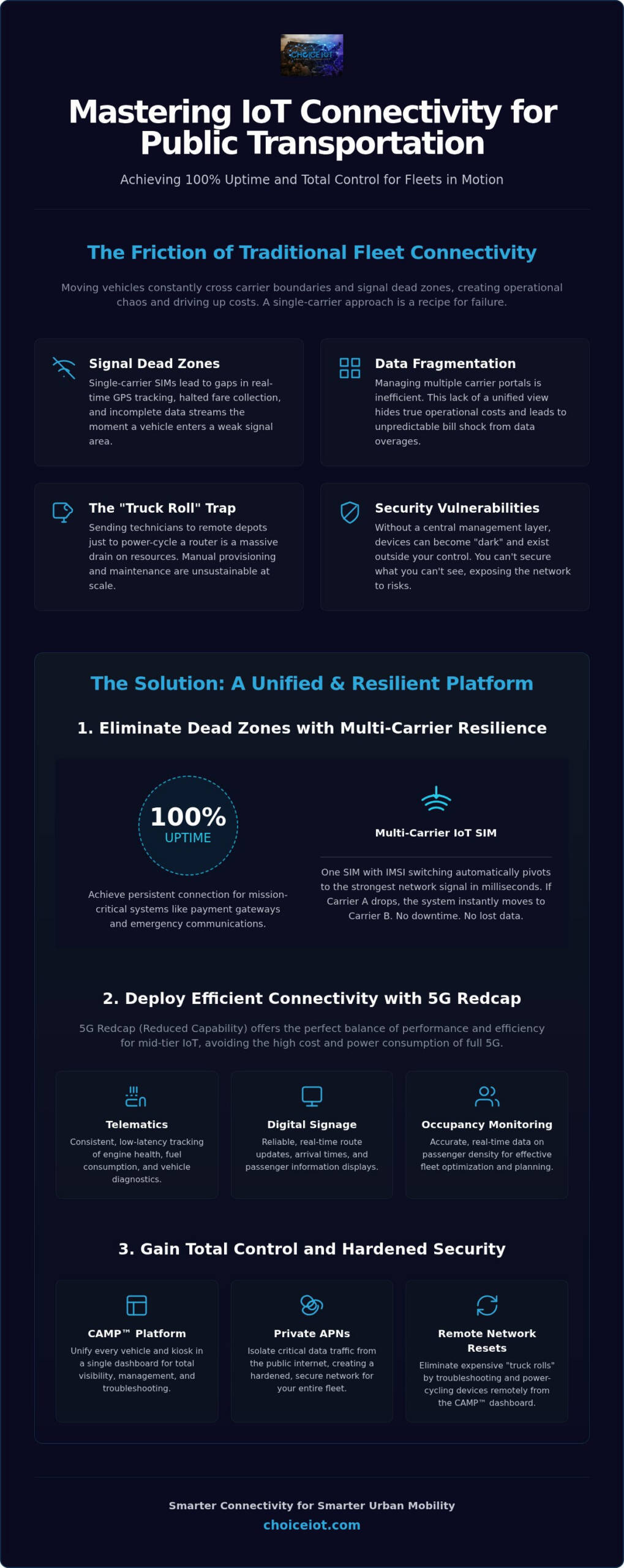
- Eliminate dead zones with multi-carrier resilience. Ensure 100% uptime for iot connectivity for public transportation across your entire moving fleet.
- Leverage 5G Redcap for efficient, mid-tier connectivity. It’s the “just right” solution for scaling transit sensors without over-provisioning.
- Centralize your operations with the CAMP™ platform. Gain total visibility into every vehicle and kiosk through one unified dashboard.
- Hardened security meets cost reduction. Use Private APNs to isolate data traffic and Remote Network Resets to eliminate the need for expensive “truck rolls.”
The Connectivity Challenges of Modern Public Transit
Reliable iot connectivity for public transportation is the foundation of smart urban mobility. It’s the digital nervous system that links vehicles, stations, and passengers. While the Internet of Things (IoT) has transformed many industries, transit presents a specific mobility problem. Moving vehicles don’t stay in one place; they constantly cross carrier boundaries and signal dead zones. Optimizing iot connectivity for public transportation requires moving beyond the limitations of single-carrier contracts. A single-carrier approach is a recipe for failure. It creates gaps in real-time GPS tracking and halts fare collection the moment a bus enters a weak signal area.
Managing thousands of devices across a fleet introduces significant scalability hurdles. When agencies use multiple carriers without a central management layer, they face extreme data fragmentation. Logging into different portals to check usage or troubleshoot a device is inefficient. It wastes time and hides the true cost of operations. Without a unified view, transit managers struggle to identify which devices are underperforming or which are nearing data caps. This lack of control leads to unpredictable overages and bill shock.
Why Multi-Carrier Resilience is Non-Negotiable
Seamless roaming is the only way to maintain 100% uptime on the move. Multi-carrier SIMs allow transit hardware to switch networks based on signal strength, not just availability. This signal optimization ensures that mission-critical systems, like emergency communications and payment gateways, have a persistent connection. Redundancy is the goal. If Carrier A drops, the system pivots to Carrier B in milliseconds. No downtime. No lost data. It’s about maintaining a constant link between the vehicle and the central office, regardless of the route.
The Operational Burden of Traditional IoT
Manual provisioning is a bottleneck that slows down deployment. Traditional setups often require on-site configuration, which is impossible to scale across hundreds of vehicles. Then there’s the “truck roll” trap. Sending a technician to a remote depot just to power-cycle a router is a massive drain on resources. It’s unsustainable. Visibility gaps create “dark” devices that exist outside your control. You can’t secure what you can’t see, and you can’t fix what you can’t reach remotely. This operational friction prevents transit agencies from achieving the efficiency they need to stay competitive.
Technical Foundations: Multi-Carrier SIMs and 5G Redcap
Reliability requires a hardware-first strategy. Traditional single-carrier SIMs are a liability in moving vehicles. They lack the agility to pivot when signal strength fades. Our iot connectivity for public transportation relies on Multi-Carrier IoT SIMs that bridge the gap between disparate networks. One SIM. Multiple carriers. Zero downtime. This architecture ensures that your fleet remains reachable from the urban core to the rural edge.
The Architecture of a Multi-Network Transit SIM
The core of this technology is IMSI switching. It allows a device to change carrier profiles in real-time without physical intervention. For cross-border rail, this means seamless transitions across national lines. Durability is equally critical. Transit environments are harsh. We utilize MFF2 embedded SIM form factors to withstand constant vibration and extreme temperature swings. This industrial-grade hardware is essential for maintaining the link between iot connectivity for public transportation and the central operations center. You can explore more about the intersection of IoT and Mobility to see how these foundations support modern city goals.
5G Redcap for Public Transportation
Not every transit sensor needs multi-gigabit speeds. High-bandwidth 5G is often overkill for telematics or occupancy monitoring. This is where 5G Redcap (Reduced Capability) excels. Standardized in 3GPP Release 17, it offers the “just right” balance of performance and efficiency. It provides the low latency of 5G without the high power consumption or hardware costs of full-tier modules. It is the ideal choice for several mid-tier applications:
- Telematics: Consistent tracking of engine health and fuel consumption.
- Digital Signage: Real-time route updates and passenger information displays.
- Occupancy Monitoring: Accurate, real-time data on passenger density for fleet optimization.
Choosing between 4G LTE and 5G Redcap depends on your long-term roadmap. While 4G remains a reliable workhorse, 5G Redcap is built for the next decade of industrial IoT. It offers better spectral efficiency and a clearer path as carriers eventually sunset older legacy networks. Transitioning now prevents future hardware swaps. It keeps your operational control intact without the need for frequent, costly upgrades. Streamlining this process requires Carrier Device Certification to ensure your hardware is ready for immediate deployment. This technical foundation removes the friction from large-scale rollouts.
Operational Control: Managing Transit Data with CAMP™
Connectivity is only half the battle. The other half is management. Without a centralized view, iot connectivity for public transportation becomes a chaotic web of unmonitored data usage. The CAMP™ platform changes that. It delivers one platform and complete operational control. You gain real-time visibility into every bus, train, and kiosk from a single dashboard. No more switching between carrier portals. No more blind spots. One dashboard. Total visibility. Zero friction.
Preventing ‘Bill Shock’ in Fleet Deployments
Transit fleets are notorious for unpredictable data spikes. A malfunctioning sensor or an unoptimized software update can lead to massive overages. We stop bill shock with intelligent alerts and proactive notifications. Manage with precision. Stop overages before they start.
Did you know? You can set custom thresholds for every SIM in your fleet. These alerts trigger the moment a device exceeds its expected usage. It allows you to intervene before the bill arrives. Usage analytics turn raw transit data into actionable cost-saving insights. You identify high-usage patterns and adjust plans accordingly. It’s about optimization, not just observation.
Streamlining Support and Troubleshooting
Downed devices mean lost revenue and frustrated passengers. Waiting for carrier support is a luxury transit agencies don’t have. CAMP™ provides built-in diagnostics that allow your team to resolve issues instantly. You can perform remote resets and check signal health without leaving your desk. Efficiency is the priority.
- Support History: Maintain a full audit trail of notes for every transit device.
- Reporting: Export performance reports for stakeholders and city officials.
- Automation: Use our API to integrate connectivity data directly into your existing transit ERP.
See how our iot connectivity management platform centralizes your operations. This level of transparency builds trust with city officials and ensures your infrastructure is always audit-ready. Ready to take command? Explore the CAMP™ dashboard today and eliminate the logistical stress of fleet management.
Securing the Transit Edge: Private APNs and Remote Resets
Public IPs are a liability. They leave your hardware exposed to the open internet, inviting unauthorized access and potential breaches. Securing iot connectivity for public transportation requires a hardened perimeter at the transit edge. Most IoT traffic remains unencrypted. This exposure is unacceptable for mission-critical urban mobility systems. You need a network that is invisible to bad actors. Maximum security. Minimum exposure. Total control.
A Private APN (Access Point Name) is the solution. It creates a dedicated, secure tunnel for your transit data, isolating it from the public internet entirely. This architecture provides a direct, low-overhead connection that is more efficient than a traditional VPN. Learn more about how a private apn for iot provides enterprise-grade security for large-scale deployments. By removing devices from the public eye, you eliminate the primary attack vector for transit infrastructure.
Securing Public-Facing Hardware
Buses, trains, and kiosks are physically accessible to the public. This creates a theft risk for your connectivity hardware. Our SIM Lock feature protects your investment by binding a SIM card to a specific device’s IMEI. If a SIM is removed from a bus router and placed in an unauthorized device, it immediately stops working. You receive an instant device change alert. This proactive security ensures your data plans are never used for unauthorized streaming or personal use. Static IP addresses further enhance management by enabling secure, two-way communication for remote updates and monitoring.
Eliminating the Need for On-Site Visits
The “truck roll” is the enemy of profitability. Sending a technician to a remote depot just to reset a frozen router is a massive drain on resources. Remote Network Reset is the ultimate tool for maximizing transit uptime. You can refresh connectivity for any device in your fleet directly from your desk. Refresh. Reconnect. Resolve. This capability allows a lean team to manage global transit deployments with high efficiency.
Reducing O&M (Operations and Maintenance) costs is about removing friction. Remote tools save thousands in annual maintenance by resolving 90% of connectivity issues without a field visit. This scalability is essential as transit agencies adopt 5G Redcap and expand their sensor networks. You maintain a high-performance fleet without the high-performance overhead. Ready to take control? Contact us at 1-888-565-0774 or sales@choiceiot.com to secure your transit infrastructure.
Take Command of Your Transit Infrastructure
Urban mobility is evolving. Your infrastructure must keep pace. Mastering iot connectivity for public transportation is about removing the friction of manual management. You’ve seen the power of multi-carrier resilience. You’ve explored the security of Private APNs. Now, it’s time to integrate these technical foundations into a streamlined, centralized system. Reliability isn’t just a goal; it’s a requirement for modern city life.
Efficiency is the target. Automation is the method. The CAMP™ platform delivers one platform and complete operational control. Use Remote Network Reset to eliminate costly truck rolls and maintain 100% uptime with multi-carrier resilience. Your fleet stays online. Your data stays secure. Your costs stay predictable. Don’t let logistical stress derail your growth. Empower your operations with a partner that has already solved the industry’s most complex hurdles. The path to smarter urban mobility is clear.
Take Control of Your Transit Connectivity with Choice IoT. Let’s build a more reliable future for urban mobility together.
Frequently Asked Questions
What are the benefits of IoT connectivity for public transportation?
Real-time tracking, improved passenger safety, and optimized fleet maintenance are the primary advantages. It enables agencies to monitor engine health and fuel consumption while providing passengers with accurate arrival times. These systems reduce operational friction by automating data collection across every bus and train. By utilizing robust iot connectivity for public transportation, agencies can also enhance fare collection efficiency and provide high-speed digital signage updates.
How do multi-carrier SIMs improve transit reliability?
Multi-carrier SIMs eliminate the risk of single-network dead zones by pivoting between carriers in real-time. Moving vehicles frequently cross coverage boundaries where one provider may fail. These SIMs use IMSI switching to identify and connect to the strongest available signal automatically. This architecture ensures that mission-critical systems, such as emergency communications and GPS tracking, maintain 100% uptime regardless of the vehicle’s location or route.
Can I manage different carriers through one portal for my transit fleet?
Yes, the CAMP™ platform provides a single dashboard for managing all devices, SIMs, and carriers in one location. This centralized control removes the need to log into multiple carrier portals to check usage or troubleshoot issues. It offers real-time visibility into your entire global deployment. You can activate SIMs, change plans, or monitor data consumption across different networks from one unified interface, streamlining your backend operations.
How does a Private APN secure public transit data?
A Private APN creates a secure, isolated tunnel that keeps your transit data off the public internet. Since most IoT traffic is unencrypted, public IPs are a major liability. The Private APN acts as a hardened perimeter, ensuring that only authorized devices can communicate with your central server. This setup provides a more direct, lower-overhead connection than a traditional VPN, protecting sensitive passenger and operational data from external cyber threats.
What is the best way to prevent data overages in large IoT deployments?
The most effective method is using intelligent alerts to set custom data-usage thresholds for every SIM. The CAMP™ platform sends proactive notifications the moment a device exceeds its expected consumption. This allows you to intervene before the billing cycle ends. Combining these alerts with real-time usage analytics helps you identify data-hungry devices or malfunctioning sensors early. This strategy eliminates bill shock and keeps your operational costs predictable.
Can I reset transit IoT devices remotely if they lose connection?
Yes, the Remote Network Reset feature allows you to refresh SIM connectivity directly from your desk without an on-site visit. This capability is essential for maximizing uptime across large-scale iot connectivity for public transportation deployments. It eliminates the need for costly “truck rolls” to manually power-cycle hardware in remote depots. You can resolve most connectivity issues through the CAMP™ platform, saving significant time and maintenance resources.