

What if a SIM is removed from an unattended IoT device and no one notices? A stolen card may be placed in another compatible device and continue using connectivity unless safeguards detect or restrict the change. That’s why preventing iot sim card theft takes more than physical security. It calls for device-level controls and a response that doesn’t depend on someone spotting the problem during a field visit.
Limited visibility can turn a small device change into a time-consuming investigation. Centralized monitoring and clear alerts help teams identify unexpected activity sooner and decide what to do next.
This guide explains how to reduce unauthorized SIM use with practical controls, actionable alerts, and a defined incident-response process. You’ll learn how locking a SIM to an authorized device, monitoring device changes, and configuring alert or suspension controls can support a layered security approach. We’ll also cover how to manage SIM security centrally, so teams can respond with more clarity and less manual effort across an IoT deployment.
Key Takeaways
- Understand how physical IoT SIM theft differs from SIM swapping, so you can focus on the right safeguards.
- Preventing iot sim card theft starts with restricting SIM use to an authorized device and watching for unexpected device changes.
- Use a clear response sequence to validate alerts, contain exposure, investigate changes, and restore service appropriately.
- Check maintenance records, device replacements, and inventory when a SIM change alert needs investigation.
- Explore how CAMP™ visibility and configured SIM controls can support centralized oversight across a deployment.
What IoT SIM Card Theft Looks Like in a Connected-Device Deployment
IoT SIM theft is the unauthorized removal, transfer, or use of a SIM assigned to a connected device. Someone with physical access may take the SIM from a meter, sensor, vehicle, or other cellular device and insert it into another compatible device. Preventing iot sim card theft starts with recognizing this physical threat and distinguishing it from other forms of SIM misuse.
SIM theft isn’t the same as SIM swapping. Physical theft involves moving a deployed SIM. Account-level SIM swapping involves an attacker manipulating a carrier account or process to transfer service to a SIM they control. Both can disrupt service or enable unauthorized use, but they involve different attack paths and may require different responses. The term SIM binding refers to linking SIM use to a device, a control explored in the next section.
How can an IoT SIM be stolen or misused?
Physical access is the starting point. A SIM may be removed from a deployed device and inserted into another compatible device. If the change isn’t detected, teams may not know whether the original asset has been tampered with, replaced, or simply lost connectivity. Account-level SIM swapping, by contrast, targets the subscriber relationship and doesn’t require someone to remove the SIM from the IoT device.
Why does unauthorized SIM use matter to operators?
Unauthorized use can create unexpected connectivity and data activity, while leaving the intended device offline or without its expected connection. The operational challenge grows when assets are unattended, remote, or distributed across multiple locations. A change at a difficult-to-access site may go unnoticed until a service issue, usage anomaly, or scheduled inspection prompts a review.
Delayed detection can make it harder to match network activity to a physical asset. Teams may need to compare SIM and device records, confirm whether maintenance or a replacement was authorized, and coordinate a field check. To make that review more efficient, keep device records current and document approved SIM transfers or replacements. The impact depends on the deployment, so assess it against your connectivity requirements, device inventory, and monitoring processes.
How Device Binding and SIM Change Alerts Reduce IoT SIM Risk
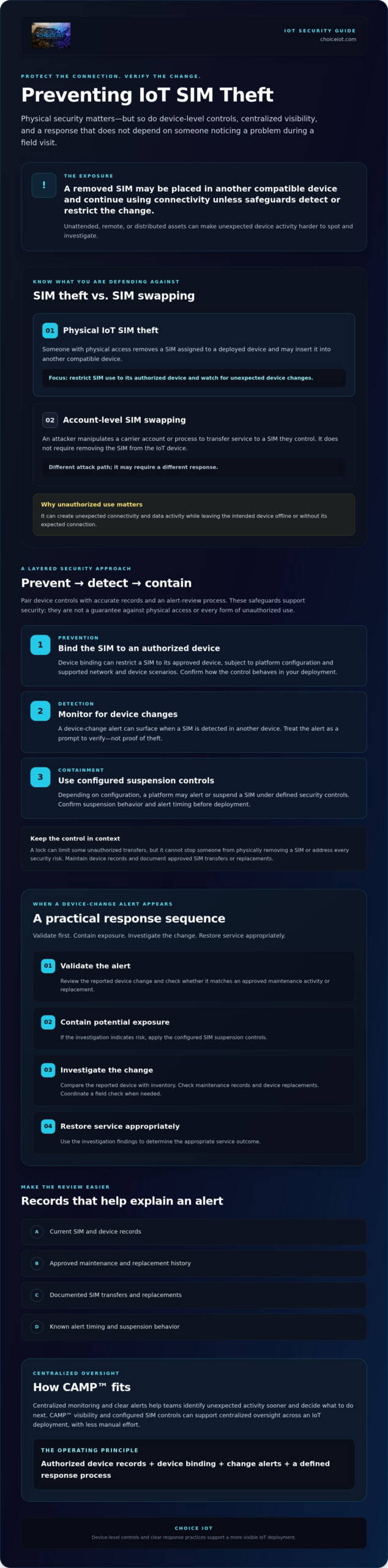
Once a SIM is assigned to a device, controls can help keep its use aligned with that assignment. Device binding restricts a SIM to an authorized device, while change alerts give teams visibility if the SIM is detected in a different one. Together, they support preventing iot sim card theft through prevention and faster detection. They’re safeguards, not a guarantee against physical access or every form of unauthorized use.
What does locking an IoT SIM to an authorized device do?
Think of the SIM and device as an approved pair in your deployment records. A SIM lock can restrict service to the authorized device, subject to the platform’s configuration and supported network and device scenarios. Before relying on the control, confirm how it works for your deployment. Behavior can vary, and a lock shouldn’t be treated as blocking every possible misuse. The IoT SIM Fraud Prevention API describes industry approaches to SIM fraud prevention, including device-related checks.
What can device-change alerts reveal?
A device-change alert can flag that a SIM has been detected in another device. Treat it as a prompt to verify, not proof of theft. Check approved maintenance and replacement records, then compare the reported device with your inventory. Depending on configuration, a platform may also alert or suspend a SIM under defined security controls. Confirm suspension behavior and alert timing before deployment so responders know what to expect.
Control type | Role in a response
Prevention: Restrict the SIM to an authorized device where supported and configured.
Detection: Use a device-change alert to surface unexpected movement for review.
Containment: Apply configured suspension controls when investigation indicates a risk.
A lock can limit some unauthorized transfers, but it can’t stop someone from physically removing a SIM or address every security risk. Pair it with an accurate device inventory, clear maintenance procedures, and a defined alert-review process. To see how centralized connectivity management can support these controls, explore the CAMP™ IoT platform.
A Practical IoT SIM Theft Response: Detect, Contain, Investigate
A device-change alert is a signal to verify what happened, not a conclusion. Planned repairs or device replacements can create legitimate changes; an inventory mismatch or unexplained event may call for containment and investigation. A repeatable process helps teams respond consistently across remote and distributed assets.
What should a team do when a SIM moves unexpectedly?
Use a defined sequence. First, validate the alert by checking the SIM and reported device identity against deployment records. Confirm whether maintenance, replacement, or an approved SIM transfer explains the event. If the change can’t be promptly verified, apply the configured suspension controls and follow internal security and carrier-support procedures. Once the event is contained, investigate the device and SIM records. Restore service only after confirming the approved device and updating relevant records.
- Validate: Match the event to the SIM, device, location, and approved work or replacement records.
- Contain: If the change remains unexplained, use the response controls configured for the deployment.
- Investigate: Review available SIM activity and platform history. Check which fields are available, such as event time, device identifier, connection or data activity, and status changes. Don’t assume every platform records the same details.
- Restore: Confirm the correct device, document the outcome, and return service according to your incident procedure.
How can operators make prevention repeatable at scale?
Keep an authorized-device inventory and document approved SIM transfers so responders can distinguish routine work from unexpected changes. Assign an owner to review alerts and resolve exceptions. Use platform reporting and diagnostics to support an investigation, while verifying which event details and history are available in your configuration.
Clear procedures make preventing iot sim card theft more manageable as deployments grow. They also help teams distinguish a suspicious device change from routine field work. For a broader security context, the Trusted Connectivity Alliance describes IoT SAFE (IoT SIM Applet For Secure End-to-End Communication) as an approach to securing IoT communications using the SIM. It complements operational controls, but doesn’t replace alert review or incident response.
Review how centralized SIM visibility and controls could fit your response process with Choice IoT’s connectivity management platform.
Manage IoT SIM Security Centrally with CAMP™
Managing SIM security across a deployment is easier when teams can see connectivity information and apply controls from a central platform. Choice IoT’s CAMP™ IoT Platform brings SIM security capabilities together with fleet-level visibility. It can support preventing iot sim card theft as part of a layered process, alongside device records, clear alert ownership, and incident procedures.
Which CAMP™ features support SIM oversight?
CAMP™ SIM Lock & Security can lock each SIM to an authorized device and, under configured controls, alert teams or suspend a SIM. Device Change Alerts notify teams when a SIM moves to another device, giving operators a prompt to review the event against maintenance and inventory records.
Real-Time Visibility centralizes device, SIM, and data-usage information. Diagnostics & Troubleshooting and Reporting & Analytics can help teams investigate an exception and review relevant connectivity activity. These capabilities support oversight; diagnostics and reports don’t prevent theft on their own, and SIM controls aren’t a guarantee against every form of unauthorized use.
How should teams evaluate a centralized security workflow?
Start with the response process, then confirm that platform settings fit it. Identify who reviews alerts, how exceptions are escalated, and what evidence is needed before service is suspended or restored. Ask Choice IoT to confirm the available configuration options, notification behavior, and suspension controls for your deployment.
Consider network-level safeguards alongside SIM-level controls. For more context on how a Private APN can support IoT connectivity security, review the separate guide and assess its relevance to your network design. Each control addresses a different part of the security workflow.
To discuss centralized SIM management and the controls your deployment may need, contact Choice IoT.
Build a More Controlled IoT SIM Security Process
Preventing iot sim card theft depends on more than securing a SIM physically. Device binding can restrict a SIM to an authorized device, while change alerts help teams spot unexpected movement. Neither control replaces a clear response process. Validate alerts against maintenance and inventory records, contain unverified activity using configured controls, and document the investigation before restoring service.
CAMP™ supports SIM locking to an authorized device, and Device Change Alerts notify teams when a SIM moves to another device. These capabilities can strengthen fleet oversight as part of a layered approach, but they aren’t a guarantee against every form of theft or misuse. Configuration, alert handling, and response ownership all matter.
Make SIM security manageable across your deployment. Discuss centralized IoT SIM security with Choice IoT and explore how its connectivity management platform may fit your operational needs. With clear controls and a practiced response, your team can act with greater confidence as the deployment grows.
Frequently Asked Questions
Can an IoT SIM card be used in another device if it is stolen?
Yes, a stolen IoT SIM may work in another device, but use depends on whether it’s locked to an authorized device, whether the receiving device is compatible, and how network controls are configured. Check the SIM’s device-lock settings and confirm which device identifiers and network scenarios the control covers. Don’t assume physical possession guarantees service, or that a lock blocks every attempted transfer.
How can I tell if someone moved an IoT SIM to another device?
A device-change alert can flag when a SIM is detected in a different device. Treat the notification as a prompt to investigate, not proof of theft. Compare the reported device with your authorized-device inventory, maintenance records, and replacement logs. If no approved change explains the event, follow your incident process. Preventing iot sim card theft depends in part on assigning someone to review alerts and resolve exceptions.
Does locking an IoT SIM prevent all unauthorized use?
No. Locking a SIM to an authorized device can help restrict use after a transfer, subject to platform configuration and supported network scenarios. It doesn’t stop someone from physically removing the SIM, address every form of misuse, or replace other safeguards. Combine device binding with change monitoring, accurate inventory, and a documented incident-response process. Confirm how the lock behaves in your deployment before relying on it.
What should I do if an IoT SIM card is stolen?
Validate the report first: check the SIM and device identities against approved maintenance, replacement, and inventory records. If the change can’t be promptly confirmed as legitimate, use available configured suspension controls to contain exposure. Then review SIM activity and platform history, document findings, and escalate through your internal security and carrier-support procedures. Restore service only after confirming the correct device and following your organization’s process.
Can I remotely disable a stolen IoT SIM?
Possibly. Remote suspension options depend on the platform, account settings, and how security controls are configured. Some management platforms can suspend SIMs under defined controls, but confirm the exact workflow and behavior with your provider before an incident occurs. Ask who can initiate suspension, how the action is applied, and what steps are required to investigate and restore service safely.
How does a Private APN help secure IoT connectivity?
A Private APN can provide a private network-access path for IoT connectivity, helping organizations manage how deployed devices connect to their network environment. Its role is at the network level, not the physical SIM level. It doesn’t prevent someone from removing a SIM or using it in another device by itself. Evaluate it alongside device controls, SIM monitoring, and your incident-response procedures.