

What if automating SIM tasks made connectivity harder to control instead of easier? As device fleets grow, manual activations, suspensions, and plan changes become harder to coordinate, especially when SIM operations are separate from CRM or ERP workflows. Automating iot sim management with api can reduce repetitive work, but execution alone isn’t enough. Teams also need visibility, safeguards, and a clear process for exceptions.
If you’re concerned about unclear API capabilities, access controls, or error handling, start by listing what the integration must do and what needs to stay under human review. The workflow should fit your operational model, not add a new layer of uncertainty. With clear rules, routine SIM changes can move through a consistent process while teams retain oversight of important decisions.
This guide explains which SIM workflows are suitable for automation and how to plan an API integration with clear ownership, permissions, and exception handling. You’ll also learn what to verify before implementation and how a connectivity management platform can bring API-driven actions together with SIM visibility, reporting, alerts, and diagnostics. The goal is controlled automation that can scale with your operations.
Key Takeaways
- Identify repeatable SIM tasks, such as activations, suspensions, and plan changes, that could be triggered by business systems.
- When automating iot sim management with api, assess task coverage, integration fit, access controls, visibility, and exception handling.
- Reduce implementation risk by starting with one narrow workflow, confirming API behavior, testing it, and monitoring results before expanding.
- Connect automated SIM actions to operational oversight with visibility, alerts, diagnostics, and reporting in CAMP™.
Why automate IoT SIM management with an API?
Repeated portal updates become harder to coordinate as deployments grow, SIM changes become more frequent, or operations span multiple business systems. An API gives authorized software a way to request SIM actions through a connectivity management platform, rather than requiring every routine change to be entered manually. The platform remains the place where connectivity operations are coordinated.
IoT SIM management automation is the use of software-triggered workflows to request and track routine SIM actions through an authorized platform interface. It doesn’t mean every decision should happen without oversight. A reliable workflow needs an owner, a way to monitor outcomes, and a defined route for exceptions. This matters when teams manage different device states and connectivity requirements. For background on the embedded SIM concept, see this overview of eSIM technology.
Which SIM tasks are suitable for automation?
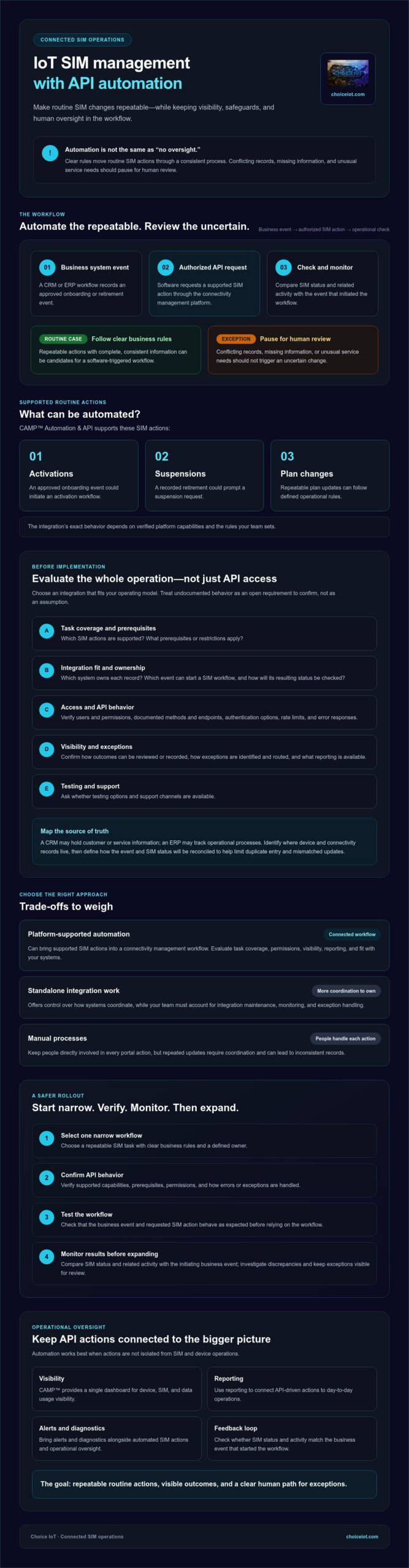
Start with repeatable actions that follow clear business rules. CAMP™ Automation & API supports SIM activations, suspensions, and plan changes. For example, an approved onboarding event in a CRM or ERP could initiate an activation workflow, while a recorded retirement could prompt a suspension request. The integration’s exact behavior depends on verified platform capabilities and the rules your team sets.
Routine cases are good candidates. Conflicting records, missing information, or unusual service needs should pause for human review rather than trigger an uncertain change.
What business problems can API-driven workflows address?
Manual updates require staff to repeat administrative steps and keep separate records aligned. A system-triggered workflow can connect an existing CRM or ERP process to a SIM action, helping teams coordinate the business event with the connectivity change. It can also make routine cases more consistent while keeping exceptions visible for review.
Automation needs a feedback loop. Teams should check whether SIM status and related activity match the business event that initiated the workflow, then investigate discrepancies. CAMP™ provides a single dashboard for device, SIM, and data usage visibility, alongside reporting. That context helps connect API actions to day-to-day operations instead of leaving them isolated in an integration.
Used this way, automating iot sim management with api can reduce repetitive portal work while preserving operational control. The objective isn’t simply to connect systems. It’s to make routine actions repeatable and give people the visibility to monitor outcomes and handle exceptions.
How to evaluate IoT SIM management API capabilities
Choose an integration based on your operating model, not the word “API” alone. Compare which SIM actions are supported, how the platform fits your systems, what access controls are available, and how teams can review and report on outcomes. Also ask how exceptions are identified and routed. API access is only one part of SIM operations. Inventory, usage visibility, and troubleshooting matter too.
Questions to ask before selecting an API-enabled platform
Confirm which actions are supported and what prerequisites or restrictions apply. Ask how users and permissions are managed, and whether automated actions can be reviewed or recorded. Verify which API methods, endpoints, authentication options, rate limits, and error responses are documented. Ask whether testing options and support channels are available. Treat anything undocumented as an open requirement to confirm with the provider, not as an assumption.
| Approach | What to evaluate |
|---|---|
| Standalone integration work | Offers control over how systems coordinate, but your team must account for integration maintenance, monitoring, and exception handling. |
| Platform-supported automation | Can bring supported SIM actions into a connectivity management workflow. Check task coverage, permissions, visibility, reporting, and fit with your systems. |
| Manual processes | Keep people directly involved in each portal action, but repeated updates require coordination and can lead to inconsistent records. |
How should API automation connect to existing business systems?
Map which system owns each record before designing the connection. Your CRM may hold customer or service information, while an ERP may track operational processes. Identify where device and connectivity records are maintained, too. Then define which event can initiate a SIM workflow and how the resulting status will be checked. A clear source of truth helps limit duplicate entry and mismatched updates.
For broader platform context, see Choice IoT’s IoT Connectivity Management Platform: The 2026 Strategic Guide. To assess how automating iot sim management with api could fit your operations, you can also discuss your connectivity requirements with Choice IoT. CAMP™ combines Automation & API for supported activations, suspensions, and plan changes with a dashboard for device, SIM, and data usage visibility, plus reporting and diagnostics.
How to implement IoT SIM API automation safely
A controlled rollout keeps an integration manageable and makes it easier to spot gaps before they affect routine operations. Treat the API connection as one part of the workflow: define who owns each action, how outcomes are checked, and what happens when the process cannot complete as expected.
Design the workflow and define safeguards
Before building, document the trigger, intended SIM action, business owner, and expected outcome. Set approval or review requirements for high-impact changes. Plan how the workflow will validate inputs, authorize requests, record actions, handle duplicate requests, and escalate failures. These are design considerations, not assumptions about what a specific platform handles automatically.
Test, monitor, and improve the integration
Use a staged rollout. Confirm current API documentation and platform capabilities first, then test expected cases and failure scenarios before production. Verify endpoint behavior, authentication requirements, permissions, and error responses with the provider. Check whether test options are available rather than assuming a sandbox exists.
- Step 1: Select one workflow. Choose a narrow, low-risk SIM action with a clear business purpose.
- Step 2: Map the trigger. Identify the source system, event, required information, and record owner.
- Step 3: Confirm API support. Verify the relevant action and any prerequisites or restrictions against current documentation.
- Step 4: Test the workflow. Check valid requests, missing or conflicting information, failed actions, and duplicate triggers.
- Step 5: Deploy with oversight. Assign an owner and define when a person must review or take over.
- Step 6: Monitor and refine. Compare outcomes with requirements, review exceptions, and adjust controls before expanding to other SIM actions.
Hypothetical example: A business might use an approved service activation event in its system to initiate a SIM activation request. If the event lacks required information, the workflow could stop and route the case for human review. This illustrates a possible process, not confirmed endpoint behavior or a specific CAMP™ feature.
After deployment, use available platform visibility, alerts, and reports to review operational outcomes. CAMP™ provides real-time visibility and includes intelligent alerts and reporting. Confirm which views and signals are relevant to your workflow. Successful automating iot sim management with api depends on keeping actions, oversight, and exception handling connected.
Discuss your API workflow and safeguards with Choice IoT’s connectivity team as you plan an implementation.
How CAMP™ supports connected SIM operations and next steps
Once workflows, safeguards, and API requirements are clear, consider how the management platform will support the operation as a whole. Choice IoT’s CAMP™ is an end-to-end IoT connectivity management platform. Its Automation & API feature supports SIM activations, suspensions, and plan changes, with integration into CRM or ERP systems. Confirm current API scope and implementation details with the provider before designing around specific behavior.
Where CAMP™ fits in an API automation architecture
API-driven actions work best when teams can also see and assess connectivity status. CAMP™ provides a dashboard for device, SIM, and data usage visibility, alongside intelligent alerts, diagnostics, and reporting. SIM Lock & Security and Device Change Alerts can contribute to operational oversight by helping teams review SIM security and device changes. They’re part of a broader control process, not a promise that every risk or issue will be prevented.
Prepare an API automation discussion with your provider
Bring a concise operational brief. Include your deployment scale, current CRM or ERP and connectivity systems, how often SIM workflows occur, and who will own the integration and exceptions. List the repetitive tasks and the outcomes you want. This gives the provider a practical basis for discussing fit and priorities.
Ask which actions the API supports, what access controls apply, and what documentation, testing options, and support channels are available. Verify current answers, including endpoint behavior, authentication, permissions, and error handling. Don’t treat undocumented capabilities as confirmed.
Network selection also shapes how a deployment is managed. For related context, consult The Ultimate Guide to Multi-Carrier IoT SIM Cards: Scaling Global Connectivity as you consider connectivity requirements alongside the automation plan.
As a final fit check, make sure the platform and workflow match your deployment scale, existing systems, task frequency, and internal ownership. Automating iot sim management with api is most useful when actions connect to visibility and accountable oversight. Discuss your API requirements and intended workflows directly with Choice IoT to assess how CAMP™ may fit your operations.
Build a More Controlled SIM Automation Plan
Effective API automation is more than connecting systems. Start with repeatable SIM workflows, confirm the platform’s capabilities and safeguards, then test a focused use case before expanding. Clear ownership, monitoring, and exception handling help teams maintain control as processes become more automated.
For businesses automating iot sim management with api, platform context matters. CAMP™ Automation & API supports SIM activations, suspensions, and plan changes. CAMP™ also combines real-time visibility with intelligent alerts, diagnostics, and reporting, helping teams keep actions connected to day-to-day operations.
Before moving forward, outline your current systems, recurring SIM tasks, desired outcomes, and the people responsible for reviewing exceptions. Then discuss your IoT SIM automation requirements with Choice IoT and explore how CAMP™ may fit your workflows. Start with a clear use case, verify the details, and build from there.
Frequently Asked Questions
What does API automation for IoT SIM management do?
API automation lets authorized software request SIM management actions through a connectivity platform, rather than relying only on manual portal updates. A business system can initiate a defined workflow based on an operational event, while platform visibility and human review help teams check the outcome. Automating iot sim management with api works best when each workflow has a clear owner, approved triggers, and a process for handling exceptions.
Which IoT SIM management tasks can an API automate?
Supported tasks depend on the platform. CAMP™ Automation & API supports SIM activations, suspensions, and plan changes, and can integrate with CRM or ERP systems. These actions may suit repeatable workflows with clear business rules. Before implementation, confirm which actions are available for your use case and any prerequisites or restrictions. Unusual, conflicting, or sensitive cases may need approval or manual review rather than automatic processing.
How do you connect an IoT SIM management API to a CRM or ERP?
Start by mapping which system owns customer, device, and connectivity records, then identify the business event that should initiate a SIM workflow. Define what information the workflow needs, who approves it, and how the resulting status will be checked. Confirm the platform’s current API documentation, supported actions, permissions, and error behavior with the provider. Choice IoT’s CAMP™ Automation & API supports integration with CRM or ERP systems, but implementation details should be verified.
Is API-based SIM management secure?
It can be designed with security controls, but connecting an API alone doesn’t guarantee secure operations. Verify the provider’s available authentication methods, permissions, and action logging, then limit access to approved users and workflows. Define review and escalation steps for unusual requests. CAMP™ includes SIM Lock & Security, which can help support SIM oversight, but security depends on appropriate configuration and operational practices. Confirm current capabilities with the provider.
Can API automation change IoT SIM plans automatically?
Yes, if the connectivity platform supports the required plan-change action and the workflow is authorized. CAMP™ Automation & API supports plan changes, alongside SIM activations and suspensions. Before automating a change, confirm the applicable prerequisites, permissions, and how the result can be verified. Businesses should define which events can trigger a plan change and whether certain cases require approval, so routine actions remain consistent without removing human oversight.
How do you test an IoT SIM management API before deployment?
Begin by confirming current API documentation and asking the provider whether test options are available. Validate expected workflows as well as failures, such as missing information, conflicting records, or duplicate triggers. Check how responses and errors are handled, and confirm actions are recorded and can be reviewed. Roll out one low-risk workflow first, monitor its outcomes using available visibility and reporting, then refine controls before expanding.