

Access control is central to IoT API management. An IoT platform with API access lets applications register devices, retrieve readings, send commands, and receive alerts. Authentication and role-based permissions help control which applications and users can access each tenant’s devices. The API provides the connection; clear access rules keep it manageable.
That distinction matters as deployments grow. Developers need to move device data and actions between systems without giving every application or tenant the same access. A secure setup also relies on protected data transmission, consistent device authentication, and clearly defined permissions.
This guide explains how API management supports device security, telemetry processing, alerts, and commands. You’ll also learn how to structure tenant access, assess data exchanges between platforms, and evaluate an IoT platform for your deployment.
Key Takeaways
- Use API workflows to provision devices, monitor their status, and manage commands from connected applications.
- Protect device and application access with authentication, encrypted transmission, and role-based permissions.
- Retrieve readings and route telemetry into processing workflows that can trigger alerts or notifications.
- Separate tenant data and permissions so each user or application can access only its authorized devices and actions.
- Explore how CAMP™ IoT Platform and Multi-Carrier IoT SIM can support centralized management and IoT connectivity needs.
How to Enable Data Security through Efficient API Management?
API management secures IoT integration by defining how devices, applications, and data sources exchange information. API use makes integration between IoT components 100% possible. An IoT platform with API access can expose specific operations while keeping each connection scoped to its purpose. Identify each application, limit its permissions, and monitor its requests. This creates a manageable resource model instead of exposing every device and operation through one broad interface.
Free tiers and developer plans vary in features and usage limits. Compare device provisioning, API access, telemetry handling, and webhook support against your deployment needs. Before building a production integration, test device registration, reading retrieval, and event delivery. Choose a plan that accommodates the workflows you need to evaluate.
For device management, structure API calls around clear lifecycle steps. An application can register a device, assign its identity and model, then monitor its connection and reported status. In one example API flow, registration returns HTTP 201, telemetry acceptance returns 202, command completion returns 200, and firmware update acceptance returns 202. These responses help a server distinguish a created resource, accepted data, completed command, and queued update.
Device-to-cloud APIs carry telemetry and status from equipment to a platform. Cloud-to-device APIs let an authorized application send commands, such as turning an actuator on or off. Applications can also query historical readings or register devices through an IoT platform API. Define which applications can issue each command, then log requests and responses to support troubleshooting.
Digital twins provide structured representations of physical devices. Model each device’s properties, reported state, and available actions so applications can use consistent fields instead of vendor-specific payloads. For example, a temperature sensor’s twin can distinguish its latest reading from a desired configuration value. Dashboards can display device state, while monitoring can flag missing updates or failed commands.
- Provisioning: Use a defined registration workflow to create device identities and associate each device with its model.
- Monitoring: Track connection state, telemetry timestamps, API responses, and command outcomes.
- Integration: Map external data sources to consistent resource names and data fields before combining readings.
- Automation: Use webhooks or event notifications to pass platform events to an application for processing.
MQTT can complement REST-style APIs for device messaging. It defines QoS levels 0, 1, and 2; QoS 1 provides at-least-once delivery and can balance reliability with efficiency for many telemetry scenarios. When evaluating an IoT platform with API access, check that connected platforms agree on authentication, data models, and protocols. Test failure handling, request tracing, and performance monitoring so an unavailable platform or malformed message doesn’t silently disrupt integration.
Secure device authentication and TLS transmission
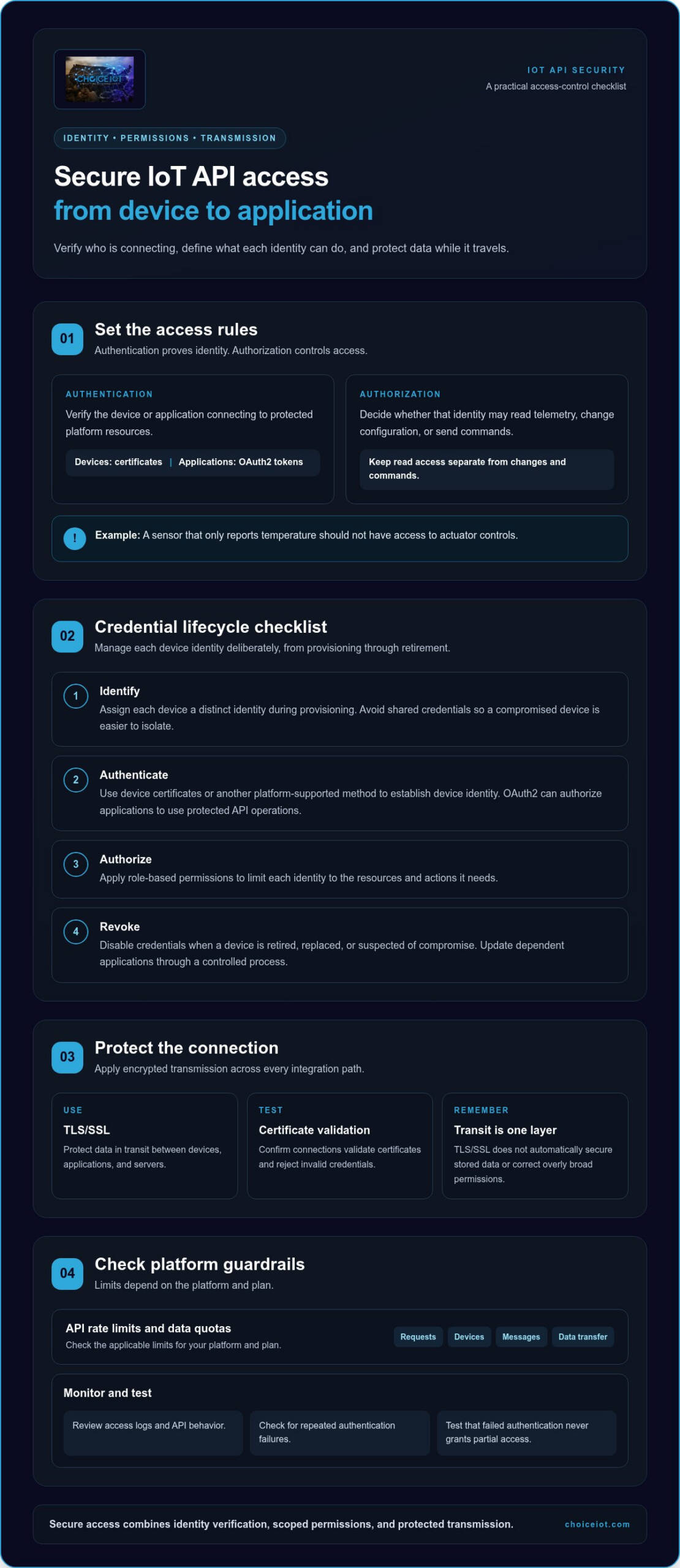
Secure API access depends on proving who or what is connecting, then limiting what that identity can do. For production IoT deployments, use TLS/SSL to protect data in transit, OAuth2 or certificate-based authentication for devices, and role-based access control. Together, these measures protect the interface between IoT devices, applications, and platform resources.
IoT platforms commonly support OAuth2 tokens for applications and certificate-based authentication for devices. They can also enforce API rate limits and data quotas. Thresholds vary by platform and plan, with request volume, connected devices, message throughput, and data transfer shaping the applicable limits.
Authentication and authorization address different needs. Authentication verifies an identity, such as a device certificate or application token. Authorization determines whether that identity can read telemetry, change configuration, or send commands. Set permissions separately. For example, a sensor that only reports temperature should not have access to actuator controls.
Use a deliberate credential lifecycle for each device:
- Identify: Assign each device a distinct identity during provisioning. Avoid shared credentials, which make it harder to isolate a compromised device.
- Authenticate: Use device certificates or another platform-supported mechanism to establish identity. OAuth2 can authorize application access to protected API operations.
- Authorize: Apply role-based permissions to restrict each identity to necessary resources and actions. Keep read access separate from configuration changes and commands.
- Revoke: Disable credentials when a device is retired, replaced, or suspected of compromise. Update dependent applications through a controlled process.
TLS/SSL protects data as it travels between a device, application, and server. It does not automatically secure stored data or fix an API permission that is too broad. Configure encrypted connections on every integration path, then test certificate validation and confirm invalid credentials are rejected. Failed authentication should never grant partial access.
Security certifications can help assess an organization’s documented controls, but they don’t replace device-level authentication or authorization. Examine the certification’s scope and relevance to the platform, its operations, and the data it handles. Then compare those controls with your requirements. A certification alone does not prove that every device, API, or custom interface is secure.
Review access logs and API behavior as part of ongoing monitoring. Look for repeated authentication failures, unexpected command requests, and changes in a device’s normal connectivity pattern. Set rate limits and data quotas to manage resource use and reduce the impact of excessive requests. For deployments where network design is part of the security plan, Private APN connectivity can support a private network path.
Data processing, alarms, and notifications
IoT applications turn sensor readings into useful decisions through processing, visualization, and event handling. For a small business, the right platform is one whose APIs fit its devices, data volume, integrations, and alert workflows.
Data Processing and Normalization
An application server can normalize incoming readings before business applications use them. For example, map different temperature fields to one shared name, standardize timestamps, and associate each reading with its device identifier. This makes data from different sensors easier to compare. Assess how the platform handles malformed payloads, duplicate messages, and missing values, as each can affect downstream automation and reporting.
REST APIs let applications retrieve a device’s latest reading or query historical data. A processing workflow can validate incoming telemetry, add device metadata, then store or forward the normalized result. Keep raw and transformed values distinct so an industrial team can trace a dashboard result back to its source. Assign ownership for each transformation to avoid inconsistent calculations across applications.
For an EU deployment, map where telemetry is collected, processed, stored, and accessed. Compare data center locations and cross-region data flows with your GDPR requirements before choosing an architecture. A dashboard setting alone does not establish where data resides. Document every processing step, including the application server and connected analytics components, so teams can follow the data path.
Alarms and Notifications
Alarms turn defined conditions into events that applications can act on. Set thresholds for meaningful device behavior, such as a sensor reporting a temperature outside its operating range. IoT platform APIs can deliver alerts through webhooks or event notifications. Review the event payload, delivery behavior, and failure handling, then route each alert to the application responsible for responding.
Keep the alarm condition separate from its notification method. For example, a rule can detect a reading beyond a configured limit, while a webhook sends the event to an application server. The server can classify and record the alert, then notify the relevant operator. Add deduplication and recovery logic so repeated readings don’t create confusing streams of alerts.
Dashboards should show the context needed to act: sensor reading, device status, event time, and alarm state. A chart can reveal whether energy use is rising steadily or spiking after equipment activation. Pair visual trends with API access to current readings, allowing applications to combine live status with historical patterns. Choose views that match each user’s role and operational tasks.
Test the full path with a sample event: submit telemetry, confirm normalization, trigger an alarm, and verify that the webhook reaches its destination. Record failures at each stage. This helps distinguish a sensor issue from a processing error or a notification delivery problem.
Access control and multi-tenancy
Multi-tenancy lets separate customers, teams, or business units use one IoT platform without unrestricted access to one another’s data. The key rule is to bind every API request to an authenticated tenant and limit its resources accordingly. For example, a maintenance application for one customer should retrieve only that customer’s device inventory and telemetry, even when another tenant uses the same server.
Build tenant boundaries into the data model, API authorization, and operational workflows. A tenant identifier can associate devices, dashboards, alerts, and users with the right account. The API should enforce that association on every read and write, rather than relying on an application screen to hide other tenants’ records. Test cross-tenant requests directly, including attempts to change a device identifier in an API call.
- Define roles: Give operators access to device status, while reserving configuration changes for authorized administrators.
- Scope service accounts: Limit each integration to the tenant resources and API actions it needs.
- Separate data: Apply tenant-aware filters to device records, telemetry, analytics, and exported reports.
- Audit changes: Record which identity accessed a resource or issued a remote command.
Protocol design matters too. With MQTT, use tenant-specific topic namespaces and permissions to prevent a device from publishing telemetry to another customer’s stream. For REST APIs, verify tenant scope on the server for every endpoint. An enterprise administrator may need cross-tenant reporting, but that privilege should be deliberate, logged, and separate from standard tenant roles.
Plan for growth before tenant numbers and message traffic increase. A platform designed to handle millions of messages still needs clear policies for resource access, request limits, and analytics queries. Keep each tenant’s operational view separate from approved aggregate reporting. If one customer’s device sends malformed or excessive telemetry, monitoring should help isolate the impact without exposing another tenant’s data.
Test the complete access path with representative identities: a tenant administrator, a standard operator, and an integration account. Confirm each can perform permitted actions and is denied access to restricted resources. Include device registration, historical telemetry retrieval, and command requests in the test plan. Repeat the checks after changing roles or moving a device between tenant groups.
For remote deployments that rely on a consistent network address, a Static IP Address for IoT connectivity can support predictable endpoint configuration. Map that network choice alongside tenant permissions, so connectivity and API authorization work together without widening access across customer environments.
Choice IoT: Multi-Carrier IoT SIM
Choice IoT’s Multi-Carrier IoT SIM supports deployments that need connectivity across multiple carrier networks. It complements API-based device management by carrying data between devices and applications. For centralized provisioning and monitoring, CAMP™ IoT Platform brings management into one place. Choice IoT also offers Fixed Wireless Connectivity and Private APN for deployments with different network requirements.
Consider these services when planning connectivity alongside API access, device operations, and tenant-level controls. The right combination depends on how your devices connect and how you manage the deployment. Contact Choice IoT to discuss your connectivity and management needs, or visit choiceiot.com.
Turn your API design into a deployment plan
Make the next step operational: assign ownership for device identities, tenant boundaries, event handling, and integration changes. An IoT platform with API access works best when these decisions guide development from the start, rather than being added after applications and devices are connected. Clear ownership gives teams a basis for testing changes while keeping established workflows in view.
Choice IoT offers CAMP™ IoT Platform, Multi-Carrier IoT SIM, and Fixed Wireless Connectivity. Together, these options support platform management and connectivity planning for IoT deployments.
Bring your API and connectivity requirements into one conversation. Contact Choice IoT about your IoT deployment and take the next step with a clearer plan.
Frequently Asked Questions
How API management helps the IoT Developers?
API management helps IoT developers connect device data and actions to applications through defined interfaces. It also gives teams a way to manage credentials, permissions, request patterns, and integrations. For example, a fleet application can use an API to access device status without embedding the communication details of each hardware model. Document API ownership and version changes so an update to one integration does not disrupt others unexpectedly.
What are APIs in the Context of IoT and Why are They Essential?
In IoT, APIs are interfaces that let software exchange data or request actions from devices and platforms. They’re essential because sensors, management platforms, and business applications may use different components and data formats. An API can provide a consistent way to retrieve readings or submit commands. Before expanding an integration, define the data fields and expected responses that applications rely on.
What is an IoT API?
An IoT API is a software interface for accessing resources such as device records, readings, and available actions. For instance, a building-management application could request a sensor’s latest reading through an API instead of accessing the sensor’s internal implementation. API documentation describes available operations and data structures. Developers use that contract to build applications that work with connected devices and platform services.
Which IoT platforms offer REST, MQTT, or GraphQL APIs?
CAMP™ provides full REST API access for programmatic control. REST suits request-and-response operations, while MQTT is a messaging protocol commonly used to exchange IoT telemetry. GraphQL support varies by platform, so compare documented interfaces with your application’s needs. Check that the chosen interface supports the operations, data structures, and integration patterns your deployment depends on.
How do you connect devices to an IoT platform using its API?
Start by matching the device’s communication method and payload format to the platform’s supported interfaces. Then build a small integration that sends representative sample data, checks how fields map, and records platform errors. Keep device connectivity separate from application API calls when they use different protocols. Before scaling, test with different device models and confirm downstream applications interpret their data consistently.
What security and compliance risks should you consider when choosing an IoT platform?
Assess how the platform handles identity, permission changes, audit records, data retention, and secure deletion. Examine the full data path, including connected applications and integration partners, to identify where sensitive telemetry is processed. For compliance planning, document the data types collected, their purpose, and who can access them. Review how credentials and records are handled when devices are replaced or a deployment changes platforms.