

The strongest domestic carrier choice can still be the wrong fit for a multinational rollout. Choosing top-tier domestic networks for U.S. deployments alongside global coverage in 190 countries means weighing local reach against international coverage, device compatibility, and how each connection is managed. The right fit depends on where devices operate and what their network requirements are.
Carrier coverage is only one part of the decision. You also need to account for technical specifications, roaming arrangements, and deployment complexity, the details that can create hidden costs or connectivity gaps when a fleet expands across borders.
This guide explains how to assess domestic networks for U.S. deployments and compare global IoT connectivity options with Choice IoT. You’ll learn which coverage and device factors matter, what to review before rollout, and how multi-carrier connectivity can simplify management across countries.
Key Takeaways
- Compare coverage at the locations where devices will operate, not just by carrier name or country count.
- Match each device’s supported network technologies and frequency bands to the connectivity planned for its deployment.
- Assess how roaming, local network access, and deployment requirements can affect multinational connectivity and ongoing management.
- Use a multi-carrier approach when a rollout needs flexible network access across U.S. and international locations.
- Consider centralized SIM management and network configuration options to streamline oversight as deployments scale.
Carrier coverage across countries and destinations
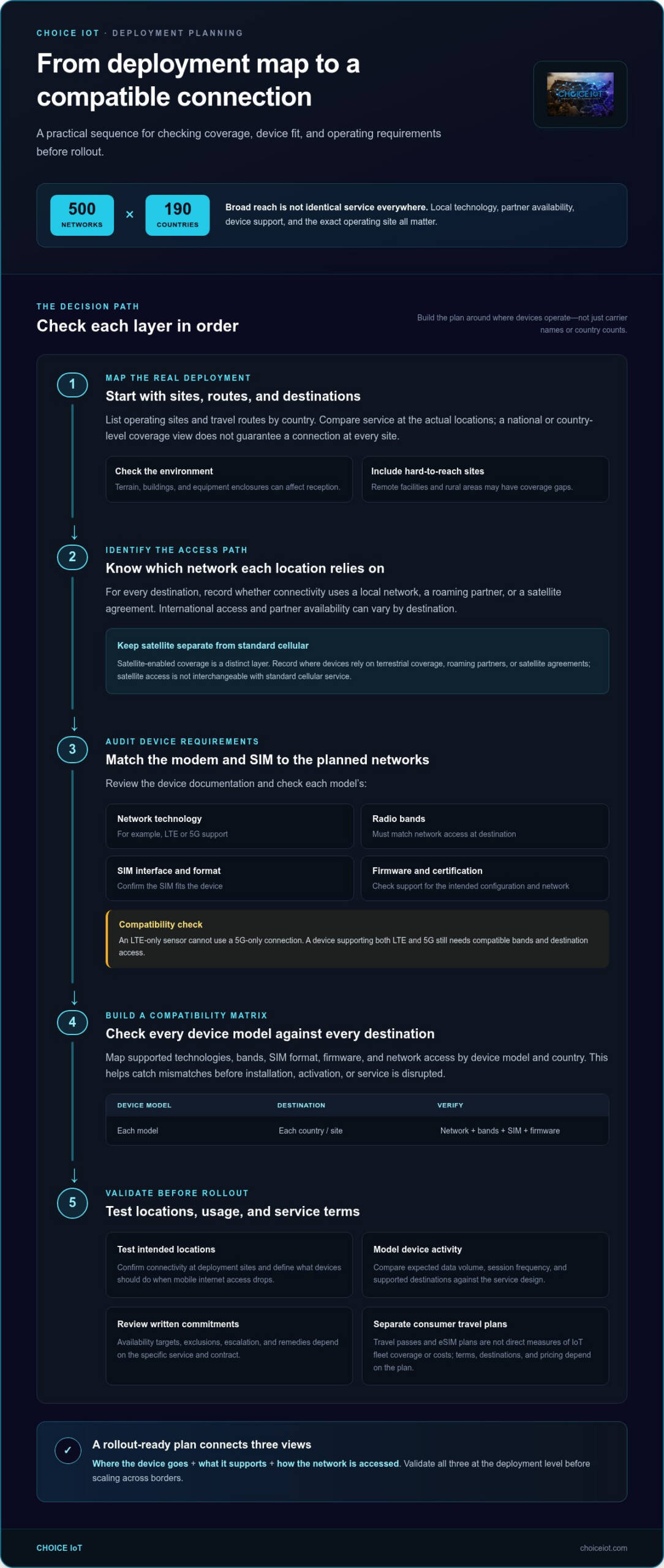
U.S. coverage maps show where a carrier reports service, not whether every IoT device will connect at every site. Terrain, buildings, network technology, and device support all affect the connection. A warehouse near an urban center, for example, may have different reception from equipment inside a metal enclosure. For multinational deployments, compare actual operating locations and network access instead of treating a country-level coverage claim as a guarantee at every site.
Verizon and AT&T serve U.S. deployments, while international connectivity can depend on partner networks and destination access. A footprint of 500 networks across 190 countries offers broad reach, but it doesn’t mean identical service everywhere. Local network technology and partner availability can vary. For teams weighing Verizon and AT&T for U.S. deployments and Global 500 networks in 190 countries, map device routes, installation sites, and destinations where access relies on roaming.
In remote and rural America, distance from cell sites, terrain, and local infrastructure can create coverage gaps. A device may connect along a main road but lose service at a remote facility or inside a building. Test intended deployment locations and define what devices should do when mobile internet access drops. For a Fortune 500 fleet, assess each operating region and the business impact of an interruption, rather than relying on one national coverage view.
AT&T International Day Pass and Verizon TravelPass are travel-roaming options, not measures of IoT fleet coverage. Destinations, eligible services, and charges depend on the consumer plan and pass terms. Don’t use their pricing to estimate connectivity costs for deployed devices. Assess consumer travel separately from IoT service. For IoT, focus on supported destinations, network access, and expected device activity.
Satellite-enabled mobile coverage is a separate layer from terrestrial service. On October 1, 2026, AT&T, T-Mobile, and Verizon announced a joint venture intended to complement terrestrial networks and improve service where traditional coverage is limited. Its first step is improving direct-to-device access. The partners also aim to provide redundant connectivity when ground networks fail during disasters or other disruptions. Existing carrier-satellite agreements remain in place, and each operator may continue its own efforts. This doesn’t make satellite access interchangeable with standard cellular coverage.
When planning around Verizon and AT&T for U.S. deployments and Global 500 networks in 190 countries, separate current cellular access from potential satellite options. Compare each destination and use case, then record where devices rely on terrestrial coverage, roaming partners, or satellite agreements. This distinction helps teams build realistic connectivity plans for devices that stay at one site and those that cross borders.
- List operating sites and travel routes by country.
- Identify where service relies on a local partner or satellite agreement.
- Match network access to device capabilities and the operational impact of an outage.
T-Mobile US, Verizon, and AT&T are in a joint venture to expand coverage in parts of the United States that terrestrial services cannot reach.
Common technical specifications and device compatibility
For an IoT deployment, compare the device’s supported network technologies, radio bands, SIM interface, and firmware with the networks it must use. An LTE-only sensor, for example, can’t use a 5G-only connection. A device that supports both LTE and 5G still needs compatible bands and network access at its destination. Review the modem documentation, then map those specifications to each deployment country before selecting connectivity.
Device compatibility is an industrywide issue, not simply a choice of carrier. Check whether each device supports the required mobile network, whether the SIM format fits, and whether its firmware supports the intended configuration. Carrier device certification may also matter when using specific networks. Build a compatibility matrix by device model and destination to catch mismatches before they disrupt installation, activation, or service.
Travel eSIM pricing and carrier roaming are not directly comparable. A travel eSIM plan may be priced by data allowance, validity period, and destination list. Carrier roaming depends on the account and applicable roaming terms. For example, a field device sending small, regular messages has a different usage profile from a traveler streaming video. Compare expected data volume, session frequency, supported destinations, and whether the service is designed for consumer travel or managed IoT devices.
AT&T, T-Mobile, and Verizon announced a joint venture on October 1, 2026, to expand connectivity in underserved U.S. areas. Its first step is improving direct-to-device access, while the three operators retain their individual efforts. This venture concerns satellite-enabled mobile coverage, not a shared specification for every IoT device. Verizon and AT&T are also described as Tier 1 global WAN providers with significant enterprise customer bases. That positioning alone doesn’t establish identical access, technical compatibility, or service terms.
For Verizon and AT&T, compare enterprise WAN performance with the deployment’s routing, security, and availability requirements. A WAN connects sites and devices across a broader network; the key question is how each service supports the required traffic path and operating model. Service-level agreements, uptime commitments, and support options depend on the specific service and contract. Review the written availability target, exclusions, escalation process, and remedies. Coverage maps alone do not establish those commitments.
Review security separately from coverage. Treat SIM credentials, device firmware, traffic routing, and roaming connections as distinct control points. Use access controls, encryption, credential management, and network monitoring suited to the deployment. A remote meter sending telemetry, for example, has different traffic needs from a payment terminal handling sensitive transactions. Independent security testing and a documented incident process help assess protection across the full connection, not just whether a device connects.
At the end of the first quarter of 2026, the GSA had identified 2,003 organizations worldwide with one or more private mobile networks. The GSA counted networks with contract values greater than €100,000 and identified a further 178 private mobile networks with values between €50,000 and €100,000.
AT&T, T-Mobile, and Verizon entered into a joint venture agreement to expand coverage in underserved areas across the United States. It will work closely with rural mobile operators to expand access, simplify integration, and help bring new products to their customers.
Carrier selection for multinational deployments
Start a multinational carrier assessment with the deployment map, not a national coverage label. List each country, operating site, customer location, and travel route. Then identify the carrier or wireless partner supporting connectivity at each point. A U.S. device that later ships to Europe, for example, needs a different access review from equipment that stays at one domestic facility. Applying the same selection process makes coverage gaps and dependencies visible before rollout.
Compare connectivity against the work each device performs. A payment terminal, remote meter, and vehicle tracker have different data patterns and different consequences if communications stop. Record expected data use, session frequency, mobility, and recovery needs. Then match those requirements to supported network access and the device’s technical capabilities. Spectrum availability and network technology vary across countries, so a modem that works in one market may not support every destination.
Review the full service structure, including roaming relationships, activation, network management, and escalation paths. Direct carrier networks and partner networks can create different operational dependencies. For devices that cross borders, document how service is maintained when they change networks. For fixed equipment, prioritize reliable access at the installation site. Score each destination against the same requirements rather than relying on a single claim about global reach.
Compliance, data residency, and regulatory requirements vary by country and by the data being transmitted. Map the rules that apply at each destination, identify where data is processed or stored, and document how the deployment handles access, retention, and cross-border transfers.
Plan deployment stages around the work involved: confirm destinations and device requirements, arrange network access, configure connectivity, and test devices at representative sites before broader activation. Timelines depend on carrier onboarding, partner agreements, device certification, and site testing, so international rollouts may follow different schedules from U.S. deployments.
Use a decision matrix to compare carriers and wireless partners against consistent criteria:
- Coverage: Record the network access available at each operating location and route.
- Compatibility: Match device bands and supported technologies to each country.
- Operations: Define activation, monitoring, escalation, and recovery responsibilities.
- Data handling: Map processing locations and applicable country requirements.
Model the impact of an interruption as well. A tracker that reports periodically may tolerate a delayed message, while a control device may need a faster recovery path. Set priorities for each device class, then compare carrier options against them. This connects spectrum, partner access, and coverage details to business needs, helping teams select connectivity that can scale across markets without assuming every network delivers the same experience.
Verizon vs AT&T: Global Reach and Service Comparison
Verizon and AT&T are both Tier 1 global WAN providers with significant enterprise customer bases. That shared position gives enterprise buyers a useful starting point, but it doesn’t establish that their networks deliver identical access everywhere. Compare the service available at each operating location, the technology supported there, and the terms that apply to the deployment. A national network assessment and a multinational assessment answer different questions.
For global reach, distinguish a carrier’s own network from connectivity provided through partners. A device operating in the United States may use a different network relationship after crossing a border. Build a destination-by-destination view for Verizon and AT&T, noting available access technology and how devices connect. A country count alone cannot show whether a particular site, route, or device is supported by the intended service.
Access technology matters because device capabilities must match the network where the device operates. For example, a device designed for LTE cannot use a network access method it does not support. Compare radio technologies and supported bands with the device specifications, then validate the match for each destination. This matters especially for deployments that cross borders, where wireless infrastructure and partner arrangements can vary.
Service availability also depends on the operating model. A fixed sensor at a U.S. facility has different needs from a tracker crossing borders or equipment installed at customer sites. For Verizon and AT&T, compare how each proposed service handles activation, network access, data routing, and support in those scenarios. Base the comparison on actual deployment locations and device profiles, not broad enterprise coverage descriptions.
Use a like-for-like scorecard to make the comparison practical:
- Reach: Record access by country, site, and travel route.
- Technology: Match each device’s supported bands and network modes.
- Service: Compare activation, management, support, and contract terms.
- Continuity: Identify how devices behave when their primary network is unavailable.
Keep satellite connectivity separate from ordinary terrestrial access. AT&T, T-Mobile, and Verizon announced a joint venture on October 1, 2026, to complement mobile networks in areas with limited traditional service. Its planned direct-to-device work may affect future access options, but it doesn’t establish identical satellite service from each carrier today. For current decisions, evaluate the terrestrial service and any satellite agreement as distinct parts of the connectivity plan.
The strongest comparison is tied to the device fleet, destinations, and operational priorities. If you’re planning a multi-network IoT deployment, discuss your connectivity requirements as a next step.
Choice IoT: Multi-Carrier IoT SIM
Choice IoT’s Multi-Carrier IoT SIM supports deployments that need connectivity across multiple carrier networks. It’s a practical option when devices operate across regions or a rollout needs a unified approach to carrier access. The CAMP™ IoT Platform centralizes provisioning, monitoring, and security for global IoT deployments, helping teams manage connectivity in one place.
For projects with specific network architecture needs, Choice IoT also offers Private APN and Fixed Wireless Connectivity. These options serve different deployment requirements, from managing connected devices to establishing a fixed wireless connection. The right combination depends on device compatibility, operating locations, and how the deployment handles data.
Discuss your deployment requirements with Choice IoT at choiceiot.com or email sales@choiceiot.com.
Turn Your Connectivity Plan Into a Deployment Roadmap
Make the next move a practical one: translate your network requirements into a deployment plan that teams can execute. For decisions involving Verizon and AT&T for U.S. deployments alongside global 500-network access in 190 countries, define the device profiles, operating locations, and connectivity priorities that will shape the rollout. A clear scope gives technical and operations teams a shared basis for planning.
Choice IoT helps solution providers, VARs, and integrators align IoT connectivity with deployment needs. Bring your location plan, device requirements, and network priorities to the conversation. Choice IoT’s Multi-Carrier IoT SIM and CAMP™ platform provide a unified approach to carrier access and connectivity management, while the specific setup can reflect the needs of each site and device.
Contact Choice IoT about global IoT SIMs to discuss your deployment. Build the next phase on a connectivity plan designed around how your devices need to operate.
Frequently Asked Questions
What Are the Hidden Costs and Gotchas to Watch For?
Hidden costs often stem from device behavior and billing terms, not just the SIM. A sensor that repeatedly reconnects in a weak-signal area may use more data than its normal telemetry suggests, and firmware updates can create unexpected usage bursts. Review how sessions, roaming, inactive lines, and data allowances are billed. Model normal use and exceptions separately, then compare projected usage with the service’s billing rules before deployment.
What compliance, data residency, and regulatory requirements affect Verizon and AT&T deployments in different countries?
Compliance, data residency, and regulatory requirements vary by country and by the data being transmitted. Map the rules that apply at each destination and identify where data is processed.