

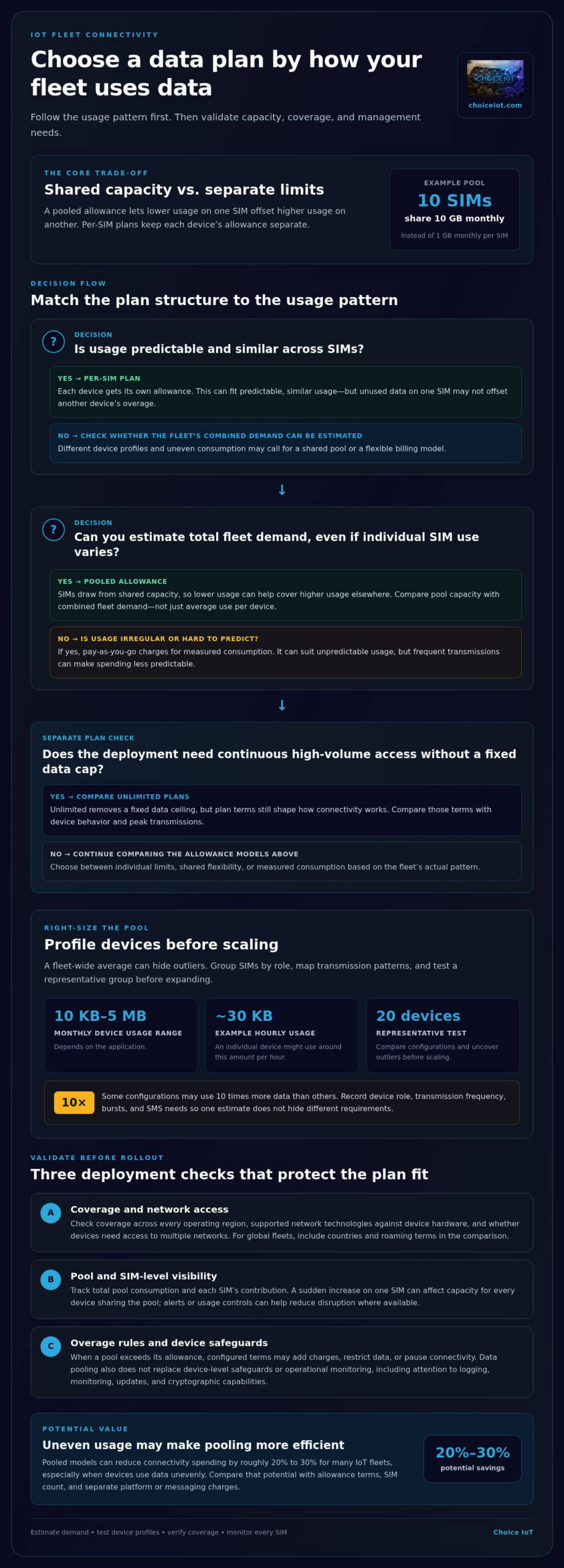
A shared allowance can fit an IoT fleet better than identical limits on every SIM. For example, pooled data plans for IoT devices can let 10 SIMs share 10 GB monthly, while an individual plan might give each SIM 1 GB monthly. The right capacity depends on the fleet’s total usage and how unevenly that usage is distributed.
It’s easy to focus on the data allowance alone. But a plan also needs to fit where devices operate, which networks they can access, and how you’ll manage usage across the fleet. A pool that looks generous on paper may still fall short if coverage or capacity doesn’t match your deployment.
This guide explains how to compare pooled capacity with device counts, estimate usage across different device profiles, and assess coverage and network requirements. You’ll also learn how to compare plan structures and choose connectivity that fits your deployment without paying for unused capacity.
Key Takeaways
- Compare shared data capacity with the fleet’s combined usage, not just an average per device.
- Account for differences between device profiles and usage peaks when estimating the pool size your deployment needs.
- Assess coverage across every operating region and consider whether devices need access to multiple networks.
- Compare plan structure, data limits, and fleet management needs together to identify the best operational fit.
Why can’t I just use regular consumer data plans for my IoT devices?
Pooled plans combine data allowances across SIMs; per-SIM plans cap usage device by device, while unlimited plans remove a fixed data ceiling. For example, ten SIMs can share 10 GB monthly instead of receiving separate 1 GB monthly allowances.
Shared Allowances Across SIMs
A shared data allowance combines usage from multiple SIMs in one deployment pool. Each device draws from the same capacity, so lower usage on one SIM can offset higher usage on another. This makes pooled data plans for IoT devices useful when consumption varies across a fleet.
Consider a pool covering ten devices. If nine use less data than expected, their unused capacity can support the tenth device’s higher usage. Monitor both total pool consumption and each SIM’s contribution to see whether the shared allowance matches actual operating patterns.
Comparing Pooled, Per-SIM, and Unlimited Plans
A per-SIM plan gives each device its own allowance. This can suit a deployment where usage is predictable and similar across SIMs, but unused data on one SIM may not offset another device’s overage. A pooled plan shares capacity across SIMs instead.
An unlimited plan removes a fixed data cap, but its terms still shape how connectivity works. Compare those terms with device behavior, including peak transmissions and mobile or cellular use. The right structure depends on whether your fleet needs predictable individual limits, shared flexibility, or continuous high-volume access.
Consumer mobile plans typically serve individual users, while IoT deployments need repeatable management across devices, locations, and countries. A business fleet may include sensors that send small updates and equipment that transmits larger data bursts. A shared deployment plan pools SIM usage, but it doesn’t make every device’s consumption identical.
Connectivity planning involves more than data volume. NIST notes that IoT devices can lack logging and monitoring, vulnerability-update support, or cryptographic capabilities to protect sensitive information. Treat data pooling and device security as separate deployment decisions. A shared IoT data package can simplify allowance management, but it doesn’t replace device-level safeguards or operational monitoring.
Use these steps to assess whether a shared pool fits your fleet:
- Group SIMs by device role, such as sensors, trackers, or gateways.
- Compare each group’s expected usage with total deployment capacity.
- Review SIM-level and pool-level monitoring to spot unusual consumption.
For example, a sudden increase in one SIM’s usage can affect capacity for every device in its pool. Monitoring individual connections alongside the shared balance helps teams spot the change and adjust capacity planning. This visibility is central to managing shared IoT data plans as a deployment grows.
What are the best value IoT data plans for fleets and volume pricing?
Choose a plan by matching fleet size with actual device usage, transmission patterns, and management needs. In the US, carrier IoT plans and connectivity providers may offer pooled data, but network access and pool terms vary by plan.
Matching Plans to Usage and Fleet Size
Start with a usage profile for each device type, then estimate the fleet’s combined demand. Pooled models can reduce connectivity spending by roughly 20% to 30% for many IoT fleets, especially when devices use data unevenly. Compare that potential with the allowance structure, SIM count, and any separate platform or messaging charges.
Test a representative group before scaling. A 20-device test can compare configurations and expose outliers; some configurations may use 10 times more data than others. Use those results to size the pool and set tracking thresholds. Choose a plan that accommodates normal demand and identifies unexpected usage before it affects other devices.
Device Data and Transmission Requirements
Device type and transmission frequency shape the iot data plan. IoT devices typically use between 10 KB and 5 MB of data monthly, depending on the application. An individual device might use around 30 KB per hour. A sensor sending small status messages differs from equipment uploading frequent, larger data payloads.
Map each SIM card to its function, then record how often it sends data, whether it transmits in bursts, and whether it needs SMS. For global deployments, include the countries and networks where devices operate. This usage map distinguishes low-volume devices from data-intensive equipment, so one estimate doesn’t obscure different requirements.
Pay-as-You-Go and Allowance Management
Pay-as-you-go plans charge for measured consumption rather than a fixed shared allowance. They can suit deployments with irregular or hard-to-predict usage, but frequent transmissions can make spending less predictable. Before choosing this model, compare the billing unit, data-accounting rules, and how SMS is treated.
When a shared pool exceeds its monthly allowance, the plan’s configured policy determines what happens next. Additional usage may incur charges, data may be restricted, or connectivity may pause. Track pool consumption and SIM status throughout the billing period, then configure alerts or usage controls where available to help reduce service disruption.
Activation and management typically involve provisioning each SIM, assigning it to a device, and tracking its status and data consumption through a management system. Keep device identifiers and SIM records aligned; review usage trends and SMS activity as part of routine fleet operations. For deployments needing multiple carrier networks, a Multi-Carrier IoT SIM can support connectivity planning across the fleet.
Network technology and geographic coverage
Choose cellular connectivity by matching supported network technologies to device hardware and operating regions. For a fleet that crosses borders, compare coverage and roaming terms as well as the data allowance.
For eSIM, 5G, LTE-M, NB-IoT, and roaming, support depends on the plan, SIM profile, device, and available networks in each country. Compare each technology against the device’s requirements and intended locations; a feature name alone doesn’t establish service across every region.
Start coverage planning with a map of where devices will be installed or travel, then match those locations to supported networks. Consumer devices may connect to one or two networks per day, while IoT devices might communicate across three to five different networks in multiple countries. This difference matters for mobile assets and distributed IoT solutions, where assuming a single network may leave coverage gaps.
Roaming can cost 10x to 50x local rates for IoT connectivity. A monthly charge can also depend on the plan’s roaming rules, data accounting, and where each SIM connects. Separate expected domestic use from international use in your forecast. Then compare the roaming terms for each destination, rather than treating global coverage as one uniform service.
- Technology: Match the SIM and device to required network types, including LTE-M, NB-IoT, or 5G.
- Location: Map fixed sites and travel routes across every operating country.
- Roaming: Review how usage is treated when a SIM connects outside its home network.
- Service limits: Compare any data throttling, session, or network-access conditions that affect device operation.
Review security and service continuity separately. NIST notes that IoT devices deployed where unauthorized people can reach them may be vulnerable to physical tampering. Consider device access, authentication, data protection, and connectivity controls together. A pooled allowance doesn’t secure a device or guarantee coverage at a specific installation point.
Build a location-and-technology matrix before selecting a plan. List each device type, required network technology, operating country, and whether it moves between networks. Add the expected data path, such as sensor telemetry or a larger device upload. This makes gaps visible before deployment and helps you compare plans by actual coverage, roaming exposure, and service limits rather than a broad global label.
Examples of pooled data capacity and device counts
A pool’s device count alone doesn’t show whether its capacity is sufficient. Compare the total allowance with device-level demand, then account for variation across connected devices. These examples show how combining predictable sensors with heavier users can change the capacity calculation.
Start with a small fleet: three IoT devices each use 2 GB monthly. Together, they consume 6 GB monthly. A 5 GB allowance would fall short if those usage patterns continued. This simple comparison shows why buyers should calculate combined demand before choosing a shared pool. A plan’s advertised device count doesn’t tell you how much data each device can use.
At a different scale, one pooled-data example lets 1,000 devices share a 5 GB allowance. That capacity can suit a fleet only if its combined usage stays within the allowance. The device total is not a usage estimate. A thousand low-transmission sensors and a thousand devices sending frequent data may have very different demand.
Use a fleet worksheet to compare actual device profiles:
- List device types: Separate sensors, trackers, and equipment with different transmission needs.
- Estimate usage: Record expected data consumption for each profile and total the fleet.
- Test variation: Compare configurations across a 20-device test group; some configurations can use 10 times more data than others.
- Review capacity: Compare the resulting usage with the shared allowance and its overage policy.
That 20-device test can reveal whether a small number of configurations drives most consumption. If so, splitting those devices from low-usage sensors may make capacity planning clearer. A shared pool works best when its members have compatible usage patterns, or when total demand leaves room for variation. For fleets scaling toward thousands of connected devices, repeat the usage review as device mixes and transmission behavior change.
Compare pricing using the same assumptions for every plan: device count, expected consumption, pool allowance, and treatment of excess data. A lower base allowance may not be the best value if the fleet regularly uses more. Conversely, a larger pool may leave capacity unused when sensors send only occasional readings. Assess the whole deployment, not just the per-SIM allowance.
Use the examples as a sizing method, not a universal capacity recommendation. Calculate combined demand, identify high-use configurations, and compare that result with plan limits. For fleets preparing connected devices for operation, explore carrier device certification as part of deployment planning.
Choice IoT: Multi-Carrier IoT SIM
Choice IoT’s Multi-Carrier IoT SIM supports fleet connectivity across multiple carrier networks. If your deployment combines different usage profiles or operates across regions, centralized management can help you monitor device connectivity alongside your data-plan decisions.
CAMP™ IoT Platform provides centralized tools for provisioning, monitoring, and securing IoT deployments. Choice IoT also offers Fixed Wireless Connectivity and Private APN for projects with specific connectivity or network requirements. These services support the wider deployment; choose data capacity based on device usage, coverage needs, and pool structure.
Contact Choice IoT to discuss connectivity for your IoT deployment.
Design a Connectivity Plan That Can Evolve
Plan for change, not just the fleet you’re deploying today. Treat pooled data plans for IoT devices as part of an operating model, with clear ownership for reviewing usage, adding devices, and responding as deployment needs shift. This keeps connectivity decisions aligned with operational priorities as your device mix grows or changes.
Choice IoT offers a Multi-Carrier IoT SIM, the CAMP™ IoT Platform, and Fixed Wireless Connectivity for different deployment requirements. Use your next planning step to align the connectivity approach with your device architecture, operating environment, and management workflow. A clear design makes future expansion easier to assess and manage.
Contact Choice IoT to discuss connectivity for your deployment. Build a practical foundation for what comes next.
Frequently Asked Questions
How to choose the right IoT data plan for your deployment?
Choose a plan by translating your deployment requirements into data, network, and management criteria. A remote sensor sending brief status updates, for example, has different needs from a mobile asset transmitting larger files. Map device roles, transmission patterns, operating locations, and required network technologies, then compare allowance structure and usage visibility. You’ll have a framework to revisit as your device mix or operating model changes.
How is an IoT data plan different from a consumer phone plan?
An IoT data plan connects devices as part of an operational deployment rather than serving one person’s phone use. A business may need to manage SIM status, usage, and connectivity across equipment in different locations. Consumer plans focus on individual mobile use. For a fleet, assess how SIMs are administered, how usage is tracked, and whether the network and plan fit each device’s function.
What Determines IoT Connectivity Cost?
IoT connectivity costs depend on the data allowance, number of active SIMs, usage patterns, network technology, and operating locations. Roaming, messaging, and management requirements can also affect the plan structure. A fixed sensor fleet with stable transmission needs, for example, differs from mobile equipment connecting across countries. The price depends on the deployment; cost factors include usage, fleet size, coverage, and service requirements.
What are pooled data plans for IoT devices, and how do they work?
Pooled data plans for IoT devices combine the allowances of multiple SIMs into a shared balance. Each SIM draws from that pool, so lower consumption on one connection can offset higher usage on another. For example, a fleet with sensors and gateways can group eligible SIMs under one allowance. Review pool membership and usage reports to see which connections draw on the shared capacity.
What are current pricing tiers and monthly fees for pooled IoT data plans?
There isn’t one universal monthly fee or tier for pooled IoT data plans; pricing depends on the plan structure and deployment requirements. Compare how the allowance is sized, how SIMs are grouped, and how additional usage is handled. Also consider network coverage, roaming, and management features. For a consistent comparison, use the same device count, expected usage, and operating locations for every plan.
How are data pools shared across SIMs, devices, and locations?
A data pool is shared among SIMs assigned to the same plan group, and devices use that capacity through their installed SIMs. Whether devices in different locations can share a pool depends on its configuration and the plan’s coverage and roaming terms. For example, a business can organize connections by region or operational unit when the plan supports that setup. Keep SIM assignments and device records aligned to make pool usage easier to understand.