

What if a more private network connection reduced exposure but still left an IoT device vulnerable? That’s the key distinction behind the benefits of private apn for security. A Private APN can help separate IoT traffic from public internet access, depending on carrier-specific routing and configuration. On its own, it doesn’t encrypt data, patch firmware, or prevent misuse of compromised credentials.
Network isolation is a useful foundation, not a complete cybersecurity strategy. To judge what a Private APN protects, compare its role with a VPN, IP controls, and device safeguards. Each addresses different risks, so the right design may use several controls together.
This guide explains where a Private APN can reduce exposure, which risks remain, and what complementary controls can strengthen an IoT deployment. It also covers how to assess connectivity requirements and how CAMP™ platform features for SIM security and operational visibility can support connectivity management.
Key Takeaways
- Map device identities, destinations, authorized users, and required communication paths before selecting connectivity controls.
- Understand the benefits of private apn for security, then identify which complementary safeguards address the risks network separation leaves open.
- Compare Private APN, VPNs, Static IP Address, and SIM controls by their purpose, scope, and limitations.
- Use CAMP™ to bring SIM security signals, alerts, and connectivity operations into view.
Why Private APN Security Matters for IoT Deployments
Connected devices need reliable routes to send telemetry, receive commands, and support remote operations. But if a device can communicate across more networks than its job requires, it may have unnecessary exposure. A Private APN can help define how cellular devices connect and where their traffic is routed, separating IoT communications from general public internet access according to the service configuration.
The Internet of Things (IoT) spans devices, networks, and applications, and each connection path should serve a clear operational purpose. A Private APN is a private access point name that governs how cellular devices connect to a network. In short, a Private APN can shape network access, but it doesn’t secure every device, application, credential, or data flow on its own.
Which IoT security risks can network separation address?
Restricting routes can reduce unnecessary exposure to public internet traffic. A remote monitoring device, for example, may only need to send readings to an approved business system. A fleet device may need access to a defined set of operational services. Limiting network paths to what the deployment requires can reduce the number of places a device is reachable from. The actual effect depends on carrier routing, isolation, access, and IP configuration.
That boundary has limits. It doesn’t establish that a device or destination is trustworthy, and it won’t necessarily stop attacks that originate on a device or use an authorized network path. Treat reduced exposure as one risk-reduction measure, not a guarantee.
What a Private APN does not secure by itself
Network access controls are different from endpoint security, identity management, and application security. A Private APN doesn’t automatically update firmware, strengthen credentials, validate users, or protect application logic. Network separation also isn’t the same as encryption. Traffic protection depends on the technologies and configuration used across its route.
Implementation matters. Carrier-specific routing, isolation, access rules, and IP behavior determine what separation a deployment actually receives. Define the required traffic paths and confirm that the configured service matches them. Then pair network controls with safeguards for devices, users, applications, and data. A Private APN is one layer, not a complete security program.
How Private APN Compares with VPNs, Static IPs, and SIM Controls
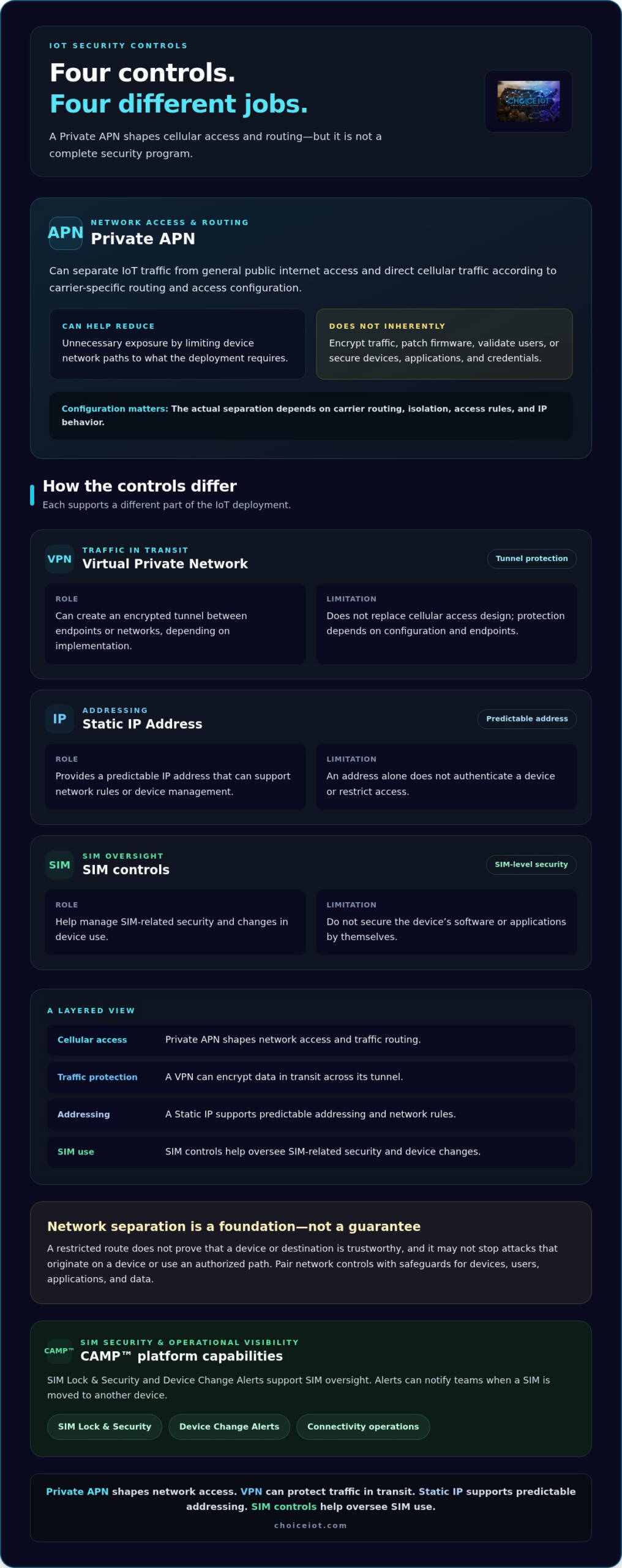
These controls work at different points in an IoT deployment. A Private APN governs cellular network access and traffic routing. A VPN can provide an encrypted tunnel, depending on its configuration. A Static IP Address gives a device or endpoint a predictable address, while SIM controls help manage the SIM itself. The benefits of private apn for security are clearest when you know which layer each control supports.
| Control | Purpose and scope | Key limitation |
|---|---|---|
| Private APN | Separates or directs cellular traffic according to the service’s carrier-specific routing and access configuration. | Doesn’t inherently encrypt traffic or secure devices, applications, or credentials. |
| VPN | Can create an encrypted tunnel between endpoints or networks, depending on the VPN implementation. | Doesn’t replace cellular access design, and its protection depends on configuration and endpoints. |
| Static IP Address | Provides a predictable IP address that can support network rules or device management. | An address alone doesn’t authenticate a device or restrict access. |
| SIM controls | Help manage SIM-related security and changes in device use. | Don’t secure the device’s software or applications by themselves. |
Private APN versus VPN: different roles in network design
Think of the Private APN as part of the cellular access and routing design. It helps determine how device traffic reaches its intended destinations. A VPN serves a different purpose. When configured for encryption, it can protect data in transit across its tunnel, whether that tunnel runs over a public or private connection. Neither control universally replaces the other. The right combination depends on required routes, endpoints, and security policies.
Static IP and SIM security as complementary controls
A Static IP Address can make an endpoint easier to identify in rules or operational workflows, but it isn’t a security boundary by itself. Access restrictions still need to be designed and enforced separately. For SIM oversight, the CAMP™ platform includes SIM Lock & Security and Device Change Alerts, which can notify teams when a SIM is moved to another device. These are SIM-level controls, not inherent Private APN features.
Quotable summary: A Private APN shapes network access, a VPN can protect traffic in transit, a Static IP Address supports predictable addressing, and SIM controls help oversee SIM use. Together, they address different layers and risks.
Choice IoT brings connectivity options such as Private APN and Static IP Address together with CAMP™ platform capabilities, so teams can consider network and SIM controls as parts of one deployment design.
How to Evaluate Private APN Security for Your IoT Deployment
Start with the deployment, not the connectivity feature. A practical review identifies which traffic needs to flow, which controls should govern it, and how teams will spot issues after launch. For foundational context on connectivity design, see Private APN for IoT: 2026 Guide to Secure Connectivity. Then use the steps below to assess how a Private APN fits your requirements.
Map access requirements before selecting network controls
Build an inventory of devices, SIMs, applications, destinations, data flows, and business-critical dependencies. Record who owns each component and who manages connectivity operations. This map can reveal unnecessary routes and clarify what must remain reachable for the deployment to work.
- Document device identities and roles. Group devices by function, location, or operational purpose, and record which systems and teams are responsible for them.
- Trace required data flows. Identify each source, destination, protocol, and business purpose. For example, note whether a monitoring device sends readings to a specific application and whether it needs inbound communication.
- Define authorized access. List the users and systems that need to manage devices or receive their data. Separate approved paths from connections with no operational purpose.
- Assess controls across layers. Review network routing and access alongside SIM safeguards, device security, application protections, and identity management. Compare carrier-specific routing, isolation, access, and IP behavior with the deployment design.
- Assign owners and response steps. Specify who reviews connectivity signals, investigates device changes, and handles network or application issues. Clear ownership turns the design into an operational process.
Plan ongoing visibility and response
A secure design needs operational follow-through. Decide which usage patterns, SIM changes, and connectivity issues warrant investigation, who reviews them, and how findings are recorded. CAMP™ includes Real-Time Visibility, Device Change Alerts, diagnostics, reporting, and automation to support connectivity management. These capabilities don’t replace device, application, or identity safeguards.
Use the benefits of private apn for security as one part of your deployment plan. Review whether configured paths still match operating needs as devices and applications change. Explore Choice IoT connectivity solutions to consider connectivity options alongside your deployment requirements.
Build a Layered IoT Security Approach with Choice IoT
A secure IoT deployment needs controls that work together, with a clear role for each one. Choice IoT offers Private APN as a connectivity option for separating and directing IoT traffic. A Static IP Address provides predictable addressing that can support network rules or device management. SIM controls and operational visibility help teams oversee connectivity activity. These capabilities complement one another, but they don’t replace endpoint protections or a well-designed network architecture.
Where Choice IoT capabilities fit in the security picture
Think in layers. First, design the network paths devices need and configure connectivity to match. Then apply device, application, and identity safeguards to protect the systems and data using those paths. The benefits of private apn for security depend on its fit with this broader design, not on the APN acting as a complete security solution.
The CAMP™ platform adds SIM-level and operational oversight. SIM Lock & Security supports SIM protection, while Device Change Alerts can flag when a SIM is moved to another device. Real-Time Visibility, reporting, diagnostics, and automation help teams manage connectivity and review operational signals. These features don’t guarantee threat detection or prevention, and they don’t make network or endpoint controls unnecessary.
For a broader view of how a management platform fits into IoT operations, explore IoT Connectivity Management Platform: The 2026 Strategic Guide. Consider that platform context alongside your deployment’s access design, device safeguards, and response responsibilities.
Choose the next step for your deployment
Before selecting or expanding connectivity controls, document the traffic paths devices require, the access rules that should govern them, and the people responsible for reviewing activity and responding to issues. Then align Private APN, Static IP Address, and SIM management with the wider security architecture. Review the design as devices, applications, and operational needs change. Clear roles. Defined paths. Ongoing oversight.
Discuss your IoT connectivity requirements with Choice IoT.
Turn Your Connectivity Design into an Operational Plan
Make security decisions part of deployment operations, not a one-time network setup. Assign clear ownership for reviewing access paths, responding to SIM or connectivity changes, and updating controls as devices and applications evolve. That gives teams a practical way to keep the design aligned with how the IoT fleet operates.
Choice IoT offers Private APN and Static IP Address, while the CAMP™ platform includes SIM Lock & Security, Device Change Alerts, and real-time visibility. These capabilities can support a broader plan alongside the network, device, application, and identity safeguards your deployment requires. The benefits of private apn for security are most useful when matched to defined requirements and maintained as operations change.
Build from your traffic needs, control priorities, and team responsibilities, then shape connectivity around the architecture you’re protecting. Discuss your IoT connectivity requirements with Choice IoT and take a confident next step toward a deployment designed for your needs.
Frequently Asked Questions
Does a private APN encrypt IoT data?
No. A Private APN doesn’t inherently encrypt data in transit. It governs cellular connectivity and traffic routing, while encryption depends on separate technologies and configuration, such as a properly implemented VPN or application-layer encryption. For a sensor sending readings to a cloud service, identify where encryption starts and ends, which systems terminate it, and whether sensitive data remains protected beyond the network connection.
Is a private APN more secure than a public APN?
It can provide more control over how IoT traffic is separated and routed, but “more secure” depends on the actual configuration and deployment requirements. A Private APN with broad or poorly managed access may not deliver the intended boundary. Compare the permitted routes, reachable destinations, and access controls for each design. The benefits of private apn for security depend on the protections implemented, not the label alone.
Can a private APN prevent IoT devices from being hacked?
No. It may reduce some exposure by limiting network reachability, but it can’t guarantee that a device won’t be compromised. Weak credentials, vulnerable software, or malicious activity through an allowed connection can still create risk. For example, a device communicating only with an approved server still needs secure authentication and maintained firmware. Treat network design as one part of device lifecycle security.
Do IoT devices still need a VPN when using a private APN?
Not always. A VPN may be appropriate when the deployment requires an encrypted tunnel between specific endpoints or networks, but the need depends on data sensitivity, existing encryption, and the security architecture. A Private APN and VPN address different design questions, so one doesn’t automatically make the other unnecessary. Map the full communication path, including where the tunnel begins and ends, before deciding.
What security controls should be used with a private APN?
Pair network access design with controls for device identity, user permissions, firmware maintenance, application security, and data protection. Define who can administer devices and restrict management access to authorized users. Also set a process for reviewing unexpected SIM or connectivity changes. CAMP™ includes SIM Lock & Security, Device Change Alerts, and visibility into connectivity operations, which can support oversight alongside your other safeguards.
Can a static IP address make an IoT connection secure?
No. A Static IP Address makes addressing predictable, which can help teams identify an endpoint or maintain network rules, but the address itself doesn’t authenticate a device or block unauthorized access. For example, an allowlist based on IP addresses may be one useful control, but it should be paired with identity checks and appropriately scoped permissions. Review how addresses are assigned and used across the full deployment.