
A private IoT APN gives connected devices a controlled route to a private network instead of sending traffic directly across the public internet. It can help control routing and access, but a private APN does not encrypt data by itself. The right setup depends on where devices need to send data and how the network manages access.
It is easy to assume that “private” means every connection is automatically secure. In practice, the APN defines the connection path and network policies, while IP addressing, authentication, firewall rules, and VPN protection each contribute to the overall design.
This guide explains how private and public APNs differ, how IoT traffic is routed, and which security and operational trade-offs to consider. You will also learn how APN settings reach deployed devices and what to assess when deciding whether a private APN fits your IoT deployment.
Key Takeaways
- Weigh private routing, traffic controls, and deployment complexity against what your IoT application actually needs.
- Understand how APN settings connect a device to its intended data network, including when devices are already deployed.
- Trace how APN configuration influences traffic handoffs to the public internet, an enterprise VPN, or a private cloud.
- Assess carrier options by the coverage and network design your deployment requires, rather than assuming every service works the same way.
- See how Choice IoT’s connectivity offerings can support deployments that need multi-carrier SIMs, centralized management, or private connectivity.
Private APN advantages and limitations for IoT
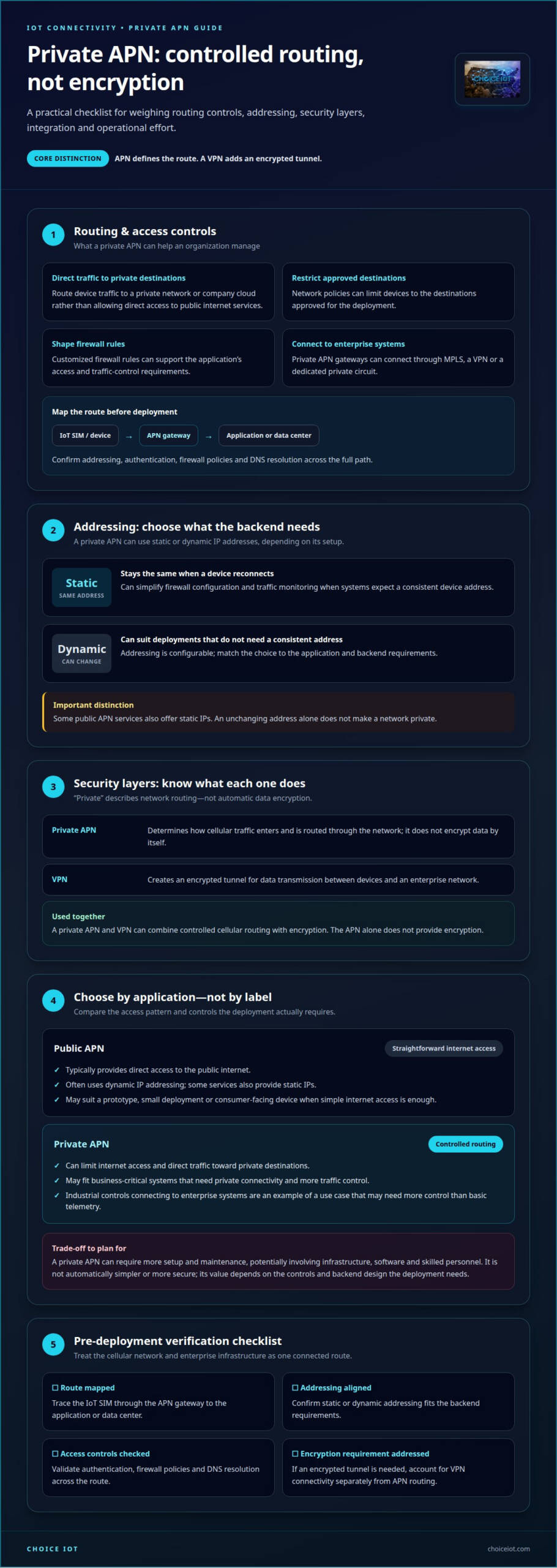
A private IoT APN can route device traffic to a private network and support static IP addressing, customized firewall rules, and VPN connectivity. It does not encrypt data by itself. Pairing it with a VPN can add an encrypted tunnel between devices and an enterprise network.
That separation helps organizations control where IoT traffic goes. For example, a sensor can send data to a company’s private cloud rather than access public internet services directly. Network policies can restrict devices to approved destinations, while static IP addresses can make firewall configuration and traffic monitoring more manageable.
Addressing is configurable, not one-size-fits-all. A private APN may use static or dynamic IPs, depending on its setup and backend requirements. A static address stays the same when a device reconnects, which can simplify rules for systems that expect a consistent device address. Dynamic addressing can suit deployments that do not need that consistency.
Integration requires alignment between the cellular network and the organization’s existing infrastructure. Private APN gateways can connect to enterprise systems through MPLS, a VPN, or a dedicated private circuit. Before deployment, map the route from the IoT SIM through the APN gateway to the application or data center. Confirm that addressing, authentication, firewall policies, and DNS resolution work across that path.
A private APN and a traditional VPN address different parts of connectivity. The APN determines how cellular traffic enters and is routed through the network. A VPN creates an encrypted tunnel for data transmission. Using both can combine controlled cellular routing with encryption, but the APN alone does not provide encryption.
Public APNs typically provide direct public internet access, often with dynamic IP addressing. Some public APN services also provide static IPs, so an unchanging address alone does not make a network private. A private APN can limit internet access and direct traffic toward private destinations. Its policies can be tailored to a deployment’s routing and access needs.
Choose based on the application, not the label. A public APN may suit a prototype, small deployment, or consumer-facing device when straightforward internet access is enough. A private APN can better fit business-critical systems that need controlled routing and private connectivity. For example, industrial controls connecting to enterprise systems may need more traffic control than basic telemetry. The trade-off is greater setup and maintenance effort, potentially involving infrastructure, software, and skilled personnel. A private APN enables specific controls, but is not automatically simpler or more secure; its value depends on the network controls and backend design required.
How do I configure APN settings without physical access to a deployed device?
You can change an APN remotely only if the device remains reachable through a management channel. That channel might be an existing cellular connection, Wi-Fi, Ethernet, or a device-management system that can deliver configuration commands. If the device is offline and has no alternate connection, a remote change cannot reach it. Plan the access path before deployment.
An Access Point Name identifies the packet data network a device requests through a carrier’s cellular network. It can direct IoT connectivity toward the public internet, a private enterprise network, or a cloud environment. The APN profile also relates to addressing and routing policies. The SIM subscription and device settings must align with the operator’s provisioning for the connection to succeed.
For remote updates, the device’s firmware or management software must support changing its cellular profile. An administrator can send the new APN value through the device’s existing management channel, then have the modem reconnect using that profile. Keep a fallback path available where possible. If the new setting blocks cellular access, the device may otherwise lose its route for receiving further instructions.
For a cellular module, the host device or modem interface may expose commands for defining an APN. For example, AT+CGDCONT defines PDP context 1 with an IP protocol type and the specified APN. The command changes the module’s connection profile; it doesn’t provision the SIM subscription or alter the operator’s gateway configuration. Those network-side settings must also permit the requested connection.
Remote configuration involves several connected points. Treat the change as a coordinated update:
- Confirm the exact APN value and whether the device requires IPv4, IPv6, or another supported profile.
- Check that the SIM subscription is provisioned for that APN by the operator.
- Send the updated setting through the active management channel, then prompt a data-session reconnect.
- Review modem status and confirm the assigned address and successful access to the intended destination.
An APN gateway applies the network’s routing policy after the device requests a data session. It can direct traffic toward an enterprise VPN, private cloud, or public internet connection, depending on the provisioned configuration. Successful modem registration alone does not prove that the application route works. Test both the cellular session and the destination service, such as the device’s cloud endpoint.
For deployments using a cellular IoT connectivity solution, coordinate device profiles, SIM provisioning, and backend routing as one design. That reduces avoidable mismatches between module settings and the network path.
How APNs route IoT traffic
An Access Point Name helps define where a mobile device’s data session connects. After an IoT device requests an APN, the mobile network operator checks its SIM profile and applies the associated network policy. That policy determines the gateway handling the session and the route to its destination. For example, a sensor may send readings to a company data center instead of a public internet service.
In a 4G LTE deployment, a private APN maps to a dedicated packet data network gateway, or PGW. The APN configuration helps determine whether the PGW sends traffic to the public internet, an enterprise VPN, or a private cloud. The gateway acts as the handoff point between the cellular network and the selected destination. That makes the APN part of the routing design, not simply a device label.
For example, a fleet-monitoring device can connect through its SIM and APN to a cellular network. The network applies the matching profile, then forwards traffic toward the configured endpoint. If the endpoint sits in a private network, the gateway needs a route into that organization’s infrastructure, such as a VPN or private circuit. A mismatch between the APN profile and backend route can prevent the application from receiving device data.
5G uses a related but different set of network functions. The device’s data network name, or DNN, supports network selection. The session management function, or SMF, selects a user plane function, or UPF, to carry the data path. Depending on the use case, a UPF can sit near the network edge or in a central location. That placement can shape how traffic reaches applications and where processing occurs.
Routing design should follow each device group’s destinations and access requirements. Map every data flow before deployment:
- Identify the SIM profile and APN or DNN each device uses.
- Name the destination, such as a public service, private cloud, or enterprise data center.
- Define the gateway handoff and the permitted route between the cellular network and that destination.
- Test an end-to-end session, from device connection through gateway routing to application response.
For a private-network design, the mobile network operator and enterprise infrastructure must support the same traffic path. A payment terminal, for instance, may need access only to designated business systems. Routing rules can limit that path, but the APN alone does not encrypt data. A VPN may provide the encrypted tunnel, while the APN and gateway determine where that tunnel’s traffic travels.
Which US carriers offer private APN services for IoT?
Private APN services are available through US mobile network operators and IoT connectivity providers. The right option depends on where devices operate, which networks their SIMs can access, and the route their traffic must take. Compare service architecture as well as coverage. An operator’s private APN may connect devices to its own network infrastructure, while an IoT provider can coordinate connectivity across multiple carrier networks.
Start by mapping where devices will operate. A fixed sensor at one site has different network needs from a vehicle or field device that moves between regions. Compare coverage along actual operating routes, then determine whether the deployment needs access to one carrier network or multiple networks. The SIM profile and APN configuration must support that design, including the intended private destination.
Next, document how each option connects to your infrastructure. For example, a utility monitoring system may need device traffic routed to a company data center rather than directly to public internet services. Identify the APN gateway path, addressing requirements, and connection to the enterprise network. Then align those details with backend routing and firewall policies. A carrier name alone does not establish that the end-to-end path matches your architecture.
Use consistent criteria to compare service designs:
- Coverage: Match network availability to device locations and movement patterns.
- Routing: Specify whether traffic must reach a private data center, cloud environment, or approved internet destination.
- Addressing: Determine whether applications need static IP addressing for device identification or access rules.
- Integration: Map how the gateway connects with existing VPNs, firewalls, and backend systems.
- Operations: Understand how SIM provisioning, APN profiles, and device connectivity fit the deployment workflow.
A single-network design can work when coverage and routing meet the project’s requirements. A multi-carrier design may suit devices operating across different coverage areas, but it requires a plan for SIM behavior, APN profiles, and backend access. For example, a field device moving between regions needs to maintain an appropriate route to its application as its cellular connection changes.
Keep connectivity and security requirements distinct. A private APN defines routing and access policies, but does not encrypt device data. If encrypted traffic is required, include VPN design in the network plan and test the complete path from device to destination.
To align carrier access, private routing, and backend requirements, plan your private APN deployment around the locations and destinations your devices need.
Private APN services are available through US mobile network operators and IoT connectivity providers that coordinate access across multiple carrier networks.
Choice IoT: Multi-Carrier IoT SIM
Choice IoT’s Multi-Carrier IoT SIM supports IoT deployments that need connectivity across carrier networks. For projects requiring controlled traffic routing, Choice IoT offers Private APN to connect devices to private network infrastructure. The CAMP™ IoT Platform provides centralized management for provisioning, monitoring, and securing IoT deployments.
This combination can suit solution providers, VARs, and integrators managing devices with different network needs. Fixed Wireless Connectivity is another option for locations where wired connectivity is not the right fit. The appropriate setup depends on device locations, data routes, and the systems each deployment must reach.
To discuss your IoT connectivity requirements, contact Choice IoT.
Turn Your Network Design Into a Deployment Plan
Make the next step a practical deployment brief. Map device locations, the application destinations they need to reach, and who manages each network connection. Then align SIM provisioning, APN profiles, and backend ownership before scaling. This gives engineering and operations teams a shared design to work from.
Choice IoT can support that planning with its Multi-Carrier IoT SIM, CAMP™ IoT Platform, and Fixed Wireless Connectivity. Together, these offerings address connectivity and deployment management needs for IoT projects. The right combination depends on your devices, network architecture, and operational requirements.
As you shape a private IoT APN deployment, bring your connectivity goals and routing requirements into the conversation. Contact Choice IoT to discuss your connectivity needs and identify a clear path for your deployment.
A well-defined plan gives your team a stronger foundation for moving forward with confidence.
Frequently Asked Questions
What is a Private APN?
A private IoT APN is a cellular connection profile that directs device traffic toward a private network rather than directly to the public internet. For example, a building sensor can connect to its organization’s approved systems. A private APN can also use assigned IP addresses and network access policies. It does not encrypt data on its own, so encryption needs separate network protection, such as a VPN where the design requires it.
Do I need a different APN for each country?
Not necessarily. Whether one APN works across countries depends on the SIM profile, participating mobile operators, and how the IoT service is provisioned. A device moving between countries may use roaming connectivity, while a deployment with local SIMs may require different profiles. For example, plan a fleet crossing borders around both SIM behavior and destination routes so devices continue reaching the intended application.
How is an APN used in IoT?
An APN lets an IoT device request a data connection to a particular packet network. The SIM subscription and device profile must support that APN. After the device requests a session, the mobile network applies the related routing and access policies. For instance, a temperature monitor can use its configured profile to send readings to a cloud service or an enterprise system, depending on the network design.
What Is an APN, and How Is It Used in IoT?
An APN is a network setting that identifies the data network an IoT device is trying to reach. It can also be associated with connection and routing policies, including the destination network and permitted traffic. For a cellular gateway, the APN value in the modem profile must match the SIM subscription’s provisioning. If those settings do not align, the device may register on the cellular network but fail to establish its intended data session.
What Is an APN?
An APN, or Access Point Name, is a setting a cellular device uses to identify the packet data network it wants to access. It is typically entered as text in a device or modem profile. For example, an IoT module can store an APN alongside its cellular connection settings. The APN is not the device’s phone number or a website address; it helps select the network path for data.
What is an Access Point Name (APN)?
An Access Point Name is the identifier a mobile device supplies when requesting a cellular data connection. The carrier uses the request and the SIM’s provisioning to determine how the session should connect. In an IoT installation, an engineer may configure the APN in the modem profile before activating data connectivity. The chosen profile affects where the device’s traffic can go, so it should match the intended application and network.