A smart meter’s value depends on the data connection behind it. IoT connectivity for smart metering carries consumption readings from the meter to utility systems, where they can inform customer monitoring and distribution planning. The meter records usage; the network moves that information so it can be analyzed and acted on.
It’s easy to focus on the meter itself, but reliable data transmission is what turns readings into useful operational insight. Timely information can help consumers understand energy use and help utilities identify demand patterns, potential faults, and ways to manage resources more effectively.
This article explains what smart meters do, how they collect and transmit utility data, and how connectivity technologies link meters with utility platforms. It also covers how those insights can support consumption monitoring, outage awareness, and distribution decisions, along with the connectivity considerations to plan for in a smart-meter deployment.
Key Takeaways
- Smart meters replace manual readings with usage data that can improve consumption visibility and support more precise utility operations.
- Understand how meters record readings and transmit them through cellular technologies such as LTE-M and NB-IoT.
- Use timely consumption data to spot demand patterns, support outage awareness, and inform distribution planning.
- Compare connectivity options by considering coverage, data needs, device requirements, and how meters must communicate with utility systems.
- For deployments needing flexible connectivity and centralized oversight, explore how a Multi-Carrier IoT SIM and CAMP™ IoT Platform can support the data flow.
What are smart meters and what are the benefits of using them?
A smart meter measures electricity, gas, or water use and records readings electronically. Unlike a traditional meter that requires manual readings, it can send consumption data to a utility system over a communications network. This creates a digital flow from the meter to the applications used for billing, monitoring, and distribution planning.
More frequent readings can give consumers a clearer view of when and how they use energy. With that visibility, a household or business can identify inefficient patterns, such as equipment drawing power outside operating hours, and adjust usage. An EU study estimated that smart meters can create energy savings of up to 2-10%. Utilities can also use the readings to support more precise billing, reduce disputes, and streamline meter-reading operations.
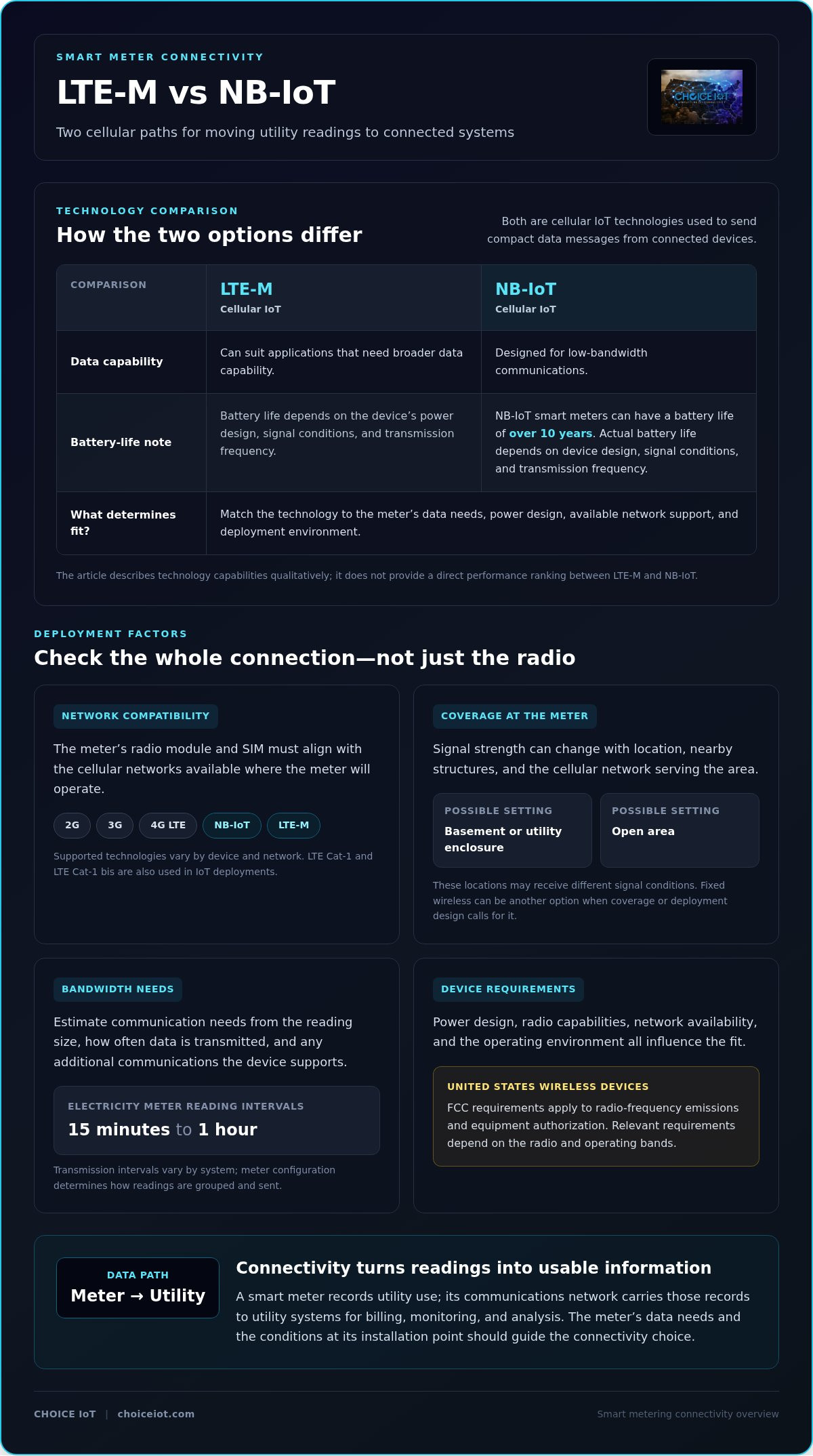
Cellular connectivity is one way to move meter data. LTE-M and NB-IoT are cellular IoT technologies designed for connected devices that send compact data messages. LTE-M can suit applications that need broader data capability, while NB-IoT is designed for low-bandwidth communications. LTE Cat-1 and LTE Cat-1 bis are also among the cellular technologies used in IoT deployments. The right fit depends on the meter’s data needs, power design, network support, and deployment environment.
Supported cellular technologies vary by device and network. A meter’s radio module and SIM must align with the cellular networks available where it will operate. Possible technologies include 2G, 3G, 4G LTE, NB-IoT, and LTE-M. This compatibility matters when a utility deploys meters across multiple locations or plans to keep them in service as network requirements evolve.
Coverage matters as much as the technology. Signal strength can vary with a meter’s location, nearby structures, and the cellular network serving the area. A meter in a basement or utility enclosure may receive a different signal from one installed in an open area. For fixed installations, fixed wireless connectivity can offer another way to connect equipment when cellular coverage or the deployment design calls for it.
For wireless smart meter devices in the United States, FCC requirements apply to radio-frequency emissions and equipment authorization; the relevant requirements depend on the radio and operating bands. Bandwidth needs depend on reading size, transmission frequency, and any additional communications the device supports. Battery life depends on the device’s power design, signal conditions, and how often it transmits; NB-IoT smart meters can have a battery life of over 10 years.
How IoT smart meters collect and transmit utility data
A smart meter turns a physical utility reading into a digital record that systems can process. IoT connectivity for smart metering carries those records to utility applications for billing, monitoring, and analysis.
Inside the meter, a sensor measures electricity, gas, or water use. The meter records and timestamps each reading, then prepares it for transmission through its communications module. Electricity meters may collect data at intervals ranging from 15 minutes to one hour. IoT smart meters can transmit recorded utility data to providers at intervals that vary by system. The meter’s configuration determines how readings are grouped and sent.
At the receiving end, a utility system accepts incoming records and associates them with the relevant meter and account. Edge processing can validate or organize data near the meter or network gateway before forwarding it. Cloud systems can then combine readings across locations, support remote analysis, and feed utility applications. This division separates time-sensitive processing from broader analysis, supporting automated workflows and efficient operations.
Encrypted Transmission and Access Control
Encrypted transmission protects data as it moves between a smart meter and utility systems, while access controls limit who or what can use it. Together, these safeguards help protect consumption records and system commands from unauthorized access. Utilities can use role-based permissions so billing systems, field operations, and analytics tools access only the data their tasks require.
Access management also includes device identity and credentials. A meter should be recognized before it exchanges information, and its permissions should reflect its role. For example, a billing application needs consumption records, while a maintenance workflow may need device status. Separating these access paths strengthens privacy across smart-meter solutions.
Smart Meter Data Protocols and Standards
Protocols define how a meter formats and exchanges readings, so devices and utility platforms can interpret data consistently. DLMS/COSEM is part of the IEC 62056 suite of international standards for smart meters. ANSI C12.18 defines data transfer between a smart utility meter and a client using an ANSI Type 2 Optical Port.
These standards address different communication contexts, from structured meter data to optical-port exchange. IEEE 1686-2013 specifies cybersecurity capabilities for intelligent electronic devices. Aligning protocols across meters, gateways, and utility systems helps prevent incompatible records and supports consistent data handling.
Public and Private IoT Networks
Utilities choose between public cellular networks and private IoT network arrangements by weighing coverage, control, deployment conditions, and system requirements. Public cellular uses existing operator infrastructure; a private network gives the utility greater control over its communications environment. The right fit depends on meter locations, available coverage, and how data needs to reach utility applications.
A Private APN can provide a private routing environment for cellular-connected meters without making the cellular access network itself private. For deployments where controlled data paths matter, Private APN connectivity can be part of the network design. Utilities should also account for how protocols, device identities, and access permissions work across the chosen connection.
Real-time consumption monitoring and distribution planning
Smart meters record and transmit energy-use data, giving utilities a view of consumption across connected locations. Some systems capture usage down to the minute, helping distinguish a short demand spike from a sustained increase. Utilities can use these insights to monitor the electric system, adjust resource allocation, and inform grid management.
For customers, interval readings show when consumption rises, not just how much energy was used over a billing period. A business can compare operating hours with meter data to identify equipment drawing power after a shift ends. This supports informed energy decisions and clearer billing reviews. At home, usage patterns can reveal when heating or cooling demand increases, helping residents understand how routines affect consumption.
For utilities, readings from multiple meters can reveal high-demand areas and potential system faults. Operators can use these signals to investigate emerging issues before they cause downtime. Smart-meter data can also support faster outage detection and service restoration by helping utilities identify affected locations. With demand-response capabilities, utilities can use consumption information to shape demand and balance resources across the grid.
Industrial load management depends on understanding how equipment affects demand over time. For example, a facility can compare meter readings with production schedules to identify when energy-intensive processes overlap. Utilities can use aggregated readings to understand demand across service areas and plan distribution accordingly. Connected sensors add another operational layer, supporting water-pipeline leak detection and predictive maintenance for electrical substations.
Network monitoring supports the data flow behind these applications. If readings stop arriving from a group of meters, operators can investigate whether the cause is the devices, local network conditions, or an upstream connection. With cellular connectivity, network availability and coverage affect whether remote meter data reaches utility systems. Tracking connection status alongside consumption helps distinguish a communication gap from a change in actual usage.
Useful planning depends on interpreting readings in context. An increase in consumption may reflect weather, operating schedules, equipment changes, or a developing fault. Comparing meter data across locations and time periods helps teams distinguish local events from broader demand patterns. For example, a rise at one industrial site calls for a different response than a simultaneous increase across a neighborhood. These monitoring capabilities help utilities prioritize investigations and make distribution decisions based on observed conditions.
Smart-meter connectivity and IoT communication
A smart meter’s communication method shapes how readings move through utility infrastructure. The right option depends on meter locations, network coverage, data requirements, and plans for developing connected applications.
Smart Meter Communication Options
Cellular, low-power wide-area networks (LPWAN), radio-frequency mesh, and power-line communication each provide a different route for meter data. Cellular sends readings through mobile network infrastructure, while LPWAN supports long-range, low-bandwidth device connections. LoRaWAN transmissions can reach up to 15 kilometres in unobstructed open areas, though terrain and buildings affect practical coverage.
RF mesh passes data between nearby devices, allowing meters to relay messages across a network. Power-line communication carries signals over existing electrical lines, connecting meters through electricity infrastructure. These choices shape deployment design: a utility might use cellular where mobile coverage is available, or mesh where meters can relay data between locations.
Communication is not just a one-way upload. Smart meters can send readings and receive information, supporting grid analysis, outage reporting, and customer updates. They can also communicate with connected devices such as smart thermostats, which may adjust based on energy pricing or demand signals. The practical takeaway is to match the communication technology to the meter environment and the application’s data flow.
Communication Modules, Networks, and Service Costs
Communication costs include the meter’s module, the network connection, and any ongoing service plan. The total depends on module capabilities, available coverage, data volume, deployment footprint, integration needs, and service duration. These factors matter because a meter’s hardware can affect compatible networks and recurring connectivity requirements.
There is no typical cost that applies to every deployment. The price depends on the specific requirements and is provided after a quote request. Relevant factors include module specifications, network access, service duration, and deployment scale. Compare the full lifecycle cost, not just the communication module’s upfront price.
For a fixed site that needs internet access, fixed wireless connectivity can provide a network option. A static IP address can support deployments that require a consistent network address for remote system access. These capabilities serve different needs, so the architecture should reflect how utility platforms connect to meters and related infrastructure.
Network availability also matters beyond the initial installation. LoRaWAN providers have no roaming agreements between mobile network operators, a consideration for deployments spanning cellular networks. Utilities planning across regions should map meter locations, required data paths, and network dependencies before selecting a communication design. Explore connectivity options for utility deployments to align the network approach with your smart-meter infrastructure.
Choice IoT: Multi-Carrier IoT SIM
Choice IoT’s Multi-Carrier IoT SIM supports smart-meter deployments that need cellular connectivity across varied locations. It suits programs where meter data travels over mobile networks and deployments span different coverage conditions.
Pair connectivity with the CAMP™ IoT Platform to manage, monitor, and secure IoT deployments. For fixed sites, Fixed Wireless Connectivity offers another option. A Private APN can provide a private network path for connected devices and utility systems.
These options address different parts of the data flow, from network access to deployment management. The right combination depends on meter locations, cellular coverage, and how utility systems receive and use readings. Contact Choice IoT to discuss connectivity for your smart-meter deployment.
Build a Connectivity Plan That Can Scale
Start by defining how meter data will support operational priorities as the deployment develops. Map the connection from each meter to the utility systems that use its readings, then consider how coverage, device management, and data access fit together. A clear architecture gives teams a practical foundation for expanding applications without treating every new meter as a separate project.
IoT connectivity for smart metering should fit your rollout model and how your teams manage connected devices. Choice IoT offers a Multi-Carrier IoT SIM for cellular connectivity, the CAMP™ IoT Platform for deployment management, and Fixed Wireless Connectivity for fixed-site requirements. Depending on the design, these options can support different parts of a metering network.
Bring your connectivity goals and deployment requirements into the planning conversation. Contact Choice IoT to discuss connectivity for your smart-meter program and identify a suitable next step. A considered plan can help your team move forward with clarity and confidence.
Frequently Asked Questions
How do intelligent metering systems work?
Intelligent metering systems combine a meter, a communications link, and software that processes readings. The meter measures utility use, attaches relevant device information, and sends records to utility systems. Those systems can associate readings with the correct meter, identify missing or unusual data, and route information to billing or operational applications. For example, a utility can compare incoming electricity readings with the meter’s previous usage pattern.
Is it possible to retrofit metering devices with IoT?
Yes, existing metering devices can sometimes be connected through an added communications module or an external sensor and gateway. The best approach depends on the meter’s output interface, available power, installation conditions, and the network technology supported by the retrofit device. For example, a pulse-output meter may connect through a compatible gateway. If the meter has no usable output, replacing it may be more practical than adding connectivity.
What are the challenges?
Common challenges include inconsistent network coverage, device and platform incompatibility, power constraints, and protecting sensitive consumption records. Utilities also need to account for data that arrives late, is duplicated, or fails to arrive. A useful troubleshooting process separates the possible sources: confirm whether the meter recorded a reading, whether the connection delivered it, and whether the receiving system processed it. This helps teams focus their investigation on the right part of the system.
What is AMI?
AMI means Advanced Metering Infrastructure, the connected system used to collect and manage meter data. It typically includes smart meters, communications networks, and data-management applications. Unlike a meter alone, AMI describes the broader infrastructure linking devices with utility operations. For example, an electricity provider can use AMI to receive readings remotely and make them available to systems supporting billing, service management, and grid operations.
What is the difference compared to conventional meters?
Conventional meters generally record accumulated use for periodic manual readings, while smart meters can record and communicate readings electronically. This changes how utilities gather consumption information and how customers can review their usage. A conventional meter may show total electricity consumed when inspected; a connected meter can provide time-based readings for analysis. Smart meters also rely on working communications and compatible systems to deliver readings remotely.
What types of meters and sensors are compatible with IoT SIM cards?
An IoT SIM works with a meter or sensor that has a compatible cellular modem, SIM interface, and supported network technology. Electricity, gas, and water devices can connect if their hardware supports cellular data, directly or through a gateway. For example, a water sensor that sends readings to a cellular gateway may use a SIM in that gateway, even if the sensor itself has no SIM slot. Compatibility depends on the device’s connectivity design.