

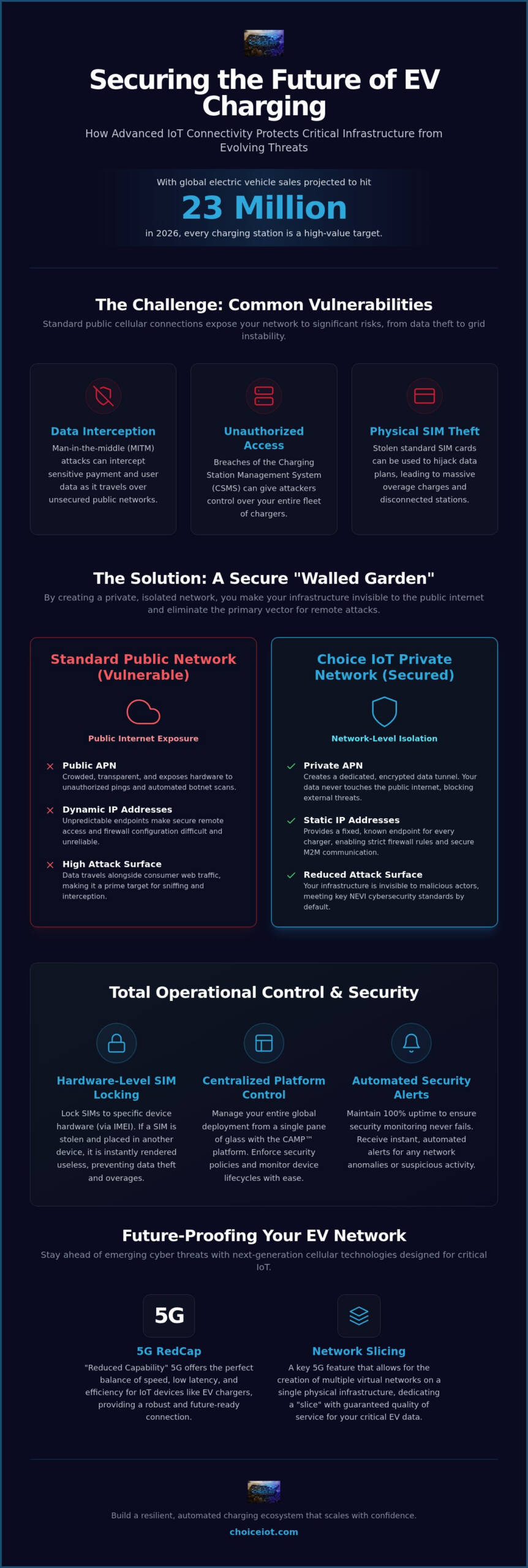
Total operational control. Real-time visibility. Zero friction. With global electric vehicle sales projected to hit 23 million units in 2026, your charging infrastructure is a high-value target. Every connected station is a potential entry point for unauthorized access. You understand the risks. Public cellular networks are vulnerable. SIM swapping is a reality. Managing security across multiple carriers is often a logistical nightmare. This guide solves those technical hurdles by focusing on iot data security for EV charging stations.
Discover how to protect your infrastructure using advanced connectivity management and private network features. We bridge the gap between hardware and secure data transmission. We’ll cover ISO 15118 compliance, 5G RedCap, and the strategic use of a Private APN to create encrypted data paths. Gain the tools to automate security alerts for anomalies and lock down your network layer for good. It’s time to move beyond basic connectivity and build a resilient, automated charging ecosystem that scales with confidence.
Key Takeaways
- Understand why EV chargers have become high-value targets in 2026 and how to implement robust iot data security for EV charging stations to protect critical infrastructure.
- Discover how Private APNs and Static IPs create a secure “walled garden” for your data, effectively eliminating public internet exposure and unauthorized access.
- Learn to centralize management and enforce operational security through the CAMP™ platform, including hardware-level SIM locking.
- Explore the arrival of 5G Redcap and network slicing as essential tools for future-proofing your charging network against evolving cyber threats.
The Critical Need for IoT Data Security for EV Charging Stations
Data security in the electric vehicle ecosystem is the protection of information as it moves between the charger, the vehicle, and the central management system. It’s more than just a software patch. It’s a comprehensive strategy to ensure the integrity of every transaction and command. In 2026, EV charging infrastructure has been officially classified as critical infrastructure. This shift is driven by the sheer scale of the network. With millions of connected nodes, iot data security for EV charging stations is now the primary bottleneck for safe, scalable deployment.
EV chargers are high-value targets because they sit at the intersection of consumer finance and the national power grid. A breach doesn’t just compromise a single station. It risks customer privacy and can even lead to grid instability if hackers manipulate load demands across a city. Relying on standard public cellular connections is a gamble. These open pathways expose your hardware to unauthorized pings and automated scans from malicious actors. Without network-level isolation, your mission-critical data travels alongside consumer web traffic, leaving it vulnerable to interception and exploitation.
Common Vulnerabilities in EV Charging Networks
Security gaps often appear where physical hardware meets digital communication. Man-in-the-middle (MITM) attacks allow hackers to intercept payment data during the handshake between the car and the charger. Beyond data theft, unauthorized access to the Charging Station Management System (CSMS) can give attackers total control over your fleet. There is also a physical risk. SIM theft is a persistent issue. When a standard SIM is stolen from a charger, it’s often used to hijack data plans for personal use, leaving you with massive overage charges and a disconnected, vulnerable station.
The Role of Connectivity in Infrastructure Protection
Robust security starts at the network layer. Encryption is necessary, but it’s not enough on its own. You need network-level isolation to create a private environment where your devices are invisible to the public internet. Connectivity providers serve as your first line of defense by providing these secure pathways. Uptime is equally critical. If your connection drops, your security monitoring fails. Maintaining 100% uptime ensures that automated alerts for security anomalies are always active. This proactive stance transforms connectivity from a simple utility into a strategic security asset for iot data security for EV charging stations.
Securing the Transmission Layer: Private APN and Static IPs
Most security strategies focus on the device or the cloud. They often ignore the “middle mile.” This is the path where data travels between your chargers and your management system. For iot data security for EV charging stations, this transmission layer is the most vulnerable point for interception. By deploying a Private APN, you create a virtual “walled garden.” This isolation ensures your data never touches the public internet. It removes your infrastructure from the reach of automated botnets and malicious scans.
Compliance is no longer optional. As operators work to meet NEVI cybersecurity standards, network-level isolation has become a baseline requirement. It’s about risk mitigation at scale. When you eliminate public exposure, you eliminate the primary vector for remote attacks. This architecture provides a foundation of “quiet confidence.” Your systems are inherently robust because they are invisible to those who shouldn’t see them.
Private APN: Your Dedicated Data Tunnel
Public APNs are crowded and transparent. They leave your hardware exposed to every unauthorized ping on the cellular network. A Private APN acts as a dedicated, encrypted tunnel. It prevents data sniffing and blocks external hacking attempts before they reach the charger. This setup is built for growth. You can manage thousands of globally distributed chargers on a single private network with total visibility. It simplifies the complexity of multi-carrier deployments while maintaining a unified security posture.
Static IP vs. Dynamic IP for Secure Access
Dynamic IPs are unpredictable. They make remote troubleshooting a moving target and complicate VPN configurations. Static IPs provide a fixed, known endpoint for every station in your fleet. This is essential for secure M2M communication. With fixed addresses, you can implement strict firewall rules that only allow traffic from verified sources. It reduces the attack surface significantly. You know exactly which device is communicating at all times. No surprises. No unauthorized access.
Implementing a private apn for iot is the most direct way to secure your transmission layer. It provides the encrypted data paths required for high-performance charging networks. If you’re ready to lock down your connectivity, exploring these private network features is the next logical step for your infrastructure.
Operational Security: Managing SIM Lifecycles with CAMP™
Visibility is the foundation of security. For iot data security for EV charging stations, managing thousands of endpoints requires a centralized command center. The CAMP™ IoT Platform provides this control. It transforms a scattered fleet into a unified, secure network. Operational security isn’t a passive state; it’s an active management process that demands total visibility. One platform. Complete operational control.
Secure your deployment using these four critical steps:
- Implementing SIM Lock: Bind every SIM card to its specific charger hardware via the IMEI. If the SIM is removed, it becomes useless in any other device.
- Setting up Device Change Alerts: Receive instant notifications the moment a SIM is detached from its authorized hardware.
- Utilizing Intelligent Alerts: Monitor for data usage anomalies that signal potential breaches or hardware malfunctions.
- Executing Remote Network Resets: Clear security glitches and restore connectivity instantly without sending a technician to the site.
Preventing SIM Theft and ‘Bill Shock’
Physical security is often the weakest link in iot data security for EV charging stations. Stolen SIMs are frequently used in unauthorized devices, leading to massive data overages and “bill shock.” SIM Lock & Security features stop this cycle before it starts. CAMP™ provides real-time detection of hardware tampering. If a breach is detected, the system can automatically suspend compromised lines. This protects your bottom line. It ensures that your data plans are used exclusively for your charging infrastructure.
Real-Time Visibility and Operational Control
Managing security across multiple carriers shouldn’t be complex. A single-dashboard view simplifies global deployments. You can set customizable security thresholds for proactive notification. This ensures you’re never the last to know about a network issue. This level of control reduces “truck rolls” through remote diagnostics. You solve problems from the office, not from the field. It’s about streamlined simplicity and total reliability. Powerful, sophisticated, and ready to be integrated.
Empower your team with total operational control over every SIM. Secure your EV infrastructure with the CAMP™ platform today.
Future-Proofing EV Security with 5G Redcap and Beyond
The infrastructure you build today must withstand the threats of tomorrow. As 2026 progresses, the transition from legacy LTE to 5G Standalone (SA) networks is accelerating. This shift isn’t just about speed. It’s about access to advanced security protocols that were previously unavailable. Maintaining iot data security for EV charging stations requires a proactive approach to hardware and network selection. You need a foundation that scales without introducing new vulnerabilities.
5G Redcap: The New Standard for EV Charging
5G Redcap (Reduced Capability) has emerged as the “Goldilocks” solution for the EV sector. It provides a strategic middle ground between low-power LTE-M and high-bandwidth 5G. It’s cost-effective. It’s power-efficient. Most importantly, it utilizes the 5G SA core for enhanced authentication and encryption. This future-proofs your fleet against the eventual 4G sunset. By adopting Redcap now, you eliminate the risk of legacy vulnerabilities while ensuring your hardware remains compatible with carrier networks for the next decade.
5G also introduces network slicing. This allows for the creation of virtual, isolated lanes for specific traffic. You can separate EV charging data from general consumer traffic at the carrier level. This adds a powerful layer of isolation beyond the Private APN. When combined with rigorous carrier device certification, you ensure that every piece of hardware on your network meets the highest security standards. No weak links. No uncertified hardware.
The Partner Advantage for VARs and Integrators
Value-Added Resellers (VARs) and integrators face unique challenges. You don’t just manage one network; you manage hundreds of security-conscious clients. You need white-label management options that project your own brand’s authority. Choice IoT provides the operational foundation to make this possible. By leveraging multi-carrier SIMs, you ensure redundant security paths. If one carrier experiences a localized outage or threat, your stations failover to a secure backup instantly.
Operational control is your greatest asset. You can offer your clients total visibility while you handle the technical complexities of 5G integration behind the scenes. It’s about removing friction and building trust. Developing a scalable iot connectivity solution is the only way to stay competitive in an increasingly regulated market. Position your business as the expert partner that has already mastered iot data security for EV charging stations.
Mastering the Connectivity Layer for Scalable EV Networks
Securing the future of electric mobility requires more than just standard software encryption. It demands total ownership of the transmission layer. By isolating your infrastructure through Private APNs and utilizing Static IPs, you remove the primary attack vectors that threaten public networks. This architectural shift, combined with the power of 5G Redcap, ensures your network remains resilient against the evolving threats of the next decade. iot data security for EV charging stations is no longer an optional feature; it is the foundation of operational reliability.
Empower your deployment with a partner that understands the complexities of IoT connectivity. Choice IoT provides the tools you need to maintain total control. Gain real-time visibility into every device. Benefit from SIM Lock and Device Change Alerts. Our team offers dedicated support for VARs and integrators to ensure your growth is never hindered by security gaps. Take control of your EV charging security with Choice IoT’s CAMP™ platform. Build with confidence, scale with speed, and lead the industry with a secure, automated ecosystem.
Frequently Asked Questions
What is a Private APN and why does my EV charging station need one?
A Private APN is a dedicated network gateway that isolates your device traffic from the public internet. Your EV charging stations need this to prevent unauthorized pings and external hacking attempts. It creates a secure “walled garden” for your data. This is essential for iot data security for EV charging stations because it bypasses the inherent risks of open cellular paths. It ensures only authorized management systems can communicate with your infrastructure.
How can I prevent my IoT SIM cards from being stolen and used in other devices?
You can prevent SIM theft by using the SIM Lock & Security feature within the CAMP™ platform. This binds each SIM card to the specific IMEI of your authorized charging hardware. If a SIM is removed, it becomes useless. You also receive instant Device Change Alerts to notify you of tampering. Simple. Effective. This proactive automation stops “bill shock” by suspending compromised lines before unauthorized data usage accumulates.
Is 5G more secure than 4G for EV charging data?
5G is more secure because it introduces enhanced authentication and encryption protocols built into the 5G Standalone core. Technologies like 5G Redcap provide a secure, cost-effective connection while leveraging these advanced 5G security features. 5G also supports network slicing. This allows you to isolate charging traffic into its own virtual lane. It reduces the risk of lateral movement attacks compared to legacy 4G LTE networks. It’s built for the next decade.
Can I remotely reset a charging station’s connectivity if I suspect a breach?
Yes. You can perform a Remote Network Reset directly through the CAMP™ platform without visiting the physical site. This tool allows you to clear security glitches and re-establish a secure connection instantly. It’s an essential feature for maintaining high uptime and rapid response. By resetting SIM connectivity remotely, you eliminate the need for costly truck rolls. It ensures your iot data security for EV charging stations remains robust even when anomalies occur.
What is the difference between a Static IP and a Dynamic IP for IoT security?
A Static IP provides a fixed, permanent address for your device. A Dynamic IP changes periodically. For IoT security, Static IPs are superior. They allow you to implement strict firewall rules that only accept traffic from known, trusted endpoints. This reduces the attack surface. It makes your network traffic predictable. It also simplifies the setup of secure VPNs and remote management tools. This ensures consistent, reliable machine-to-machine communication across your entire fleet.
How does the CAMP™ platform help with cybersecurity compliance?
The CAMP™ platform centralizes security management to provide the real-time visibility required by modern regulatory frameworks. It offers built-in tools like SIM Lock, Device Change Alerts, and automated reporting. These help you meet rigorous standards. By using a single dashboard to monitor global multi-carrier deployments, you can quickly identify and document security anomalies. This proactive approach ensures your infrastructure stays compliant with evolving industry standards. Total control. Complete visibility.