

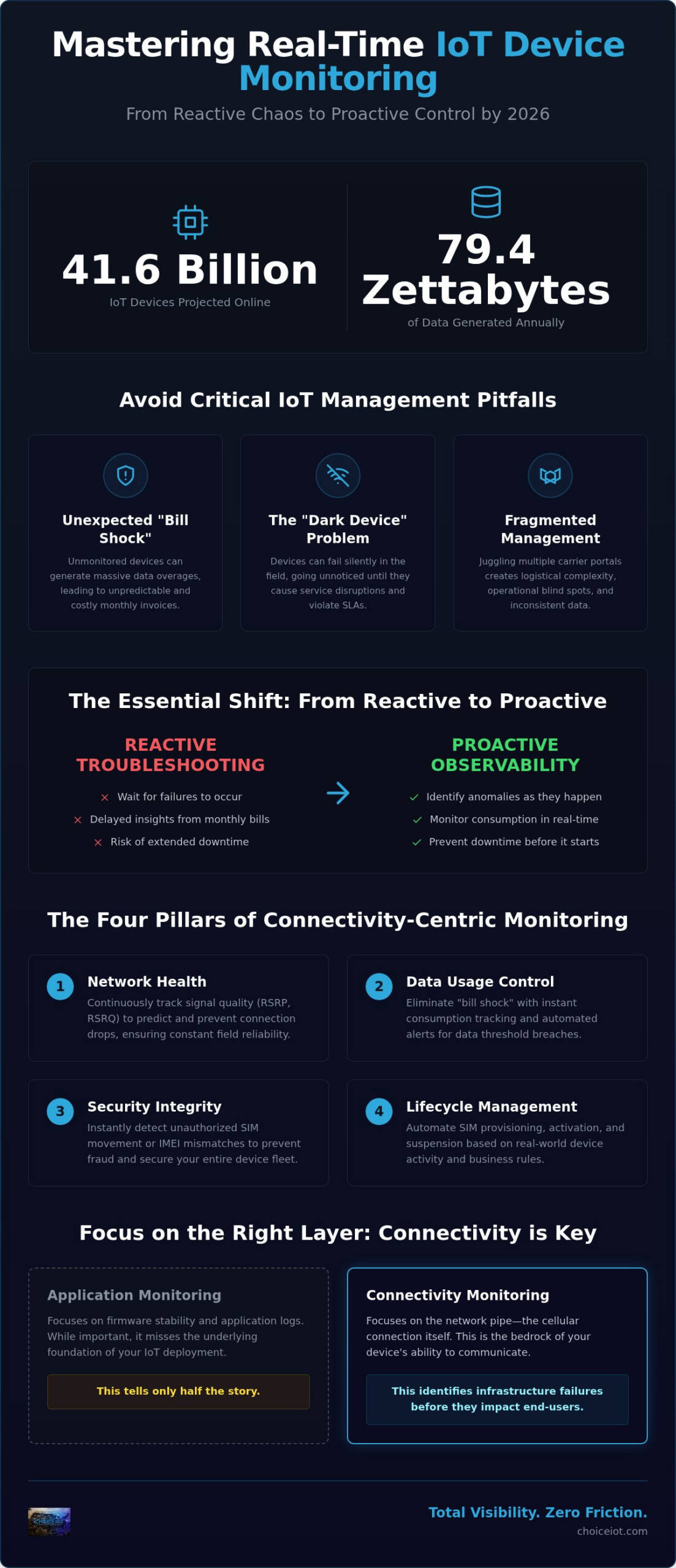
By 2026, an estimated 41.6 billion IoT devices will generate 79.4 zettabytes of data. That is a massive volume of information to manage without a safety net. You likely already know the frustration of opening a monthly invoice only to find unexpected bill shock from data overages you didn’t see coming. It’s even worse when a device fails silently in the field; it leaves your clients in the dark and puts your SLAs at risk. Fragmented visibility across multiple carriers only adds to the logistical stress.
Effective real time iot device monitoring is no longer a luxury. It is a financial and operational safeguard for your connectivity integrity. This guide will help you master global observability and eliminate connectivity downtime through centralized management. You’ll learn how to leverage a single pane of glass to gain total control over fragmented networks. We’ll explore automated alerts for data anomalies and the latest 2026 regulatory shifts. Total visibility. Zero friction. It’s time to build a more resilient IoT infrastructure.
Key Takeaways
- Transition from reactive troubleshooting to proactive observability to maintain constant device uptime and network health.
- Prevent “bill shock” by monitoring data consumption thresholds in real-time to eliminate unexpected overages.
- Address the “dark device” problem by monitoring the connectivity pipe; this ensures visibility even when application logs fail.
- Establish a centralized strategy for real time iot device monitoring to manage global fleets across multiple carriers from a single pane of glass.
- Leverage the CAMP™ IoT Platform for instant SIM provisioning and granular visibility into network health metrics such as signal quality and tower logs.
What is Real-Time IoT Device Monitoring in 2026?
Real-time IoT device monitoring is the continuous, sub-second tracking of connectivity health and data consumption across a global fleet. In 2026, the scale of deployments makes manual oversight impossible. With over 41 billion devices projected to be online, you cannot afford to wait for a monthly bill to discover a malfunction. You need an automated engine that identifies anomalies the moment they occur. This is the transition from reactive troubleshooting to proactive observability. It is the bedrock of a modern enterprise tech stack. Total visibility. Absolute control.
Traditional Network monitoring often focuses on the core infrastructure, but IoT requires a granular look at the individual SIM session. To maintain operational integrity, you must track specific metrics that signal trouble before it escalates. Key indicators include:
- Signal Quality: Monitoring RSRP and RSRQ values to predict drops.
- Data Throughput: Identifying spikes that suggest firmware loops or security breaches.
- SIM Session Status: Real-time tracking of tower attachments and carrier switching.
- Latency Thresholds: Measuring the delay between device transmission and cloud reception.
The Evolution of IoT Observability
We’ve moved beyond simple “heartbeat” pings that only confirm if a device is powered on. Modern observability utilizes deep packet inspection and granular telemetry to provide a high-resolution image of device performance. 5G RedCap is a primary driver in 2026. It enables high-frequency real time iot device monitoring for mid-tier devices without the excessive power drain of full-scale 5G. This allows for predictive maintenance. You can identify a degrading signal and reroute traffic before a connection drops. It is about staying ahead of the curve.
Why Latency Matters for Monitoring
Latency is the enemy of operational efficiency. In a cellular environment, even a few minutes of lag can result in massive data overages or extended downtime for critical infrastructure. If your monitoring system isn’t fast, it isn’t useful. For 2026 deployments, “real-time” is defined as sub-second connectivity reporting that triggers an automated response the moment a threshold is breached. Speed is the priority. Rapid detection leads to rapid resolution. When your systems communicate without delay, your business scales without friction.
The Core Pillars of Connectivity-Centric Monitoring
Most monitoring strategies fail because they focus exclusively on the application layer. While firmware stability is important, it tells only half the story. If your application is running perfectly but the cellular connection is degrading, your device is effectively a brick. You need a strategy that prioritizes the network pipe. This is where real time iot device monitoring becomes a critical operational safeguard. By focusing on the connectivity layer, you identify infrastructure failures before they impact your end users. Total oversight. No blind spots.
As highlighted in Harvard Business Review’s analysis of Transforming Competition with Smart, Connected Products, the strategic value of IoT lies in the continuous, reliable flow of data. If that flow breaks at the network level, your competitive advantage vanishes. To prevent this, your monitoring framework must rest on four pillars: network health, data control, security integrity, and lifecycle automation. These pillars ensure that every SIM in your fleet is an asset, not a liability.
- Network Health: Tracking RSRP and RSRQ values to assess signal quality.
- Data Usage Control: Eliminating “bill-shock” through instant consumption tracking.
- Security Integrity: Detecting unauthorized SIM movement or IMEI mismatches immediately.
- Lifecycle Management: Automating provisioning based on real-world device activity.
Connectivity Performance and Signal Integrity
Field reliability depends on signal integrity. You must track metrics like RSSI and Signal-to-Noise Ratio (SNR) to predict potential connection drops. This data allows you to identify “rogue” devices. These are units that constantly hunt for a signal, draining battery life and wasting bandwidth. By using multi-carrier data, you can see which carrier is underperforming in a specific region and switch to a stronger network. It is about maintaining a high-performance engine across your entire deployment. If you want to simplify these complex network metrics, consider a centralized connectivity management platform designed for scale.
Financial Monitoring: Preventing Data Overages
Unexpected overages are the silent killers of IoT profitability. You need real-time triggers that flag unusual data spikes the moment they happen. If a device begins a runaway data session due to a firmware loop, your system should trigger an automated SIM suspension. This level of control is vital for VARs and integrators who manage thousands of lines across different clients. Centralized billing visibility ensures you never pay for data you didn’t authorize. Rapid detection. Instant protection. Secure your margins with automated financial safeguards.
Connectivity Monitoring vs. Application Monitoring
Monitoring the payload tells you what the device is thinking. Monitoring the pipe tells you if it can speak. Many enterprises make the mistake of relying solely on application-layer logs to gauge fleet health. While these logs track firmware performance and sensor data, they are blind to the underlying cellular infrastructure. If the network link fails, the application cannot report the failure. You are left with a visibility gap that leads to silent downtime. Real time iot device monitoring at the connectivity level closes this gap by tracking the “pipe” itself.
Connectivity data identifies issues before your application even registers a fault. For example, a spike in signal interference or a sequence of failed tower attachments will appear in network logs long before an application timeout occurs. By tracking these network-level events, you can intervene before the device goes offline. For large fleets, this approach is far more cost-effective than routing every minor connectivity ping through a heavy, expensive general analytics engine. You need lean, purposeful data that focuses on the link. Total oversight. Reduced overhead.
The ‘Dark’ Device Challenge
A “dark” device is the ultimate operational nightmare. This occurs when an application dashboard shows a “healthy” status simply because it hasn’t received an error code, yet the device has actually lost its network connection. It is a false positive that delays your response time. Using SIM-level session data allows you to confirm network attachment in real time. By utilizing a Private APN, you can further isolate your device traffic from the public internet. This makes it easier to determine if a connection issue is local to the device or a broader network outage. Rapid identification. Instant clarity.
Strategic Integration: Combining Layers
The most resilient deployments correlate network signal drops with application error rates. When you see an increase in latency at the SIM level followed by an application timeout, you have a clear diagnostic path. This unified view reduces your Mean Time to Repair (MTTR) by eliminating the guesswork between hardware and connectivity teams. A single dashboard that displays both signal integrity and session status allows your support staff to resolve issues in minutes, not hours. Tiered monitoring ensures that your connectivity is the stable foundation for your application’s success. Faster resolution. Empowered teams.
Implementing a Real-Time Monitoring Strategy
Strategy is the foundation of scalability. Without a structured approach, real time iot device monitoring becomes a reactive burden rather than a strategic asset. You need a framework that moves beyond simple observation. It requires a proactive system that centralizes inventory, defines operational baselines, and automates responses. This transition turns raw connectivity data into actionable business intelligence. Total control. Maximum efficiency.
Security hardening is a non-negotiable component of this strategy. Implementing Static IPs and Private APNs ensures that your monitoring traffic is shielded from the public internet. This reduces the attack surface and provides a stable environment for remote diagnostics. When your devices are secure, your monitoring data is reliable. Build your strategy on a foundation of network-level security. Reliable infrastructure leads to reliable results.
- Inventory Discovery: Centralize every SIM and device into a single management portal.
- Threshold Setting: Define baseline data usage and signal norms to identify outliers.
- Alert Automation: Configure instant notifications via SMS, email, or API hooks.
- Security Integration: Deploy Private APNs to isolate monitoring traffic.
Step 1: Centralizing Connectivity Management
Fragmented carrier portals are a bottleneck. Managing multiple logins for various global regions wastes time and hides critical data. You need a single pane of glass. A centralized platform allows you to monitor global deployments across multiple carriers from one interface. This streamlines provisioning with automated workflows. It eliminates the friction of manual activation. Speed matters. Deployment should be seamless. If you’re ready to consolidate your fleet, you can explore our connectivity management solutions to gain total visibility.
Step 2: Configuring AI-Driven Alerts
Static thresholds are no longer sufficient for complex 2026 deployments. You need anomaly detection that learns the unique behavior of your devices. AI-driven monitoring identifies “bill shock” patterns by detecting incremental consumption increases that deviate from historical baselines before they hit your budget. These alerts shouldn’t live in a silo. Integrate them directly with your existing Network Operations Center (NOC) tools via API. This ensures your team reacts to connectivity drops or data spikes in seconds. Rapid response. Guaranteed uptime. Intelligence at the edge.
Centralized Visibility with Choice IoT’s CAMP™ Platform
Complexity is the enemy of scale. To manage a global fleet in 2026, you need more than just raw data; you need a high-performance engine. Choice IoT’s CAMP™ platform is built to be that engine. It provides the centralized visibility required to master the nuances of global connectivity. With CAMP™, real time iot device monitoring is no longer a manual chore. It is an automated, streamlined process. Instant provisioning. Real-time SIM status. Total control. The platform acts as your command center, bringing every carrier and every device into one intuitive view.
For VARs and solution providers, the platform offers robust multi-tenant visibility. This functionality allows you to manage hundreds of client accounts from a single interface without compromising data isolation or security. White-label options allow you to deliver these sophisticated monitoring tools under your own brand, increasing the value of your service offering. It’s about empowering your business to provide enterprise-grade reliability with quiet confidence. Total transparency. Zero friction.
- Instant Provisioning: Activate or suspend SIMs across multiple carriers in seconds.
- Granular Usage Alerts: Set custom thresholds to prevent overages before they occur.
- Multi-Tenant Management: Oversee diverse client fleets from one centralized dashboard.
- White-Label Flexibility: Brand the platform as your own to enhance client loyalty.
The CAMP™ Advantage for Integrators
Choice IoT simplifies the hurdles of carrier device certification, allowing you to move from prototype to deployment faster. By leveraging 5G RedCap, you can build future-proof industrial deployments that balance high-performance connectivity with optimized power consumption. You gain total control over data plans and usage alerts in one interface. No more fragmented portals. No more hidden costs. It is a solution-oriented approach that respects your time and your budget. This efficiency allows you to focus on growth rather than logistics.
Building a Secure Edge
Maximum security requires more than just a standard connection. By combining real-time monitoring with a Private APN, you create a dedicated pathway for your device traffic. This ensures data privacy and shields your hardware from public internet threats. Secure Static IP management allows for consistent remote access and diagnostics, ensuring your team can troubleshoot without leaving the office. It is the essential foundation for any mission-critical IoT deployment. Protect your data. Secure your future.
Optimize your IoT deployment with Choice IoT today.
Secure Your Competitive Edge in 2026
Success in the 2026 IoT landscape depends on your ability to see what others miss. You’ve learned that proactive observability is the only way to eliminate silent downtime and prevent the financial impact of data overages. By focusing on the connectivity layer, you ensure that every device in your fleet remains an active, profitable asset. It’s about moving beyond simple logs to achieve total network integrity. Real time iot device monitoring is the foundation of this strategy. Total oversight. Absolute reliability.
Centralization is the next step in your operational evolution. Choice IoT offers the tools to simplify your global deployments through multi-carrier redundancy and robust Private APN and Static IP security. We handle the complexities of carrier device certification so you can focus on scaling your business. Don’t let fragmented visibility hold you back. It’s time to integrate a system that works as hard as you do. Rapid deployment. Seamless integration.
Streamline your IoT fleet with the CAMP™ Platform. Build your infrastructure on a foundation of quiet confidence and technical mastery. Your fleet is ready for the future.
Frequently Asked Questions
What is real-time IoT device monitoring?
Real-time IoT device monitoring is the continuous, sub-second tracking of a device’s connectivity health and data consumption. It moves beyond simple “heartbeat” pings to provide a granular view of signal quality and session status. This level of visibility allows you to detect network-level issues or data spikes the moment they occur. Total oversight. Instant awareness.
How does real-time monitoring prevent IoT bill shock?
Real-time monitoring prevents bill shock by identifying data consumption anomalies before they escalate into massive overages. You can set automated triggers that notify your team or suspend a SIM if a device exceeds its baseline usage. This proactive approach stops runaway data sessions caused by firmware loops or security breaches. Secure your margins. Eliminate surprises.
Can I monitor devices across multiple carriers in one platform?
Yes, a centralized platform like CAMP™ allows you to monitor global deployments across multiple carriers from a single pane of glass. It eliminates the need to manage fragmented carrier portals, providing a unified view of your entire inventory. You gain consistent visibility into signal strength and data usage regardless of which carrier the device is using. One interface. Total control.
Does real-time monitoring affect the battery life of my IoT devices?
Real-time monitoring is designed to be highly efficient, especially when using optimized technologies like 5G RedCap. Modern connectivity management platforms pull data from the carrier core rather than taxing the device’s local processor. This approach ensures you maintain deep visibility without significantly impacting the battery life of your field assets. High resolution. Low impact.
What is the difference between device monitoring and connectivity monitoring?
Device monitoring typically focuses on the application layer, such as firmware stability and sensor accuracy. Connectivity monitoring tracks the “pipe” itself, focusing on signal quality, tower attachments, and SIM session status. While application logs tell you what the device is thinking, connectivity monitoring confirms it can actually speak to the network. Both are essential for total observability.
How do Private APNs improve real-time monitoring security?
Private APNs improve real-time monitoring security by isolating your device traffic from the public internet. This creates a dedicated pathway that reduces the attack surface and prevents unauthorized access to your data streams. When combined with a Static IP, you gain a secure and reliable environment for remote diagnostics and fleet oversight. Encrypted pathways. Hardened security.
What role does 5G RedCap play in IoT monitoring for 2026?
In 2026, 5G RedCap acts as a primary driver for high-frequency monitoring in mid-tier devices. It provides the throughput needed for real time iot device monitoring without the excessive cost or power drain of full-scale 5G. This technology ensures your industrial assets remain future-proof and highly observable in a dense network environment. Scalable performance. Modern infrastructure.
How can VARs benefit from a white-label IoT management platform?
VARs benefit from white-label platforms by delivering sophisticated monitoring tools under their own brand. A multi-tenant interface allows integrators to manage diverse client fleets from one central location while maintaining strict data isolation. This increases the value of your service offering and builds long-term client trust through professional, transparent reporting. Elevated service. Growth-centric tools.