

What if your global IoT deployment could bypass the permanent roaming bans currently tightening in Brazil and Turkey without swapping a single physical card? Most integrators treat carrier lock-in as an unavoidable hurdle, but relying on multi carrier iot sim cards changes the equation. Managing a dozen carrier portals while dodging unexpected data overages is a recipe for operational failure. You deserve a streamlined architecture. One platform. Total control. No more logistical friction.
We understand the pressure of scaling across borders while maintaining rigid security standards like the EU Cyber Resilience Act. This guide helps you master global connectivity to eliminate coverage gaps and simplify your logistics. You’ll learn how to leverage the CAMP™ platform for centralized management, implement private APNs for secure data transmission, and utilize the latest SGP.32 standards. We’re moving beyond simple connectivity to a future of resilient, automated, and predictable global scaling. No more bill shock. No more manual switching. Just high-performance connectivity that stays under your command.
Key Takeaways
- Understand the technical architecture of multi carrier iot sim cards, specifically the differences between Multi-IMSI and eUICC for seamless global failover.
- Secure your edge deployments by replacing vulnerable public APNs with private tunnels and static IPs to ensure robust data transmission.
- Eliminate the logistical nightmare of managing dozens of carrier portals by centralizing visibility and control through the CAMP™ IoT platform.
- Discover how to prevent “bill shock” and data overages with real-time monitoring and predictable wholesale pricing structures.
- Accelerate your time-to-market by leveraging carrier device certification services to navigate complex network approval processes with ease.
What are Multi-Carrier IoT SIM Cards?
Connectivity is the lifeblood of the modern enterprise. Without it, data dies. A multi-carrier IoT SIM card is a single physical or digital SIM capable of connecting to multiple cellular providers within a single region or across the globe. Unlike traditional SIMs tied to a single network, these cards use intelligent switching to find the strongest signal available. They eliminate the primary bottleneck of global deployments: carrier lock-in. For solution providers, this means hardware can be shipped anywhere without worrying about local network compatibility or regional dead zones.
True multi carrier iot sim cards differ significantly from consumer roaming. When you travel with a smartphone, your device is often “steered” toward a partner network regardless of signal quality. In the industrial world, this latency is unacceptable. IoT-grade connectivity prioritizes uptime over carrier preference. It ensures that if a primary tower fails, the device switches to a secondary or tertiary provider in seconds. This level of resilience is non-negotiable for 2026. Centralized management through a “single pane of glass” like the CAMP™ IoT Platform allows you to oversee these transitions across thousands of devices without logging into a dozen different carrier portals. Total visibility. Zero friction.
The Evolution from Single to Multi-Network Connectivity
The days of manual SIM swaps are over. Historically, switching carriers meant a “truck roll” nightmare; sending technicians to remote sites to physically replace hardware. It was expensive and slow. Modern eUICC technology has transformed the SIM from a static piece of hardware into a dynamic, software-defined gateway. This shift allows for remote provisioning and profile management over-the-air. Furthermore, multi-carrier technology solves the growing threat of permanent roaming restrictions. Countries like Brazil and India now ban devices that roam indefinitely on foreign SIMs. Multi-carrier solutions bypass this by utilizing local profiles, ensuring your fleet remains compliant and connected. Connectivity is no longer a hardware limitation; it is a managed service.
Why Multi-Carrier is the Standard for Industrial IoT
Uptime is the only metric that matters for mission-critical M2M applications. While 99.9% uptime sounds impressive, it still allows for nearly nine hours of downtime per year. For a medical device or a smart grid, that is a failure. Multi-carrier SIMs provide the redundancy needed to push toward five-nines reliability. Beyond uptime, the business case is built on cost-efficiency and scalability. You can leverage predictable wholesale rates across a global footprint rather than negotiating individual contracts in every country. Scale faster. Deploy in one country today and expand to ten tomorrow without changing your hardware BOM. It is the essential foundation for any high-growth IoT integrator.
How Multi-Carrier Technology Works: Multi-IMSI vs. eUICC
The intelligence of multi carrier iot sim cards resides in the logic layer of the chip. This “brain” determines which network profile to activate based on real-time environmental factors. Most consumer cards use “steered” roaming to favor specific commercial partners, often at the expense of signal quality. In contrast, unsteered IoT SIMs prioritize signal integrity above all else. This results in superior performance. No artificial throttling. No forced connections to weak towers. Just reliable data transmission. When a device detects signal degradation, it initiates an automatic failover. It scans for the next available provider and re-establishes a connection in seconds. Total resilience. Zero downtime.
As we move into 2026, the arrival of 5G Redcap (Reduced Capability) is a game changer for mid-tier deployments. It bridges the gap between high-speed 5G and low-power LPWA networks. Redcap provides the throughput needed for industrial sensing or video monitoring without the massive power drain of full-scale 5G. Integrating Redcap into your multi-carrier strategy ensures your hardware remains relevant as 4G sunsets begin to loom. It balances speed, power, and cost efficiency in a way previous generations couldn’t. If you’re ready to simplify your architecture, exploring the best multi network sim for iot connectivity is a logical next step.
Multi-IMSI: The Power of Multiple Identities
Multi-IMSI technology allows a single SIM to carry several International Mobile Subscriber Identities. Each IMSI represents a unique network identity. When a device enters a new region, it can “break out” locally, significantly reducing latency by avoiding long-distance data backhaul. By evaluating available PLMN (Public Land Mobile Network) IDs against a prioritized list on the SIM, the device autonomously selects the strongest local tower for registration. This is the foundation of global agility. It allows your fleet to behave like a local device on any network, anywhere in the world.
eUICC and Remote SIM Provisioning (RSP)
While Multi-IMSI handles switching between pre-loaded identities, eUICC enables Remote SIM Provisioning. This allows you to change or add carrier profiles Over-the-Air (OTA) without ever touching the device. It’s the ultimate insurance policy. If a carrier goes bankrupt or changes its pricing, you simply push a new profile to your fleet. It future-proofs your investment. Combining Multi-IMSI for instant failover with eUICC for long-term lifecycle management creates a robust, unbreakable connectivity stack. You gain total control over your connectivity lifecycle, from deployment to decommissioning.
Securing the Multi-Carrier Edge: Private APN and Static IPs
Global connectivity is useless if your data is exposed. Standard SIMs typically rely on public Access Point Names (APNs), which place your devices directly on the public internet. This exposure is a massive security risk. It invites unauthorized access, brute-force attacks, and unnecessary data consumption from bot traffic. When utilizing multi carrier iot sim cards, security must remain consistent across every network transition. You can’t afford a security gap during a failover event. Securing the edge requires a combination of Private APNs and Static IP addresses to ensure a persistent, encrypted environment that travels with the device.
The real challenge for many integrators is maintaining this security fabric when a device switches providers. If a sensor fails over from a primary carrier to a secondary one, the secure tunnel shouldn’t break. Enterprise-grade solutions ensure that your security protocols are mirrored across the entire multi-carrier fabric. Your encryption remains active. Your routing stays private. You maintain total command over your data, even as the underlying network changes. This architectural integrity is what separates a basic roaming SIM from a professional IoT solution.
Why Your Deployment Needs a Private APN
A Private APN acts as a secure, virtual tunnel. It effectively isolates your IoT traffic from the noise and threats of the public web. By creating this private network, you shield your fleet from DDoS attacks that target public-facing IP ranges. You also gain total control over custom routing. Data travels directly from the device to your data center or cloud environment without unnecessary detours. This simplifies firewall management. Instead of managing rules for thousands of shifting public IPs, you maintain a single, hardened gateway. It’s about removing the target from your devices’ backs.
The Role of Static IPs in M2M Communication
Most cellular connections use dynamic IPs. These addresses change every time a device reboots or switches towers. For simple data uploads, this is acceptable. For mission-critical M2M communication, it’s a failure. Static IPs enable server-originated communication, allowing your central system to “reach out” to a specific device at any time. This capability is the foundation for remote troubleshooting and emergency firmware updates. A Static IP is a technical necessity for industrial gateway management because it provides a fixed, reliable anchor for two-way data exchanges regardless of which cellular provider is currently active. You gain the ability to manage your hardware as if it were on a local wired network, no matter where it’s deployed globally.
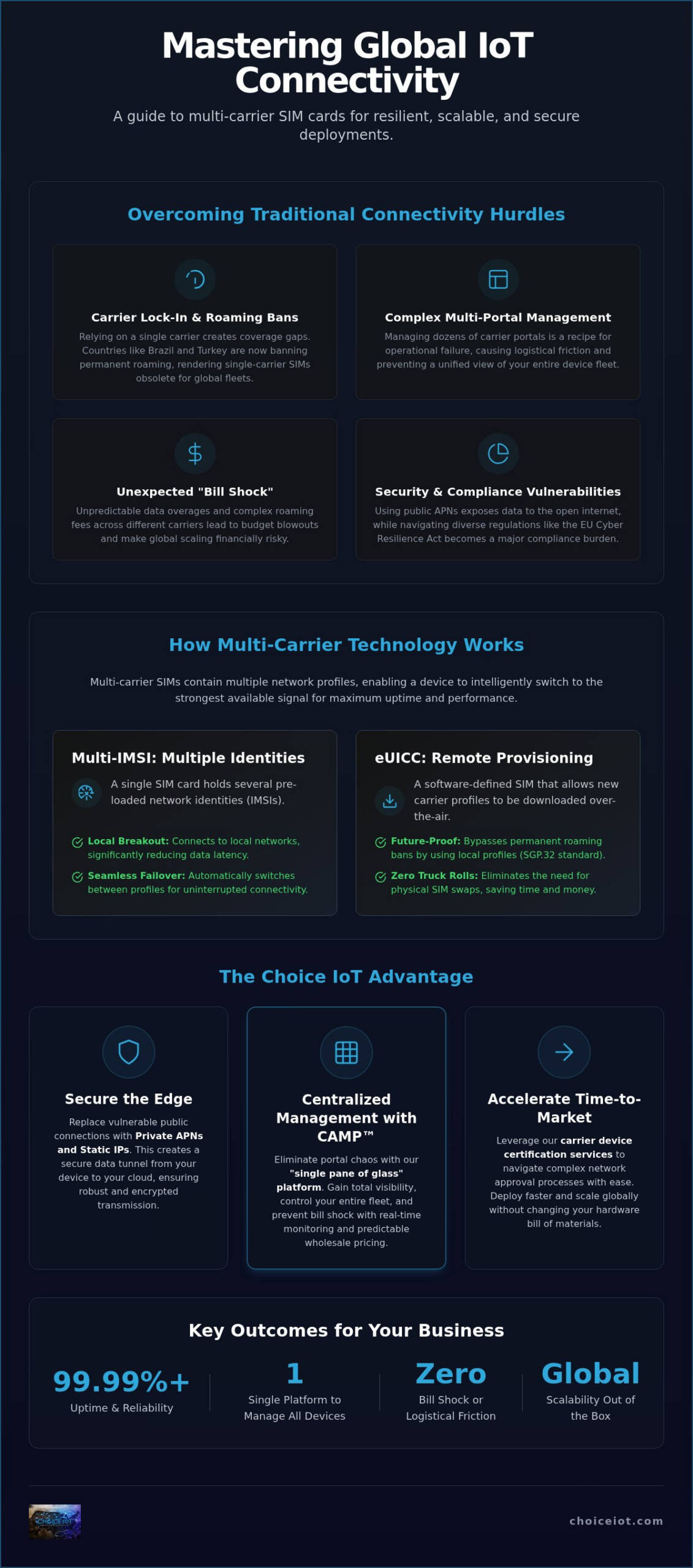
Centralized Management: Preventing Bill Shock with CAMP™
Scaling a global fleet of multi carrier iot sim cards without centralized control is an operational impossibility. Many integrators fall into what we call the “Management Mess.” This occurs when you’re forced to juggle ten or more different carrier portals simultaneously. Each portal has its own UI. Each has its own reporting lag. Each has its own billing cycle. This fragmentation leads to total operational blindness. You simply cannot manage what you cannot see in real-time. It is a recipe for inefficiency and human error. You need a unified view to maintain control.
The CAMP™ IoT Platform replaces this chaos with a single, unified interface. It provides real-time monitoring that matters. You see data consumption as it happens. Most traditional carriers provide data usage reports with a significant lag, sometimes up to 48 hours. In that window, a malfunctioning “zombie” device or a security breach can rack up thousands of dollars in overages. CAMP™ stops this through proactive thresholding and automated alerts. If a SIM exceeds its expected data limit, the system can automatically throttle or kill the connection. Instant protection. Total transparency. One platform. Total control. For a comprehensive framework on eliminating unexpected overages across your entire fleet, review this enterprise checklist to prevent IoT bill shock before your next deployment.
Managing these complexities shouldn’t be your full-time job. You need a partner that removes the friction of global connectivity. Take the first step toward a streamlined deployment by viewing the CAMP™ IoT Platform features for your next project.
Provisioning and Lifecycle Management
Efficient inventory management is the backbone of a profitable IoT business. CAMP™ allows for bulk activation and deactivation, ensuring you only pay for SIMs that are actively generating value. You can automate the transition from testing phases to production. This prevents devices from sitting in a billable state before they’ve even shipped to a customer. Tracking SIM health and connectivity history becomes a centralized function rather than a manual search. Rapid troubleshooting. Streamlined logistics. Simplified growth.
Data Usage Optimization and Reporting
Aggregated data pools are the ultimate tool for cost-efficiency. Instead of paying for individual, siloed plans, you can share data across your entire fleet. This buffers against high-usage devices and significantly lowers your overall cost per megabyte. CAMP™ provides detailed reporting for internal ROI analysis and accurate client billing. By implementing proactive thresholding across your entire fleet, the platform effectively eliminates the risk of unexpected bill shock. You gain predictable wholesale pricing and the data-driven insights needed to optimize your bottom line.
The Choice IoT Advantage for Solution Providers and VARs
Choice IoT functions as a force multiplier for your business. We are not just a vendor; we are a strategic partner for high-growth integrators. For Value-Added Resellers (VARs) and solution providers, the hardware is only one piece of the puzzle. You need an ecosystem that supports your entire business model. Our multi carrier iot sim cards provide the necessary global reach, but our value lies in removing the technical and regulatory friction that stalls deployments. We provide the infrastructure. You own the customer relationship. This white-label empowerment allows you to maintain total control over your brand and your margins.
Beyond mobile deployments, we provide the backbone for stationary enterprise needs through fixed wireless connectivity for business. This is the ideal solution for retail branch offices, pop-up locations, or secondary failover for mission-critical sites. We understand that your reputation depends on the reliability of the networks you provide. That is why we offer more than just data. We offer a foundation of quiet confidence. Our systems are built to be integrated, sophisticated, and powerful. We handle the complexities of global connectivity so you can focus on building your solution.
Streamlining Hardware Deployment
Carrier certification is often the primary bottleneck for new IoT projects. It can delay a launch by six months or more. Our Carrier Device Certification services shave months off your time-to-market by navigating the complex path to network approval on your behalf. We ensure your hardware is fully compatible with the latest 5G Redcap and LTE-M networks. Access to pre-certified modules and expert technical support reduces your R&D risk. Rapid approval. Direct paths to market. We remove the hurdles of hardware validation so your fleet hits the field faster.
Partnering for Scalability and Growth
Growth requires predictable costs and protected margins. Our wholesale pricing models are designed specifically for the needs of solution providers. We don’t compete with our partners; we empower them to scale. This partnership includes deep technical consulting for Private APN configurations and complex network architecture. If you’re managing a sophisticated deployment, you need more than a help desk. You need an authoritative expert. We recommend starting with a pilot program for your next project. It allows you to verify the performance of our multi carrier iot sim cards and the CAMP™ platform in your specific environment. Test the reliability. See the transparency. Scale with a partner that has already solved the industry’s most complex hurdles.
Master Your Global IoT Footprint
Scaling a global IoT deployment doesn’t have to be a logistical nightmare. Success depends on shifting from fragmented carrier management to a unified, secure architecture. By leveraging multi carrier iot sim cards, you eliminate regional dead zones and bypass complex roaming restrictions. You gain total control. You ensure uptime. You protect your margins. The transition from hardware-locked connectivity to software-defined agility is no longer optional; it’s the standard for 2026.
The combination of the CAMP™ IoT Platform for total visibility and carrier-grade security through Private APNs creates a foundation for limitless growth. Expert-led carrier device certification ensures your hardware hits the market months ahead of the competition. Don’t let logistical friction or “bill shock” stall your progress. You have the tools to deploy faster, manage smarter, and scale without limits. It’s time to build on a foundation of quiet confidence.
Ready to take command of your connectivity? Simplify your global deployment with Choice IoT’s multi-carrier solutions and CAMP™ platform. The future of your connectivity is automated, predictable, and fully under your control. Let’s get to work.
Frequently Asked Questions
What is the difference between a multi-carrier SIM and a roaming SIM?
Roaming SIMs are often “steered” toward specific partner networks to reduce costs for the provider, regardless of signal quality. Multi-carrier SIMs prioritize performance. They use unsteered logic to connect to the strongest available tower. This ensures your devices behave like local units on any network. Better uptime. Lower latency. Total reliability.
Can I use a multi-carrier IoT SIM card in any cellular device?
Yes, as long as the device is carrier-certified and supports the necessary frequency bands. Most multi carrier iot sim cards are available in standard form factors (2FF, 3FF, 4FF) and MFF2 embedded chips. If you’re unsure about compatibility, our carrier device certification services can help you navigate the approval process for specific networks.
How does automatic network failover work on an IoT SIM?
The SIM’s internal logic layer constantly monitors signal integrity. If the primary connection drops below a pre-set threshold or fails entirely, the SIM triggers a re-registration process. It autonomously scans for the next strongest PLMN ID and re-establishes the data session. This happens in seconds. No manual intervention required. Continuous connectivity.
Do multi-carrier SIM cards support 5G and NB-IoT?
Modern multi-carrier solutions are built for the full spectrum of cellular technology. This includes high-speed 5G, 5G Redcap for 2026 mid-tier deployments, and low-power LPWA options like LTE-M and NB-IoT. You can manage multiple technologies on a single SIM profile. Future-proof your hardware. Scale without limits.
How do I manage data usage for thousands of SIM cards at once?
Managing a massive fleet requires a centralized platform like CAMP™. It eliminates the need to log into multiple carrier portals. You get a “single pane of glass” view for real-time monitoring. Bulk provisioning. Automated alerts. Shared data pools. You see exactly what’s happening across your entire deployment instantly.
What happens to my security settings when the SIM switches carriers?
Enterprise-grade SIMs maintain persistent security protocols across every network transition. Your Private APN and Static IP configurations are mirrored across the multi-carrier fabric. This prevents security gaps during failover events. Your data remains encrypted. Your routing stays private. Security that travels with the device.
Is a Private APN required for multi-carrier deployments?
It isn’t strictly mandatory, but it’s the gold standard for industrial IoT. A Private APN isolates your traffic from the public internet. It shields your fleet from DDoS attacks and unauthorized access. For mission-critical deployments, it’s the best way to ensure secure, private data transmission across multiple carriers.
What are the costs associated with multi-network IoT connectivity?
Pricing is typically structured around a monthly subscription per active SIM plus data consumption. Most providers offer wholesale rates and shared data pools to keep costs predictable. This model protects your margins. It eliminates “bill shock” from high-usage devices. You pay for the resilience and flexibility your deployment requires.