

What if your IoT deployment scaled twice as fast but cost 30% less to maintain? Most fleet managers accept unpredictable bill shock and idle SIM fees as a necessary evil of global expansion. It isn’t. Effective iot connectivity cost optimization isn’t about finding the cheapest data rate. It’s about engineering a system that eliminates waste before it happens. You’re likely tired of managing fragmented carrier contracts and logistically draining portals. You want visibility. You need control. Total transparency. Zero friction.
We’ve designed this strategic guide to help you move beyond reactive management. You’ll learn the exact technical steps to automate usage alerts, leverage data pooling, and utilize the CAMP™ platform for a single pane of glass view. We’ll show you how to transition to 5G Redcap and private APNs to secure your traffic and stabilize your budget. By the end of this article, you’ll have a clear roadmap to predictable billing and a high-performance fleet that’s ready for the demands of 2026. Let’s build a more efficient foundation for your global operations.
Key Takeaways
- Master iot connectivity cost optimization by balancing data consumption, power management, and security to eliminate unpredictable bill shock.
- Conduct a thorough fleet audit to identify zombie SIMs and align your actual data throughput with historical billing.
- Deploy Private APNs to filter out non-essential internet noise and prevent unauthorized pings from inflating your data usage.
- Centralize global operations through a single pane of glass to automate provisioning and reduce the overhead of manual SIM management.
- Utilize the CAMP™ platform to gain real-time visibility and maintain flexible margins as you scale your IoT deployments.
The Hidden Drivers of IoT Connectivity Costs in 2026
In 2026, iot connectivity cost optimization is the difference between a profitable deployment and a financial drain. It’s a delicate triad. Data. Power. Security. If one is out of sync, the entire budget collapses. Many integrators suffer from “bill shock” because they apply consumer-grade cellular logic to M2M environments. Machines don’t have human restraint. They transmit until the battery dies or the budget breaks. Standard plans lack the granular control required to manage thousands of autonomous endpoints.
Unoptimized firmware is a leading cause of inflated IoT SIM pricing. These “chatty devices” initiate constant, unnecessary sessions. They ping servers without reason. They retry failed connections with aggressive frequency. This isn’t just a technical glitch; it’s a financial leak. When combined with the operational waste of managing multiple carrier portals, the costs skyrocket. Friction is expensive. Fragmented visibility leads to idle SIMs that continue to draw monthly access fees long after their project ends.
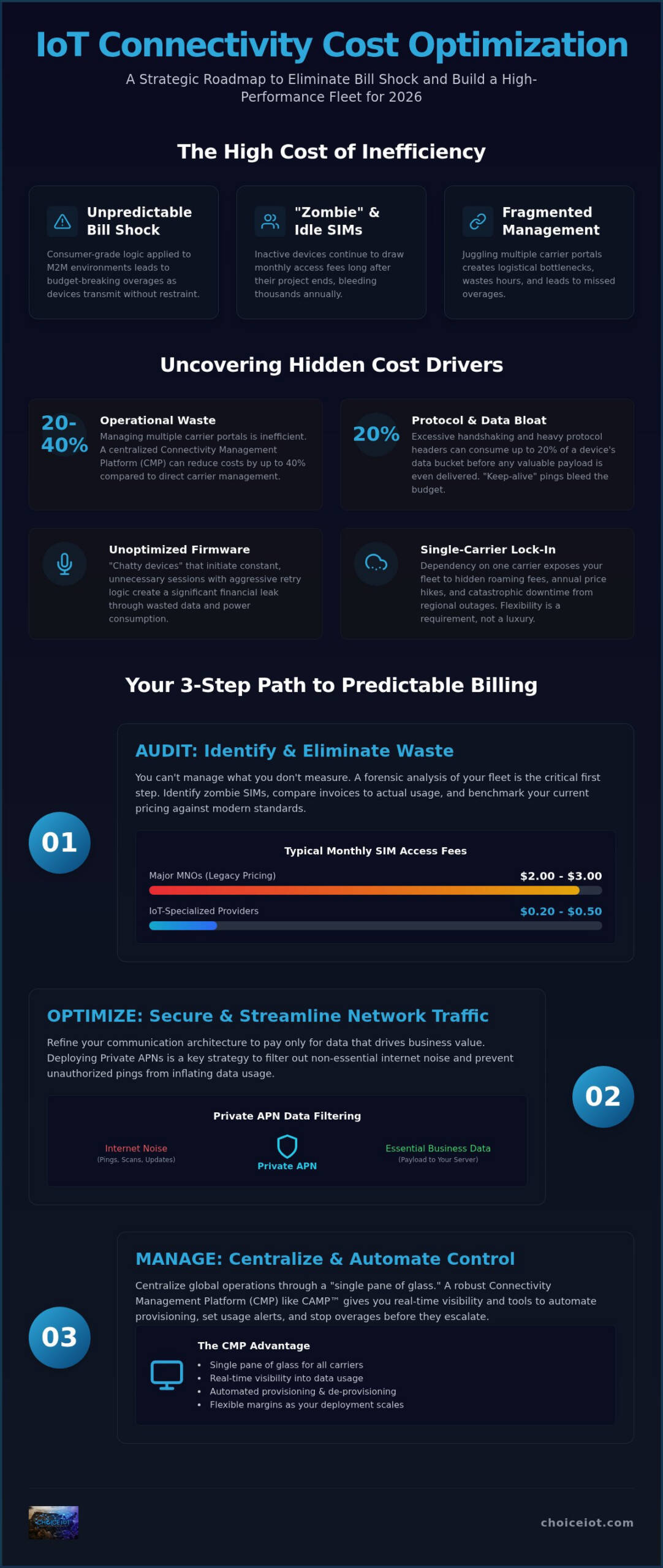
Operational fragmentation is the silent killer of ROI. Managing separate portals for different carriers creates a logistical bottleneck. Your team loses hours reconciling invoices and monitoring usage across inconsistent interfaces. Centralized visibility is the only way to catch overages before they escalate. Industry reports indicate that using a Connectivity Management Platform (CMP) can reduce costs by 20% to 40% compared to direct carrier management. With 22.4 billion devices projected to be online by late 2026, manual oversight is no longer an option.
Data Overhead and Protocol Inefficiency
Every packet has a price. Excessive handshaking and heavy protocol headers can consume up to 20% of a low-data device’s monthly bucket before a single piece of actual payload is delivered. Frequent “keep-alive” pings maintain the connection but bleed the budget. Refining your communication architecture is essential. Implementing MQTT or CoAP optimization directly impacts your bottom line by stripping away protocol bloat and ensuring you only pay for the data that drives business value.
The True Cost of Single-Carrier Lock-In
Dependency is a liability. Relying on a single carrier exposes your fleet to hidden roaming charges when devices move across network zones. You lose all leverage. Without a multi-carrier alternative, you’re at the mercy of annual price hikes and regional outages. A single network failure can lead to catastrophic operational downtime. True optimization requires the flexibility to switch paths. This ensures your devices stay online and your costs remain competitive regardless of carrier shifts. High performance. Total control. Seamless integration.
Step 1: Auditing Your IoT Fleet for Data Inefficiencies
You can’t manage what you don’t measure. Forensic analysis is the prerequisite for iot connectivity cost optimization. Start by establishing a rigorous cost baseline. Compare your historical invoices against actual data throughput reported by your devices. Discrepancies are common; they almost always favor the carrier. If your billing says 500MB but your logs show 350MB, you’re paying for “ghost” data or inefficient session management. Identify the gap. Close it.
The next priority is hunting for “Zombies.” These are SIM cards that remain active in the field but transmit zero meaningful business data. They are dead weight. In a large scale deployment, even a small percentage of idle SIMs can bleed thousands of dollars annually through recurring access fees. Once identified, segment your fleet by usage profile. Categorize them. Low-data sensors utilizing NB-IoT or LTE-M shouldn’t share a cost structure with high-bandwidth 5G gateways. Each profile requires a tailored rate plan to ensure you aren’t overpaying for capacity you’ll never use.
Benchmarking is essential for 2026. Industry data shows that while major MNOs often charge $2 to $3 per SIM in monthly access fees, IoT-specialized providers have driven those costs down to $0.20 to $0.50. If your current contracts reflect 2023 pricing, you’re leaving margin on the table. Aligning your fleet with modern standards ensures your operational expenses scale linearly, not exponentially.
Visualizing Data Consumption Patterns
Static reports aren’t enough. Use heatmaps to identify peak usage times and unexpected spikes. If a subset of devices consumes 10x the fleet average, investigate the root cause immediately. Is it a firmware loop? A security breach? Correlating data usage with device location or environmental factors helps you predict future costs. It transforms your strategy from reactive to proactive. High-performance visibility stops minor glitches from becoming major financial liabilities.
Analyzing Plan Alignment
Stop paying for “safety margins.” Carriers encourage over-provisioning because it’s pure profit for them. Transition to data pooling. Shared buckets allow high-usage devices to be offset by low-usage ones, mitigating individual overage penalties. It’s a mathematical hedge against volatility. Evaluate your current usage to find the threshold where switching from fixed to dynamic rate plans yields the highest ROI. Utilizing a centralized connectivity management platform makes this audit process continuous and automated, ensuring you never drift back into inefficiency.
Step 2: Optimizing Network Architecture with Private APNs
Architectural design is the silent engine of iot connectivity cost optimization. Most deployments fail to account for the “internet noise” that plagues devices on public Access Point Names (APNs). Every botnet scan and unauthorized ping from the open web consumes data. It adds up. A Private APN creates a secure, walled garden. It ensures your devices only communicate with your authorized servers. This eliminates the data waste caused by non-essential traffic and unauthorized external requests. You stop paying for the background chatter of the public internet.
Traffic segmentation is a powerful tool for managing IoT data costs. By isolating your machine-to-machine (M2M) traffic, you gain granular control over exactly what enters and exits your network. Static IP addresses further enhance this efficiency. They provide consistent reachability and reduce the heavy data overhead associated with frequent IP renegotiations and reconnection handshakes. This stability is vital for high-availability fleets where every byte saved on overhead is a byte earned in margin. Total transparency. Maximum control. No waste.
Security as a Cost-Saving Measure
Security is often viewed as an expense, but in IoT, it’s a primary cost-saving measure. Publicly reachable devices are magnets for malware and automated scans. These attacks can trigger massive data overages, resulting in catastrophic bill shock that can bankrupt a project overnight. A Private APN removes your devices from the public eye. You don’t just protect your data; you protect your budget. This architecture also reduces the need for resource-heavy, on-device security software that drains both power and data. Simplified troubleshooting means your engineering team spends fewer hours chasing phantom traffic spikes. Efficiency is built-in.
Leveraging 5G Redcap for Medium-Speed Efficiency
5G Redcap (Reduced Capability) is the “sweet spot” for industrial IoT in 2026. Standard 5G is often overkill for sensors and trackers; it’s expensive and power-hungry. 5G Redcap is the cost-effective bridge between LTE-M and full 5G. It provides the latency and longevity advantages of the 5G ecosystem without the high hardware and connectivity price tags. Compared to standard 5G, Redcap devices utilize simpler antennas and lower bandwidth, significantly reducing power consumption and data waste. It is the strategic choice for fleets that require more performance than narrowband can offer but cannot justify the premium of high-speed 5G. Performance meets profitability.
Step 3: Implementing Real-Time Management via a CMP
Visibility is the foundation of control. Without a Connectivity Management Platform (CMP), you’re flying blind. A centralized “Single Pane of Glass” is non-negotiable for iot connectivity cost optimization. It consolidates every device, every carrier, and every data byte into one interface. This removes the logistical friction of jumping between disparate carrier portals. You gain total transparency. Real-time oversight becomes your primary defense against budget creep. It’s about seeing the problem before the bill arrives.
Manual SIM activation is a relic. It’s a waste of high-value engineering hours. Automated provisioning allows you to deploy thousands of units with a single click. This reduces the human cost of lifecycle management and ensures SIMs are only active when they’re generating value. Remote lifecycle management lets you pause or deactivate idle units instantly. No field visits required. No logistical delays. You maintain total command over your SIM fleet from a single workstation.
The Power of Automated Usage Triggers
Stop overages before they happen. Configure automated usage triggers to act as digital “kill switches.” If a device exceeds 150% of its monthly quota, the system should automatically suspend it or alert your team immediately. This prevents a single malfunctioning device from sabotaging your monthly budget. You can also automate plan upgrades. If a high-usage device is consistently hitting its limits, the CMP can move it to a larger data pool mid-cycle. Integrating this data with your ERP ensures transparent billing and accurate cost allocation across your entire organization.
Centralized Multi-Carrier Control
Carrier lock-in is a choice, not a necessity. A robust CMP allows you to switch carriers remotely without physical SIM swaps. This flexibility is essential for maintaining competitive rates as your fleet grows. You can consolidate invoices from multiple providers into a single, unified view. This simplifies accounting and clarifies your total cost of ownership. Learn how multi-carrier IoT SIM cards simplify global scaling to maximize your network resilience and eliminate regional coverage gaps.
Take total control of your fleet today. Explore how the CAMP™ platform streamlines your IoT management and eliminates logistical friction.
Scaling Sustainably with Choice IoT’s CAMP™ Platform
Mastering iot connectivity cost optimization requires more than just better habits. It requires a high-performance engine designed for the channel. Choice IoT’s CAMP™ platform is that engine. Built specifically for VARs and integrators, CAMP™ transforms connectivity from a logistical headache into a scalable revenue stream. It provides the visibility you need to eliminate waste and the flexibility to protect your margins. You gain total command over your global footprint through a single, intuitive interface.
The partner-first approach is central to the Choice IoT philosophy. We don’t just provide SIMs; we provide a foundation for your brand. White-labeling capabilities allow you to maintain ownership of the customer relationship while leveraging our infrastructure. Flexible margins ensure your business remains profitable as you scale. Our carrier device certification services further accelerate your ROI by removing the technical hurdles that typically delay deployment. We handle the complexity. You focus on growth. Speed is your new competitive advantage.
Navigating the transition to 5G Redcap and Private APNs is a significant hurdle for many providers. Choice IoT simplifies this journey. We act as your strategic guide, ensuring your hardware is optimized for the latest network standards without the typical trial-and-error costs. You get the performance of the 5G ecosystem with the cost profile of a mid-tier solution. Total transparency. Maximum efficiency. Zero friction.
Designed for Solution Providers and VARs
Scaling a global fleet shouldn’t mean managing a dozen different vendors. Choice IoT consolidates your requirements through a single strategic partner. Our customized data pooling grows with your customer base, ensuring you never pay for unused capacity. We offer expert technical support to help you optimize device firmware for maximum network efficiency. This reduces unnecessary chatter and extends device longevity. Your success is our primary metric.
Future-Proofing Your IoT Investment
The technology landscape is shifting rapidly. 2G and 3G networks are disappearing globally. 5G Redcap is emerging as the new standard for industrial efficiency and longevity. Choice IoT keeps you ahead of these sunsets and technology shifts. Our platform provides scalable security features that evolve alongside global regulatory requirements like the EU Cyber Resilience Act. You don’t just deploy for today; you build for the demands of 2026 and beyond. Optimize your IoT connectivity costs with Choice IoT today. Take control of your fleet. Secure your margins. Scale with confidence.
Secure Your Margins for the Next Generation of IoT
Precision. Visibility. Total control. Mastering iot connectivity cost optimization isn’t a one-time event; it’s a continuous operational standard. By auditing your fleet for inefficiencies and deploying Private APNs to silence internet noise, you’ll transition from reactive damage control to proactive financial management. You stop paying for “ghost” data. You start paying for performance. Control is the only way to scale without compromise.
Choice IoT provides the tools to make this transition seamless. Our CAMP™ platform delivers the centralized visibility required to manage global fleets with total confidence. You get real-time usage alerts to kill overages, multi-carrier redundancy to ensure uptime, and Private APN security to protect your budget from external threats. Efficiency is built into every layer of our infrastructure. It’s time to remove the friction from your operations and focus on building your business.
Start optimizing your IoT fleet with the CAMP™ Platform. Your road to predictable billing and high-performance scaling begins here. Let’s build a more efficient future together.
Frequently Asked Questions
What is the most effective way to reduce IoT data overages?
Data pooling is the most effective method for eliminating overage penalties. It allows high-usage devices to draw from a shared bucket of data, offset by low-usage units in the same fleet. This mathematical hedge ensures you aren’t penalized for individual outliers. Using a platform like CAMP™ adds another layer of protection through real-time usage alerts. You see the spike before it becomes a financial liability. Proactive. Efficient. Profitable.
How much can a Connectivity Management Platform (CMP) actually save me?
Industry data from March 2026 indicates that a CMP can reduce costs by 20% to 40% compared to direct carrier management. These savings stem from reduced labor hours and automated SIM lifecycle management. You stop paying for “zombie” SIM cards that sit idle in the field. Centralization is the cornerstone of iot connectivity cost optimization. It turns fragmented logistical chaos into a streamlined, high-performance operation.
Does a Private APN increase or decrease my overall IoT costs?
A Private APN significantly decreases your overall costs by filtering out unauthorized traffic. Publicly reachable devices are hit by constant “internet noise” and botnet scans that consume data. Each ping adds to your bill. A Private APN creates a secure garden where only essential traffic passes. You don’t just protect your data; you protect your budget. No waste. No surprises.
What is 5G Redcap and should I use it for my IoT deployment?
5G Redcap (Reduced Capability) is a mid-tier connectivity standard designed for devices that need more speed than LTE-M but don’t require full 5G. It’s the cost-effective bridge for 2026 deployments. Hardware costs are lower and power consumption is significantly reduced. It’s ideal for video surveillance or industrial sensors where efficiency is paramount. High performance at a lower price point.
How do I manage IoT connectivity costs across multiple international carriers?
Use a “single pane of glass” platform to manage multiple carriers from one interface. Fragmented billing is a logistical drain on your engineering and accounting teams. A multi-carrier SIM paired with a CMP like CAMP™ allows you to consolidate invoices and monitor global usage in real time. You maintain total visibility without switching between dozens of portals. Simplify your stack. Scale your fleet.
What is ‘bill shock’ in IoT and how can I prevent it?
Bill shock is the sudden discovery of massive, unexpected overage charges on your monthly invoice. Prevent it by implementing automated “kill switches” and real-time usage triggers. If a device exceeds a set threshold, the system pauses it immediately. This stops a malfunctioning firmware loop from draining your bank account. Total transparency. Zero friction.
Is a Static IP necessary for cost optimization in M2M communication?
A Static IP is a critical tool for iot connectivity cost optimization in high-availability environments. It provides consistent reachability and eliminates the data overhead of frequent IP renegotiations. Without it, devices waste megabytes on reconnection handshakes. It stabilizes your connection and your budget simultaneously. Efficiency by design. Consistent performance.
Can I switch IoT data plans mid-month to avoid overage charges?
Yes, a flexible CMP allows you to move high-usage devices to larger data pools mid-cycle. This prevents individual units from triggering expensive overage rates. You don’t have to wait for the next billing cycle to adjust your strategy. Real-time plan alignment ensures you’re always on the most cost-effective tier. Adaptable. Scalable. Smart.