

The most reliable fiber connection might be the one you never have to dig for. For years, enterprises accepted six-month lead times and six-figure trenching costs as the necessary price of high-speed access. You know the frustration of waiting on local permits while your operations sit in a connectivity vacuum. It’s a bottleneck that stunts growth. It drains budgets. It stops progress.
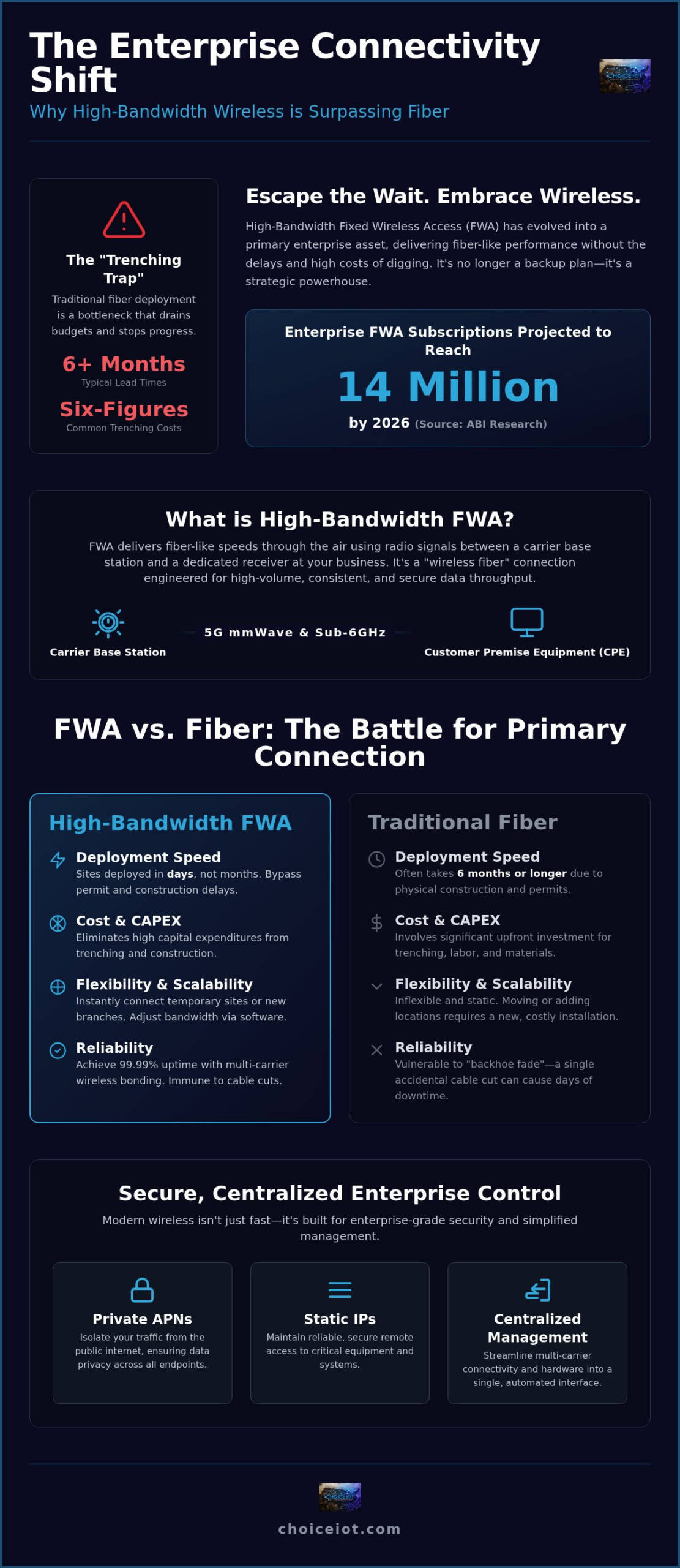
This guide proves that high bandwidth fixed wireless has evolved into a primary enterprise asset that rivals fiber for speed and reliability. By 2026, with enterprise subscriptions reaching 14 million according to ABI Research, this technology is no longer just a rural backup plan. It’s a strategic powerhouse. We’ll show you how to achieve fiber-like performance with rapid deployment and total centralized control. You’ll learn how to leverage 5G RedCap, private APNs, and multi-carrier redundancy to secure sensitive data while streamlining your entire wireless infrastructure. The era of waiting for the trench is over; the future of enterprise connectivity is agile, secure, and ready now.
Key Takeaways
- Evaluate how high bandwidth fixed wireless matches fiber’s performance while bypassing the costs and delays of traditional trenching.
- Identify the specific spectrum and 5G Redcap standards that ensure consistent, enterprise-grade throughput for stationary locations.
- Secure your network with Private APNs and Static IPs to maintain data privacy and reliable remote access across all endpoints.
- Streamline operations by centralizing multi-carrier connectivity and hardware management into a single, automated interface.
- Compare speed, latency, and reliability benchmarks to determine if FWA or fiber is the optimal fit for your 2026 deployment goals.
What is High Bandwidth Fixed Wireless Access (FWA)?
High bandwidth fixed wireless delivers fiber-like speeds through the air. It utilizes radio signals to transmit data between two stationary points; typically a carrier base station and a dedicated receiver at your business location. Unlike the mobile broadband used for smartphones, enterprise-grade FWA is engineered for high-volume, consistent data throughput. It provides a dedicated lane for your traffic. No congestion. No shared consumer bottlenecks. Just raw, symmetrical performance.
The “High Bandwidth” designation represents a massive leap over legacy wireless. We are no longer talking about simple failover or basic connectivity. Modern high bandwidth fixed wireless systems now deliver 1Gbps+ speeds, effectively matching the performance of high-end fiber optics. 2026 marks the definitive turning point for this technology. According to ABI Research, enterprise FWA subscriptions are expected to reach 14 million this year. This surge is driven by the maturity of 5G mmWave and Sub-6GHz spectrum, which provide the capacity required for data-heavy applications like real-time cloud analytics and high-definition video conferencing.
Fixed wireless technology serves as the high-performance bridge for businesses that need immediate, scalable infrastructure without the physical constraints of a wired network.
The Core Components of an FWA System
An enterprise FWA deployment relies on two primary hardware elements. First, the carrier operates stationary base stations, often mounted on towers or rooftops. Second, your facility uses a specialized client receiver, known as Customer Premise Equipment (CPE). This receiver is professionally aligned to the base station to ensure maximum signal integrity. To maintain bandwidth consistency, these systems often utilize licensed spectrum, which protects your connection from the interference common in public Wi-Fi bands. Essentially, high bandwidth fixed wireless acts as a “wireless fiber” alternative that provides the stability of a physical cable with the agility of a radio wave.
Why Enterprises are Moving Away from Wired Infrastructure
The primary driver for the shift toward wireless is the “Trenching Trap.” Traditional fiber installations often involve high capital expenditures and lead times that can stretch to six months or longer. Waiting for municipal permits and construction crews is a luxury modern enterprises can’t afford. High bandwidth fixed wireless eliminates these hurdles. Consider these advantages:
- Rapid Deployment: You can set up multi-gigabit sites in days rather than months.
- Total Flexibility: Easily deploy connectivity to temporary sites, warehouses, or new branch offices.
- Software-Defined Scalability: Adjust your bandwidth through a management interface without waiting for a hardware overhaul or a new physical line.
Wireless infrastructure offers a level of control that wired connections simply cannot match. It removes the friction of physical deployment. It empowers your IT team to move at the speed of your business.
High Bandwidth Fixed Wireless vs. Fiber, Satellite, and Cable
Choosing between connectivity types is no longer a matter of “wireless or wired.” It’s a matter of strategy. For 90% of standard business applications, modern 5G-powered high bandwidth fixed wireless matches fiber’s performance point-for-point. While fiber remains the gold standard for massive data centers, FWA provides the agility that distributed enterprises need. It’s about removing the physical constraints that slow you down. It’s about speed without the trench.
Reliability profiles are shifting too. Fiber is vulnerable to “backhoe fade.” One accidental cable cut can take a site offline for days. FWA faces line-of-sight challenges, but these are easily mitigated. Professional site surveys. Multi-carrier redundancy. This is how you win. The FCC guide to broadband technologies highlights how wireless options have become essential for modern infrastructure. It’s a reliable, terrestrial alternative that bypasses the risks of underground construction.
FWA vs. Fiber: The Battle for the Primary Connection
In 2026, the gap in symmetrical performance is closing. High-end FWA deployments now offer the upload speeds required for heavy cloud uploads and synchronized backups. By utilizing multi-carrier wireless bonding, businesses are achieving 99.99% uptime without laying a single foot of glass. For a deeper dive into these technical benchmarks, see our Fixed Wireless for Business: 2026 Enterprise Guide. It’s the blueprint for primary wireless adoption.
FWA vs. Satellite: Why Low Earth Orbit (LEO) isn’t always enough
Low Earth Orbit (LEO) satellite services have improved, but they still struggle with terrestrial latency. Fixed wireless maintains a direct, localized path to the tower. This results in significantly lower ping times, which is critical for VoIP and real-time ERP systems. Weather resilience is another factor. While heavy rain can degrade satellite signals, high bandwidth fixed wireless utilizes robust frequencies designed to penetrate adverse conditions. You also avoid the “bill shock” associated with satellite data caps. FWA offers predictable, enterprise-grade usage tiers.
The cost analysis is clear. Fiber requires heavy CapEx for trenching and permits. FWA is an OpEx-friendly model. You trade months of construction for days of configuration. This deployment speed is a non-negotiable advantage for retail pop-ups, construction sites, and rapid expansions. If you need to scale without the wait, evaluating Fixed Wireless Connectivity is the logical next step for your infrastructure.
Technical Pillars of Enterprise-Grade Wireless Bandwidth
Technical superiority is the bedrock of high bandwidth fixed wireless. It isn’t just about the radio; it’s about the strategic use of spectrum. Sub-6GHz bands provide the wide-area reliability needed for suburban and rural branches. Millimeter Wave (mmWave) serves as the performance engine. It delivers the gigabit-plus speeds that allow FWA to replace fiber in dense urban environments. By combining these bands through carrier aggregation, enterprises access a massive, unified data pipe that adapts to environmental conditions in real time.
Network slicing adds the final layer of enterprise control. In a standard cellular environment, your data often competes with consumer traffic. Slicing changes the math. It creates a virtual, private lane specifically for your business applications. This guarantees throughput. It ensures your ERP remains responsive during peak hours. It provides the “quiet confidence” that your mission-critical traffic will never be throttled by local network congestion.
Optimizing Throughput with 5G Redcap
5G Redcap (Reduced Capability) is the strategic middle ground for 2026 deployments. It balances power consumption, hardware cost, and speed for high-density deployments. While mmWave handles the massive data loads, Redcap provides a cost-effective bridge between legacy LTE and full-spec 5G for mid-tier IoT and FWA applications. It’s optimized for efficiency. It’s the future of “middle-mile” connectivity. This standard allows businesses to scale their wireless footprint without the high overhead of top-tier 5G modems, making it the ideal choice for massive sensor networks or secondary branch connections.
Ensuring Low Latency for Real-Time Data
Speed means nothing without low latency. Multi-access Edge Computing (MEC) moves data processing to the network’s edge, significantly reducing the physical distance data must travel. The result is near-instantaneous response times. This makes high bandwidth fixed wireless a viable foundation for high-frequency trading, telehealth, and industrial automation. Hardware certification is the final piece of the puzzle. By using carrier-certified devices, you ensure your modems are perfectly tuned for specific carrier bands. It removes the guesswork. It guarantees peak performance. It provides the streamlined simplicity that IT directors demand for their global deployments.
The combination of these technologies creates a system that is sophisticated, powerful, and ready for immediate integration. It isn’t just a wireless connection. It’s a high-performance engine for your business growth.
Securing and Managing High Bandwidth Deployments
Managing high bandwidth fixed wireless requires a shift from passive monitoring to active governance. High speed is useless if the connection is vulnerable. Security at the edge protects your endpoints from DDoS attacks and unauthorized access attempts. It ensures that your high-performance network remains available only to those who need it. Centralized visibility is the second pillar. You need real-time data on consumption to identify anomalies before they become security breaches or financial burdens. It’s about total control. It’s about total transparency.
Security at the edge isn’t an optional add-on. It’s the foundation. By isolating traffic at the hardware level, you prevent threats from ever reaching your core network. This proactive stance allows your IT team to focus on growth rather than constant troubleshooting. It turns your wireless infrastructure into a fortified asset.
The Necessity of Private APNs and Static IPs
Security starts with invisibility. A Private APN creates a secure, private tunnel over the public cellular infrastructure. It effectively hides your data from the public internet. This bypasses the common vectors used by hackers to exploit IoT and FWA devices. For large-scale integrators, Static IP Addresses are equally vital. They provide a permanent, non-negotiable anchor for remote access and VPN tunnels. This simplifies device management across thousands of endpoints. It removes the friction of dynamic IP changes that can break critical business links. For a deeper look at how to orchestrate these features, read our IoT Connectivity Management Platform: The 2026 Strategic Guide.
Preventing ‘Bill Shock’ in High-Bandwidth Environments
High-speed connectivity can lead to high-speed costs if left unmanaged. You need automated safeguards. AI-driven alerts notify your team the moment a data threshold is breached. This isn’t just about saving money. It’s about operational intelligence. Automated provisioning and de-provisioning allow your network to scale based on actual usage patterns. If a site goes dormant, the system should reflect that. Multi-carrier redundancy also plays a strategic role here. It allows you to switch carriers based on local performance or cost-efficiency, ensuring you never pay for sub-par service. For enterprises that cannot afford downtime, a purpose-built enterprise fixed wireless backup strategy for 100% uptime ensures your multi-carrier redundancy eliminates every single point of failure. This level of granular control is what defines a modern enterprise deployment.
Total control. Streamlined simplicity. These aren’t just goals; they are the standard for any organization deploying high bandwidth fixed wireless. If you are ready to secure your edge, exploring a Private APN solution is the most effective way to protect your business traffic today.
Scaling with Choice IoT: The Future of Managed Connectivity
Scaling an enterprise network across multiple regions requires more than just hardware. It requires a unified strategy. Choice IoT provides the essential foundation for high bandwidth fixed wireless deployments by removing the friction of multi-carrier management. We move beyond simple connectivity. We offer a high-performance engine designed for scalability, optimization, and cost-effectiveness. Our approach assumes your business needs total control without the administrative overhead of managing separate carrier contracts. It is about streamlined simplicity. It is about empowering your growth.
Every business outcome is unique. That is why we reject one-size-fits-all connectivity. We specialize in custom data plans tailored to specific enterprise requirements. Whether you are supporting a high-density retail environment or a remote industrial site, your data plan should reflect your actual usage patterns. We provide the flexibility to adjust these plans as your needs evolve. This ensures you only pay for the bandwidth you use while maintaining the high-speed access your operations demand. It is a growth-centric model that prioritizes your bottom line.
Total Control via the CAMP™ Platform
The CAMP™ IoT Platform is the heartbeat of our managed service. It centralizes every high bandwidth fixed wireless endpoint into a single, intuitive interface. You get real-time monitoring and reporting for every deployment. You see the data usage. You identify trends. You act. This centralized visibility allows for automated provisioning and de-provisioning, ensuring your network remains agile. Our streamlined billing model eliminates administrative friction, allowing your team to focus on high-level strategy rather than invoice reconciliation. For resellers, our white-label options provide the power to own the customer relationship while leveraging our robust, behind-the-scenes infrastructure.
Getting Started with Enterprise Fixed Wireless
Implementation begins with a precise assessment of your site for 5G coverage. We don’t guess; we verify. By selecting the right hardware and carrier mix, we ensure maximum uptime for your mission-critical applications. Choice IoT handles the carrier device certification and end-to-end technical support, ensuring your modems are perfectly tuned for the specific frequencies in your area. This partner-first approach empowers VARs and integrators to scale their offerings with quiet confidence. We handle the technical complexities of the carriers so you can focus on delivering value to your clients.
The transition to wireless infrastructure is a strategic move toward total operational control. It removes the physical barriers of the trench. It replaces long lead times with rapid, secure deployment. If you are ready to eliminate the wait for fiber, Scale your business with Choice IoT’s Fixed Wireless Solutions and take command of your enterprise connectivity today.
Future-Proof Your Enterprise Infrastructure
The choice between waiting for fiber and moving at the speed of business is clear. High bandwidth fixed wireless has proven itself as the primary connectivity standard for 2026. It delivers the gigabit performance you need without the logistical nightmare of construction. You gain rapid deployment. You ensure total security through Private APNs. You maintain absolute control over your data. Trenching is a relic of the past; agile connectivity is the standard of the present.
Scaling your operations doesn’t have to be a complex burden. By centralizing your management, you eliminate the friction of multiple carrier relationships. You secure your edge. You empower your team. Choice IoT provides the essential foundation for this transition. We offer the CAMP™ IoT Platform for 24/7 visibility and multi-carrier redundancy across all major networks. Our expert technical support ensures that integrators and VARs always have the specialized guidance they need to succeed. Stop letting permits dictate your growth schedule. Take command of your connectivity and build a network that is as powerful as your organization.
Partner with Choice IoT for high-performance fixed wireless and start deploying today.
Frequently Asked Questions
Can high bandwidth fixed wireless replace my business fiber connection?
Yes, for the majority of enterprise applications, high-performance fixed wireless is a viable primary connection. Modern 5G infrastructure matches fiber speeds and latency for 90% of business tasks, providing a reliable terrestrial alternative that bypasses the long lead times of wired construction. It offers the same stability as a physical cable with significantly more deployment agility.
What is the typical latency for enterprise fixed wireless access?
Typical latency for 5G-powered fixed wireless falls between 20ms and 30ms. This performance level is more than sufficient for mission-critical real-time applications, including VoIP, video conferencing, and cloud-based ERP systems. When utilizing millimeter wave spectrum, latency can drop even lower, rivaling the responsiveness of local fiber loops.
How does weather affect high bandwidth fixed wireless performance?
Modern high bandwidth fixed wireless is engineered to maintain signal integrity during adverse weather conditions. Unlike satellite connections that rely on signals traveling through the entire atmosphere, FWA uses terrestrial towers and high-gain antennas. Professional installation ensures that your equipment is properly aligned and shielded to prevent rain fade or signal degradation during storms.
Is fixed wireless access secure enough for financial or healthcare data?
Enterprise fixed wireless is highly secure when deployed with a Private APN and Static IP addresses. This configuration effectively removes your traffic from the public internet, creating a private tunnel for your data. It meets the strict security and compliance standards required for sensitive financial or healthcare transmissions by isolating your network from public cellular users.
What is the difference between fixed wireless and a mobile hotspot?
Fixed wireless is a permanent, high-performance installation designed for consistent throughput at a specific location. Mobile hotspots are transient consumer tools that lack the specialized hardware and high-gain antennas required for enterprise stability. FWA uses dedicated Customer Premise Equipment (CPE) that is professionally tuned to a specific carrier base station for maximum reliability.
How long does it take to deploy a high-bandwidth FWA site?
Deployment typically occurs within days rather than the months required for fiber. Since FWA requires no trenching or municipal permits for underground construction, you can have a site live as soon as the hardware is installed and configured. This makes it the ideal solution for rapid expansions, temporary sites, or retail pop-ups.
Do I need a Private APN for my fixed wireless deployment?
A Private APN is essential for any enterprise that values security and centralized control. It provides an “invisible” network layer that protects your endpoints from external threats and DDoS attacks. It also allows your IT team to manage all wireless endpoints through a single interface, ensuring consistent security policies across every location.
What are the typical speeds for 5G fixed wireless in 2026?
In 2026, high bandwidth fixed wireless frequently delivers speeds of 1Gbps or higher in urban environments. Typical enterprise plans range from 100 Mbps to multi-gigabit performance depending on the available spectrum. These benchmarks ensure that your wireless infrastructure can handle the massive data loads required by modern, cloud-centric business operations.