

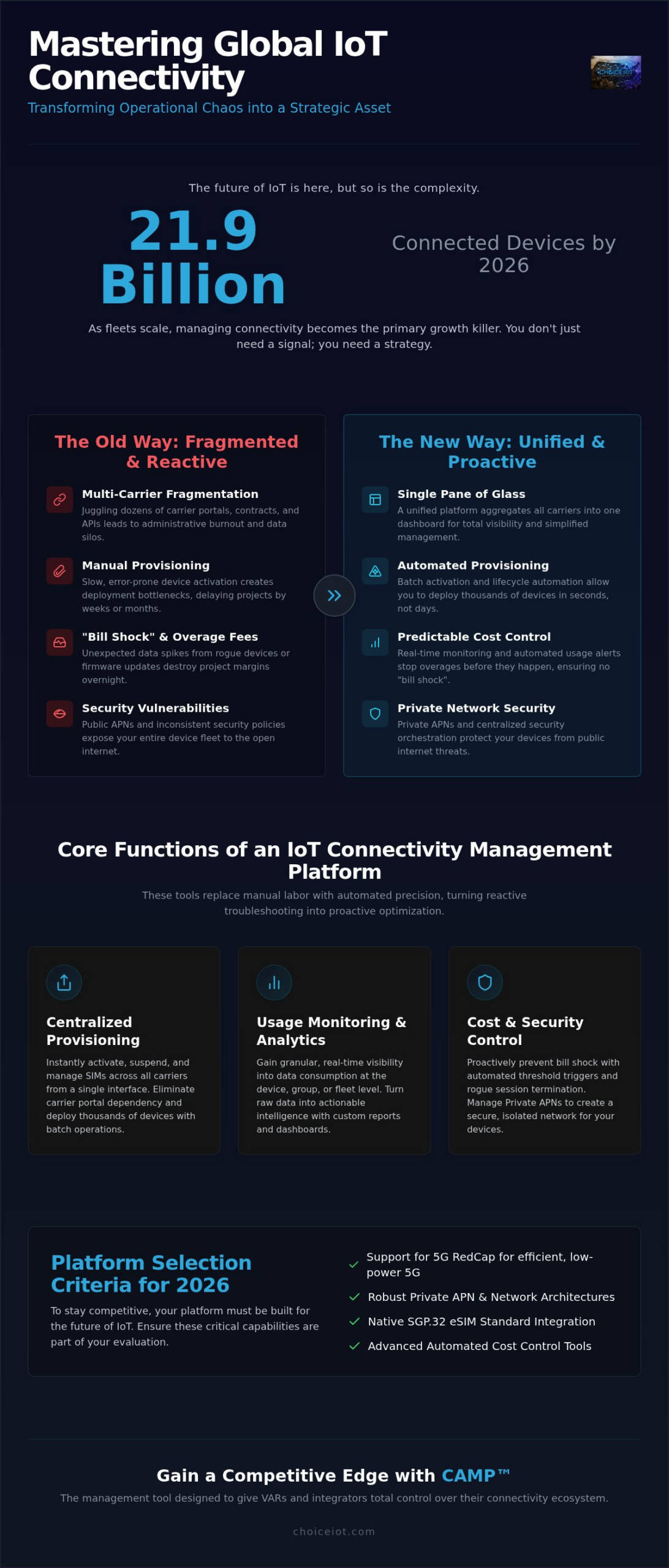
Scaling to 21.9 billion connected devices by the end of 2026 means connectivity is no longer your biggest hurdle; it’s the sheer chaos of managing it. Fragmented carriers. Unexpected data overage charges. Security vulnerabilities in public APNs. These aren’t just technical glitches. They’re growth killers. You need more than a signal. You need a strategy. Deploying a robust iot connectivity management platform is the only way to transform a sprawling network into a high-performance asset.
We understand the pressure to scale without the friction of manual provisioning or the sting of “bill shock.” It’s a common frustration for enterprise leaders who demand total visibility and reliable control. This strategic guide provides the blueprint to master global IoT complexities through a centralized management framework. You’ll learn how to eliminate logistical stress and streamline multi-carrier deployments with ease. We’ll explore the impact of the SGP.32 eSIM standard, the necessity of private network architectures, and the automated tools that keep your overhead predictable and your deployments secure.
Key Takeaways
- Master the transition from small-scale pilots to massive IoT fleets by solving the multi-carrier fragmentation crisis.
- Deploy devices in seconds rather than days using a robust iot connectivity management platform built for automated provisioning.
- Identify the critical 2026 selection criteria for platforms, including essential support for 5G Redcap and Private APN architectures.
- Shift from reactive firefighting to proactive cost control with real-time monitoring that eliminates bill shock.
- Gain a competitive edge with CAMP™, the management tool designed to give VARs and integrators total control over their connectivity ecosystem.
The Complexity Crisis in Global IoT Connectivity
Scaling the Internet of things (IoT) is no longer a hardware problem. It’s an operational management crisis. Organizations are rapidly moving from small, localized pilots to massive, heterogeneous fleets spanning continents. This shift exposes the fatal flaws in traditional connectivity models. Without a centralized iot connectivity management platform, you aren’t just scaling devices; you’re scaling complexity. You’re building on a foundation of friction. Total control becomes an illusion.
Multi-carrier fragmentation is the primary growth killer for modern integrators. Juggling separate contracts for domestic and international carriers creates a toxic cycle of administrative burnout. Every carrier has its own portal. Every portal has its own proprietary logic. This lack of uniformity makes it impossible to maintain a unified security posture across your entire deployment. Manual provisioning delays deployment timelines by weeks. Public APNs leave your devices exposed to the open web. The risks are high. The costs are higher. Deploying a unified iot connectivity management platform transforms these disparate signals into a single, actionable stream.
Fragmented Networks and Operational Friction
Managing multiple carrier relationships manually is a logistical dead end. It forces your technical team to act as data translators. They spend hours reconciling disparate reports rather than optimizing fleet performance. Data silos are the inevitable result. When information is trapped in carrier-specific silos, real-time decision-making becomes impossible. You can’t secure what you can’t see. A unified management layer is the only way to bridge these gaps and ensure consistent security across every network node. It’s about visibility. It’s about speed.
The Financial Risk of ‘Bill Shock’
Traditional data plans are built for predictable consumer usage. They fail in dynamic IoT environments. A single rogue device or a firmware update gone wrong can trigger massive overage charges in hours. This is “bill shock.” It’s the moment an unexpected invoice erases your project margins. Many businesses find that manual monitoring is too slow to catch these spikes. You need proactive, automated usage alerts. You need visibility into every kilobyte before the invoice arrives. Centralized control isn’t just a convenience. It’s a financial necessity for survival. Efficiency is the only path to a sustainable ROI.
Core Functions of an IoT Connectivity Management Platform
Efficiency isn’t a luxury; it’s a strategic requirement. An iot connectivity management platform serves as the central nervous system for your global deployments. It bridges the gap between complex hardware and disparate networks. It replaces manual labor with automated precision. By centralizing these operations, you move from reactive troubleshooting to proactive optimization. Total control. Zero friction.
The latest Berg Insight report on IoT Connectivity confirms that the integration of remote provisioning and lifecycle management is now a standard expectation for enterprise-grade solutions. An effective iot connectivity management platform handles the heavy lifting of network switching and protocol translation. This allows your team to focus on core business logic rather than connectivity plumbing. It’s about building a foundation that scales as fast as your ambitions.
Centralized Provisioning and Onboarding
Scale requires speed. Manual entry is the enemy of growth. Batch activation strategies allow you to roll out thousands of devices simultaneously. This eliminates the bottleneck of carrier-specific portals. By utilizing carrier device certification services, you ensure that your hardware is pre-validated for the network. This minimizes troubleshooting at the point of deployment. It’s about getting it right the first time. Deploy in seconds. Not days.
Data Usage Monitoring and Analytics
Visibility is your best defense against unexpected costs. Granular tracking allows you to monitor data at the device, group, or fleet level. You shouldn’t wait for the monthly bill to see a problem. Automated threshold triggers stop overages before they happen. They kill the rogue sessions that threaten your margins. Custom reporting provides the transparency your stakeholders demand. It turns raw data into actionable business intelligence. If you’re ready to gain total visibility into your fleet, exploring the CAMP™ platform is the logical next step.
Security orchestration is equally critical. Managing Private APNs and Static IPs from a single interface hardens your network against external threats. It keeps your sensitive data off the public internet. Lifecycle management rounds out the feature set. From activation to suspension and decommissioning, you need total control over the SIM state. This prevents “zombie” devices from accruing costs after their service life ends. It’s a proactive approach to fleet health that ensures long-term sustainability.
Evaluating Platforms: Selection Criteria for 2026
Choosing an iot connectivity management platform in 2026 requires a shift in perspective. Connectivity is now a commodity. Management is the strategy. You don’t just need a provider that can give you a signal. You need a partner that offers a true single pane of glass. This means managing thousands of SIMs across different carriers, technologies, and regions without ever leaving a single dashboard. If you’re forced to log into multiple portals to check data usage or provision a device, your platform has already failed the scalability test. A world-class solution handles 10,000 devices as easily as it handles ten.
API robustness is the silent engine of growth. Your platform shouldn’t exist in a vacuum. It must integrate seamlessly with your existing ERP or CRM systems via RESTful APIs. This allows for automated billing, real-time inventory updates, and streamlined support workflows. When your connectivity management is programmable, your business becomes agile. You eliminate the manual data entry that leads to errors and operational lag. Efficiency is built into the architecture.
Technical Capabilities and Network Support
Advanced network features are no longer optional for enterprise-grade deployments. The rise of medium-speed industrial applications has made 5G Redcap connectivity a critical requirement for 2026. It offers the perfect balance of throughput and power efficiency for sensors and industrial controllers. Security is equally paramount. Private APNs are non-negotiable. They keep your device traffic off the public internet, creating a secure, private tunnel for your data. When combined with Static IP requirements for M2M communication, you gain the ability to remotely access and manage hardware with total confidence. You aren’t just connecting devices. You’re securing an ecosystem.
Platform Flexibility and Integration
For VARs and solution providers, the “one size fits all” approach is a liability. You need a platform that supports your brand and your business model. This is where ‘White Label’ options become essential. They allow you to offer a branded management experience to your end-customers while maintaining total control over the underlying infrastructure. Many integrators are currently evaluating Twilio IoT alternatives to find better pricing structures and more specialized support. Flexibility in contract terms and carrier choice is the key to protecting your margins. Don’t settle for a rigid platform that limits your growth. Demand a solution that adapts to your specific market needs.
Operationalizing Success: ROI and Cost Control
Connectivity is a cost center until it is managed. Many organizations focus solely on network uptime, but true operational success is measured by the bottom line. Shifting from reactive firefighting to proactive oversight is the only way to protect your margins as you scale. An iot connectivity management platform provides the financial visibility required to turn a sprawling network into a predictable asset. It allows you to manage data pools across different geographies, ensuring that high usage in one region is offset by underutilization in another. This level of control is essential for maintaining a low Total Cost of Ownership (TCO).
Reliability is the silent partner of ROI. Utilizing multi-carrier IoT SIM cards ensures that your devices stay connected regardless of local carrier outages or signal degradation. When a device stays online, it continues to generate value. When it drops, the cost of truck rolls and manual troubleshooting quickly exceeds the monthly connectivity fee. By centralizing management, you ensure that every device in your fleet is operating on the most efficient network available. You aren’t just buying data; you’re buying guaranteed uptime.
Eliminating Administrative Overhead
Consolidating disparate carrier portals into a single interface saves hundreds of labor hours annually. It removes the need for your team to act as manual data integrators. Human error in provisioning and billing is a primary driver of hidden costs. Automated workflows ensure that SIMs are activated, assigned to the correct data plan, and billed accurately every time. Industry benchmarks indicate that implementing a centralized iot connectivity management platform reduces TCO by at least 20% through the elimination of manual processes and billing inaccuracies. Efficiency is the ultimate margin protector.
Predictable Billing and Margin Protection
Bill shock is the enemy of the integrator. You need the ability to create custom alerts for anomalous device behavior before the billing cycle ends. If a sensor begins “chattering” and consuming excessive data, your platform should trigger an immediate notification or automated suspension. This level of granularity allows you to manage Fixed Wireless and cellular connections under one financial roof. For resellers, transparent pricing and real-time usage tracking are the keys to ensuring consistent margins across diverse client portfolios. If you are ready to eliminate the financial risks of unmanaged connectivity, explore the CAMP™ platform today to regain total control over your fleet costs.
CAMP™: The Choice IoT Advantage for Solution Providers
CAMP™ is the culmination of years spent solving the industry’s most complex hurdles. We built this iot connectivity management platform specifically for the needs of VARs and integrators. It is not a consumer tool repurposed for business. It is a high-performance engine designed for scale. You get total control. Manage multi-carrier SIMs, Private APNs, and Static IPs from one interface. No more jumping between carrier portals. No more administrative friction. Total visibility. Complete command.
The power of choice is central to our philosophy. CAMP™ allows you to switch between major carriers seamlessly. This ensures your deployments are always on the strongest, most cost-effective network available. We provide support beyond the screen. Access our carrier certification services to ensure your hardware is ready for the field. Our technical expertise becomes your competitive advantage. We handle the carrier negotiations and technical deep dives. You focus on your customers.
A Platform Designed for Partners
Choice IoT empowers integrators to act as their own MVNO. You own the customer relationship. You control the margins. We provide the infrastructure and the automation. This partnership-first model replaces transactional sales with long-term strategic value. It’s about building a foundation for sustainable growth. Beyond mobile IoT, you can leverage fixed wireless connectivity to ensure business continuity for your clients. It’s a comprehensive approach to connectivity that covers every use case.
Getting Started with CAMP™
Onboarding is fast. We prioritize rapid integration so you can start deploying immediately. Our hardware certification process removes the guesswork from device selection. It ensures your fleet is robust from day one. Once active, you can customize your dashboard for maximum operational visibility. Focus on the metrics that matter most to your specific business model. The path to total control is clear. Take the next step in your growth strategy. Request a demo of the CAMP™ iot connectivity management platform today and see how we eliminate the friction of global scaling.
Mastering Global Scale in 2026 and Beyond
The transition from pilot projects to massive, heterogeneous fleets requires a shift from reactive troubleshooting to proactive orchestration. Scaling to nearly 22 billion devices by the end of 2026 isn’t just about obtaining a signal. It’s about maintaining total visibility. A centralized iot connectivity management platform is the essential foundation for this growth. It replaces the administrative burnout of fragmented carrier portals with a single, high-performance interface. Total control. Zero friction.
Automation is your most powerful tool for margin protection. By leveraging real-time monitoring and AI-driven alerts, you eliminate the threat of bill shock and human error. Enterprise-grade security through Private APNs and Static IPs ensures your data stays off the public internet, protecting both your reputation and your revenue. You don’t have to navigate these technical hurdles alone. We’ve already built the tools you need to succeed.
The future of IoT belongs to those who control their connectivity ecosystem. Request a Demo of the CAMP™ IoT Platform today to manage multiple carriers in one pane of glass and unlock the full potential of your global deployments. It’s time to build with confidence.
Frequently Asked Questions
What is an IoT connectivity management platform?
An iot connectivity management platform is a centralized software layer used to manage the lifecycle of SIM cards and network connections across a fleet of devices. It provides a single interface for provisioning, monitoring data usage, and securing traffic. This eliminates the need to manage each carrier relationship individually through separate portals. It’s the operational hub for your entire connectivity ecosystem.
How does a connectivity platform prevent bill shock?
A platform prevents bill shock by providing real-time visibility into data consumption and triggering automated alerts when usage thresholds are met. You can set specific rules to suspend rogue devices or throttle data before overages occur. This proactive approach stops unexpected costs before they hit your invoice. It turns unpredictable expenses into manageable operational costs.
Can I manage multiple carriers from a single IoT platform?
Yes, managing multiple carriers from a single pane of glass is the primary advantage of a robust iot connectivity management platform. It aggregates data from various network providers into a unified dashboard. This allows you to deploy devices globally using different carriers while maintaining consistent control and reporting. You get one interface, one set of APIs, and total visibility.
What is the difference between a connectivity platform and a device management platform?
A connectivity platform focuses on the network layer, managing SIM states, data usage, and carrier switching. A device management platform handles the hardware layer, including firmware updates, device health, and application logic. While they often work together, the connectivity platform is what ensures your devices stay online and within budget. It’s the foundation for reliable communication.
Does Choice IoT support 5G Redcap and Private APN?
Yes, Choice IoT provides full support for 5G Redcap and Private APN architectures through the CAMP™ platform. These features are essential for enterprise-grade security and medium-speed industrial applications. You can manage these advanced network settings directly from your dashboard. This ensures your traffic stays off the public internet while optimizing for the latest cellular standards.
How do APIs help in IoT connectivity management?
APIs allow you to integrate connectivity data directly into your existing ERP, CRM, or billing systems. This enables automated provisioning, real-time usage updates, and streamlined support workflows without manual data entry. By making your connectivity programmable, you reduce human error and increase operational speed. It’s about building a seamless, automated business engine.
Why should VARs use a white-label connectivity platform?
VARs use white-label platforms to maintain brand ownership while acting as their own MVNO. It allows you to offer a branded management experience to your end-customers, strengthening your position as a primary solution provider. You control the pricing, the dashboard, and the customer relationship. This model shifts your business from transactional sales to a recurring, value-added service.
What are the best Twilio IoT alternatives for 2026?
The best Twilio IoT alternatives for 2026 are specialized platforms like CAMP™ that offer deeper multi-carrier support and integrated features like Private APN and Static IP. Many integrators are moving away from generic providers to find more tailored support for VARs and better pricing structures. You need a platform built for the specific complexities of large-scale, professional IoT deployments.