

What if the lowest-cost IoT data plan leads to the highest cost over a deployment’s lifetime? The iot connectivity total cost of ownership goes beyond monthly charges. Staff time spent managing SIMs, troubleshooting outages, monitoring usage, and arranging site visits can all shape the real bill.
Plan prices are easy to compare. The operational costs behind them are harder to see, especially as a fleet grows. A fair comparison accounts for the deployment’s connectivity requirements and the work involved in keeping devices online and under control.
This guide shows you how to build a repeatable lifecycle cost model, compare connectivity options based on deployment needs, and identify operational costs you can manage. You’ll look beyond recurring connectivity fees to include administration, usage variability, support, and field maintenance. You’ll also see how tools such as CAMP™ bring device, SIM, and usage visibility into one dashboard, making costs easier to track and operations easier to manage.
Key Takeaways
- Build an iot connectivity total cost of ownership model that captures lifecycle costs, not just recurring connectivity charges.
- Organize cost inputs by deployment, ongoing service, operations, and changes or retirement to make scenarios easier to compare.
- Use consistent assumptions for device volume, time horizon, coverage, and support needs when evaluating connectivity options.
- Test how changes in usage, labor, or downtime assumptions affect your model before making a decision.
- Use visibility, alerts, diagnostics, remote actions, and automation to improve operational control and inform cost decisions.
Why IoT Connectivity Total Cost of Ownership Goes Beyond the SIM Plan
IoT connectivity total cost of ownership (TCO) is the total relevant cost of deploying, operating, managing, and retiring connected devices over a defined lifecycle. A data-plan price is only one input. The broader Total Cost of Ownership (TCO) concept accounts for direct and indirect costs, making it useful for comparing connectivity scenarios.
Recurring charges are easy to spot: connectivity, platform access, and other ongoing services included in the deployment. Less visible costs come from staff effort. Someone may need to activate SIMs, investigate usage exceptions, troubleshoot offline devices, prepare reports, or coordinate support. A low rate per SIM doesn’t establish the lowest-cost deployment if it also requires more hands-on management.
What costs belong in an IoT connectivity TCO estimate?
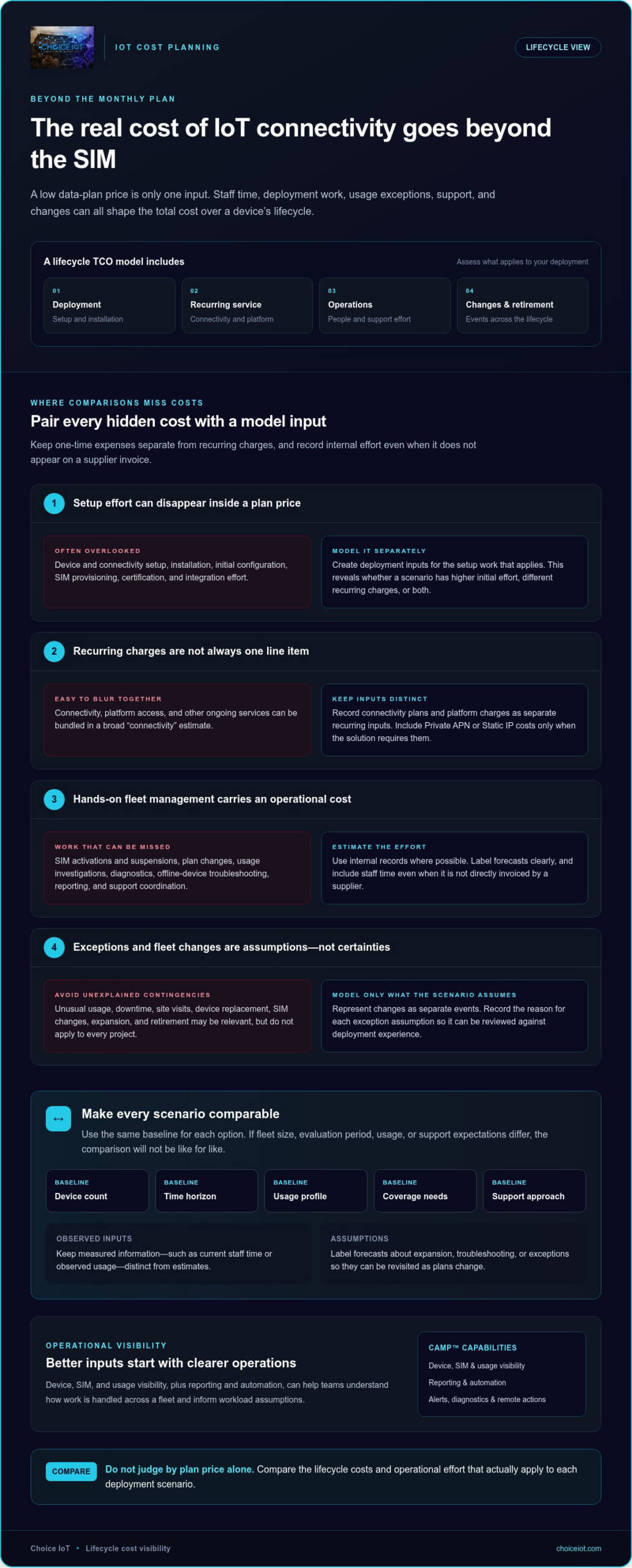
Group inputs so the model captures both setup and ongoing work. Keep one-time deployment expenses separate from recurring charges, and record internal effort even when it doesn’t appear on a supplier invoice.
- Deployment: device and connectivity setup, installation, and initial configuration.
- Recurring service: connectivity and platform charges across the modeled period.
- Operations: SIM administration, troubleshooting, reporting, and support effort.
- Exceptions and changes: potential downtime, site visits, unusual usage, and device changes or retirement.
Treat exceptions as assumptions, not certainties. For example, include the cost of a site visit only if the scenario assumes one. Record the reason for the assumption so it can be reviewed against actual deployment experience later.
Why can the lowest IoT data plan cost more over time?
A plan that looks inexpensive may not fit actual data patterns or coverage requirements. If usage regularly exceeds the expected profile, teams may spend time investigating exceptions. If connectivity is inconsistent at deployment locations, troubleshooting or site visits may become relevant costs. These outcomes aren’t guaranteed, but leaving them out can make the comparison incomplete.
Compare options using the same device count, lifecycle, usage profile, coverage needs, and support expectations. Then include the operational effort required to manage each one. Network choice is part of that assessment: multi-carrier IoT SIM cards provide useful context for evaluating connectivity across different network needs. The goal isn’t to assume one approach costs less. It’s to identify which costs apply to your deployment and make the trade-offs clear.
Build an IoT Connectivity TCO Model Around the Full Lifecycle
A useful model follows the deployment from setup through day-to-day operation, changes, and retirement. The main IoT connectivity TCO categories are deployment expenses, recurring connectivity and platform charges, operational effort, and change or retirement events. These are categories to assess, not fixed costs that apply to every project.
Start with a consistent comparison baseline. Record the device count, time horizon, expected usage profile, coverage requirements, and support approach for each scenario. If one option is modeled for a larger fleet or longer period, the results won’t be comparable. Keep source data distinct from estimates: label measured inputs, such as current staff time or observed usage, separately from assumptions about future expansion or troubleshooting.
Which recurring and deployment costs should the model capture?
Use separate rows for connectivity plans and platform access, then add setup inputs that apply to the deployment. These might include SIM provisioning, integration work, or device certification. Include Private APN or Static IP costs only when those features are required by the solution. This structure shows which inputs are essential and which depend on the design.
- Deployment: setup, provisioning, certification, and integration effort, where applicable.
- Recurring service: connectivity and platform charges, recorded as separate inputs.
- Required network features: options such as Private APN or Static IP when the use case calls for them.
Don’t bury setup work in a general “connectivity” line. Separating it shows whether a scenario has higher initial effort, different recurring charges, or both.
How should operational effort and change events be represented?
Estimate staff effort for SIM activations, suspensions, plan changes, diagnostics, and reporting. Base estimates on available internal records where possible, and label forecasts clearly. Model device replacement, SIM changes, and fleet expansion as separate events instead of blending them into an unexplained contingency. That makes the model easier to revise when deployment plans change.
Centralized tools can make operational inputs easier to observe. CAMP™ provides device, SIM, and usage visibility, along with reporting and automation that can inform workload assumptions. Its dashboard and management tools help teams see how activities are handled across a fleet. Choice IoT’s CAMP™ platform brings these functions together to support operational planning.
How to Compare IoT Connectivity TCO Scenarios Step by Step
A useful comparison starts with consistent inputs, not a preferred technology. Keep the use case, device behavior, fleet size, evaluation period, coverage requirements, and support expectations aligned across scenarios. Then show where the options differ, such as a single-network approach versus a multi-carrier approach designed for the deployment’s coverage or resilience needs.
Use this process to make your iot connectivity total cost of ownership comparison repeatable:
- Define the scope. Set the device count, deployment locations, operating period, and connectivity requirements. State what the model includes and excludes.
- Collect inputs. Gather relevant connectivity and platform charges, usage data, and operational effort. Note the source, such as invoices, system records, vendor proposals, or internal estimates.
- Set assumptions. Establish a best-estimate scenario, then create separate higher-usage or higher-support scenarios. Treat these as what-if cases, not forecasts.
- Compare options. Apply the same baseline to each approach. Change only the inputs that genuinely differ, such as network design or management workload.
- Review sensitivity. Identify which assumptions have the greatest effect on the result, then validate those inputs before making a decision.
Make inputs and assumptions visible
A compact worksheet keeps the comparison auditable. Add a row for each important cost or operational input, then record its evidence and scenario treatment. For example, use current system records for observed data usage, but label projected fleet growth as an internal estimate. Clear labels make it easier to update the model without mistaking assumptions for measured facts.
- Input: Monthly data usage per device
- Source: Device or connectivity records
- Assumption: Observed usage remains stable, or rises in a sensitivity case
- Scenario: Baseline, higher usage, or another defined case
Repeat the same structure for fleet size, support effort, and deployment growth. If security requirements or network architecture affect the options being compared, include those as explicit criteria. A Private APN for IoT may be relevant to the architecture being evaluated, so include it when the deployment requires it.
Operational visibility can help teams investigate usage patterns and connectivity issues, giving them better information for workload assumptions. It doesn’t guarantee a particular financial outcome. Choice IoT provides connectivity and management solutions, including multi-carrier SIMs and the CAMP™ platform, to support deployment oversight. Explore Choice IoT connectivity solutions.
Reduce IoT Connectivity TCO with Better Operational Control
Operational controls help teams see where time and usage are going, then investigate exceptions with better information. That makes inputs in an iot connectivity total cost of ownership model easier to review. It doesn’t guarantee lower costs. The effect depends on the deployment, how teams use the controls, and what the data shows.
Which connectivity management tasks can become easier to control?
Map each capability to a task and a model input. Real-Time Visibility and Reporting and Analytics bring device, SIM, usage, and cost information into view. Intelligent Alerts notify teams when configured data-usage thresholds are reached. Remote Network Reset and Diagnostics & Troubleshooting support remote issue investigation. SIM Lock & Security helps protect SIMs, Device Change Alerts flag device changes, and Automation & API support SIM activations, suspensions, plan changes, and business-system integrations.
Use the table as a mapping tool, not a savings forecast. For example, remote investigation may change how a team handles a connectivity issue, but the model should reflect observed effort rather than assume every incident avoids an on-site visit. CAMP™ centralizes these controls and information to support operational review across a deployment.
Before updating your TCO model, check that each operational input has a clear source, alert thresholds reflect the deployment’s usage needs, and your scenarios distinguish measured workload from estimates. Review which tasks remain manual, which can be handled remotely, and where reporting or automation could make activity easier to track. Then compare the revised assumptions against the same fleet size, service requirements, and time horizon.
Choice IoT combines multi-carrier connectivity with CAMP™ tools for visibility, alerts, diagnostics, remote network reset, and automation. Learn about Choice IoT’s connectivity management solutions.
Put Your Connectivity Cost Model to Work
A TCO model becomes more valuable when it guides decisions beyond the initial deployment. Use it as a living reference: revisit assumptions as device behavior, fleet size, and operational needs change. That keeps future connectivity decisions grounded in current evidence, not outdated estimates.
Operational visibility can help teams refine those inputs. CAMP™ brings Real-Time Visibility, Intelligent Alerts, Reporting and Analytics, and Automation & API together to support oversight and workflow review. Remote Network Reset and built-in diagnostics support remote troubleshooting workflows. These capabilities can inform your cost model, but the impact depends on how your team uses them and what the data reveals.
With a clearer view of your iot connectivity total cost of ownership, you can evaluate trade-offs and plan for the next stage of your deployment. Build your model around evidence from your own operation, then update it as usage, fleet size, or workflows change.
Frequently Asked Questions
How much does IoT connectivity total cost of ownership include?
IoT connectivity total cost of ownership includes the costs relevant to a specific deployment, so there’s no single total that applies to every fleet. Start with connectivity and platform charges, then include applicable setup, administration, support, and lifecycle expenses. Use your own invoices and operational records to build the estimate. Generic price assumptions can obscure differences in usage, staffing, or deployment design that matter to your actual costs.
Is the cheapest IoT SIM plan always the lowest-cost option?
No. A SIM plan rate is only one input, and a low rate doesn’t show how well the service fits device usage, coverage needs, or support workflows. For example, a plan that requires frequent manual investigation of connectivity or usage exceptions may carry extra operational effort. Compare plans within the same use case and include relevant management and support requirements. No network model is automatically the least expensive for every deployment.
How can a business estimate IoT connectivity costs before deployment?
Build an initial estimate from the deployment design: expected device count, data usage, coverage requirements, operating period, and management workload. Use comparable deployments or test data when available, and mark projections as estimates rather than measured facts. For a new use case, document what you don’t yet know, such as actual usage variation, then update the model as deployment records accumulate. This makes the estimate useful as planning evidence, not a fixed promise.
Can multi-carrier IoT connectivity reduce deployment costs?
It can be worth evaluating, but multi-carrier connectivity doesn’t guarantee lower costs for every deployment. Its fit depends on the coverage and resilience needs of the devices, operational requirements, and applicable plan terms. Compare it with other approaches using equivalent locations, device behavior, support expectations, and evaluation periods. Then assess whether its network flexibility addresses a real deployment need. The result should reflect your service requirements, not a general assumption that one model always costs less.
What is the difference between IoT connectivity TCO and data-plan cost?
A data-plan cost is one recurring connectivity input, while IoT connectivity TCO considers relevant costs across the deployment lifecycle. Depending on the design, the broader view may also include platform access, setup effort, internal administration, support, and costs associated with changes to devices or service. This distinction helps decision-makers avoid treating a plan quote as a complete deployment estimate. Include only categories that apply, and base them on evidence from your own operation.
How often should a business review its IoT connectivity TCO assumptions?
Review assumptions when something changes that could affect the model, such as fleet size, device behavior, service requirements, or operational processes. Compare the estimate with actual usage and cost reports to spot where assumptions no longer match deployment conditions. A fleet expansion, for instance, may change both connectivity inputs and the workload involved in managing SIMs. Let operational changes and new evidence guide the review rather than relying on an arbitrary universal interval.