

The cellular option may already be LPWAN. That’s why “lpwan vs cellular for iot” can be a misleading comparison: LPWAN is a category that includes cellular technologies such as NB-IoT and LTE-M, alongside options such as LoRaWAN. The right choice depends on the device, its data needs, where it operates, and how it moves.
There isn’t one winner for battery life, cost, or coverage. Those trade-offs depend on the technology, network availability, signal conditions, and how often a device sends data. Start with the deployment requirements, not a broad claim about LPWAN or cellular. This guide compares the main options and walks through practical criteria for coverage, power, data, and operations. If cellular fits your use case, Choice IoT’s Multi-Carrier IoT SIM and CAMP™ platform can help manage carrier connectivity and day-to-day operations.
Key Takeaways
- Compare LoRaWAN and cellular by power profile, coverage model, mobility, data volume, and infrastructure responsibilities.
- Make the lpwan vs cellular for iot decision by mapping device locations, movement, reporting frequency, and communication needs.
- Account for the different deployment requirements of unlicensed spectrum and operator-managed cellular networks.
- Consider managed cellular after cellular fits the use case, especially when carrier choice and centralized oversight matter.
- Choice IoT’s Multi-Carrier IoT SIM can steer among 500+ Global Networks for optimal connectivity.
LPWAN vs. cellular for IoT: first, clarify what the terms mean
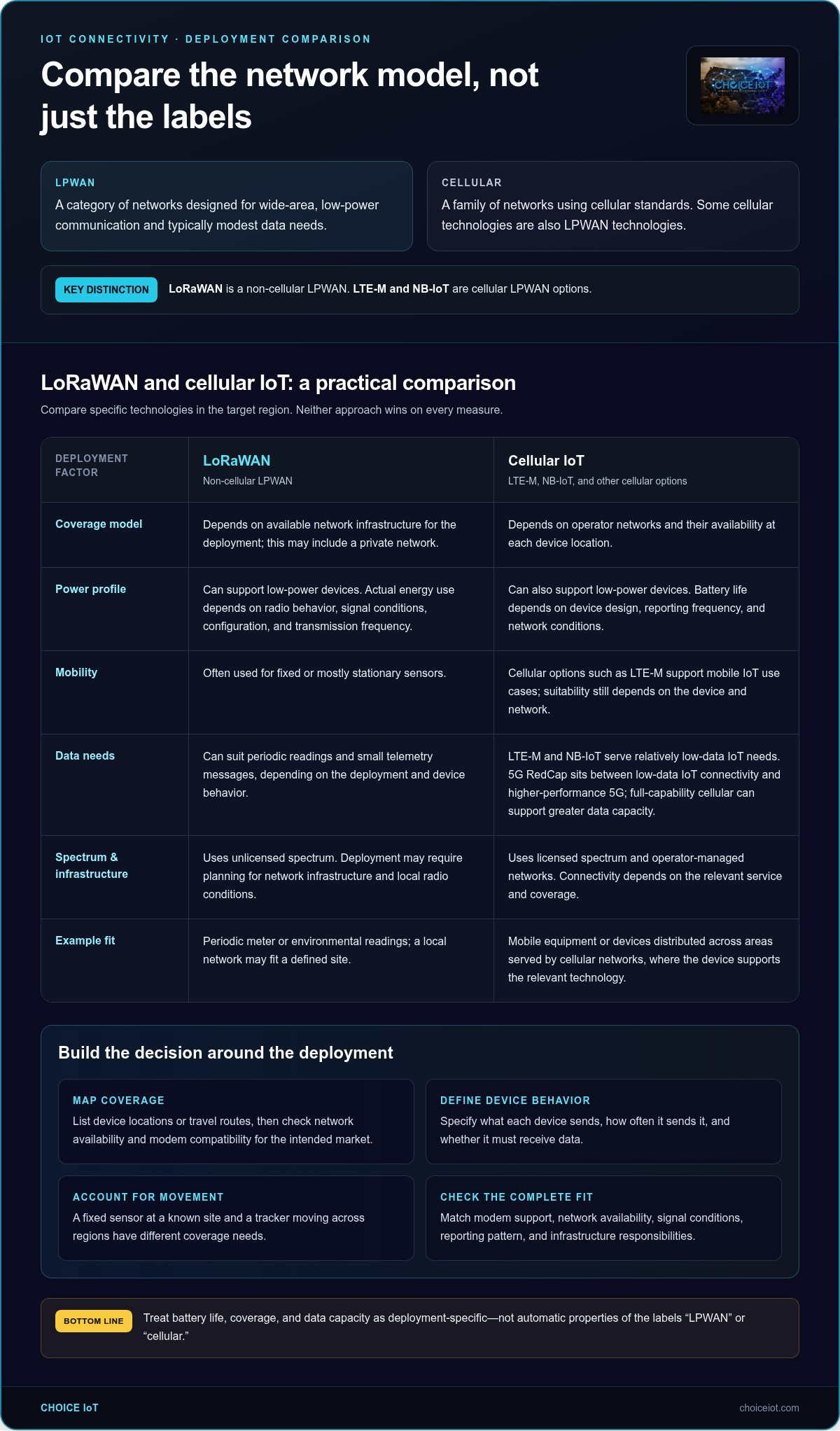
These terms describe different things. LPWAN is a network category designed to connect devices over wide areas with low power and typically modest data needs. Cellular refers to a family of networks that use cellular standards. The terms aren’t mutually exclusive: some cellular technologies are also LPWAN technologies.
Cellular LPWAN is cellular connectivity designed for low-power, wide-area IoT communication. LTE-M and NB-IoT fit this description. LoRaWAN is a useful non-cellular comparison. It is also an LPWAN technology, but it does not use cellular networks.
What does LPWAN mean in an IoT deployment?
LPWAN describes a design goal, not a guarantee of range, battery life, or data rate. The Low-power wide-area network (LPWAN) category includes technologies designed to connect devices over broad areas while limiting power use and supporting relatively small data transmissions.
LoRaWAN is one example of a non-cellular LPWAN. It can suit devices that send periodic readings, such as a sensor reporting a meter value or an environmental measurement. Its fit depends on the deployment’s coverage model, device behavior, and available network.
Is cellular LPWAN different from cellular connectivity?
LTE-M and NB-IoT are cellular LPWAN options standardized for IoT use cases with relatively low data needs. Other cellular technologies serve different throughput requirements. For example, 5G RedCap is positioned between low-data IoT connectivity and higher-performance 5G, while full-capability cellular can support applications that need greater data capacity.
So, “cellular” doesn’t automatically mean high bandwidth, and “LPWAN” doesn’t automatically mean non-cellular. That distinction is central to lpwan vs cellular for iot: compare specific technologies and how they fit your requirements, not just the labels.
Device compatibility and network availability narrow the options. A device must support the relevant radio technology, and the chosen network must be available where it will operate. Check the device modem specifications against the technology and the intended deployment regions before settling on an architecture.
How LoRaWAN and cellular IoT differ in coverage, power, and data
Neither option wins on every measure. Compare a specific LoRaWAN deployment with a specific cellular technology in the target region. These dimensions help clarify the trade-offs:
Power profile: Both can support low-power devices, but energy use depends on radio behavior, signal conditions, device configuration, and transmission frequency.
Coverage model: LoRaWAN coverage depends on the network infrastructure available for the deployment, which may include a private network. Cellular coverage depends on operator networks and their availability at each device location.
Mobility: LoRaWAN is often used for fixed or mostly stationary sensors. Cellular options such as LTE-M support mobile IoT use cases, although suitability still depends on the device and network.
Data volume: Periodic readings and small telemetry messages suit low-data designs. Firmware updates, frequent reporting, or larger transfers may call for a technology with data capabilities suited to those workflows.
Infrastructure: LoRaWAN uses unlicensed spectrum and may require planning for network infrastructure. Cellular uses licensed spectrum and operator-managed networks, with connectivity tied to the relevant service and coverage.
How do coverage and mobility affect the choice?
A fixed sensor in a known facility and a tracker moving across regions have different coverage needs. A local LoRaWAN network may suit a defined site, while mobile equipment may need connectivity across areas served by cellular networks. Neither model guarantees coverage everywhere. Map installation locations or travel routes, then assess network availability and device modem compatibility for the intended market.
Unlicensed spectrum can offer flexibility to deploy a LoRaWAN network, but the organization must account for local infrastructure and radio conditions. With cellular, operators manage the network infrastructure, while the deployment depends on the cellular technologies supported by the device and available in the region.
What do power use and data requirements change?
Battery planning starts with device behavior. Sleep cycles, reporting intervals, retransmissions, and signal conditions all influence communication energy use. Battery life depends on device design, reporting frequency, and network conditions. Treat a battery estimate as specific to the complete device and deployment, not as an automatic property of a network label.
A sensor sending an occasional status value has a different profile from a device that needs frequent updates or firmware transfers. Define what each device sends, how often it sends it, and whether it must receive data too. Then compare technologies against that workload rather than relying on broad claims about power or throughput. Where cellular fits, Choice IoT’s multi-carrier IoT connectivity lets teams consider carrier choice alongside network fit.
How to choose LPWAN or cellular for your IoT use case
Start with the device and its operating environment, not a preferred network label. Use this sequence to turn the lpwan vs cellular for iot question into a deployment brief you can evaluate against real requirements.
- Map movement and location. Record whether devices are fixed or mobile, indoors or outdoors, and concentrated at one site or distributed across regions. A stationary sensor in a controlled facility has different coverage needs from an asset moving across service areas.
- Describe the reporting pattern. Estimate message size, reporting frequency, and how quickly the system needs to receive a reading. Include two-way communication and remote firmware updates if the device requires them. Occasional small telemetry can have different network needs from frequent or larger transfers.
- Check device compatibility. Match the modem and radio support in the device to the candidate technology. Assess network availability in every intended deployment area as well. An option is viable only if both the device and the region support it.
- Set the energy budget. Consider battery capacity, sleep behavior, transmission frequency, and expected communication conditions. Evaluate the complete device configuration instead of assuming the network category alone determines power use.
- Choose the infrastructure owner. Decide whether your team wants to plan and operate local LPWAN infrastructure or rely on operator-managed cellular networks. Include the people and processes needed for provisioning, monitoring, troubleshooting, and expansion.
- Compare total operating requirements. Look beyond the connectivity line item. Account for compatible hardware, network infrastructure, ongoing service, device certification, maintenance, and operational effort. Costs vary by deployment, so compare the same requirements across options rather than assuming one technology is always cheaper.
Match the technology to the workload
Cellular LPWAN can suit low-power devices that need cellular connectivity and send modest amounts of data. Broader cellular options may fit better when an application needs more capacity for frequent transfers, remote updates, or other data-intensive workflows. Non-cellular LPWAN can fit when its infrastructure model, radio support, and coverage align with the use case.
For deployments that point toward cellular, consider how SIM management and carrier choice fit the rollout plan. The multi-carrier IoT SIM guide explains the role of multi-carrier connectivity in distributed deployments. Choice IoT’s multi-carrier connectivity supports cellular deployments that need carrier choice.
Where managed multi-carrier cellular fits after the technology decision
Managed cellular connectivity comes into play after cellular has been selected for the use case. It doesn’t replace the technology decision or make cellular the right fit for every device. It helps teams manage the connectivity layer once the device, radio technology, and deployment requirements point to cellular.
Choice IoT’s Multi-Carrier IoT SIM can steer among AT&T, T-Mobile, Verizon, and 500+ Global Networks. Carrier choice can support deployment planning across locations and network options. It does not guarantee uninterrupted service: connectivity still depends on network availability, device compatibility, and conditions where a device operates. Choice IoT also offers eSIM with OTA steering for deployments using eSIM-capable devices.
What changes when an IoT deployment uses multi-carrier cellular?
Rather than planning around a single carrier, teams can consider supported network options across their deployment footprint. This can matter for devices distributed across regions, where coverage and operations vary by location. Multi-carrier connectivity adds flexibility to the cellular plan, but it doesn’t remove the need to assess coverage and device support. For more on the operational role of these tools, the IoT connectivity management platform guide explores how connectivity management fits into deployment operations.
How does CAMP™ support day-to-day connectivity operations?
Managing SIMs and devices at scale involves more than activating connectivity. CAMP™ provides centralized visibility and management, with tools for provisioning, usage monitoring, alerts, diagnostics, remote reset, and API access. Real-Time Visibility brings devices, SIMs, and data usage into one dashboard. Intelligent Alerts let teams set data-usage thresholds, while Diagnostics & Troubleshooting and Remote Network Reset help manage issues remotely. Reporting & Analytics provides usage, cost, and performance reports, and Automation & API can streamline SIM tasks and connect workflows with business systems.
For finance deployments with specific network security requirements, Private APN and static IP options support the connectivity architecture. These are distinct capabilities to consider alongside device and network requirements.
Managed connectivity is the operational layer after choosing between non-cellular LPWAN and cellular. It won’t change which radio technology a device needs, but it can help organize cellular connectivity across a deployment. Learn more about Choice IoT connectivity solutions and how they support cellular operations.
Turn your connectivity decision into a deployment plan
Make the choice testable. Document device requirements, operating locations, and data patterns, then use them to validate network and hardware assumptions before scaling. This gives your team a practical baseline for assessing whether the selected approach continues to fit as the deployment grows.
If cellular is the right match, plan for the operational layer alongside the radio technology. Choice IoT’s Multi-Carrier IoT SIM offers steering among AT&T, T-Mobile, Verizon, and 500+ Global Networks. CAMP™ centralizes provisioning, monitoring, diagnostics, alerts, and connectivity management. For finance deployments, Private APN and static IP options support security requirements. These capabilities help manage deployment operations; they don’t replace choosing connectivity based on device behavior and coverage.
Keep the decision grounded in your use case. The goal of lpwan vs cellular for iot isn’t to pick a universal winner. It’s to build a connectivity plan your devices and operations can support.
Talk with Choice IoT about your connectivity deployment and take the next step with a plan built around your devices and operating needs.
Frequently Asked Questions
Is cellular LPWAN the same as LPWAN?
Cellular LPWAN is a type of LPWAN, but LPWAN is broader than cellular. The category describes connectivity designed for wide-area devices with low-power, low-data needs; cellular identifies a network family. LTE-M and NB-IoT are cellular LPWAN technologies, while LoRaWAN is a non-cellular LPWAN option. “LPWAN vs. cellular” can be an imprecise comparison unless you name the specific technologies.
What is the difference between LoRaWAN and cellular LPWAN?
LoRaWAN uses a non-cellular network model, while cellular LPWAN uses cellular standards and operator networks. In an lpwan vs cellular for iot evaluation, a team with sensors across a defined property might assess the effort of establishing LoRaWAN infrastructure. A distributed deployment might instead assess cellular service availability and compatible modules across operating regions. Compare the network responsibilities and who will maintain the infrastructure over the deployment’s life.
Which uses less power, LPWAN or cellular?
Neither category is automatically lower-power in every deployment. Assess the complete device’s energy use, including sensing, processing, radio wake-ups, transmissions, and retries when signal conditions are poor. A meter that reports infrequently may behave differently from a tracker sending regular updates. Test representative devices using the intended reporting intervals and operating conditions, then base battery planning on measured behavior rather than a technology label.
Can cellular LPWAN support mobile IoT devices?
Some cellular LPWAN technologies can support mobile IoT, but capabilities differ by standard. LTE-M supports mobility and may suit moving assets; NB-IoT is generally better aligned with stationary devices and may have limited mobility. The device modem must support the selected technology, and the relevant network must be available along the asset’s route. Assess both against the deployment region before choosing.
When should an IoT deployment use LoRaWAN instead of cellular?
Consider LoRaWAN when its network model fits the site and your team can operate or arrange the required infrastructure. It may suit a bounded campus, farm, or facility with mostly stationary sensors sending modest telemetry. Include radio compatibility, local coverage planning, and ongoing network ownership in the decision. If devices need mobility or connectivity across regions, compare cellular options against those requirements too.
Can an IoT deployment combine cellular connectivity with centralized SIM management?
Yes. Cellular connectivity and SIM management are separate layers: the radio technology determines how devices access a network, while CAMP™ helps teams administer SIMs and connectivity operations centrally. For example, operators can use platform workflows and API access to manage SIM activity across a fleet without changing its cellular standard. Centralized management supports operational coordination, but it doesn’t replace radio coverage or compatible device hardware.