
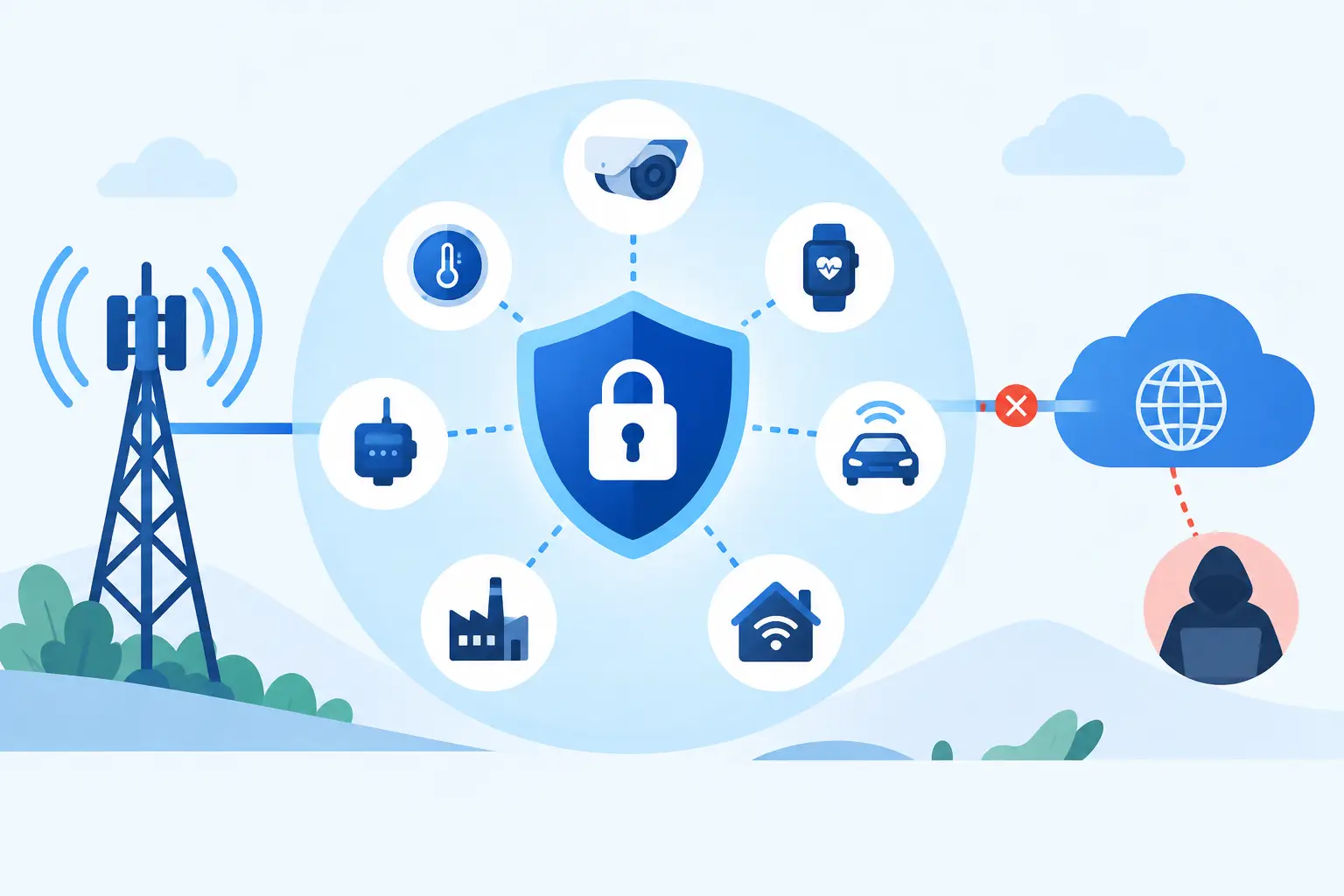
A field gateway that suddenly starts sending data to an unfamiliar destination can create a costly support event long before it becomes a headline. For solution providers managing thousands of cameras, kiosks, monitors, trackers, or controllers, a private APN for IoT security creates a controlled cellular path that limits where devices can communicate and how that traffic reaches business systems.
That matters because a standard public internet connection treats every deployed device like another endpoint on the open web. A private APN changes the network design. It gives your fleet a defined entry point, allows traffic policies to be applied consistently, and reduces the number of paths an attacker or misconfigured device can use.
It is not a substitute for secure firmware, strong device credentials, application-layer encryption, or disciplined operations. It is a practical network control that makes those safeguards more effective and easier to manage at scale.
What a Private APN Actually Changes
An APN, or Access Point Name, tells a cellular network how to route a device’s data session. On a typical public APN, traffic exits to the internet. The device may reach cloud services, but it can also attempt connections to destinations your team never intended to support.
With a private APN, carrier traffic is routed into a private network environment rather than directly to the public internet. That environment can be connected to your data center, cloud virtual network, security platform, or another controlled destination through a private connection or secure tunnel. The exact design depends on the carriers, hosting environment, device protocol, and operational requirements.
The practical result is simple: a device can communicate with the services it needs without receiving broad, unnecessary internet access. Your team gains a better-defined boundary for monitoring, allowlisting, segmentation, and incident response.
Why Private APN for IoT Security Reduces Exposure
Most IoT fleets are purpose-built. A payment terminal may only need to reach a transaction processor. A remote patient monitor may only need to reach a clinical application. A construction camera may only need to send video to a management platform. Giving these devices unrestricted outbound access adds risk without adding business value.
A private APN supports a least-privilege approach at the network layer. Policies can limit communication to approved IP ranges, ports, protocols, and destinations. If a device is compromised, that containment reduces its ability to scan public services, connect to command-and-control infrastructure, or move laterally toward sensitive systems.
Private routing also makes traffic more predictable. Security teams can inspect flows at a central firewall or cloud security boundary instead of trying to understand scattered traffic patterns from thousands of devices across multiple public carrier paths. When something unusual occurs, the investigation starts with a smaller, more meaningful set of permitted connections.
This is especially valuable for devices that cannot run a full endpoint security agent. Many IoT endpoints have limited memory, aging operating systems, proprietary firmware, or long replacement cycles. Network controls cannot fix weak firmware, but they provide an essential compensating layer when device-side controls are limited.
The Security Controls That Belong Around the APN
A private APN is an architecture component, not a security checkbox. The strongest deployments pair it with controls at the SIM, network, device, and application layers.
At the SIM layer, teams should control activation status, usage thresholds, roaming behavior, and carrier access. A SIM that is no longer assigned to an active asset should be suspended quickly. Unexpected data spikes, location changes, or device changes should trigger alerts before an overage or breach turns into a truck roll.
At the network layer, enforce allowlists and deny unnecessary traffic by default. Segment devices by customer, application, geography, or risk profile. A nationwide security-camera deployment should not share unrestricted access with a fleet of utility meters simply because both use cellular connectivity.
At the device and application layers, use unique credentials, rotate keys where the hardware supports it, encrypt data in transit, validate certificates, and maintain an OTA update process. A private APN can reduce exposure, but encryption still protects data when it moves through approved paths. Authentication still proves that the device reaching your platform is the device it claims to be.
For operational teams, centralized visibility ties those layers together. A connectivity management platform should show whether a session is active, which network a device is using, how much data it has consumed, and whether it has changed behavior. Choice IoT customers can use CAMP™ Automated Mobility OS to monitor and automate many of these SIM and device workflows across carrier environments from one control plane.
Private APN vs. Public APN: The Operational Difference
The decision is not about labeling one option as universally secure and the other as unsafe. It is about matching network architecture to the device’s risk, data sensitivity, and support model.
| Requirement | Public APN | Private APN | | — | — | — | | Internet access | Direct access is common | Access can be limited to approved destinations | | Traffic visibility | Often distributed across public paths | Centralized inspection and policy enforcement are easier | | Segmentation | Relies heavily on device and cloud controls | Supports dedicated routing domains and network boundaries | | Deployment effort | Usually simpler for low-risk use cases | Requires routing, firewall, and carrier configuration | | Best fit | Low-risk, internet-native devices | Managed fleets handling sensitive or operationally critical traffic |
A public APN can be appropriate for a low-risk sensor that sends encrypted data to a well-protected cloud endpoint and has no inbound exposure. A private APN is usually the better fit when devices connect to private applications, support sensitive workflows, require contractual network isolation, or operate in sectors where a failed device can disrupt operations.
Static IP addressing may also be useful, but it is not automatically required. Static IPs can simplify allowlisting and device-specific access policies. They can also create administrative overhead and may expose a more consistent target if inbound access is not tightly controlled. In many architectures, private addressing combined with outbound-only sessions and strict firewall rules is the safer pattern.
Design for the Fleet You Will Have in Two Years
The biggest APN mistake is designing only for the pilot. Ten devices can be managed with manual exceptions. Ten thousand devices across multiple carriers, customer accounts, and regions require repeatable policy and automation.
Start by mapping every device conversation. Identify where telemetry goes, how remote management occurs, whether technicians need access, and which protocols are truly necessary. If a vendor cannot explain why a port must be open, it should not be open by default.
Next, separate environments. Production devices should not share the same network path as development hardware, test SIMs, or technician laptops. For partners managing multiple end customers, tenant separation is equally important. It protects customers from one another and prevents a support action intended for one fleet from affecting another.
Then plan for carrier diversity without weakening policy. Multi-carrier connectivity and automated failover can protect uptime when coverage changes by location. But each carrier path must preserve the intended private routing and policy enforcement. A failover SIM that falls back to uncontrolled public access can defeat the point of the architecture at the moment your device is under stress.
Finally, document the response workflow. Decide who can suspend a SIM, change an allowlist, initiate a remote reset, or approve a new endpoint. Security improves when operations teams can act quickly, but not when every administrator has unrestricted access to every customer fleet.
Questions to Ask Before You Deploy
Before choosing a private APN design, ask whether traffic remains private across every carrier and roaming scenario, where firewall policy is enforced, and how devices are segmented. Confirm how SIM activation, suspension, and usage alerts are handled. Ask what happens during carrier failover, how quickly policies can be changed, and whether your team can access session-level diagnostics without opening a carrier support ticket.
Also ask about implementation ownership. Private connectivity can involve carrier provisioning, tunnel configuration, cloud routing, firewall rules, DNS, and application allowlists. A technically sound design still fails operationally if no one owns testing each layer before devices ship.
The right private APN should make the secure path the easy path for your deployment team. When a new device activates, it should land in the correct segment, reach only approved services, generate useful alerts when behavior changes, and give support teams enough control to solve problems remotely. That is how cellular security protects more than data. It protects rollout schedules, service margins, and the trust your customers place in every connected device.