

Does remote access automatically mean your IoT device needs a static IP? Not always. Devices that only initiate outbound connections to a cloud platform may work with dynamic addressing. The question of when to use a static ip for iot comes down to the workflow: does an external system need to initiate a connection, does an allowlist rely on a fixed address, or does a legacy system expect a known endpoint? A fixed address alone doesn’t bypass carrier NAT, guarantee inbound reachability, or secure a device.
It’s reasonable to want a predictable way to reach and manage deployed devices. The key is separating stable addressing from the access path and security controls. This guide explains which use cases benefit from a static IP, when dynamic addressing may be sufficient, and how options such as a Private APN or VPN fit into the network design. You’ll also learn what to clarify about carrier routing, NAT, and inbound access before deployment. Choice IoT’s static IP and Private APN options sit alongside multi-carrier IoT connectivity and CAMP™, which provides centralized device and SIM visibility.
Key Takeaways
- Decide when to use a static ip for iot by identifying which application or system depends on a consistent device address.
- Map connection direction and access requirements before selecting an addressing approach. A fixed address is only one part of the network design.
- Validate carrier routing, NAT, and inbound-access behavior against the deployment workflow before rollout.
- Compare Choice IoT’s Static IP Address and Private APN options with your application requirements; they address distinct connectivity needs.
- Use CAMP™ for centralized visibility into devices, SIMs, and data usage, supported by diagnostics, reporting, alerts, and automation.
When to use a static IP for IoT: start with the application requirement
Start with one question: which system needs to locate or allowlist the device? A static IP is an address intended to remain consistent over time, subject to the provider’s service and network design. That consistency can help an application recognize a known endpoint. It doesn’t, by itself, determine whether the endpoint is reachable.
What does a static IP mean in an IoT deployment?
A static IP address is an address intended to stay the same, while access to the device depends on routing and network configuration. The address assigned to a device may differ from the address an application or external system can see. If carrier NAT sits between them, for example, a stable device-side address doesn’t automatically create a route for incoming connections. Stability and reachability are separate design questions.
So are security and encryption. A fixed address doesn’t encrypt traffic or protect a device from unauthorized access. Access controls and a secure connection path must be designed separately.
Which IoT workflows may need a predictable address?
A static address may fit a workflow when another system relies on a known endpoint. The deciding factor is how the connection is established, not simply whether a device is monitored or managed remotely.
- Application-side allowlists: A service may accept connections only from approved addresses. A consistent device address can help if the application expects the device itself to connect from a known IP.
- Fixed endpoint expectations: A system may be configured to send requests to a particular device address. Confirm that routing makes that address reachable from the system.
- Network integrations: Existing infrastructure may use address-based rules or fixed routes. Check whether those rules apply to the device’s assigned address or an address visible beyond the carrier network.
By contrast, a device that initiates an outbound connection to a cloud endpoint may not need a fixed device IP. The cloud service can receive the device’s connection, and replies may travel over that established session, depending on the network and application design. Remote monitoring or management alone doesn’t prove a static IP is required.
To decide when to use a static ip for iot, trace the connection in both directions. Identify who starts it, which address each system sees, and what the application’s rules expect. Then match addressing to that requirement, rather than treating a stable IP as a shortcut to access or security.
How static IPs affect IoT reachability, NAT, and security
A stable address can make a device easier to identify, but it doesn’t decide which networks can reach it or which traffic is permitted. Keep four design questions separate:
| Network factor | What it determines |
|---|---|
| Stable address | Whether the address is intended to remain consistent |
| Routability | Whether a network has a path to that address |
| Connection direction | Whether the device or an external system initiates communication |
| Access controls | Which devices or services are allowed to communicate |
Does a static IP make an IoT device reachable?
No, not by itself. A carrier may use NAT, including carrier-grade NAT, which can prevent unsolicited connections from reaching a device. A static address doesn’t automatically create a route through that network. Firewall rules and the application’s listening service also matter. Carrier- and service-specific addressing, routing, NAT, and inbound-access behavior must be validated for the deployment.
For cloud telemetry, devices often initiate outbound sessions to a cloud endpoint and send data over those connections. If the application only needs to receive device-initiated data and return traffic through the established session, inbound access to each device may not be necessary. Confirm the actual connection flow and network behavior before relying on it.
Is a static IP a security feature?
No. Address stability is not authentication, encryption, or an access-control policy. An allowlist can limit which IP addresses an application accepts, but it should be part of a broader design, not the sole safeguard. A Private APN, VPN, firewall, and static IP serve different roles in a network architecture; they aren’t interchangeable, and their behavior depends on configuration.
A Private APN may be relevant when an IoT deployment calls for private-network connectivity. The Private APN for IoT guide explains that network approach. For teams assessing when to use a static ip for iot, the practical step is to document who initiates connections, which endpoints must communicate, and what controls protect each path. Choice IoT’s IoT connectivity options include Static IP Address and Private APN as distinct choices for defined application needs.
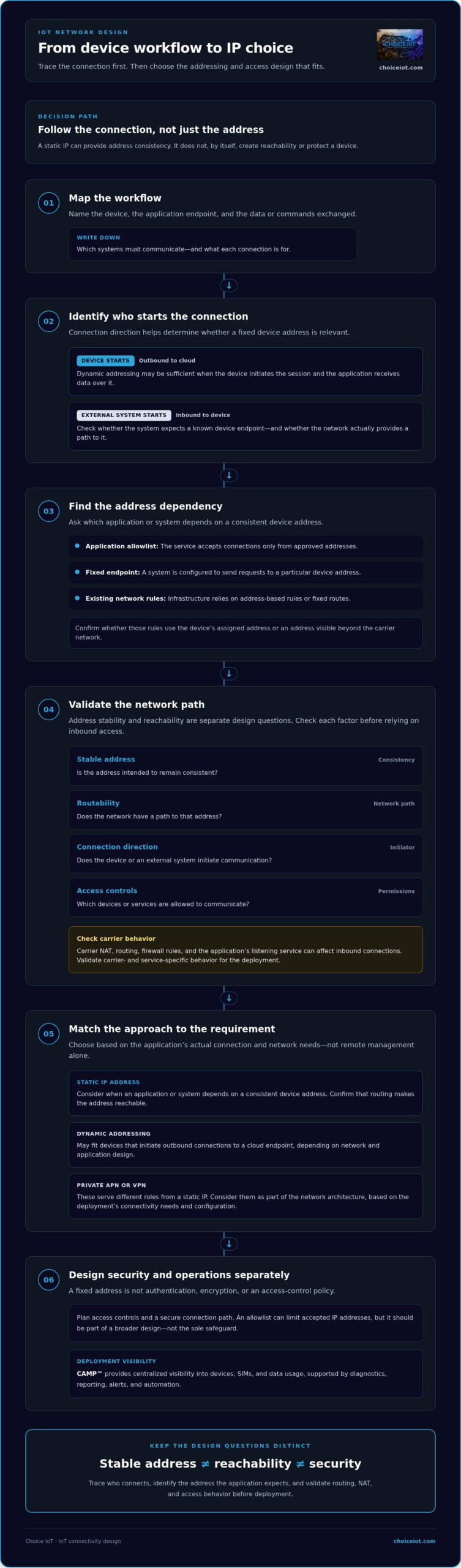
A practical checklist for deciding whether your IoT deployment needs one
Turn the application requirement into a repeatable decision. Before choosing an address type, trace the communication path from device to application and back. This checklist helps pinpoint when to use a static ip for iot, when dynamic addressing may fit, and when network behavior needs validation.
- Map the workflow. Name the device, application endpoint, and data or commands exchanged.
- Identify the connection initiator. Does an external system open a connection to the device, or does the device send data to a cloud endpoint?
- Check access requirements. Record who needs access, from where, and whether an integration requires a fixed source or destination address, or an allowlist.
- Validate network behavior. Check carrier routing and NAT against the specific design, including whether the required traffic can travel in the intended direction.
Questions to answer before selecting an address type
Write down the application endpoint and the system that starts each connection. Specify whether communication must be device-to-cloud, cloud-to-device, or both. Then document what any integration expects: a fixed source address, a fixed destination, or neither. Finally, validate carrier routing and NAT for the deployment itself. A design assumption is not a connectivity test.
When dynamic addressing may be sufficient
Dynamic addressing may work for a device that initiates an outbound session to a cloud service, if the application can associate the session with the correct device without relying on a fixed device IP. For example, the device may identify itself within its application connection. This is an architectural fit, not a universal rule: confirm that the required features and return traffic work through the chosen network.
Static IP candidate: An application requires a consistent device address for an integration, allowlist, or fixed endpoint, and the network supports the required path.
Dynamic addressing candidate: Devices initiate connections to an application that identifies them without relying on a permanent device address.
Verify network design: The requirement depends on inbound access, carrier NAT, routing, or address visibility that hasn’t been validated for the deployment.
Use the checklist to turn assumptions into explicit application requirements. Choice IoT offers Static IP Address and Private APN as distinct connectivity options. Explore Choice IoT connectivity options to align the network approach with your deployment needs.
Choosing an IoT connectivity approach with Choice IoT
The decision framework points to a practical next step: match connectivity choices to the application’s documented requirements. Start with the addressing need, the intended communication path, and the controls required around that path. Then consider how your team will oversee SIMs and connectivity across deployed devices. These are related parts of the design, but they solve different operational needs.
How static IP and Private APN fit different requirements
A Static IP Address is an addressing option for applications that need a consistent address. A Private APN is a separate network option to consider when private-network connectivity is part of the design. Neither should be assumed to include or replace the other. The right combination depends on the application, routing, and access requirements. For more context on private-network considerations, see the Private APN for IoT guide.
This distinction keeps the decision focused. If an integration depends on a stable address, assess the Static IP Address requirement. If the deployment calls for a private network approach, assess Private APN requirements. In either case, confirm how the selected design supports the required communication paths rather than assuming an option guarantees reachability or security.
Manage connectivity operations across an IoT deployment
Addressing decisions are only one part of a managed deployment. As the device fleet grows, teams also need operational visibility into SIMs and data usage. CAMP™ provides a unified view, with Real-Time Visibility and Reporting & Analytics to support oversight. Diagnostics & Troubleshooting and Intelligent Alerts add operational capabilities, while automation supports connectivity management workflows.
These platform capabilities complement the network design; they don’t configure or manage static IP addresses. For further context on platform operations, explore the IoT connectivity management platform guide.
When deciding when to use a static ip for iot, connect the address choice to a defined application need, then plan for visibility across the deployment. Explore IoT connectivity options with Choice IoT to consider how Static IP Address, Private APN, multi-carrier IoT SIMs, and CAMP™ fit into your connectivity approach.
Make connectivity decisions part of deployment planning
Addressing choices are easier to maintain when they’re documented alongside the application’s communication flows. Record the endpoint expectations, access paths, and network assumptions that informed the design. That gives engineering and operations teams a shared reference as devices, integrations, or security requirements change.
Use when to use a static ip for iot as a deployment question, not a default setting. A defined requirement can guide the design; an untested assumption can create avoidable rework. Build time to validate the intended connectivity path before expanding the rollout.
Choice IoT brings connectivity options and operational visibility together for managed IoT deployments. Explore IoT connectivity options with Choice IoT and take the next step with a clearer basis for your network design.
Frequently Asked Questions
When should an IoT device have a static IP address?
Use a static IP when a device’s application or integration depends on its address staying consistent. For example, an enterprise system might have a device-specific rule that points to a known endpoint, or an application might accept traffic only from a defined source address. Before selecting one, check whether the requirement applies to the device’s address or to an address visible to the application. That distinction can change the network design.
Does a static IP make an IoT device accessible over the internet?
No. A static IP doesn’t automatically make an IoT device reachable from the public internet. The address must be routable from the system trying to connect, and network routing, carrier NAT, firewall rules, and the device’s service configuration all affect access. For example, a device may keep the same address while an upstream network still blocks unsolicited inbound traffic. Confirm the full path before designing remote access around a fixed address.
Do IoT devices need a static IP to connect to the cloud?
No. Many cloud applications can work with devices that initiate outbound connections, without requiring each device to keep a fixed IP. The application can identify a device through its connection and application-level credentials or identifiers. For example, a sensor can send readings to a cloud endpoint using an established session. Whether this fits depends on the application’s connection model, response requirements, and network configuration, so test the end-to-end workflow.
Is a static IP more secure than a dynamic IP for IoT?
No. A static address is not a security control, and a changing address shouldn’t be treated as protection. Security depends on measures such as authentication, encryption, firewall policy, and limiting access to authorized systems. An IP allowlist can be one layer, but it doesn’t verify a user or encrypt traffic. In practice, design security around device identity and permitted communication, then choose addressing to meet the application’s operational needs.
What is the difference between a static IP and a Private APN for IoT?
A static IP concerns address consistency; a Private APN concerns the cellular network context used by a device. They answer different design questions. For example, an application may require a consistent address, while the deployment’s network architecture separately calls for private connectivity. Neither option should be assumed to include or replace the other. Assess address requirements and network access requirements independently, then validate how the selected design handles routing and communication.
Can IoT devices behind carrier NAT use a static IP?
Possibly, but a static IP label alone doesn’t show whether inbound connections can reach a device behind carrier NAT. The carrier’s addressing and routing design determines how that address is presented and what traffic can pass. For instance, a stable address might support outbound identification while unsolicited inbound traffic remains blocked. Verify the specific service’s NAT behavior, routing, and inbound-access model against the application before relying on direct device access.