

Why pay for the full 5G “firehose” when your mid-tier devices only need a steady stream? You’re likely feeling the squeeze. Legacy 4G networks are sunsetting, but full 5G modules remain too expensive for mass-market deployment. Implementing 5g redcap connectivity changes the equation. It addresses the high cost of hardware and the battery life concerns that plague mid-tier sensors. You need the performance of the latest generation without the logistical friction or the overhead of unnecessary complexity.
This guide provides the definitive roadmap for your 5G migration. RedCap isn’t a compromise; it’s a strategic, right-sized standard designed specifically for the 2026 IoT landscape. You’ll learn to leverage technical advantages and cost efficiencies to future-proof your hardware today. We’ll analyze the real-world ROI of RedCap against LTE and explore how centralized tools like the CAMP™ platform streamline global management. High performance. Lower costs. Total control. It’s time to bridge the gap between legacy limitations and next-generation scalability.
Key Takeaways
- Identify why 5G RedCap is the “right-sized” successor to LTE, offering the perfect balance of performance and power efficiency for mid-tier industrial devices.
- Analyze the specific throughput and latency benchmarks that make 5g redcap connectivity superior to legacy 4G networks while maintaining significantly lower hardware costs.
- Navigate the complexities of hardware integration and the carrier device certification process to accelerate your time-to-market for next-generation solutions.
- Discover how to manage global deployments and eliminate carrier lock-in by leveraging the CAMP™ IoT Platform for real-time monitoring and centralized control.
Understanding 5G RedCap: The Middle Ground of Industrial Connectivity
2026 marks the end of the experimental phase for 5G in industrial IoT. We’ve moved past the hype. Now, we’re looking at efficiency. 5G RedCap, or Reduced Capability, represents the 3GPP Release 17 standard designed to bridge the massive gap between low-power sensors and high-bandwidth broadband. It’s the “Goldilocks” tier. Not too slow. Not too expensive. Just right. For solution providers, 5g redcap connectivity is the missing link in a fragmented market.
The industry is at a crossroads. Legacy 4G networks are nearing their end of life, yet the high cost of full 5G modules makes large-scale migration difficult. RedCap solves this. It offers a strategic path forward by providing the reliability of 5G at a price point that rivals LTE. It’s built for the mid-tier. Think industrial sensors, wearables, and surveillance. These devices don’t need gigabit speeds, but they do need the longevity and security of the 5G Core. 2026 is the pivotal year for adoption because carrier 5G Standalone (SA) networks have finally reached the maturity required to support these specialized devices at scale.
The 3GPP Release 17 Standard Explained
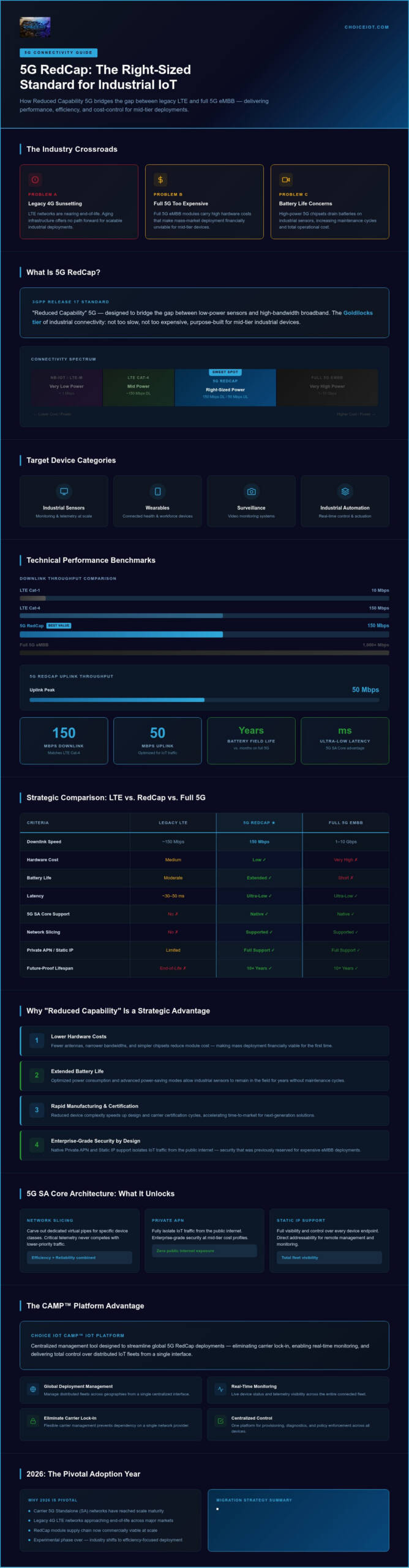
Release 17 introduced RedCap to simplify the 5G radio. Full 5G, often referred to as eMBB (Enhanced Mobile Broadband), requires complex antenna arrays and massive processing power. RedCap strips away this excess. It reduces the device footprint by requiring fewer antennas and narrower bandwidths. This isn’t about cutting corners; it’s about “right-sizing” the data pipe. 5G RedCap is the definitive technical successor to LTE Cat-4. It moves the industry away from the limitations of aging infrastructure and onto a modern, software-defined foundation that supports network slicing and advanced power-saving modes.
Why “Reduced Capability” is a Strategic Advantage
Don’t let the name fool you. “Reduced” is a strategic choice for scalability and profit. By simplifying the hardware, manufacturers can significantly lower the barrier to entry for 5G integration. The benefits are direct and measurable:
- Lower Hardware Costs: Fewer components mean cheaper modules. This makes mass deployment financially viable.
- Extended Battery Life: Optimized power consumption allows industrial sensors to remain in the field for years without maintenance.
- Rapid Manufacturing: Reduced device complexity speeds up the design and certification cycle.
Implementing 5g redcap connectivity allows you to ditch legacy 4G without the financial sting of high-end 5G. It provides the enterprise-grade security of a Private APN while maintaining the cost-efficiency required for a healthy ROI. This is about total control. It’s about building on a foundation that won’t be obsolete in three years. RedCap is the engine for the next decade of industrial growth.
Technical Performance: Why 5G RedCap Outperforms Legacy LTE
The transition to 5G isn’t just about adding more bandwidth. It’s about fundamental architectural improvements. 5g redcap connectivity leverages the 5G Standalone (SA) Core to offer capabilities that legacy LTE simply cannot match. While LTE was built for a world of smartphones, RedCap is purpose-built for the industrial machine. This shift unlocks native support for network slicing. You can now carve out dedicated virtual pipes for specific device classes, ensuring that critical telemetry never competes with lower-priority traffic. Efficiency meets reliability.
Security is no longer a secondary layer. It’s integrated by design. RedCap allows for the seamless implementation of enterprise-grade security protocols. You can deploy a Private APN to isolate your IoT traffic from the public internet entirely. Combined with Static IP addresses, this provides a level of visibility and control that was previously reserved for high-cost eMBB deployments. You get the security of a private network with the cost-profile of a mid-tier solution. No compromises. No friction.
Speed and Latency: Beyond LTE Cat 1 and Cat 4
Let’s look at the raw data. RedCap delivers peak throughput of up to 150 Mbps downlink and 50 Mbps uplink. This matches or exceeds LTE Cat 4, but with a massive advantage in latency. By utilizing the 5G SA architecture, RedCap slashes response times. This is vital for real-time applications like video surveillance and industrial automation. Systems stay synchronized. Devices react in milliseconds. You aren’t just moving data faster; you’re making your entire ecosystem more responsive. Reliability becomes a constant, not a variable.
Energy Efficiency and Battery Longevity
Power is the lifeblood of remote IoT. RedCap introduces sophisticated energy-saving features that extend the field life of your hardware. Two pillars drive this efficiency: Extended Discontinuous Reception (eDRX) and Power Saving Mode (PSM). These allow devices to remain in a low-power state for longer periods, waking up only when necessary to transmit data. The results are practical and immediate:
- Smart Meters: Deploy sensors in hard-to-reach locations with the confidence they’ll last for a decade.
- Wearable Health Monitors: Create smaller, lighter devices that don’t require daily charging.
- Industrial Sensors: Reduce the high cost of “truck rolls” by eliminating frequent battery replacements.
By optimizing 5g redcap connectivity for these power-efficient modes, you maximize the uptime of your fleet. You’re building for longevity. You’re ensuring that your solution remains operational long after legacy LTE networks have been decommissioned. This is the foundation of a future-proof deployment.
Strategic Comparison: 5G RedCap vs. LTE and Full 5G eMBB
Choosing the right connectivity standard is a matter of long-term survival. In 2026, the 4G sunset is no longer a distant threat; it is a logistical reality. Carriers are aggressively re-farming spectrum to prioritize 5G infrastructure. 5g redcap connectivity offers the optimal path forward. It provides the longevity of the 5G ecosystem without the prohibitive costs of high-tier modules. While LTE-M and NB-IoT remain the standard for low-power, massive IoT deployments, RedCap is the strategic choice for applications requiring higher throughput and lower latency. It bridges the gap. It eliminates the risk of being anchored to legacy networks that are slowly being phased out.
Spectrum efficiency is the driving force behind carrier prioritization. RedCap allows operators to support more devices on the same frequency bands compared to legacy LTE. This efficiency leads to better network performance and lower operational costs for the carrier, which eventually translates to better support and pricing for the end-user. For solution providers, this means your devices are operating on the most stable, well-supported bands available. You aren’t just buying hardware; you’re securing a ten-year operational window. High performance. Low risk. Total scalability.
RedCap vs. LTE Cat 4: The Direct Replacement
LTE Cat 4 has been the workhorse of industrial IoT for years. That era is ending. RedCap serves as the direct, future-proof replacement. It simplifies the radio design significantly. By reducing antenna configurations to 1×1 or 2×2 MIMO, RedCap lowers the hardware footprint and manufacturing complexity. This simplicity translates to faster deployment cycles and reduced points of failure. To maximize this efficiency, solution providers should look toward The Ultimate Guide to Multi-Carrier IoT SIM Cards to ensure their devices maintain global uptime across shifting carrier landscapes. Reliability is built into the architecture, not added as an afterthought.
RedCap vs. Full 5G (eMBB): When is it Overkill?
Full 5G eMBB is a powerhouse. It is also often unnecessary. Using eMBB for a mid-tier industrial sensor is a waste of resources. It introduces excessive hardware costs, complex thermal management requirements, and larger device dimensions. RedCap removes this friction. It delivers “right-sized” performance. You get the 5G Core benefits, such as network slicing and enhanced security, without the power drain of a gigabit-capable modem. 5g redcap connectivity ensures your hardware is optimized for its specific task. Smaller devices. Cooler operation. Lower overhead. This is how you scale a profitable IoT business in a competitive market.
Deployment Roadmap: Integrating 5G RedCap into Your IoT Stack
Strategy is nothing without execution. Transitioning to 5g redcap connectivity requires a structured deployment framework that prioritizes hardware compatibility and network readiness. It begins with hardware selection. You must identify modules that natively support 3GPP Release 17. Don’t settle for “5G-ready” legacy chips. You need components optimized for the reduced complexity of the RedCap standard. Once your hardware is locked, the focus shifts to integration and the rigorous testing of devices in 5G Standalone (SA) environments. This ensures your solution can leverage network slicing and advanced power management from day one.
The roadmap isn’t just about the physical device. It’s about the infrastructure that supports it. Pilot testing in a 5G SA environment allows you to validate power consumption and latency benchmarks under real-world conditions. This is where you fine-tune eDRX settings and confirm that your deployment meets the promised ROI. It’s the bridge between a prototype and a global rollout. High performance requires a high-performance roadmap. Total control starts with a methodical approach to integration.
Carrier Device Certification Services
Certification is the bottleneck. It’s the most common point of failure for new hardware launches. Each major carrier has unique requirements that can delay your time-to-market by months. Choice IoT removes this friction. We offer Carrier Device Certification services to navigate the complex lab testing and approval cycles on your behalf. By streamlining this path, you reduce logistical stress and accelerate deployment at scale. Speed is your competitive advantage. Don’t let paperwork stall your innovation.
Securing the RedCap Edge
RedCap isn’t just about speed; it’s about control. Industrial deployments require isolated, secure environments. Implementing a Private APN ensures your data never touches the public internet. This is non-negotiable for connected surveillance and smart city infrastructure. Pair this with a Static IP address to enable reliable machine-to-machine (M2M) communication. You gain a fixed point of entry for remote management without exposing your devices to external threats. Security by design. Reliability by default.
By optimizing 5g redcap connectivity through these secure channels, you reduce the attack surface for your entire fleet. You’re building a fortress, not just a network. This level of centralization and security is what separates enterprise-grade solutions from consumer-grade compromises. Focus on the foundation. The scale will follow.
Scaling with Choice IoT: Managed 5G RedCap and the CAMP™ Advantage
Deployment is the beginning. Management is the long game. To truly scale 5g redcap connectivity, you need a centralized nervous system. Choice IoT provides this through the CAMP™ IoT Platform. It’s not just a dashboard. It’s a command center. You shouldn’t be juggling multiple carrier portals or struggling with opaque billing cycles. We eliminate that friction. By unifying your entire fleet under one interface, you gain total transparency. Real-time visibility. Automated control. This is how you prevent bill shock and ensure your 5G plans remain profitable as you grow.
Global deployments demand flexibility. Carrier lock-in is a legacy anchor that kills agility. Our Multi-Carrier IoT SIMs ensure your devices stay connected across shifting network landscapes without requiring a physical swap. You get the best of all worlds: the technical superiority of RedCap and the operational freedom of a carrier-agnostic partner. We handle the complexity. You focus on the solution. Expert support is built into our DNA. We don’t just provide SIMs; we provide the architectural foundation for your end-to-end success.
The CAMP™ IoT Platform for 5G RedCap
Provision devices in seconds. Not days. CAMP™ allows you to activate, deactivate, and monitor RedCap lifecycles with surgical precision. The platform provides automated alerts that trigger the moment a device deviates from its expected data profile. This proactive monitoring is essential for managing large-scale fleets where a single runaway sensor can compromise your margins. For those integrating broader connectivity strategies, our Fixed Wireless for Business: 2026 Enterprise Guide explores how these managed services extend beyond mobile IoT into the primary enterprise infrastructure.
White Label Solutions for Resellers and Integrators
Value-Added Resellers (VARs) and integrators have a unique opportunity in 2026. 5g redcap connectivity is the high-margin service your clients are asking for. Choice IoT offers white-label potential that allows you to build your own branded connectivity services on our robust foundation. You can customize data plans to match specific industrial use cases, from low-bandwidth telemetry to high-frequency industrial monitoring. We function as your behind-the-scenes partner. We provide the expertise, the infrastructure, and the supportive, partner-first guide you need to dominate the 5G era. Scalability isn’t just about more devices. It’s about smarter management. Partner with Choice IoT and turn connectivity into a competitive advantage.
Future-Proof Your IoT Infrastructure with 5G RedCap
The transition to 5g redcap connectivity is a strategic repositioning for the 2026 market. You’ve seen how this standard balances high-tier performance with mid-tier cost efficiency. It provides the longevity of the 5G ecosystem without the hardware overhead of high-end modules. Success in this new landscape depends on moving beyond the device itself. You need a management strategy that prioritizes total visibility and enterprise-grade security across every connection.
By leveraging the CAMP™ IoT Platform, you gain the real-time control necessary to manage global fleets with ease. You don’t have to navigate the friction of Carrier Device Certification alone or risk the vulnerabilities of the public internet. With Private APN and Static IP options, your deployment remains isolated, secure, and robust. The roadmap is clear. The technology is mature. It’s time to eliminate legacy risks and build on a foundation designed for the next decade of industrial innovation.
Streamline your 5G RedCap deployment with Choice IoT today. We’re ready to help you master the complexities of the 5G era and scale with absolute confidence.
Frequently Asked Questions
What is 5G RedCap and how does it differ from standard 5G?
5G RedCap is the 3GPP Release 17 standard designed to bridge the gap between low-power sensors and high-speed broadband. It differs from standard 5G by reducing complexity. Standard 5G (eMBB) prioritizes massive throughput. RedCap focuses on efficiency. It uses fewer antennas and narrower bandwidth to lower hardware costs while maintaining 5G Core benefits like network slicing.
Can 5G RedCap devices work on existing 4G LTE networks?
Most 5G RedCap devices are built specifically for 5G Standalone (SA) networks and don’t natively support 4G LTE. While dual-mode modules exist, they increase cost and complexity. The goal of migrating to 5g redcap connectivity is to move away from legacy LTE infrastructure. This transition ensures your devices are ready for the 4G sunset and avoids the limitations of aging networks.
Is 5G RedCap available nationwide in the US for 2026?
Yes, major US carriers have achieved nationwide 5G RedCap availability by 2026. This coverage is tied directly to the expansion of 5G Standalone (SA) networks. Solution providers can now deploy RedCap devices with the confidence that they’ll have consistent access to high-performance infrastructure across the country. It’s a mature, reliable foundation for large-scale industrial rollouts.
What are the primary use cases for 5G RedCap connectivity?
Primary use cases include industrial automation, smart city infrastructure, and connected health. It’s the perfect fit for devices that need more speed than NB-IoT but don’t require the gigabit performance of full 5G. Think high-definition surveillance cameras, grid sensors, and wearable medical monitors. It offers a “right-sized” solution for mid-tier data needs in the 2026 IoT landscape.
How much cheaper are 5G RedCap modules compared to full 5G modules?
RedCap modules are significantly more affordable than full 5G eMBB modules. The cost reduction comes from simplifying the radio frequency (RF) front end and reducing the number of required antennas. This makes it financially viable to deploy 5G across thousands of devices. It lowers the total cost of ownership for large-scale industrial projects without sacrificing the security of the 5G Core.
Do I need carrier certification for my 5G RedCap device?
Yes, carrier device certification is mandatory for any hardware operating on major US networks. This process ensures your device meets specific performance and security standards. Choice IoT provides expert support to navigate these lab tests. We streamline the certification path to help you reach the market faster and avoid the technical bottlenecks that often stall new hardware launches.
How does 5G RedCap improve battery life for IoT sensors?
5G RedCap utilizes advanced features like Power Saving Mode (PSM) and Extended Discontinuous Reception (eDRX) to minimize energy drain. Devices can stay in a low-power state for longer intervals. They only wake up when data transmission is necessary. This drastically extends the battery life of remote sensors, often allowing them to operate for several years in the field without maintenance.
Can I use a Private APN with 5G RedCap connectivity?
You can and should use a Private APN with 5g redcap connectivity to secure your data. A Private APN creates an isolated tunnel for your traffic, keeping it off the public internet entirely. When combined with a Static IP, this provides the enterprise-grade security and visibility required for sensitive industrial applications. It’s a critical component for centralization and risk management.