

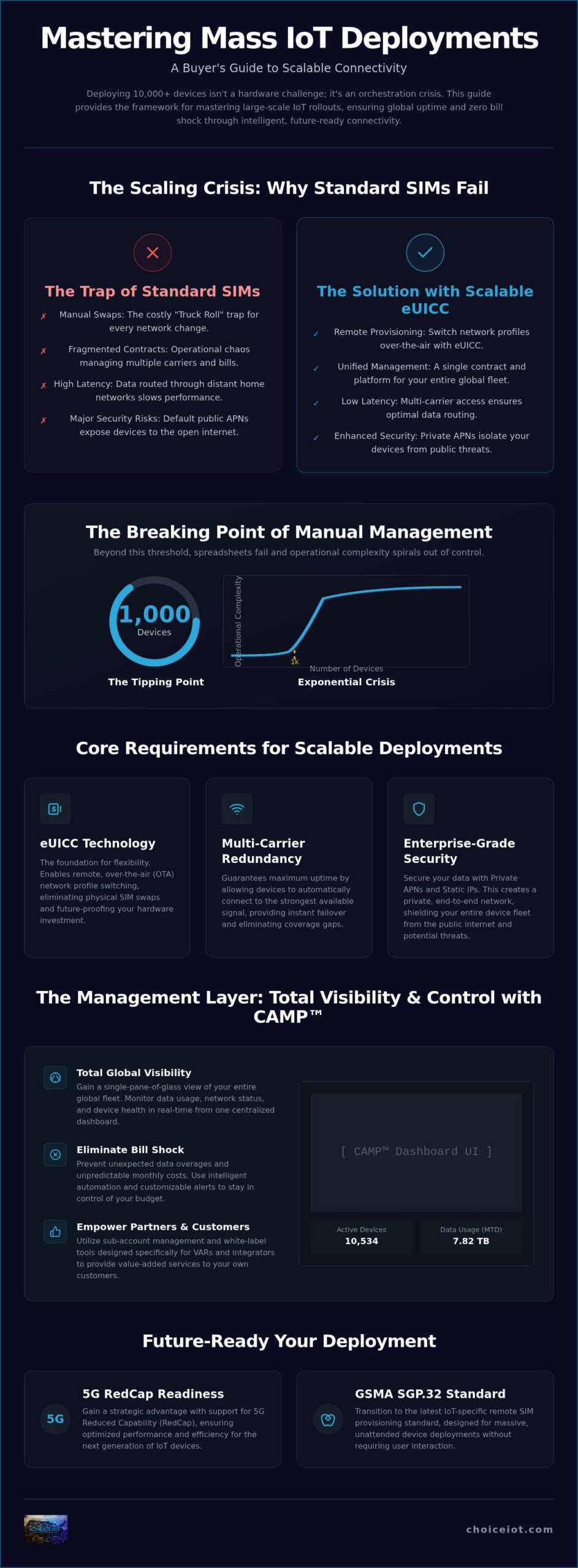
Deploying ten thousand devices isn’t a hardware challenge. It’s an orchestration crisis. Most enterprises realize too late that the plastic in the slot matters far less than the management layer behind it. If you’re searching for the best iot sim for large scale deployment, you aren’t just buying connectivity. You’re buying the ability to scale without friction.
We understand the pressure of global expansion. Manual provisioning for thousands of units is unsustainable. Security vulnerabilities in public APNs are unacceptable. You need total control. This 2026 buying guide delivers a framework to master mass IoT rollouts. We’ll show you how to guarantee global uptime and achieve zero bill shock through intelligent automation and multi-carrier flexibility.
We will explore the critical transition to GSMA SGP.32 standards, the strategic advantage of 5G RedCap, and how a single-pane-of-glass platform like CAMP™ simplifies complex fleet management. It’s time to replace logistical stress with predictable, secure, and rapid deployment. Let’s build a foundation that scales as fast as your business.
Key Takeaways
- Stop managing fragmented carrier contracts and learn how to eliminate physical SIM swaps with network-agnostic connectivity.
- Identify the technical criteria for the best iot sim for large scale deployment including eUICC capabilities and 5G Redcap readiness.
- Gain total visibility over your global fleet using the CAMP™ platform to prevent data overages and unexpected monthly costs.
- Simplify hardware rollouts by mastering the carrier certification process and securing your data with Private APN and Static IP addresses.
- Empower your customers through sub-account management and white-label tools designed specifically for VARs and integrators.
The Reality of Large-Scale IoT: Why Standard SIMs Fail
Deploying a dozen sensors in a lab is straightforward. Scaling that to 50,000 units across three continents is where most projects collapse. The primary culprit is often the reliance on standard, consumer-grade SIM cards. These cards are engineered for individual users, not enterprise-level industrial environments. They lack the resilience, management features, and flexibility required to sustain a massive rollout. Scale is a different beast. It demands a specialized approach to connectivity.
The “Truck Roll” trap is the most immediate threat to your ROI. Imagine your carrier changes their roaming agreement or increases their data rates. If your devices are already in the field, you face a grim choice: absorb the bill shock or send a technician to manually swap every physical card. For a large fleet, the labor costs alone will exceed the hardware value. This is why the best iot sim for large scale deployment must leverage eSIM technology. Remote provisioning allows you to switch network profiles over-the-air. No trucks. No manual labor. Total control.
Managing fragmented carrier relationships adds another layer of friction. Dealing with five different contracts, five support portals, and five distinct billing cycles is an operational disaster. It drains resources and obscures your total cost of ownership. There’s also the latency tax to consider. Standard roaming agreements often route data through a home network thousands of miles away. This lag degrades performance for mission-critical applications like autonomous robotics or real-time medical monitoring. High latency isn’t just a nuisance; it’s a failure point.
The Hidden Costs of Unmanaged Connectivity
Unmanaged connectivity hides its true price in operational overhead. Manual provisioning for a massive rollout is a recipe for error. One misconfigured device can lead to a security breach if it’s left on a public APN. These default settings expose your hardware to the open internet, making them easy targets for botnets. Additionally, signal dead zones in remote areas lead to data gaps. Without multi-carrier redundancy, a single network outage becomes a total service failure. Reliability shouldn’t be a gamble.
Identifying the Breaking Point of Your Current Fleet
When does manual management become mathematically impossible? For most organizations, the breaking point occurs at the 1,000-device mark. Beyond this, spreadsheets fail. If you’re planning 10,000+ device increments, you need an automated management layer. In sectors like healthcare or logistics, even an hour of downtime is catastrophic. If your current provider can’t offer a Private APN or a single-pane-of-glass view, they are a liability to your growth. The best iot sim for large scale deployment is a software solution as much as it is a hardware one.
Technical Requirements for Mass Deployment: Multi-Carrier and eUICC
Success in mass rollouts hinges on two pillars: redundancy and remote management. Finding the best iot sim for large scale deployment requires a shift from consumer-grade thinking to industrial-grade specifications. In 2026, eUICC serves as the critical architectural foundation for global deployments by enabling remote, over-the-air profile switching without physical hardware intervention. This technology, paired with multi-carrier access, ensures your devices aren’t tethered to a single point of failure. It’s about building a future-proof fleet.
Experts discussing the Future of IoT Connectivity emphasize that software-defined networking is now mandatory for enterprise resiliency. Multi-carrier SIMs provide a network-agnostic approach. They allow hardware to connect to the strongest available signal across multiple providers. This eliminates the “dead zone” risk. It also simplifies your supply chain. You can ship one SKU globally and manage the local carrier profile remotely via the cloud. Efficiency becomes your default setting.
Multi-Carrier vs. Single-Network SIMs
Single-network SIMs are a liability at scale. If a major carrier experiences a regional outage, your entire fleet goes dark. Multi-carrier solutions provide instant failover. When one network drops, the device automatically handshakes with the next strongest tower. This optimization happens at the chipset level. It ensures maximum uptime regardless of the local zip code. It’s about stability and predictable performance across diverse geographies.
Enterprise Security: Private APN and Static IPs
Standard connectivity exposes your devices to the public internet. This is a non-starter for enterprise IoT. A Private APN creates a secure “walled garden.” It isolates your data traffic from the public web. This prevents unauthorized access and eliminates the risk of botnet recruitment. Pairing this with a Static IP Address is essential for bi-directional M2M communication. It allows your central server to reach out to specific devices for remote troubleshooting or updates. Security isn’t an add-on; it’s the foundation.
Achieving this level of security and uptime shouldn’t be complex. Choosing a partner that offers integrated Multi-Carrier IoT SIM solutions can streamline your entire security posture from day one.
Centralized Management: Eliminating Bill Shock and Operational Friction
Scaling a fleet to thousands of units introduces a logistical burden that traditional carrier portals cannot handle. If you’re searching for the best iot sim for large scale deployment, the hardware is only half the equation. The other half is the management layer. Without a centralized platform, your team will spend hundreds of hours on manual provisioning and reactive troubleshooting. Control must be absolute. Visibility must be real-time. Efficiency must be the default state.
The CAMP™ IoT Platform serves as a single pane of glass for your entire global operation. It aggregates data from multiple carriers into one intuitive interface. This eliminates the need to toggle between different vendor systems. You can manage the entire lifecycle of a SIM from activation to retirement with surgical precision. Automation replaces manual effort. This centralized approach removes the friction of managing fragmented carrier relationships and allows your team to focus on core business growth rather than connectivity logistics.
Mastering the CAMP™ IoT Platform
Real-time monitoring is the first line of defense against operational drift. You can identify rogue devices or hardware malfunctions in seconds, not days. Bulk actions allow you to activate 5,000 SIMs with a single click. This speed is essential for rapid hardware rollouts. Detailed reporting provides the data needed for compliance audits and cost optimization. It’s about having total command over your digital infrastructure. For solution providers, this level of transparency is non-negotiable.
Avoiding the ‘Bill Shock’ Nightmare
Data overages are the silent killer of IoT ROI. A single malfunctioning device can consume gigabytes of data in hours, leading to thousands of dollars in unexpected fees. You can prevent IoT bill shock by setting custom data thresholds and automated suspension rules. If a device exceeds its limit, the system shuts it down instantly. No surprises. No financial leaks. This proactive stance ensures your monthly connectivity costs remain entirely predictable.
Data pooling offers a superior alternative to rigid per-device caps. In a pooled model, your entire fleet shares a massive bucket of data. This allows “chatty” devices to be offset by those with lower consumption. It creates a stable cost structure that scales gracefully with your business. For VARs and integrators, this flexibility is a major competitive advantage. You can offer your customers stable pricing while maintaining healthy margins. The best iot sim for large scale deployment is one that protects your bottom line as effectively as it connects your devices.
Streamlining the Rollout: Carrier Certification and 5G Redcap
Operational efficiency doesn’t end with a management platform. The final hurdle to a successful rollout is the hardware itself. Many enterprises select the best iot sim for large scale deployment only to find their devices blocked by major network providers. This isn’t a software glitch. It’s a compliance failure. Navigating the intersection of hardware modules and specific network requirements is essential for maintaining momentum during a mass market entry.
Navigating Carrier Device Certification Services
Leading US network providers require every device on their infrastructure to undergo rigorous testing. This is the “invisible hurdle” that stalls deployments for months. If your hardware lacks the proper certification, it faces an immediate network boot-off. This unauthorized device rejection can kill a pilot program before it starts. Choice IoT removes this friction. We offer direct Carrier Device Certification support to accelerate your timeline. We ensure your modules are compliant before they ever reach the field. Don’t let a lab-tested prototype fail in the real world due to a missing certification stamp.
5G Redcap for Industrial Scaling
The connectivity landscape in 2026 is defined by 5G Redcap (Reduced Capability). This technology fills the critical gap between low-power LTE-M and high-bandwidth 5G. It’s the perfect middle ground for industrial IoT. 5G Redcap offers the high speed needed for video surveillance or industrial sensors while maintaining the low power consumption required for long-term battery life. It reduces hardware costs significantly compared to full 5G modules. This makes it a primary choice for fleets scaling into the tens of thousands. It’s about future-proofing. Deploying Redcap-ready hardware today ensures your fleet remains relevant for the next decade of network evolution.
Moving from a single prototype to 100,000 units requires a methodical roadmap. It starts in the lab. It ends with global dominance. Follow these five steps for a seamless transition:
- Module Selection: Choose hardware that supports multi-carrier profiles and 5G Redcap.
- Carrier Certification: Secure approval from major providers to avoid network rejection.
- Pilot Integration: Deploy 100 units to test signal strength and data consumption.
- Management Layer Setup: Integrate the CAMP™ platform for real-time fleet visibility.
- Mass Activation: Execute bulk provisioning to bring thousands of devices online simultaneously.
The complexity of industrial IoT demands an authoritative partner. You can bypass the technical bottlenecks and accelerate your time-to-market with our specialized Carrier Device Certification services.
Partnering for Scale: Why Solution Providers Choose Choice IoT
Scaling an IoT business requires more than just hardware. It requires a strategic alliance. For VARs and integrators, the best iot sim for large scale deployment is one that integrates into their own service offering. Choice IoT doesn’t just sell connectivity. We provide the infrastructure for you to build a recurring revenue machine. Our systems are engineered to remove the friction of middleman logistics, allowing you to focus on client acquisition and retention. Efficiency is the goal. Profitability is the result.
Managing thousands of connections for dozens of different clients is an operational nightmare without the right tools. Sub-account management within our platform solves this. You can grant your customers visibility into their specific fleet while maintaining master control. It’s about empowering your clients without losing your oversight. We also provide expert guidance for complex network configurations. Whether you’re setting up a Private APN or navigating carrier certifications, our technical support team acts as your behind-the-scenes expert. We solve the hurdles so you don’t have to. Reliability is our baseline.
White-Label IoT Management for Resellers
Branding is equity. You can brand the CAMP™ platform as your own proprietary solution. This white-label capability allows you to present a high-performance, unified management portal to your end-users. You set the custom margins. You define the billing cycles. You own the customer relationship. By utilizing multi carrier iot sim cards across every vertical, you create a versatile service portfolio. This transition to connectivity-as-a-service builds the long-term value of your firm. It’s about total ownership and simplified growth.
The Choice IoT Roadmap to 2026 and Beyond
Innovation is constant. We are continuously expanding our footprint through Tier-1 carrier partnerships and advancements in fixed wireless connectivity for business. This ensures your deployments remain future-proof as 5G Redcap and eUICC technology become the global standards. Our roadmap is designed to keep you ahead of the curve. We provide the stability of an established provider with the agility of a bold innovator. Your growth is our primary metric of success. Let’s build the foundation for your next ten thousand devices.
Ready to master the complexities of your next rollout? Consult with a Choice IoT expert today to scale your deployment.
Future-Proof Your Global IoT Infrastructure
Massive IoT rollouts fail when complexity outpaces control. Standard connectivity creates bottlenecks, from manual provisioning to catastrophic bill shock. Success in 2026 requires more than a simple data plan. It demands a sophisticated management layer and hardware certified for the world’s largest networks. By prioritizing multi-carrier redundancy and eUICC technology, you ensure your fleet remains agile. Total visibility. Zero friction. Rapid scale.
The best iot sim for large scale deployment is a gateway to a streamlined, secure operation. Choice IoT provides the essential foundation for this growth. With the CAMP™ IoT Platform, you gain total control over every device. Our expert Carrier Device Certification support removes the technical hurdles that stall market entry. You receive multi-carrier redundancy across Tier-1 networks, ensuring your data moves without interruption. It’s about building on a foundation that’s already mastered the industry’s most complex hurdles.
Scale your IoT deployment with Choice IoT’s CAMP™ Platform today.
Stop managing connectivity logistics and start growing your business. You’re ready to deploy with confidence and master the complexities of mass rollouts. Let’s get to work.
Frequently Asked Questions
What is the best IoT SIM for large scale deployment in 2026?
The best iot sim for large scale deployment in 2026 is a multi-carrier eUICC solution that supports 5G Redcap. This combination ensures global network redundancy while allowing for remote, over-the-air profile updates. It eliminates the need for expensive physical SIM swaps. High-performance fleets require this level of hardware flexibility and network-agnostic connectivity to maintain uptime across diverse geographies and carrier territories.
How do I prevent bill shock when managing thousands of IoT devices?
Preventing bill shock requires automated management and data pooling. Use the CAMP™ platform to set custom data thresholds and automated suspension rules for every device in your fleet. If a rogue device malfunctions and consumes excessive data, the system shuts it down instantly. Data pooling further mitigates risk by sharing a large data bucket across your entire deployment. This balances “chatty” devices with low-consumption units for a predictable monthly cost.
What is the difference between eUICC and standard IoT SIM cards?
Standard IoT SIMs are hardcoded to a single carrier, while eUICC cards are programmable and network-agnostic. eUICC technology allows you to switch carrier profiles remotely without touching the device hardware. This is essential for global deployments where roaming agreements may change or signal strength fluctuates. It turns your connectivity into a software-defined asset. Standard SIMs, by contrast, require a physical swap for every carrier change, which is unsustainable at scale.
Why is carrier device certification necessary for mass rollouts?
Carrier device certification is a mandatory compliance step for accessing major US infrastructure and Tier-1 networks. Without this certification, providers will identify your hardware as an unauthorized device and boot it off the network. This process ensures your device doesn’t degrade network performance or cause interference. Securing expert support for this certification accelerates your timeline and prevents costly hardware rejections during the critical mass rollout phase.
Can I manage multiple carriers through a single platform?
Yes, you can manage multiple carriers through a single-pane-of-glass platform like CAMP™. This centralized approach aggregates data from different network providers into one interface. It eliminates the operational friction of logging into multiple carrier portals. You gain a unified view of your entire global fleet, allowing for bulk activations, real-time monitoring, and consolidated billing. Efficiency is maximized when your team manages one system rather than five.
What are the benefits of a Private APN for large IoT fleets?
A Private APN creates a secure, isolated “walled garden” for your device data, keeping it off the public internet. This isolation prevents unauthorized access and protects your fleet from botnet attacks or hacking attempts. It also allows for custom routing and enhanced data privacy. For large fleets, a Private APN ensures that data traffic remains predictable and secure, which is a non-negotiable requirement for industrial and healthcare applications.
How does 5G Redcap improve large-scale industrial IoT?
5G Redcap (Reduced Capability) provides a high-efficiency middle ground between low-power LTE-M and high-bandwidth 5G. It offers the necessary speed for industrial sensors and video surveillance while significantly reducing battery consumption and hardware costs. This makes it ideal for future-proofing large-scale deployments. It ensures your devices remain compatible with evolving network standards for the next decade without the overhead of full-scale 5G modules.
Does Choice IoT offer white-label management portals for VARs?
Yes, Choice IoT provides white-label management portals specifically designed for VARs and integrators. You can brand the CAMP™ platform as your own proprietary solution to build recurring revenue and client loyalty. The system includes sub-account management tools, allowing you to give your customers control over their specific fleets while you maintain master visibility. It’s a complete infrastructure for solution providers looking to scale their connectivity-as-a-service business.