

Scaling across borders shouldn’t feel like a gamble with your bottom line. You’ve likely dealt with the fallout: devices going dark in restricted regions due to permanent roaming bans or a surprise invoice that erases a year’s worth of ROI. It’s frustrating to juggle ten different carrier portals just to keep a single fleet online. You expect connectivity to be seamless. The reality of global iot deployment challenges in 2026 is a fragmented landscape of regulatory shifts and unpredictable data costs. Total control feels out of reach. Logistics shouldn’t dictate your strategy.
We understand the pressure to perform. This guide identifies the critical hurdles of international scaling and provides the strategic framework you need to maintain connectivity, security, and cost control. You’ll discover how to navigate the shift toward new standards and leverage centralized management to eliminate operational friction. We’re moving past the chaos. It’s time to build a future-proof deployment that works as hard as your hardware does. Reliable. Scalable. Simple.
Key Takeaways
- Navigate regulatory minefields. Understand how to bypass permanent roaming bans and comply with evolving data sovereignty laws across international borders.
- Solve global iot deployment challenges. Eliminate the operational friction of managing multiple carrier portals by centralizing your fleet through a single management platform.
- Harden your data security. Replace vulnerable public internet routing with Private APN and Static IP configurations for secure, end-to-end global transmission.
- Eliminate financial surprises. Prevent unpredictable data costs and bill shock by deploying automated threshold alerts and real-time usage visibility.
- Ensure redundant connectivity. Leverage a multi-carrier SIM strategy to maintain consistent uptime and redundant global coverage for your entire device fleet.
Navigating the Complexity of Global IoT Deployments
Global connectivity isn’t just about hardware. It’s a multi-layered infrastructure challenge. While domestic projects often rely on a single carrier and a predictable regulatory environment, crossing international borders introduces a web of technical and legal hurdles. You aren’t just managing devices; you’re managing geopolitical boundaries. This is where many Internet of Things initiatives lose momentum. Success in 2026 requires moving beyond basic connectivity. It demands a unified strategy that accounts for regional carrier nuances and shifting technical standards. Total visibility. No surprises. Seamless execution.
The landscape is shifting rapidly. We’re seeing a massive transition from legacy 4G networks to 5G Redcap in global markets. This isn’t just a speed upgrade. It’s a fundamental change in how industrial sensors and low-power devices communicate. For VARs and integrators, the primary hurdle is no longer just getting a signal. It’s maintaining that signal while navigating global iot deployment challenges like local data laws and carrier interoperability. You need a framework that handles the complexity so you can focus on growth.
The Transition from Domestic to International
Local network logic fails in a global context. In your home market, you likely depend on one relationship and one portal. That logic shatters when you scale. Fragmented carrier relationships are a silent killer of ROI. Each new country adds a new management interface, different billing cycles, and unique technical requirements. You lose hours to administrative overhead. Connectivity becomes a liability instead of an asset. Global IoT Scaling is a strategic business shift that replaces regional silos with a centralized, borderless framework. Don’t let paperwork dictate your deployment speed.
Why Scalability is the #1 Failure Point
The Logistics Wall is real. Shipping hardware is only half the battle. Provisioning thousands of devices for disparate markets often leads to operational collapse. Managing devices across twenty time zones isn’t just difficult; it’s a drain on resources. By 2026, the impact of 5G Redcap on industrial sensors will be undeniable. It offers the efficiency needed for massive sensor arrays but adds another layer of hardware certification requirements. If your deployment can’t handle these shifts, it will fail. Scaling requires automation. It requires a single pane of glass to manage the inevitable global iot deployment challenges that arise as your fleet grows. Precise control. Rapid activation. Zero friction.
Structural Challenges: Regulation, Roaming, and Resilience
Regulatory compliance is the foundation of uptime. Many enterprises overlook the structural barriers that trigger mass disconnections. These are the core global iot deployment challenges that turn a pilot program into a logistical nightmare. It isn’t just about signal strength. It’s about the legal right to transmit data across a specific border. Without a localized strategy, your fleet is a liability. Total compliance. Zero downtime. Global reach.
The transition from legacy 2G and 3G networks to 4G and 5G is no longer a future roadmap item. It is a current requirement. Network sunsetting has already rendered thousands of legacy devices obsolete in major markets. Managing this transition requires an agile hardware strategy and a connectivity partner that understands the sunsetting timeline of every regional carrier. Don’t wait for a blackout to upgrade your infrastructure.
Permanent Roaming Restrictions
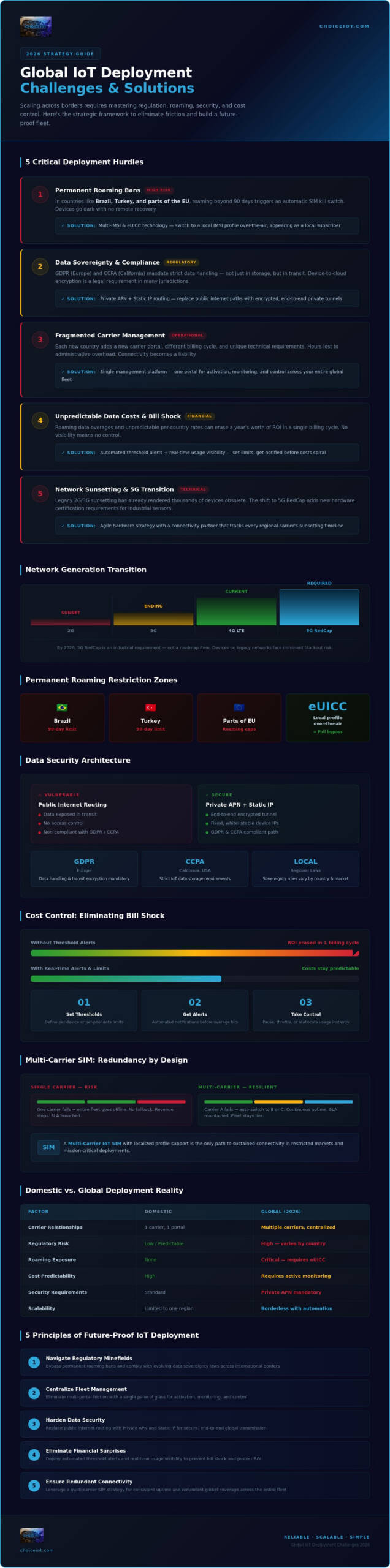
Carriers protect their revenue. Permanent roaming is the primary target. In countries like Brazil, Turkey, and even parts of the EU, roaming for more than 90 days results in an automatic kill switch. Your devices go dark. There is no remote fix once a SIM is permanently blocked by a local carrier. You need localized profiles to survive. Advanced Multi-IMSI technology and eUICC capabilities allow you to switch to a local IMSI over-the-air. This bypasses roaming bans by appearing as a local subscriber. It ensures long-term resilience for stationary assets like smart meters or industrial sensors. If you are targeting restricted markets, a Multi-Carrier IoT SIM with localized profile support is your only path to sustained connectivity.
Data Sovereignty and Compliance
Where does your data live? Laws like GDPR in Europe and CCPA in California dictate strict handling and storage requirements for IoT traffic. It isn’t just about the cloud; it’s about the transit. Regulatory requirements often mandate device-to-cloud encryption to prevent data interception. Navigating these global iot deployment challenges requires a deep understanding of regional standards.
- Data Residency: Ensuring metadata and payloads remain within specific geographic boundaries.
- Encryption Standards: Implementing TLS 1.3 or higher for all international traffic.
- Carrier Certification: Streamlining hardware approval to meet local carrier technical specifications.
Proper certification ensures your hardware is cleared for use before it ever leaves the warehouse. This proactive approach eliminates customs delays and technical rejections. Secure your data. Protect your brand. Streamline your operations.
Technical Hurdles in Connectivity Management
Technical hurdles often hide behind the promise of global coverage. While structural barriers define where you can operate, technical friction defines how well you operate. Managing a diverse fleet requires more than just a signal. It requires precision. Portal fatigue is a productivity killer. Logging into fifteen different carrier portals to manage fifteen different regions is an operational failure. You lose time. You miss critical alerts. You lose control. Centralized management is no longer optional. It is the baseline for efficiency.
Interoperability adds another layer of friction. Choosing between NB-IoT and Cat-M isn’t always a binary decision; it’s often dictated by regional carrier availability. By 2026, 5G Redcap has emerged as the essential bridge for mid-speed industrial applications. It offers the performance of standard 5G without the power drain. This makes it ideal for global deployments that require a balance of longevity and throughput. Mastering these global iot deployment challenges means aligning your hardware capabilities with the specific cellular standards of your target markets. Total visibility. Instant control.
Fragmented Carrier Ecosystems
Inconsistent APN settings are a major source of global iot deployment challenges. Every carrier has its own configuration requirements. If your devices aren’t pre-configured or dynamically updated, they won’t connect. Remote troubleshooting becomes impossible without local boots on the ground. You can’t afford to fly an engineer halfway across the world to fix a configuration error.
- Single-Carrier SIMs: Tie you to one network’s technical limitations and localized outages.
- Multi-Carrier IoT SIMs: Provide the flexibility to switch networks based on signal quality or regional requirements.
- Centralized Provisioning: Use a platform like the CAMP™ IoT Platform to push updates to your entire fleet simultaneously.
Automated updates. Reduced risk. Streamlined operations.
Latency and Quality of Service (QoS)
Latency is the silent enemy of real-time applications. Routing data from a sensor in Singapore back to a home core network in New York increases ‘ping’ times significantly. This delay breaks time-sensitive logic. Local breakout (LBO) is the technical solution. By processing data closer to the device, you maintain high performance and reliable Quality of Service. High-speed response. Reliable data flow. Optimized performance. Investing in low-latency connectivity in 2026 directly correlates to higher operational ROI by enabling real-time decision-making and reducing system downtime. Don’t let distance degrade your data value.
Security and Operational Visibility at Scale
Security at the edge is often the weakest link in international fleets. Relying on public internet routing exposes your data to interception and botnet infiltration. This is one of the most critical global iot deployment challenges because a single breach can compromise your entire network. You need a centralized security policy that applies regardless of which carrier is providing the signal. Total visibility. Absolute control. Secure transit. Operational visibility isn’t just about knowing if a device is online. It’s about knowing exactly how it’s communicating and at what cost. Centralizing these policies across a multi-national fleet ensures that your security posture remains rigid even as your geography expands.
Operational friction often stems from a lack of remote management capabilities. Static IPs play a vital role here. They allow your technical teams to ‘ping’ or log into a device for remote troubleshooting and firmware updates. Without a Static IP, you’re often left in the dark when a device stops responding in a foreign market. This capability turns a potential service call into a five minute remote fix. Efficiency at scale. Reduced truck rolls. Maximum uptime.
Securing the Global Edge with Private APNs
Public APNs are a magnet for automated botnet attacks. They leave your devices exposed to the open web, making them easy targets for unauthorized access. A Private APN acts as a secure tunnel, isolating your IoT traffic from public threats. This security remains consistent even as your devices hop between carriers across different continents. When you pair a Private APN with a Static IP Address, you gain the ability to establish bi-directional communication. You can push updates or pull logs securely. It’s about maintaining a fortress around your data. Secure the perimeter. Eliminate exposure. Protect the asset.
Preventing ‘Bill Shock’ Through Real-Time Monitoring
Budget predictability is an operational necessity. ‘Zombie’ devices, units that continue to transmit data while malfunctioning or after being decommissioned, can trigger massive invoices in international roaming zones. You can’t wait thirty days for a billing cycle to catch an error. High roaming rates mean a single runaway device can erase your monthly margin. AI-driven data usage alerts are the solution. They provide real-time notification when a device exceeds its threshold, allowing for immediate suspension or adjustment. For more strategies on controlling costs, see our guide on Preventing IoT Bill Shock: Data Usage Management Tips.
Managing security and costs across borders shouldn’t be a manual process. You need a platform that automates protection and oversight while addressing the core global iot deployment challenges of 2026. Deploy Private APN and Static IP solutions to harden your global infrastructure and gain total visibility today.
Overcoming Deployment Hurdles with Choice IoT
Navigating the 2026 landscape requires an ecosystem built for enterprise precision. You’ve identified the risks of roaming bans, security gaps, and latency. Now you need a solution that scales without adding operational overhead. Managing global iot deployment challenges requires more than just a SIM card. It requires a centralized engine designed to eliminate fragmentation. Choice IoT provides the infrastructure to consolidate your international efforts. Total centralization. Redundant coverage. Simplified logistics. We turn complexity into a competitive advantage.
Redundancy is the backbone of global uptime. Our multi-carrier SIM strategy ensures that your devices aren’t tethered to a single point of failure. If one network goes down or a roaming agreement shifts, your fleet remains online through alternative local carriers. This redundant global coverage is essential for mission-critical applications where data gaps aren’t an option. Reliable connectivity. Everywhere. Every time.
Centralized Control via CAMP™
Portal fatigue ends here. The CAMP™ IoT Platform serves as your single pane of glass for every device in your fleet, regardless of its geographic location. You don’t need fifteen tabs to manage fifteen countries. Provision new units in seconds. Monitor real-time data usage to identify anomalies. Kill SIMs instantly to prevent overages. This level of granular control is the antidote to operational friction. For VARs and integrators, CAMP™ offers even more value through customizable reporting. You can provide your end-users with the transparency and data visibility they demand without building your own interface. Automated lifecycle management ensures your fleet remains optimized. One login. Total control. Zero friction.
Future-Proofing Your Global Strategy
Staying ahead of the market means adopting standards before they become mandatory. 5G Redcap is the new standard for cost-effective global IoT, offering the mid-speed performance industrial applications require at a fraction of the cost of full 5G. We’ve integrated 5G Redcap support to ensure your deployments are future-proof from day one. To further accelerate your timeline, our Carrier Device Certification services streamline the path to market. We handle the technical approval process so you can ship hardware faster. No more regional approval delays. No more technical rejections.
Security remains the ultimate priority. By leveraging Private APN configurations, we provide enterprise-grade protection that travels with your devices. Your data stays within a secure tunnel, isolated from the threats of the public internet. This infrastructure addresses the most demanding global iot deployment challenges by combining connectivity with a rigid security posture. Build your foundation on a platform designed for scale. Scale your global IoT deployment with Choice IoT today.
Mastering Your International Connectivity Strategy
Success in 2026 requires moving beyond basic connectivity. You’ve seen how roaming restrictions and fragmented carrier portals can stall growth. Success depends on a centralized approach that treats security and cost control as a single priority. By leveraging multi-carrier SIMs and Private APN technology, you protect your fleet from both connectivity blackouts and cyber threats. Total visibility. Absolute control. Secure transit. These aren’t just features; they’re the foundation of international scale.
Mastering global iot deployment challenges is a strategic necessity for any enterprise looking to expand. You don’t have to manage the complexity alone. Our proprietary CAMP™ IoT management platform gives you the single pane of glass needed to provision, monitor, and secure your devices anywhere in the world. With specialized expertise in Static IP security and global redundancy, we ensure your infrastructure is as robust as your ambition. It’s time to eliminate the friction and focus on what you build best. Build with confidence. Scale with ease.
Simplify Your Global IoT Deployment with CAMP™
Frequently Asked Questions
What are the most common regulatory challenges for global IoT?
Data residency laws and sovereignty requirements are the most frequent regulatory hurdles. Many nations now mandate that IoT data remain within national borders for processing and storage. Navigating these global iot deployment challenges requires localized data routing and strict compliance with regional standards like GDPR. Proactive legal mapping ensures your traffic remains compliant and avoids heavy fines.
How do I avoid permanent roaming restrictions in international markets?
Deploy Multi-IMSI or eUICC technology to switch to localized profiles over-the-air. This capability allows your device to appear as a local subscriber instead of a roamer. It effectively bypasses the 90-day roaming limits enforced in restrictive markets like Brazil or Turkey. Localized connectivity is the only way to ensure long-term uptime for stationary assets. Resilience through localization.
What is the difference between an IoT SIM and a regular roaming SIM?
An IoT SIM is engineered for industrial longevity and centralized management. Unlike a regular roaming SIM; it offers granular control over data thresholds and remote provisioning via a dedicated platform. It’s built to survive harsh environments and provides access to multiple carriers for redundant coverage. Regular consumer SIMs lack the visibility and durability needed for enterprise-scale fleets.
Why is centralized management critical for global IoT deployments?
Centralized management eliminates portal fatigue by consolidating multiple carrier relationships into a single interface. Managing devices across different time zones and networks is impossible without a single pane of glass. It reduces operational friction. This approach allows for instant provisioning and fleet-wide security updates from one dashboard. Solving global iot deployment challenges starts with total visibility. Efficiency drives ROI.
How does 5G Redcap solve global connectivity issues in 2026?
5G Redcap provides a mid-speed connectivity tier that balances performance with power efficiency. It allows industrial sensors to leverage 5G infrastructure without the high cost or complexity of full-bandwidth modules. This makes it a future-proof choice for global deployments where longevity is a priority. It bridges the gap between legacy networks and high-performance 5G. Scalability meets efficiency.
Can a Private APN improve global IoT security?
Yes; a Private APN creates a secure tunnel that isolates your IoT traffic from the public internet. This prevents your devices from being targeted by automated botnet attacks or unauthorized scans. When combined with a Static IP; it allows for secure bi-directional communication for remote troubleshooting. You gain total control over your network perimeter. Secure transit is non-negotiable for enterprise data.
What is carrier device certification and why do I need it?
Carrier device certification is the formal approval process required by mobile operators to ensure hardware doesn’t disrupt their network. You need it to prevent your devices from being blocked or rejected during international deployment. Streamlining this process through an expert partner reduces time-to-market significantly. It ensures your hardware is cleared for global use before it leaves the warehouse.
How can I prevent unexpected data overage costs on global SIMs?
Deploy automated threshold alerts and real-time monitoring to catch usage spikes before they turn into bill shock. Malfunctioning devices can quickly drain budgets if left unchecked in international roaming zones. A management platform like CAMP™ allows you to set hard limits or receive instant notifications of unusual activity. Proactive oversight is the only way to maintain cost control at scale.