

Unpredictable connectivity costs aren’t an IoT inevitability. They’re a symptom of an unoptimized architecture. If you’re currently struggling with manual SIM monitoring or inefficient protocol overhead, you’ve seen how quickly data waste erodes your ROI. It’s a common hurdle for scaling enterprises. We’re here to help you clear it. This guide provides a strategic framework for how to reduce iot data usage by targeting the “invisible” overhead that inflates your monthly billing and complicates your operations.
You’ll learn to audit your deployment, implement leaner device communication, and prevent bill shock before it happens. We focus on total infrastructure control. Our checklist covers everything from protocol efficiency to the strategic use of Private APNs and centralized management platforms for real-time monitoring. Expect predictable billing. Demand total transparency. We’ll show you how to transform your IoT network into a high-performance engine that prioritizes both scalability and cost-effectiveness. It’s time to stop reacting to data spikes and start commanding your connectivity with absolute confidence.
Key Takeaways
- Discover how to reduce iot data usage by transitioning from verbose formats like JSON to efficient binary payloads and optimized transport protocols.
- Minimize background noise and prevent network congestion by implementing delta-based FOTA updates and staggered deployment schedules.
- Eliminate unauthorized inbound traffic and public internet noise through the strategic deployment of Private APNs and Static IPs.
- Secure total visibility over your SIM estate using real-time monitoring and automated usage alerts to stop runaway data consumption instantly.
- Scale your deployment with confidence by right-sizing connectivity plans and utilizing multi-carrier SIMs to eliminate unnecessary roaming overhead.
Audit Your Communication Protocols and Payloads
Data waste isn’t just a billing issue. It’s a design failure. Many enterprises launch deployments using standard web protocols without realizing how quickly “invisible” overhead accumulates across thousands of devices. If you want to master how to reduce iot data usage, you must start at the architectural level. Every byte of header data and every redundant heartbeat signal represents a direct hit to your ROI.
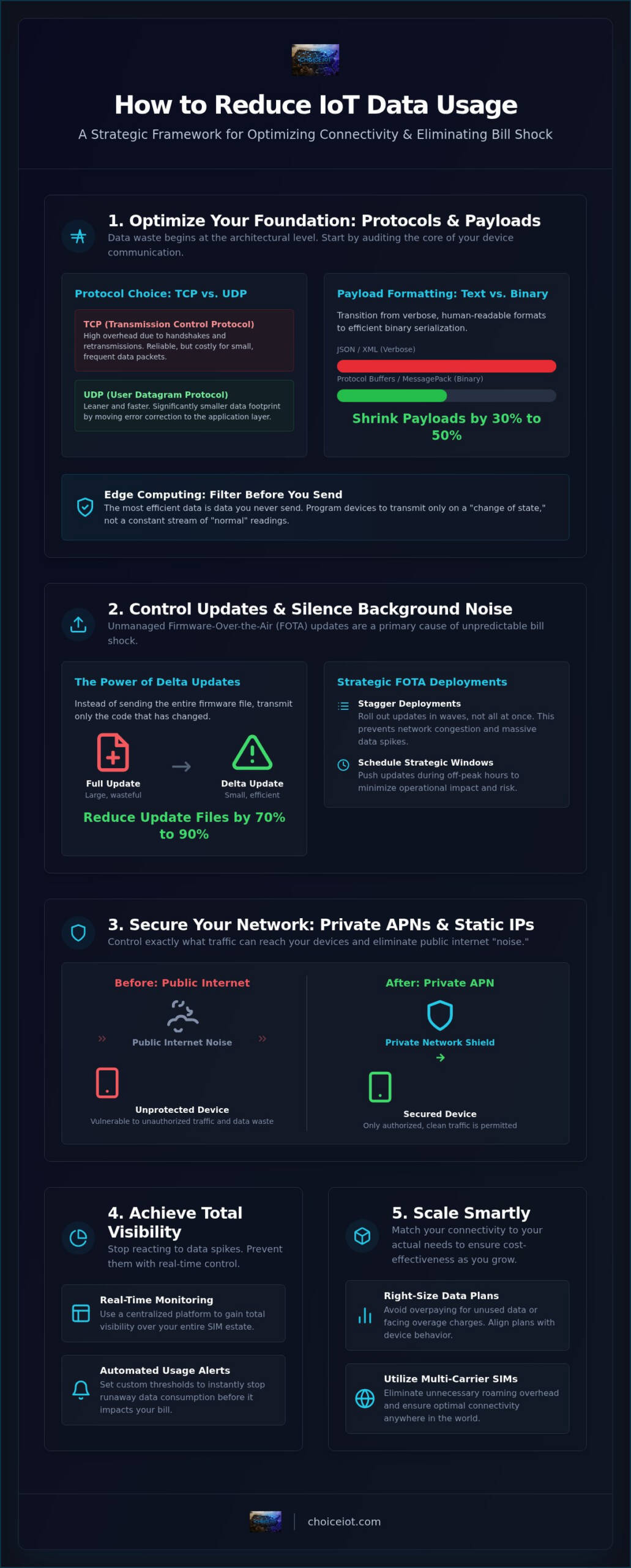
The choice between TCP and UDP is your first strategic decision. TCP provides reliability through handshakes and retransmissions, but this comes at the cost of high data overhead. For many applications within the Internet of Things (IoT), UDP is the superior choice. It’s leaner and faster. While it lacks built-in error correction, moving that logic to the application layer often results in a significantly smaller data footprint. Stop paying for the “chatter” of connection management when your application only needs to deliver a simple sensor reading.
Payload formatting is the next target. Verbose formats like JSON and XML are human-readable but computationally expensive and data-heavy. Transitioning to binary serialization formats, such as Protocol Buffers or MessagePack, can shrink your payloads by 30% to 50% instantly. You aren’t just saving on transmission costs; you’re also extending the battery life of your hardware by reducing modem “on-time.”
Checklist: Protocol and Payload Optimization
- Ditch HTTP for MQTT or CoAP: HTTP headers are massive. MQTT and CoAP are designed for constrained environments, offering much smaller headers and more efficient publish/subscribe models.
- Implement Binary Serialization: Use CBOR or MessagePack. These formats pack data into the smallest possible space while maintaining structure.
- Recalibrate Keep-Alive Intervals: Audit your “heartbeat” signals. Extending a 30-second interval to 5 minutes can save megabytes of data per month, per device.
Edge Computing: Filter Before You Send
The most efficient way to handle data is to never send it at all. Edge processing allows your devices to act as intelligent filters rather than passive conduits. Instead of transmitting a constant stream of “everything is normal” telemetry, program your hardware to report only on a “change of state.” If a temperature sensor remains within a safe threshold, the modem should stay dormant.
Aggregation is another powerful tool. Rather than sending ten small packets as they occur, buffer them locally and send them as a single, larger transmission. This reduces the frequency of modem wake-up cycles and minimizes the percentage of total data consumed by protocol headers. Execute local logic to discard redundant data at the source. It’s about sending actionable intelligence, not raw noise. This is the foundation of a lean, scalable IoT strategy.
Manage Firmware Over-the-Air (FOTA) and Background Noise
Security is non-negotiable. However, firmware updates are often the single largest contributor to unpredictable bill shock. A single unmanaged FOTA push across a fleet of 5,000 devices can consume gigabytes of data in a matter of minutes. If you’re investigating how to reduce iot data usage, you must treat firmware management as a high-precision operation rather than a background task. It’s about control. It’s about efficiency.
Stagger your deployments. Launching a global update simultaneously causes network congestion and creates massive, unmanageable data spikes. Instead, roll out updates in waves. This allows you to monitor consumption in real-time and halt the process if a bug causes excessive retransmissions. High-performance deployments rely on delta updates. By transmitting only the fragments of code that have changed, you can reduce update file sizes by 70% to 90%. It’s the difference between a lean patch and a budget-breaking overhaul.
Beyond the big updates, “chattiness” in device-to-cloud handshakes creates a constant, draining noise. Every DNS lookup and every ICMP ping adds up. While these packets seem small, their frequency across a large-scale estate creates significant overhead. You can gain total visibility into these patterns and manage your SIM estate effectively through the CAMP™ IoT Platform, which helps identify runaway devices before they impact your bottom line.
Checklist: Efficient FOTA Strategies
- Verify Delta Support: Ensure your hardware and cloud architecture support incremental updates. Transmitting only changed code is the most effective way to protect your data budget.
- Schedule Strategic Windows: Push updates during off-peak hours. This minimizes the risk of network-induced failures and ensures higher completion rates on the first attempt.
- Execute 1% Dry Runs: Never update the full fleet at once. Test on a small subset to measure the actual data impact against your projections.
Eliminating Silent Data Killers
Background services are often the “silent killers” of an IoT budget. Many default firmware configurations include aggressive DNS lookups and frequent “keep-alive” pings that provide little operational value. Optimize your DNS caching. Program your devices to remember server addresses for longer periods to avoid repetitive queries. Additionally, review your TLS/SSL handshake frequency. Full handshakes are data-heavy; implementing session resumption allows devices to reconnect securely without repeating the entire cryptographic exchange. Small changes. Big savings. Absolute control.
Leverage Private APNs and Static IPs for Traffic Control
Optimization isn’t just about shrinking your own payloads. It’s about securing the perimeter. When a device sits on the public internet, it becomes a target for constant, unsolicited traffic. Bots, port scanners, and malicious actors probe public IP addresses every second. Even if your device rejects these connections, the data used to receive and process the request still counts against your monthly limit. If you’re serious about how to reduce iot data usage, you must move your fleet off the public grid.
A Private Access Point Name (APN) provides this isolation. It creates a private tunnel between your devices and your enterprise network. No public internet noise. No unauthorized inbound packets. By restricting communication to specific IP ranges, you ensure that every byte consumed is intentional and productive. This infrastructure-level security doesn’t just protect your data; it protects your bottom line. It’s a proactive approach to cost management. Total control. Zero waste.
The Data-Saving Power of a Private APN
Public IPs are a liability. They invite background data usage that you can’t control. A Private APN effectively hides your devices from the world. You gain total control over the traffic flow. You define the gateways. You set the rules. A Private APN acts as a network-level firewall that prevents unsolicited external traffic from ever reaching your device’s data bucket. This eliminates the “invisible” data drain caused by hackers scanning for open ports or vulnerable services.
Static IPs and Secure M2M Communication
Dynamic IP addresses create unnecessary chatter. Every time a device reconnects or its lease expires, it must report its new location to your server. This constant “phone home” cycle consumes data that adds no value to your operations. Static IPs eliminate this requirement. Your server always knows exactly where the device is. This is a fundamental step in mastering how to reduce iot data usage across global deployments.
This allows for streamlined remote management. You can push commands or pull logs without waiting for the device to initiate contact. When you combine Static IPs with a Private APN for IoT, you create a high-efficiency environment built for scale. No redundant reporting. No public noise. Just lean, secure, and predictable machine-to-machine communication. It’s about removing friction and maximizing the utility of every packet transmitted.
Implement Real-Time Monitoring and Automated Alerts
Visibility is the foundation of any optimization strategy. If you can’t see a data spike in real-time, you can’t stop it. Many organizations rely on monthly billing statements to catch usage issues, but that’s a reactive approach that guarantees bill shock. Mastering how to reduce iot data usage requires a proactive, centralized platform that monitors every data session as it happens. You need to identify usage outliers instantly. One malfunctioning device shouldn’t compromise the budget of your entire fleet.
Granular alerts are essential. Set triggers at 50%, 75%, and 90% of your data limits. These milestones provide the window needed to investigate and intervene before overages occur. Group your devices by use-case. A fleet of smart meters has a different profile than a network of high-bandwidth gateways. By segmenting your estate, you can “right-size” plans for each group, ensuring you aren’t paying for unused capacity on low-bandwidth devices. Absolute transparency. Immediate action.
Checklist: Connectivity Management Platform Features
A robust platform does more than just show numbers. It enables total control. Use the CAMP™ IoT Platform to manage your multi carrier iot sim cards from one intuitive interface. This centralization removes the friction of jumping between carrier portals. Enable real-time session monitoring to catch anomalies as they occur. Configure automated triggers that move high-usage devices to larger pools dynamically. Efficiency through automation. It’s about working smarter, not harder.
Preventing Bill Shock with Automation
Manual oversight doesn’t scale. Automation does. Define “Normal” usage profiles for your devices and set alerts for any deviation. If a sensor suddenly starts transmitting 200% of its expected volume, it likely has a firmware bug or a security breach. Set up auto-suspend rules to kill the connection immediately. It’s better to have a single offline device than a five-figure overage bill. This is a critical component of how to reduce iot data usage in large-scale deployments.
Implement data pooling and sharing. This allows low-usage devices to offset the spikes of high-usage ones, creating a predictable, balanced monthly cost. You’re no longer penalized for individual device behavior. Instead, you’re managing a collective, optimized resource. Start managing your connectivity with the CAMP™ IoT Platform to ensure total transparency and control over your entire global footprint.
Right-Size Your IoT Data Plans for Scalability
Engineering a lean device profile is only the first step. To truly master how to reduce iot data usage, you must align your commercial structure with your operational reality. Many enterprises overpay for capacity they never use. Others get crushed by overages because they lack a flexible safety net. Scalability requires a plan that breathes with your deployment. It’s about precision. It’s about agility.
Historical usage data is your most valuable asset during this phase. Don’t guess your requirements. Analyze at least three months of transmission patterns to identify the delta between your peak and average consumption. This data tells you whether to opt for fixed individual plans or a larger collective pool. Multi-carrier SIMs are a strategic asset here. They don’t just provide better coverage; they eliminate the data overhead often associated with forced roaming or inefficient network switching. By selecting the best available carrier for every location, you maintain a consistent, lean data profile regardless of geography.
Your IoT needs aren’t static. Your plans shouldn’t be either. Review and adjust your data tiers quarterly to match your evolving deployment needs. If a specific region is seeing higher latency and more retransmissions, adjust the plan to account for that overhead before it hits your bottom line. Negotiate custom tiers based on actual fleet performance rather than industry averages. Demand a partner that offers the flexibility to scale up or down without bureaucratic friction.
Checklist: Selecting the Optimal Plan Structure
- Analyze Pay-As-You-Go vs. Pooled: For massive fleets with variable usage, pooling is almost always superior. It allows low-usage devices to subsidize the outliers, creating a predictable monthly cost.
- Audit Under-Utilized Assets: Identify devices consistently using less than 10% of their allocation. Downgrade them immediately. Don’t pay for digital dust.
- Ensure Tiered Buffers: Verify that your provider offers “no-overage” safety nets. You need a buffer between your standard tier and expensive overage rates to protect your ROI during unexpected spikes.
The Choice IoT Advantage: CAMP™ and Visibility
Transparency is our foundation. The CAMP™ IoT Platform provides the “single pane of glass” needed to identify hidden costs that traditional carrier portals often obscure. You shouldn’t need a degree in forensic accounting to understand your connectivity bill. We provide the data. You make the decisions. Our platform allows you to re-provision SIMs to higher or lower tiers instantly. If a pilot project scales faster than expected, you can adjust your plan in seconds. No bureaucratic delays. No manual paperwork. Just total infrastructure control.
We’ve mastered the complexities of global connectivity so you can focus on growth. If you’re ready to eliminate waste and maximize your ROI, contact Choice IoT for a custom audit of your current IoT data usage. We’ll help you find the inefficiencies you didn’t know existed and build a connectivity foundation that’s ready for the future.
Command Your Connectivity Infrastructure
Efficiency is the benchmark for enterprise-grade IoT. We’ve detailed how to reduce iot data usage by targeting lean protocols, managing firmware updates with precision, and isolating your fleet from public internet noise. True optimization is a multi-layered strategy. It starts with your payloads but ends with total infrastructure control. By implementing Private APN security and AI-driven usage alerts, you eliminate the “invisible” waste that threatens your ROI. You gain total visibility.
Centralized multi-carrier management is the engine of a scalable deployment. It removes the logistical friction of managing thousands of SIMs across different networks. You’re no longer reacting to bill shock. You’re preventing it through automated thresholds and real-time session monitoring. This level of transparency is the essential foundation upon which your business can grow. Demand more from your connectivity provider. Prioritize lean communication and predictable billing.
Stop overpaying for IoT data. Audit your deployment with the CAMP™ Platform today.
Take the final step toward a leaner, more resilient network. Your deployment is ready for the next level of performance. Start optimizing today.
Frequently Asked Questions
What is the most efficient protocol for IoT data reduction?
MQTT and CoAP are the most efficient protocols for constrained environments. They utilize significantly smaller headers than HTTP, which reduces the “chatter” between your device and the server. To maximize efficiency, combine these with binary serialization like MessagePack or CBOR instead of verbose JSON. This shrinks your payload size and minimizes modem on-time.
How does a Private APN help reduce IoT data costs?
A Private APN isolates your devices from the public internet, acting as a network-level firewall. This blocks unsolicited inbound traffic from bots and malicious scanners. Because your device never receives or processes this public “noise,” you eliminate the background data consumption that often leads to mysterious billing increases on public IP addresses.
Can firmware updates be optimized to use less data?
Firmware updates are optimized through “delta” patches. These patches transmit only the specific fragments of code that have changed rather than the entire firmware file. This approach can reduce update sizes by 70% to 90%. Staggering these updates across your fleet also prevents massive, unmanageable data spikes that can trigger network congestion.
What is ‘bill shock’ in IoT and how can I prevent it?
Bill shock refers to massive, unexpected overage charges caused by runaway devices or unmanaged firmware pushes. You can prevent it by setting granular usage alerts at 50%, 75%, and 90% of your data limits. Implementing automated suspension rules ensures a malfunctioning device is taken offline before it consumes your entire monthly budget.
How much data does an average IoT device use per month?
Usage varies wildly by application. A smart meter might consume only 500 KB per month, while an industrial gateway could use several GBs. The focus shouldn’t be on averages, but on how to reduce iot data usage by establishing a baseline for your specific hardware and eliminating all non-essential background telemetry and protocol overhead.
What is the difference between pooled and individual data plans?
Individual plans assign a fixed data limit to each specific SIM card. Pooled plans create a collective data “bucket” shared across your entire fleet. Pooling is generally more cost-effective for enterprise deployments. It allows low-usage devices to offset those that occasionally spike, creating a more predictable and stable monthly connectivity expense.
How can I monitor IoT data usage in real-time?
Real-time monitoring requires a centralized connectivity management platform like CAMP™. This provides a “single pane of glass” to track every data session as it occurs across multiple carriers. This visibility is critical for identifying usage outliers instantly, allowing you to re-provision SIMs or adjust data tiers before the billing cycle concludes.
Does using a Static IP increase my data usage?
Static IPs do not increase data usage; they often decrease it. They eliminate the need for devices to constantly “phone home” to report new dynamic IP addresses to your server. By removing this redundant reporting cycle, you maintain a leaner communication profile while simplifying remote access and improving the overall stability of your machine-to-machine connections.