

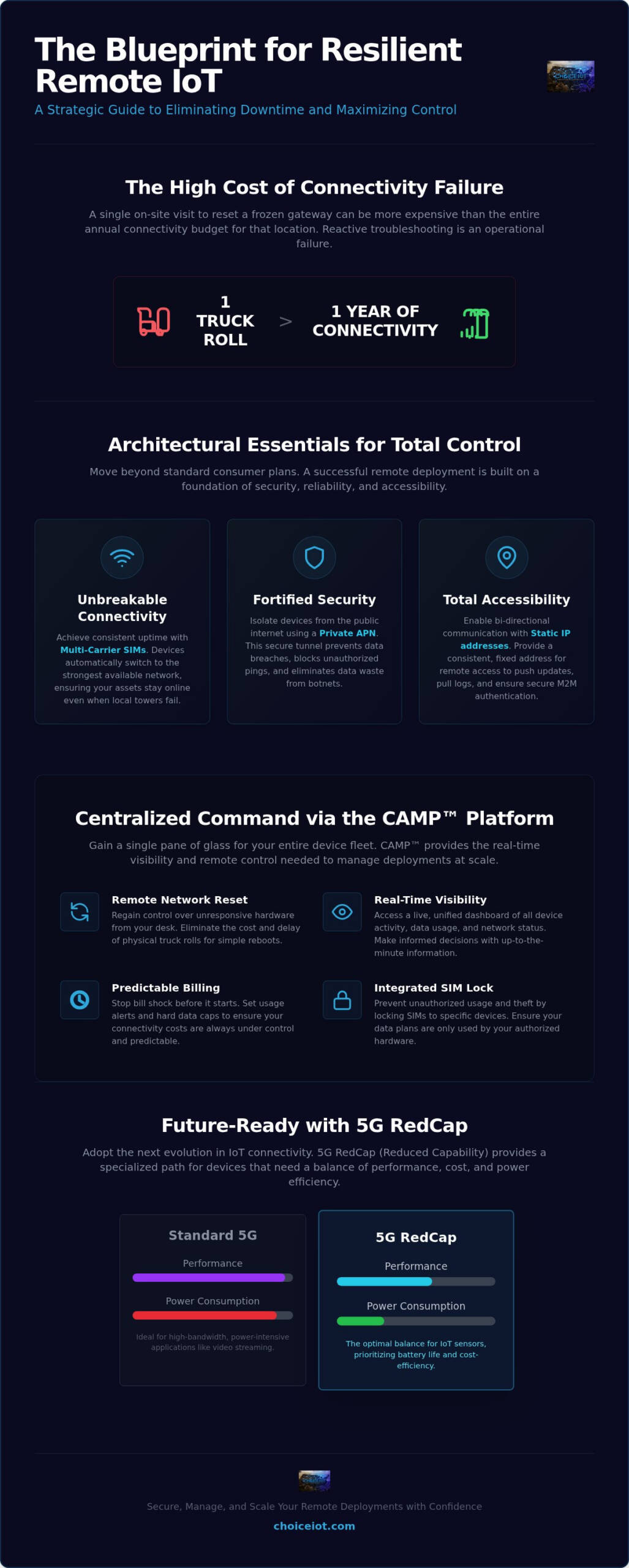
A single truck roll to reset a frozen gateway can cost more than your entire annual connectivity budget for that site. It’s a common, expensive reality. Deploying reliable IoT connectivity for remote monitoring systems requires more than just a standard data plan. It demands a strategic architecture that eliminates friction. You know the frustration of unauthorized data usage and the vulnerability of public APNs. It’s time to move beyond reactive troubleshooting. Total control is the only way forward.
This 2026 strategic guide provides the technical and operational blueprint to secure, manage, and scale your remote deployments with confidence. We’ll show you how to master centralized control and implement secure, private network architectures. We’ll also explore how tools like the CAMP™ platform and 5G Redcap provide the visibility needed to stop bill shock before it starts. From remote network resets to multi-carrier redundancy, you’ll learn to build a high-performance engine that runs itself. Efficiency starts here. Real-time visibility is no longer optional; it’s the foundation of your growth.
Key Takeaways
- Eliminate on-site maintenance costs with Remote Network Reset capabilities. Regain control over unattended hardware without expensive truck rolls.
- Secure your iot connectivity for remote monitoring systems using Private APN and Static IP architectures. Prevent data breaches and unauthorized usage with integrated SIM Lock features.
- Achieve consistent uptime through multi-carrier redundancy. Deploy 5G Redcap for a balance of high performance and operational cost-efficiency.
- Centralize all device management within the CAMP™ platform. Access real-time visibility and ensure predictable billing through a single, unified dashboard.
The Critical Role of IoT Connectivity in Remote Monitoring Systems
Remote monitoring is the essential bridge between physical sensors and actionable digital data. Without a robust link, your hardware is just an isolated island of information. For industrial assets located in remote or harsh environments, iot connectivity for remote monitoring systems is the lifeblood of the operation. It’s not just about sending data; it’s about maintaining a bi-directional channel for remote commands and real-time adjustments. Standard cellular plans designed for consumers fail here because they lack the persistent reliability and specialized APN configurations that unattended industrial hardware requires. Success requires a strategic architecture built for scale.
Reliability Beyond the Reach of Fiber
Wired infrastructure is often non-existent in remote environmental or industrial zones. Fiber is too expensive and slow to deploy for a distributed network of sensors. Cellular serves as the primary backbone. While 4G LTE and 5G provide high-speed data, the emergence of 5G Redcap offers a specialized path for devices that prioritize battery life and cost-efficiency. Reliability is non-negotiable. Relying on a single carrier is a gamble. Multi-carrier resilience ensures your assets stay connected even when local towers fail. It’s about redundancy. It’s about uptime. Using a Multi-Carrier IoT SIM provides the flexibility to switch to the strongest available signal automatically.
The High Cost of Connectivity Downtime
Downtime isn’t just a technical glitch; it’s a financial drain. Calculating the cost of a “truck roll” for a simple network reset often reveals a staggering impact on Total Cost of Ownership. Sending a technician to a remote site for a manual reboot is an operational failure. In mission-critical sectors, such as medical cold chain logistics or structural health monitoring, data gaps can lead to catastrophic losses. Centralized management through the CAMP™ platform eliminates these blind spots. By utilizing Remote Network Reset capabilities, operators can resolve connectivity issues from their desks. Speed matters. Efficiency wins. This level of control allows businesses to significantly reduce operational overhead while maintaining 100% visibility into their device fleet.
Architectural Essentials: Private APN, Static IP, and Multi-Carrier SIMs
Scaling iot connectivity for remote monitoring systems requires a foundation that balances hardware compatibility with network agility. It starts with Carrier Device Certification. Ensuring your hardware is pre-approved by major carriers prevents deployment delays and ensures seamless integration. Once hardware is certified, the focus shifts to the SIM. Multi-Carrier IoT SIM cards provide a carrier-agnostic architecture. They don’t lock you into one provider. They hunt for the strongest signal. This flexibility is vital for assets that move or operate in fringe coverage areas. It’s about building a system that doesn’t break when a single tower goes down. Reliability is the priority.
Securing Remote Assets with Private APN
Public APNs expose your devices to the open internet. This makes remote sensors easy targets for botnets and unauthorized pings. Implementing a Private APN for IoT creates a secure, isolated tunnel for your data. It moves your traffic off the public grid. This isolation does more than just enhance security; it reduces data waste. By blocking unwanted “ping” traffic from the outside world, you prevent bill shock from unauthorized data usage. It’s a clean, private network designed specifically for your fleet. For those looking to secure their infrastructure, a Private APN is the standard for enterprise-grade deployments.
Static IP for Bi-Directional Communication
Remote monitoring isn’t a one-way street. While devices often “push” data to the cloud, sophisticated systems frequently need to “pull” logs or push configuration updates. Static IP addresses enable this bi-directional flow. They provide a consistent address for remote SSH or web-GUI access to industrial controllers. Without a Static IP, your devices are effectively invisible to your management tools. This fixed identity is also essential for secure M2M (Machine-to-Machine) authentication. It ensures that only authorized servers can communicate with your remote hardware. It’s about control. It’s about accessibility.
Fixed Wireless for High-Bandwidth Remote Sites
Sometimes, standard SIM cards aren’t enough for the mission. High-bandwidth applications like remote video surveillance or large-scale data backhaul require more power. This is where Fixed Wireless connectivity for business becomes the primary solution. By using high-gain antennas and professional-grade gateways, you can establish a robust link where fiber can’t reach. Hybrid deployments offer the ultimate uptime. You can combine Fixed Wireless as your primary backhaul with cellular SIMs as a failover. This architecture ensures 100% connectivity for your most critical remote sites. It’s powerful. It’s resilient. It’s the engine of modern industrial monitoring.
Operational Control: Managing Remote Deployments via CAMP™
Operational friction is the enemy of scale. Managing iot connectivity for remote monitoring systems requires more than just a connection; it requires a command center. The CAMP™ platform delivers “One Platform. Complete Operational Control.” It provides a single, unified dashboard where you can monitor every device and SIM in real time. No more guessing. No more blind spots. You gain total visibility into signal strength, data consumption, and device status across your entire fleet. It is a high-performance engine for your digital infrastructure.
Eliminate bill shock through intelligent alerts. You can set custom data-usage thresholds that flag anomalies the moment they occur. If a remote sensor malfunctions and begins an unauthorized data spike, the system notifies you instantly. Automation is the core of this efficiency. Through robust API integration, you can bridge CAMP™ directly into your existing CRM or ERP systems. This streamlines your workflow and ensures that connectivity management is a seamless part of your broader business strategy. Centralization is the key to profitability.
Eliminating Truck Rolls with Remote Network Reset
The most expensive part of remote monitoring is the physical site visit. A simple gateway freeze shouldn’t cost hundreds in labor and travel. The Remote Network Reset feature allows you to cycle SIM connectivity from your desk. You can reboot the connection without being on-site. This self-service capability reduces your reliance on carrier support queues. Use built-in diagnostics for real-time troubleshooting. Solve the problem in seconds. Keep your assets online. Save your budget. Efficiency is about removing friction.
Security and Fraud Prevention at the Edge
Theft and unauthorized usage are constant threats to remote hardware. CAMP™ provides proactive security at the edge. With SIM Lock & Security, you can lock a SIM card to a specific, authorized device. If a SIM is removed and placed in unauthorized hardware, you receive an instant Device Change Alert. The system can trigger automated suspensions to protect your bottom line. It’s a secure, private network architecture that works while you sleep. Your data stays where it belongs.
Ready to take control of your fleet? Explore the CAMP™ IoT Platform for total operational visibility.
Selecting the Right IoT Connectivity Partner for Scale
Choosing a provider for iot connectivity for remote monitoring systems isn’t just about finding the lowest price-per-megabyte. It’s about finding a strategic partner. Cheap data plans often hide expensive operational gaps. You need a foundation that supports long-term growth. Evaluating Scalable IoT Connectivity Solutions is the first step in a modern enterprise strategy. The technical advantage of using CAMP™ as the Choice IoT for solution providers lies in its ability to remove technical friction. It’s about speed. It’s about rapid deployment. It’s about total control.
Future-proofing your fleet means looking at 5G Redcap. This technology balances high-speed performance with low power consumption. It’s the ideal middle ground for remote sensors that need longevity without sacrificing bandwidth. Efficiency matters. Cost-effectiveness is key. By selecting a partner that supports these emerging standards, you ensure your hardware remains relevant for years to come. Don’t just connect; optimize.
The Support Advantage for Integrators and VARs
Integrators and VARs need more than a login. They need a support advantage. Friendly, tip-based communication ensures that deployment hurdles are cleared quickly. Having a single point of contact for multi-carrier troubleshooting saves hours of administrative work. Accessing deep reporting and analytics allows for data-driven decision-making. Total transparency. No blind spots. This level of support empowers you to focus on your core business while your connectivity partner handles the infrastructure. It’s a supportive, partner-first approach that drives results.
Next Steps: From Pilot to Global Deployment
Moving from a pilot to a global deployment requires a methodical approach. Start with carrier device certification. This ensures your hardware is ready for the network before you ship a single unit. It eliminates compatibility issues early. Scaling from 10 to 10,000 devices becomes a matter of automated provisioning, not manual labor. Ready to build a high-performance engine? Contact Choice IoT for a customized remote monitoring connectivity strategy. Efficiency is the only path to scale. Real-time visibility is the foundation of your success.
Mastering the Future of Remote Deployment
Mastering iot connectivity for remote monitoring systems isn’t just a technical requirement. It’s a strategic advantage. You have seen how architectural choices like Private APNs and Static IPs build the security your enterprise demands. By centralizing management through a single dashboard, you move from reactive troubleshooting to total operational control. This shift ensures your unattended assets remain secure and efficient without constant manual intervention. It’s about removing friction from every layer of your digital infrastructure.
The CAMP™ platform provides real-time visibility across all major carriers. It is the definitive solution for one platform and complete operational control. You can eliminate expensive truck rolls with the Remote Network Reset feature and scale your fleet from pilot to global deployment with confidence. The technical complexity of the 2026 landscape demands a partner that simplifies the infrastructure so you can focus on your core business growth. Efficiency is the only path forward. Don’t let logistical hurdles slow your momentum.
Contact Choice IoT to secure your remote monitoring connectivity and start optimizing your deployment today. Your path to 100% uptime and predictable billing starts with the right foundation. Build with confidence.
Frequently Asked Questions
How does a Private APN improve security for remote monitoring systems?
A Private APN isolates your data traffic from the public internet by creating a secure, private tunnel. This architecture prevents remote sensors from being targeted by botnets or unauthorized ping traffic. It effectively moves your iot connectivity for remote monitoring systems off the grid. By controlling access at the network level, you ensure only authorized servers communicate with your hardware. This reduces the risk of data breaches and unauthorized usage.
Can I reset a remote IoT device connectivity without visiting the site?
You can reset connectivity for any device remotely using the Remote Network Reset feature within the CAMP™ platform. This tool allows you to cycle SIM connectivity from your dashboard without a physical site visit. It eliminates the need for costly truck rolls to resolve simple gateway freezes or network hangs. Having this self-service capability reduces your reliance on carrier support queues. It ensures maximum uptime for your remote assets with immediate resolution.
What is the benefit of a multi-carrier SIM for remote industrial sites?
Multi-carrier IoT SIMs offer redundancy by automatically connecting to the strongest available signal across multiple major carriers. This is critical for remote industrial sites where coverage from a single provider might be inconsistent or prone to outages. It ensures your assets remain online regardless of local tower failures. You gain a carrier-agnostic architecture that prioritizes uptime. This flexibility is essential for maintaining reliable data transmission in fringe or cross-border areas.
How do I prevent data overage charges in large-scale monitoring deployments?
Preventing bill shock requires real-time visibility and automated notifications. The CAMP™ platform uses Intelligent Alerts to let you set custom data-usage thresholds for every SIM in your fleet. If a device exceeds its expected usage, the system sends a proactive notification instantly. You can even automate suspensions to stop unauthorized consumption. This centralized control allows you to manage thousands of devices without the risk of unexpected monthly overage charges.
What is 5G Redcap and is it suitable for remote monitoring?
5G Redcap, or Reduced Capability, is a specialized 5G standard designed for devices that require high reliability but lower data throughput. It is highly suitable for iot connectivity for remote monitoring systems because it balances speed with lower power consumption and hardware costs. It provides the low-latency benefits of 5G without the complexity of high-bandwidth modules. This makes it an ideal future-proofing choice for battery-operated sensors and industrial monitors that need long lifecycles.
How does SIM Locking protect my remote IoT hardware?
SIM Locking protects your hardware by binding each SIM card to a specific, authorized device IMEI. If a SIM is removed and inserted into unauthorized hardware, the CAMP™ platform triggers an instant Device Change Alert. You can configure the system to automatically suspend the SIM to prevent theft or data fraud. This feature ensures your data plans are only used by your designated assets. It adds a critical layer of security for unattended hardware at the edge.