
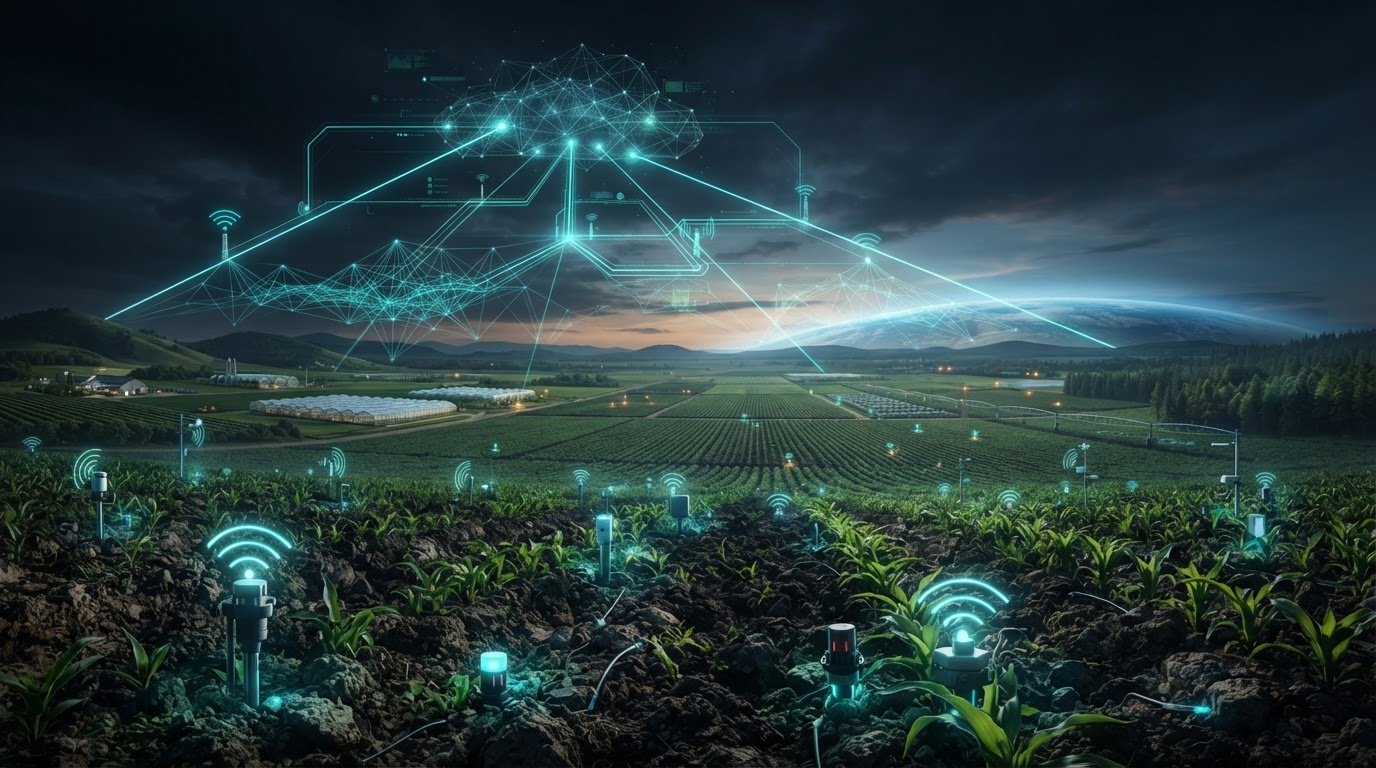
A sensor can collect the right field data and still be useless if that data can’t reach the systems that need it. Reliable iot connectivity for smart agriculture sensors depends on more than picking a network: field coverage, sensor power needs, data volume, and maintenance all shape the right setup.
That complexity is familiar to farm teams. Cellular coverage can vary across a single property, and it’s not always obvious whether a sensor needs a gateway or can connect directly. A better approach is to match the connection path to the sensor’s requirements and the conditions at its actual installation point.
This guide explains how data travels from sensor to application, compares cellular and local LPWAN approaches, and shows how to match a network to device behavior and field conditions. You’ll also learn what to check for power use and data demands, and how centralized visibility can help you monitor SIMs, usage, alerts, and device status as deployments grow. The goal is a practical plan for connecting sensors reliably and managing them with less manual effort.
Key Takeaways
- Map each sensor’s location, measurements, reporting interval, power source, and maintenance access before selecting a network.
- Compare cellular, local LPWAN, and gateway-based architectures against field conditions and operational needs.
- Reliable iot connectivity for smart agriculture sensors starts with matching the connection path to what each device must send and where it operates.
- Pilot the deployment in representative areas, then use what you learn to guide wider rollout.
- Use CAMP™ to view SIMs and usage centrally, set alerts, support remote resets and diagnostics, and review reports as the deployment grows.
What IoT connectivity for smart agriculture sensors needs to deliver
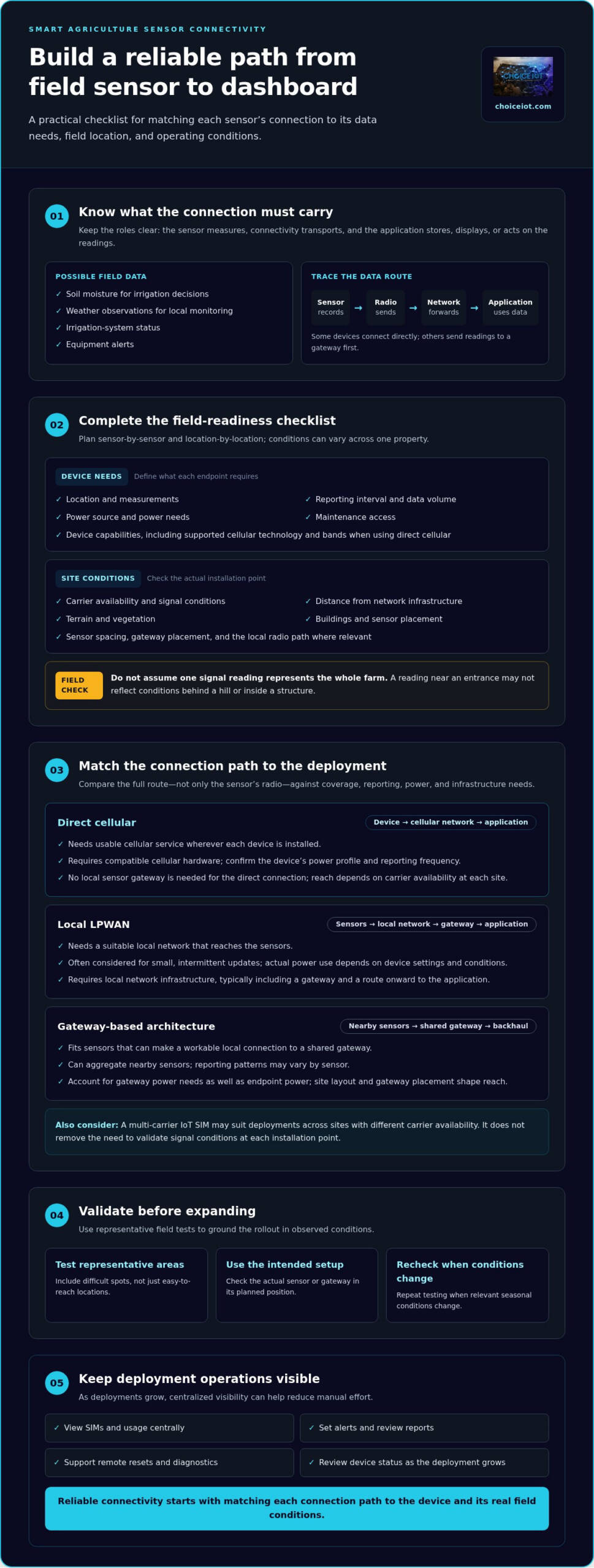
IoT connectivity for smart agriculture sensors is the communication path that carries measurements from a field device to the application that uses them. The sensor measures conditions; connectivity transports its readings; the application stores, displays, or acts on the data. Keeping these roles distinct helps teams identify where a deployment is working and where it needs attention.
That path might carry soil moisture readings for irrigation decisions, weather observations for local monitoring, irrigation-system status, or equipment alerts. A Smart agriculture overview provides broader context on how IoT and sensors support connected farming. In practice, the connectivity design must fit both the information being collected and the farm environment where devices operate.
How agricultural sensor data travels from field to dashboard
A sensor records a measurement and sends it over a radio connection. From there, data travels across a network to a receiving application, where it can be viewed or used by another system. The route depends on the device and site layout.
A cellular-enabled device can send data directly through a cellular network. Other sensors first communicate over a local radio link to a gateway, which then forwards their readings through its backhaul connection. A gateway can suit a group of nearby devices, while direct cellular requires each device to support the selected cellular technology and bands. Compare both routes against device capabilities, sensor spacing, coverage, and the requirements of the receiving application.
Why field conditions change the connectivity decision
Coverage at one point on a farm doesn’t establish coverage everywhere. Distance from network infrastructure, terrain, vegetation, buildings, and sensor placement can all affect the radio path. A signal reading near a farm entrance may not represent conditions behind a hill or inside a structure. Assess carrier availability and signal conditions at each intended location.
Signal is only one part of the decision. A device’s power source, reporting interval, data volume, and access for maintenance affect how practical its connection will be. More frequent reporting can change data and power demands, so confirm the requirements for the chosen device rather than assuming all sensors behave alike.
Test representative locations before expanding. Include difficult spots, check the actual sensor or gateway in its intended position, and repeat testing when relevant seasonal conditions change. This grounds the deployment plan in real-world observations and helps prevent coverage assumptions from becoming operational surprises.
Compare connectivity approaches for smart agriculture sensors
No single network suits every field, crop, and sensor. Compare the full connection path against where devices sit, how often they report, available power, and the infrastructure your team can operate. Clemson University’s discussion of precision agriculture and IoT offers broader context for these technology choices.
| Approach | Coverage needs | Power and reporting | Infrastructure and reach |
|---|---|---|---|
| Direct cellular | Usable cellular service where each device is installed. | Confirm the device’s power profile and expected reporting frequency. | Compatible cellular hardware connects without a local sensor gateway; operational reach depends on carrier availability at each site. |
| Local LPWAN | A suitable local network must reach the sensors. | Often considered for devices sending small, intermittent updates, but actual power use depends on device settings and conditions. | Requires local network infrastructure, typically including a gateway and a route onward to the application. |
| Gateway-based architecture | Sensors need a workable local connection to a shared gateway. | Reporting patterns can vary by sensor; account for the gateway’s power needs as well as the endpoints’. | Can aggregate nearby sensors, with the gateway providing the backhaul connection. Site layout and gateway placement shape operational reach. |
Cellular IoT versus local sensor networks
Direct cellular suits devices with compatible cellular hardware and bands, provided service is available at their locations. Local LPWAN separates the sensor radio link from the backhaul: sensors report locally, then a gateway forwards readings onward. That can suit a cluster of nearby devices, but it adds infrastructure to plan and maintain. For iot connectivity for smart agriculture sensors, compare the entire route, not just the sensor’s radio.
When a gateway or multi-carrier SIM may fit
A gateway may be practical when nearby sensors can share its connection. For deployments spread across sites with different carrier availability, a multi-carrier IoT SIM is another cellular option. It doesn’t remove the need to validate signal conditions at each installation point. Review the multi-carrier IoT SIM guide for more on cellular network selection, or explore Choice IoT connectivity options for distributed device deployments.
Plan a reliable smart agriculture sensor connectivity deployment
A dependable rollout starts with a field plan, not a bulk device order. Use this sequence to connect sensor requirements, site conditions, and operating responsibilities before scaling:
- Define the use case. Decide what decision each sensor supports, such as irrigation adjustment, weather monitoring, or equipment-status follow-up.
- Map the sites. Mark sensor positions, gateways if needed, power sources, access routes, and locations where cellular signal may be uncertain.
- Inventory device and data needs. Record each sensor’s measurement type, reporting interval, power limits, connectivity capabilities, and maintenance access.
- Estimate data use. Use expected message size and reporting schedule to form an estimate, and label assumptions that need pilot validation.
- Pilot, review, then scale. Test representative locations and operating conditions, resolve gaps, and expand in stages using what the pilot reveals.
Map sensor, power, and reporting requirements
Build a device record that connects each measurement to its location, reporting frequency, and power source. A battery-powered sensor may need a different transmission schedule from equipment with a steady power supply. Estimate data use from message size and reporting frequency, but treat the result as a planning estimate until you observe actual device behavior. This inventory gives connectivity decisions a clear operational basis.
Before purchasing connectivity, check sensor locations, device compatibility, power limits, reporting and data-use assumptions, site-level signal, and maintenance access. Validate cellular availability and signal where devices will operate, not only at a nearby road or building. Record dead zones and seasonal uncertainties, then test again under representative field conditions before increasing the device count.
Pilot, secure, and prepare for interruptions
Choose pilot locations that represent different site conditions, including harder-to-reach areas. Confirm that the sensor or gateway supports the selected cellular technology and bands. Where the device supports it, plan how data will be buffered or retried after a connection interruption, and verify how that behavior affects power and reporting. Assign owners for usage alerts, troubleshooting, and keeping device records current.
Set data-use thresholds and notification owners before deployment so unusual consumption has a clear response path. For network separation considerations, see this Private APN for IoT guide. Choice IoT’s CAMP™ connectivity management platform centralizes SIM and usage visibility, alerts, diagnostics, and reporting as deployments grow.
Manage agricultural sensor connectivity at scale with Choice IoT
As sensor deployments spread across fields and farm sites, tracking SIM status and data use device by device becomes harder to sustain. A centralized view helps teams spot usage changes, investigate connectivity issues, and maintain consistent operating processes. For iot connectivity for smart agriculture sensors, the management layer should make network operations visible without confusing them with the sensor’s job: CAMP™ manages connectivity and SIM operations, not agricultural sensor hardware.
Use CAMP™ to monitor usage and troubleshoot remotely
CAMP™ brings device, SIM, and data-usage visibility into one dashboard. Teams can review the deployment centrally rather than relying only on separate device records. Intelligent Alerts let teams set custom data-usage thresholds and receive proactive notifications, helping them identify unexpected usage and decide what to investigate.
If a cellular-connected device loses service, Remote Network Reset can reset SIM connectivity without an on-site visit. Diagnostics and Troubleshooting tools provide information for investigating connectivity issues, including a history of support notes. These tools don’t replace site-level signal testing or device checks, but they can reduce avoidable manual steps in day-to-day SIM operations.
SIM Lock & Security can lock each SIM to an authorized device, with automatic alerts or suspension, and Device Change Alerts can notify teams when a SIM moves to a different device. These controls help keep SIM use and device records visible as a deployment changes.
Build repeatable operations as deployments grow
Consistent records make expansion easier to manage. Reporting & Analytics provides exportable usage, cost, and performance reports, which teams can use to review patterns and inform deployment decisions. Automation & API supports repeatable SIM workflows, including activations, suspensions, and plan changes, and can integrate with CRM or ERP systems.
Set clear ownership for alerts, troubleshooting, and record updates. Define who reviews unusual usage, who investigates offline devices, and how resolved issues are documented. This turns connectivity management into a repeatable operating process rather than a series of isolated fixes. For a deeper look at platform capabilities and their role in IoT operations, see the IoT connectivity management platform guide.
Central visibility is most useful when it’s part of the deployment plan from the start. If you’re preparing to manage agricultural devices across multiple sites, explore Choice IoT connectivity solutions.
Turn your sensor plan into a scalable operation
The next step is to treat connectivity as an operating capability, not a one-time setup. As sensor deployments expand, teams need a clear way to understand device status, recognize issues, and refine network decisions using what the field deployment reveals. That ongoing visibility helps keep iot connectivity for smart agriculture sensors aligned with changing sites and operational priorities.
CAMP™ brings Real-Time Visibility for devices, SIMs, and data usage together with custom Intelligent Alerts, Remote Network Reset, diagnostics, reporting, and automation. These tools help teams manage connectivity workflows and make informed adjustments as deployments evolve. The sensors remain responsible for collecting field measurements; the platform supports the SIM and connectivity operations around them.
Build from the locations and use cases that matter most, then grow with a clearer view of what’s happening across the deployment. Explore Choice IoT connectivity solutions to take the next step toward a more manageable connected farm operation.
Frequently Asked Questions
Can agricultural sensors connect directly to a cellular network?
Yes, if the sensor has a compatible built-in modem, supports the required cellular bands, and has a power design suited to transmitting over cellular. Signal must also be available where the device will be installed. In a gateway setup, sensors send measurements over a local link first, and the gateway forwards them onward. Test representative devices in actual locations before settling on an architecture for iot connectivity for smart agriculture sensors.
How much data do smart agriculture sensors use?
Usage depends on message size, reporting frequency, sensor count, retries, and diagnostic traffic. A device sending occasional temperature readings can use data differently from one that transmits frequent measurements or images. Estimate usage from the actual payload and planned schedule, including expected retries where known. Then compare that estimate with observed usage during a pilot, and set thresholds to flag unexpected changes instead of relying on a fixed assumption.
Do smart agriculture sensors need 5G connectivity?
No, a sensor doesn’t automatically need 5G. The suitable network depends on the application’s data volume and latency needs, the device’s supported technology, local coverage, and its power budget. A monitoring device sending periodic readings may have different requirements from equipment transmitting larger volumes of data. Match the connection to the use case, confirm device compatibility, and verify service availability at the installation site before planning a rollout.
What happens if a field sensor temporarily loses its connection?
It depends on the device and its configuration. Some sensors can store readings locally and retry transmission after service returns; others may leave a data gap. During a pilot, check how the device buffers readings, how often it retries, and whether an alert can indicate an outage. Stored data may arrive later, but real-time visibility can pause while the connection is unavailable.
Can one connectivity platform manage sensors across multiple farms?
Yes, centralized SIM management can help teams oversee distributed devices that use supported IoT SIMs. CAMP™ provides visibility into devices, SIMs, and data usage, alongside alerts, reporting, and troubleshooting tools. Teams can use that view to spot usage changes or review device status across sites. Platform management doesn’t guarantee cellular coverage, so validate signal conditions at each farm and deployment location.
Is cellular connectivity suitable for battery-powered agricultural sensors?
It can be, depending on the sensor’s design, cellular technology, signal quality, and transmission schedule. Frequent reporting or repeated connection attempts may affect power needs, so evaluate device specifications alongside the planned operating pattern. Test the sensor in the field using a realistic reporting schedule and expected conditions. Use those measurements to inform maintenance planning, rather than assuming a particular battery life without device-specific evidence.