

In 2026, a “good enough” connection is a liability. If your service level agreement only covers basic network uptime, you are risking more than just downtime. You are inviting bill shock and regulatory failure. Implementing iot connectivity sla best practices is no longer optional for mission-critical deployments. You know that managing multiple carrier agreements is a logistical nightmare. It’s frustrating when hidden overages or unpredictable outages erode the trust you’ve built with your end users. You need a foundation that’s robust, intuitive, and transparent.
This article gives you the tools to regain total control. You’ll master the technical and operational benchmarks required to guarantee 100% uptime and eliminate the friction of global deployments. We’ll detail a clear framework for evaluating partners. Automated tools. Real-time monitoring. We’ll show you how to use the CAMP™ platform as your SLA enforcement engine while leveraging multi-carrier SIMs for built-in redundancy. From Private APNs to 5G RedCap latency, here’s your checklist for enterprise-grade reliability.
Key Takeaways
- Shift from best-effort plans to mission-critical infrastructure. Understand why 99.9% uptime is insufficient for modern industrial applications.
- Master iot connectivity sla best practices. Use Private APNs and multi-carrier redundancy to secure a foundation for 100% availability.
- Benchmark performance metrics. Identify the specific latency and jitter limits required for real-time video and high-stakes sensor deployments.
- Automate compliance. Leverage the CAMP™ platform for real-time visibility, usage triggers, and total cost control across global networks.
- Gain a strategic edge. Access carrier-neutral expertise and technical support to ensure long-term stability for your IoT ecosystem.
Defining the Modern IoT Connectivity SLA: Beyond Simple Uptime
Enterprise IoT demands more than a signal. It requires a guarantee. The shift from consumer “best-effort” plans to mission-critical connectivity defines the current market. Standard mobile plans are designed for human patience. Industrial IoT (IIoT) applications are not. When a smart grid or a medical monitor goes offline, the consequences are immediate and severe. You can’t afford to wait for a network to “find” a device. You need a connection that’s always active and always visible.
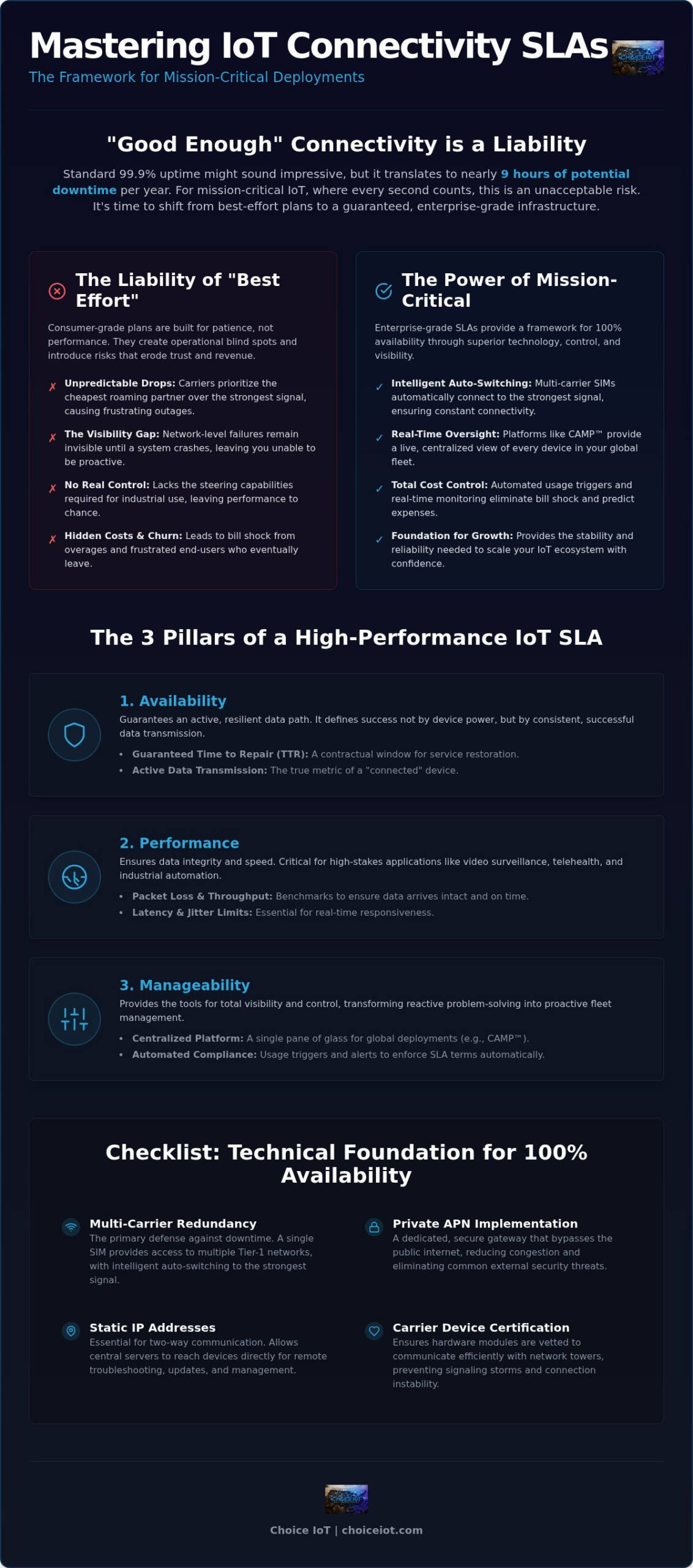
Relying on 99.9% uptime is no longer sufficient. While “three nines” sounds impressive, it allows for nearly nine hours of downtime per year. In a high-stakes industrial environment, that’s unacceptable. A modern Service-level agreement (SLA) must go further. It acts as a partnership framework, aligning technical benchmarks with your specific business goals. To master iot connectivity sla best practices, you must build your agreement on three pillars: Availability, Performance, and Manageability. These pillars transform a legal fallback into a high-performance engine for growth.
The Core Components of an IoT SLA
Network Availability is the baseline. However, you must distinguish between a device being “up” and being “connected.” A device might have power but lack a path to the cloud. Effective SLAs define connectivity through the lens of active data transmission. Time to Repair (TTR) is equally vital. For VARs and integrators, response speed is the ultimate metric of success. If a node fails, you need a guaranteed window for restoration. Finally, Packet Loss and Throughput metrics ensure data integrity. High-bandwidth applications, such as video surveillance, depend on these benchmarks to function without corruption.
Why ‘Best Effort’ Connectivity Fails Enterprise Goals
Consumer-grade roaming SIMs are a liability. They lack the steering control required for industrial use. Carriers often prioritize the cheapest roaming partner over the strongest signal. This results in unpredictable drops and frustrated end users. Without centralized visibility, these issues remain hidden until they cause client churn. The Visibility Gap is the operational blind spot where network-level failures remain invisible to the end-user until after the system crashes. Relying on “best-effort” connectivity means accepting this gap as a cost of doing business. Enterprise-grade solutions, like the CAMP™ platform, eliminate this risk by providing real-time oversight of every Multi-Carrier IoT SIM in your fleet. This level of control ensures that iot connectivity sla best practices are enforced at every level of the deployment.
Checklist 1: Technical Infrastructure for Network Availability
Infrastructure is the bedrock of any connectivity agreement. You cannot guarantee performance on a foundation of weak hardware or singular network paths. Adhering to iot connectivity sla best practices requires a shift from singular network reliance to a distributed infrastructure model. This ensures that your deployment remains resilient even when local towers fail or regional outages occur. To achieve enterprise-grade reliability, your technical checklist must include the following core components.
- Multi-carrier redundancy: The primary defense against downtime. It provides access to multiple Tier-1 networks on a single SIM.
- Private APN implementation: A dedicated gateway that bypasses the public internet. This reduces congestion and eliminates common external security threats.
- Static IP addresses: Essential for two-way communication. They allow your central servers to “reach down” to the device for remote troubleshooting and updates.
- Carrier Device Certification: Hardware must be vetted. Using certified modules ensures that your devices communicate efficiently with network towers without causing signaling storms.
The Role of Multi-Carrier SIMs in Availability
Single-carrier solutions are a gamble. If one carrier experiences a localized outage, your entire operation stops. Multi-carrier SIMs solve this through intelligent auto-switching. When the primary signal drops below a defined threshold, the device automatically reconnects to the next strongest available network. This creates resilient multi-carrier connections that are vital for mobile assets or remote installations where site visits are cost-prohibitive. By eliminating single-point-of-failure risks, you protect your end-user trust and maintain strict compliance with your SLA. For a deeper look at this technology, consult The Ultimate Guide to Multi-Carrier IoT SIM Cards.
Security Features as Availability Enhancers
Security is not just about data protection; it is about uptime. A DDoS attack on a public IP can saturate a device’s connection, effectively knocking it offline. Using a Private APN shields your fleet from this traffic. It creates a “walled garden” where only authorized data passes through. Static IPs further enhance this by enabling secure, persistent M2M communication tunnels. These tunnels allow for proactive management rather than reactive firefighting. In 2026, 5G RedCap serves as a critical bridge, offering reduced complexity and lower power consumption that significantly extends the operational life of mid-tier industrial sensors. Implementing a Multi-Carrier IoT SIM with these features is the most effective way to align your infrastructure with iot connectivity sla best practices.
Checklist 2: Performance Metrics and Cost Stability
Performance isn’t just speed. It’s consistency. A connection that fluctuates between high-speed and total stall is useless for mission-critical tasks. When you implement iot connectivity sla best practices, you must move beyond the binary metric of “up or down.” You need to define how the data travels and what that travel costs. Financial predictability is a technical requirement. If an unexpected data spike bankrupts your project, the network’s uptime becomes irrelevant. True enterprise-grade SLAs treat bill shock prevention with the same urgency as network availability.
- Latency benchmarks: Define specific millisecond limits. Real-time monitoring requires sub-100ms response times. Periodic reporting can tolerate more.
- Jitter and Packet Delivery: Critical for video surveillance. Jitter causes stutter. Packet loss causes corruption. Both must have hard caps in your agreement.
- Bill Shock Prevention: Automated triggers are mandatory. Your SLA should guarantee visibility into usage before it becomes a financial crisis.
- Data Throttling Policies: Demand transparency. Know exactly when and why a carrier might deprioritize your traffic.
Latency and Jitter: The Silent SLA Killers
Latency is the delay. Jitter is the variation in that delay. In high-density IoT environments, network congestion can turn a reliable sensor into a lagging liability. Setting realistic targets is essential. While 4G LTE remains a workhorse, 5G RedCap is the 2026 standard for balancing performance and power. It offers the low-latency benefits of 5G without the hardware complexity. Before full-scale deployment, test your devices under simulated load. High-bandwidth applications, like remote medical imaging or industrial robotics, cannot survive “best-effort” packet delivery. They require guaranteed throughput. According to the Omdia Market Radar, the ability to manage these granular performance metrics is what separates elite connectivity partners from basic resellers.
Financial Predictability as a Service Level
Unmanaged data is a liability. Bill shock happens when visibility fails. To maintain cost stability, your iot connectivity sla best practices must include real-time usage alerts. Don’t wait thirty days for an invoice to discover a malfunctioning device. Use the CAMP™ platform to set automated thresholds. If a device exceeds its expected data limit, you should receive a notification instantly. Customizable data pools allow you to share data across your entire fleet, smoothing out the peaks and valleys of individual consumption. Finally, eliminate “zombie SIM” costs. These are active SIMs in decommissioned or lost hardware. Automated suspension triggers ensure you only pay for devices that are actually providing value to your ecosystem. Efficiency is the ultimate performance metric.
Checklist 3: Automating SLA Compliance with CAMP™
Manual oversight is the enemy of scale. If you’re manually logging into multiple carrier portals to verify uptime, you’ve already lost the battle against downtime. Automation is the only way to enforce iot connectivity sla best practices across a global fleet. You need a system that acts as a silent sentry. A platform that doesn’t just watch but reacts. The CAMP™ platform is that engine. It transforms raw network data into actionable intelligence, ensuring your connectivity remains within the strict parameters of your agreement. It removes the friction of management so you can focus on growth.
- Centralized Monitoring: Real-time visibility. One screen. Every SIM. Every carrier.
- Automated Alerting: Instant triggers for data usage spikes, connectivity drops, or IMEI mismatches.
- Lifecycle Management: Streamlined provisioning and deactivation. No “zombie SIMs” draining your budget.
- Reporting and Analytics: Audit-ready logs. Prove compliance to stakeholders with data-driven evidence.
Real-Time Monitoring with the CAMP™ Platform
Visibility is control. A single-pane-of-glass view eliminates the need to toggle between fragmented carrier dashboards. This centralization streamlines troubleshooting by providing a unified data stream for every device in your ecosystem. You can monitor signal strength and network attachment status at the device level in real-time. If a carrier underperforms in a specific geographic region, you’ll see it immediately. This allows you to isolate localized issues before they impact your end users. It’s about moving from reactive firefighting to proactive network optimization.
Proactive Troubleshooting and Automation
Don’t wait for a support ticket. Automate the response. The CAMP™ platform allows you to trigger device resets or SIM re-provisioning directly from the management portal. You can set up multi-tier alerts that notify both your internal teams and your end-customers the moment a threshold is breached. Use API integrations to feed this connectivity data directly into your existing NOC. This ensures your technical staff has the same visibility as the platform itself. By integrating these iot connectivity sla best practices into your daily operations, you eliminate the logistical stress of global deployments. Master your deployment with the CAMP™ IoT Platform today.
The Strategic Advantage: Choosing a Partner for Long-Term SLA Success
A Service Level Agreement is a promise. However, a promise is only as reliable as the partner who makes it. Technical support is often the most underrated component of iot connectivity sla best practices. Most providers treat support as a reactive help desk. You need an engineering partner. When a deployment faces a connectivity hurdle, you don’t need a script. You need an expert who understands carrier device certification and network signaling. This level of behind-the-scenes mastery ensures that your “mission-critical” label isn’t just marketing. It’s a technical reality.
Carrier-neutral advice is a strategic asset for VARs and integrators. Traditional carriers have quotas to fill. They push their own network regardless of its suitability for your specific use case. A partner-first provider offers flexibility. They match the carrier to the requirement. This neutrality allows you to scale global deployments without logistical friction. You get the best signal for every node. Every time. This approach simplifies the management of complex ecosystems and protects your margins from the hidden costs of poor coverage. Expert engineers. Rapid response. Total transparency.
Partner-First Support for VARs and Integrators
Your brand is your reputation. Choice IoT empowers you to maintain that consistency through white-label management options. You own the customer relationship. We provide the high-performance engine. Our expert engineers assist with everything from initial device certification to complex network troubleshooting. We offer flexible contract terms that align with your growth. No rigid structures. No deployment bottlenecks. Just a streamlined path to scalability. We handle the carrier complexities so you can focus on delivering value to your clients. It is a partnership built on empowerment and reliability.
Conclusion: The Checklist for Future IoT Success
Success in 2026 requires a shift from passive uptime to proactive management. The era of “connect and forget” is over. To future-proof your deployments, you must prepare for the next generation of industrial standards, including 5G RedCap. This requires a platform-centric approach. Don’t just buy a data plan. Invest in an enforcement engine. By following iot connectivity sla best practices and leveraging the CAMP™ platform, you eliminate bill shock, guarantee uptime, and regain total control over your IoT ecosystem. Centralized. Automated. Secure.
Master your deployment. Guarantee your uptime. Schedule a demo of the CAMP™ platform today and see how we turn complex connectivity into a competitive advantage.
Secure the Future of Your Global IoT Infrastructure
Deployment success depends on visibility. You’ve seen how legacy “best-effort” plans fail the enterprise. Adopting iot connectivity sla best practices is the only way to guarantee 100% uptime and eliminate the logistical stress of unmanaged downtime. By prioritizing multi-carrier redundancy and leveraging Private APNs, you create a secure, resilient foundation that scales without friction. Static IPs and dedicated carrier certification support ensure your hardware remains connected and reachable, regardless of geographic shifts.
The CAMP™ platform serves as your command center. It automates monitoring and enforces your performance benchmarks in real-time. You don’t just get a data plan; you get a partnership built on transparency and technical mastery. It’s time to move beyond the “connect and forget” mindset. Regain control of your fleet and protect your end-user trust today.
Empower your IoT deployments with Choice IoT’s CAMP™ Platform. Our team is ready to help you implement a solution that offers multi-carrier redundancy, enterprise-grade security, and dedicated support for VARs and integrators. Build your ecosystem on a foundation that never quits.
Frequently Asked Questions
What is the standard uptime for an enterprise IoT connectivity SLA?
Enterprise-grade uptime typically targets 99.9%, but mission-critical deployments often require “four nines” or higher. Standard “best-effort” plans aren’t designed for industrial reliability. To achieve these levels, you must implement multi-carrier redundancy. This ensures that if one network fails, your devices automatically switch to another. It’s the only way to minimize downtime risks in high-stakes environments where every second of connectivity matters.
How do Private APNs improve service level agreements for IoT?
Private APNs improve SLAs by removing your devices from the public internet. This eliminates congestion from consumer traffic and shields your fleet from DDoS attacks. By creating a secure, isolated gateway, you ensure consistent performance and data integrity. It’s a technical requirement for any deployment that prioritizes iot connectivity sla best practices. Security and availability are inextricably linked in a professional ecosystem.
Can a management platform like CAMP™ help me avoid bill shock?
Yes, the CAMP™ platform is designed to eliminate bill shock through real-time usage monitoring. You can set automated triggers that notify you the moment a device exceeds its data threshold. This allows you to suspend malfunctioning SIMs or adjust data pools before overages occur. Centralized visibility means you’re never surprised by an invoice. It’s about proactive cost control and total operational transparency.
What is the difference between a Tier-1 carrier SLA and a multi-carrier SLA?
A Tier-1 carrier SLA guarantees uptime on a single network, while a multi-carrier SLA covers connectivity across multiple providers. The difference is redundancy. If a single carrier’s tower goes down, their SLA might offer a credit, but your devices stay offline. A multi-carrier approach provides a path to 100% uptime by allowing devices to switch networks instantly. It’s the ultimate fail-safe for global assets.
How does 5G RedCap impact connectivity SLAs for industrial devices?
5G RedCap allows industrial devices to meet high-performance SLA targets without the power drain of full 5G. It provides the low latency needed for real-time monitoring while extending hardware longevity. In 2026, it’s the standard for mid-tier sensors that require more than NB-IoT but less than high-speed broadband. It ensures your connectivity benchmarks stay modern and efficient without compromising on device battery life.
What happens if a connectivity provider fails to meet their SLA targets?
Most agreements provide service credits based on the duration of the outage. However, for mission-critical deployments, the real value lies in the Time to Repair (TTR) guarantee. You need a partner who offers technical support that resolves issues within a specific window. Credits don’t restore end-user trust. Rapid, expert intervention does. Always prioritize TTR over simple financial rebates when evaluating your connectivity partners.
Is carrier device certification necessary for a reliable SLA?
Carrier device certification is mandatory for maintaining a reliable SLA. Uncertified hardware can cause signaling issues that lead to network rejection or frequent disconnects. Certified devices are vetted to ensure they communicate efficiently with cellular towers. This reduces troubleshooting time and ensures your hardware doesn’t become the weak link in your connectivity chain. It’s a foundational step for iot connectivity sla best practices.
How often should I audit my IoT connectivity performance metrics?
You should audit your connectivity performance metrics monthly. Real-time platforms like CAMP™ allow for continuous oversight, but a formal monthly review helps identify long-term trends. Check for recurring latency spikes or packet loss in specific regions. Regular audits ensure your deployment stays optimized as network conditions and carrier regulations evolve. Don’t wait for a system failure to check your performance stats.