

Deploying a global IoT fleet shouldn’t feel like a high-stakes gamble. Many enterprises realize too late that “global coverage” is often just a patchwork of fragile roaming agreements and hidden costs. You’ve likely felt the sting of fragmented carrier management or the sudden silence of connectivity dead zones in critical regions. These hurdles don’t just delay timelines; they erode your bottom line. Success in the international field begins long before your first device ships, specifically during the critical phase of iot hardware validation testing. This process ensures your hardware is fully optimized for the diverse network architectures it will encounter across different continents.
It’s time to take control. You deserve a connectivity strategy that’s as ambitious as your growth targets. This guide provides the technical and strategic roadmap you need to master global IoT connectivity and deploy with total confidence. We’ll explore how to leverage multi-carrier redundancy, secure your data with private APNs, and utilize centralized platforms to eliminate bill shock once and for all. You’ll learn how to streamline your operations and ensure your devices remain online, regardless of where they land. Let’s build a foundation for scalable, resilient global growth.
Key Takeaways
- Distinguish between standard roaming and specialized Global IoT SIMs. Achieve 100% uptime through autonomous multi-carrier redundancy.
- Optimize your iot hardware validation testing with carrier device certification. Guarantee hardware performance across diverse international networks.
- Stop bill shock and simplify global logistics. Utilize a single management portal with consolidated data pooling for total cost predictability.
- Protect global data assets. Deploy Private APNs and Static IPs to isolate your traffic from the inherent risks of the public internet.
- Leverage the CAMP™ platform for real-time provisioning. Activate, monitor, and scale your global fleet from a single pane of glass.
What is a Global IoT SIM Card and How Does it Differ from Roaming?
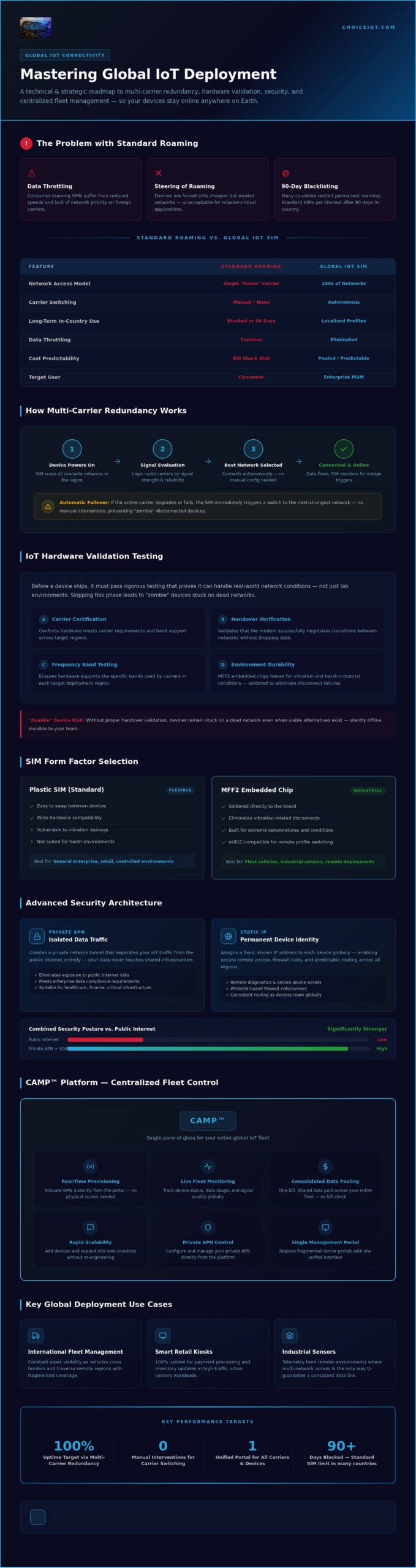
Global IoT SIM cards are purpose-built engines for machine-to-machine (M2M) communication. They aren’t consumer-grade products. While a standard roaming SIM relies on a “home” carrier’s limited partnerships, a Multi-Carrier IoT SIM functions as a local device on multiple international networks simultaneously. This distinction is critical. Consumer roaming often suffers from data throttling, lack of network priority, and “steering of roaming” where the device is forced onto a cheaper but weaker network. For mission-critical enterprise applications, these variables are unacceptable. Reliability is the only metric that matters.
The core mechanism behind this technology is multi-carrier redundancy. By leveraging pre-negotiated agreements across hundreds of networks, the SIM identifies and connects to the strongest available signal autonomously. This happens without manual intervention or complex coding. However, achieving this level of seamless connectivity requires rigorous iot hardware validation testing. Before a device hits the field, it must be verified to handle these network handovers and specific frequency bands across different regions. This testing phase ensures your hardware doesn’t just work in the lab; it thrives in the wild. It’s the foundation of a “deploy anywhere” strategy.
Permanent roaming is another vital factor for global success. Many countries now restrict devices that roam on a foreign network for more than 90 days. Standard consumer SIMs get blacklisted. Global IoT SIMs circumvent these blocks through localized profiles and intelligent switching logic. This ensures long-term compliance and connectivity for international deployments that stay in-country for years.
The Evolution of M2M Connectivity
The industry has moved past the era of single-carrier lock-in. Modern connectivity is software-defined. You no longer need to manage dozens of local SKUs or swap physical SIM cards when moving into new territories. This flexibility is expanding with the introduction of 5G Redcap. This technology offers a middle ground for applications that need more throughput than NB-IoT but less complexity than full-scale 5G. It’s about optimization. Efficiency. Rapid deployment without the logistical weight of traditional hardware management.
Key Use Cases for Global Deployments
- International Fleet Management: Maintaining constant visibility as assets cross borders and navigate remote regions with fragmented coverage.
- Smart Retail Kiosks: Ensuring 100% uptime for payment processing and inventory updates in high-traffic urban centers.
- Industrial Sensors: Collecting telemetry from remote environments where multi-network access is the only way to guarantee a consistent data link.
Technical Foundations: Multi-Carrier Logic and eUICC
Reliability is the product of logic. Not luck. In the enterprise IoT space, uptime is a direct result of how a device handles network transitions. Multi-carrier redundancy ensures your hardware isn’t tethered to a single point of failure. If one carrier experiences an outage or signal degradation, the SIM logic triggers an immediate switch to the next strongest available network. This keeps your data flowing without manual intervention. It is the core of a resilient deployment.
Integrating this logic requires precision during iot hardware validation testing. You must verify that the device’s modem can successfully negotiate these handovers across diverse network environments. Failure to validate this behavior often leads to “zombie” devices. These units remain stuck on a dead network even when a viable alternative is present. Testing confirms the logic works in real-world scenarios. It ensures your fleet remains connected regardless of regional carrier instability.
Latency remains a critical hurdle for global applications. High latency can break real-time communication. By utilizing localized breakout points, data travels shorter distances to reach its destination. This improves performance for high-speed use cases. Choosing the right form factor is equally vital. While standard plastic SIMs offer flexibility, embedded MFF2 chips provide the durability needed for harsh industrial environments. They are soldered directly onto the board. This eliminates vibration-related connectivity issues.
Understanding Multi-Network Redundancy
Access to multiple carriers within a single country is non-negotiable. It provides the redundancy required for 100% uptime. Devices prioritize networks based on a hierarchy of signal strength and data costs. This ensures the most efficient connection is always active. For a deeper dive into these mechanisms, explore The Ultimate Guide to Multi-Carrier IoT SIM Cards: Scaling Global Connectivity. It breaks down the logic required for true global coverage.
The Role of eUICC in Global Scalability
eUICC technology represents the ultimate future-proofing tool. It allows you to change carrier profiles over-the-air (OTA) without physical access to the device. This eliminates the need for costly “truck rolls” to swap SIMs when regional pricing shifts or a carrier sunsets a specific network. Logistics become streamlined. Ship one SKU. Program it anywhere. This software-defined approach reduces operational friction. It empowers you to manage global fleets with total control. To ensure your hardware is ready for these sophisticated profile swaps, consider engaging in professional carrier device certification services. This final step confirms your hardware is fully compatible with global network standards.
Strategic Advantages of Global IoT Connectivity
Scaling an IoT deployment across international borders used to mean managing a nightmare of local carrier contracts. It was inefficient. Slow. Expensive. Global IoT connectivity changes the equation by centralizing everything under one roof. You get one contract. One invoice. One management portal. This level of consolidation allows your operations team to focus on growth rather than administrative friction. It’s about total control. Simplified logistics mean your devices are ready for deployment the moment they leave the factory floor.
Speed is a competitive advantage. With a global SIM strategy, you can deploy in new countries without the need for local carrier negotiations. This drastically reduces your time-to-market. For Value-Added Resellers (VARs) and integrators, this scalability is a game-changer. You can offer a single, unified solution to international clients effortlessly. It positions you as a sophisticated partner capable of handling global complexity. You provide the hardware; we provide the bridge to the world.
However, strategic success depends on the reliability of your physical assets. This is where iot hardware validation testing becomes indispensable. By verifying your hardware’s performance across multiple global bands and network types during the validation phase, you ensure that the strategic benefits of global connectivity aren’t undermined by hardware failure. Reliable hardware is the vehicle for your global strategy. Testing ensures that vehicle is built to last.
Preventing Bill Shock in International Markets
Industrial IoT applications often consume significant bandwidth. In high-usage scenarios, traditional pay-as-you-go roaming is a recipe for financial disaster. Unexpected bill shock can cripple a project’s ROI in weeks. Data pooling is the solution. By aggregating data across your entire global fleet, you smooth out usage spikes and maintain strict budget control. Real-time alerts provide an extra layer of security. To master these financial controls, review How to Prevent IoT Bill Shock: The Enterprise Connectivity Checklist. It offers a blueprint for maintaining cost predictability in every market.
Streamlining Carrier Device Certification
Global SIMs provide the network access, but your hardware must still meet specific carrier standards. Rigorous iot hardware validation testing is the prerequisite for formal certification. Using pre-certified modules can accelerate this process significantly. Choice IoT facilitates this journey by guiding you through the carrier device certification requirements. We ensure your hardware is compatible with global network parameters. This proactive approach prevents costly delays. It ensures your devices are cleared for deployment on any supported network worldwide without technical friction.
Advanced Security: Private APN and Static IPs on a Global Scale
Security is not an afterthought. It is a foundational requirement. For international IoT fleets, the public internet is a hostile environment. Public APNs leave your devices visible to every malicious actor on the web. They are a liability. A Private APN acts as a secure, isolated tunnel. It bypasses the public internet entirely. This architecture is vital for maintaining a robust security posture across different global carrier nodes. During iot hardware validation testing, you must verify that your device modem can correctly authenticate with these private gateways consistently. Security must be baked into the hardware logic from day one.
Static IP Addresses provide the necessary “handshake” for your remote assets. Without a Static IP Address, your management server cannot initiate a connection to the device for troubleshooting or critical security patches. It enables two-way visibility. By assigning a persistent address to each unit, you can whitelist specific traffic and block everything else. This layered defense is essential for large-scale M2M communication. It ensures that your global fleet remains reachable, manageable, and secure regardless of the local network provider.
Implementing end-to-end encryption across multiple carrier networks requires precision. You need a unified security policy that doesn’t fragment when a device moves from one region to another. This centralization is what separates enterprise-grade solutions from basic connectivity. It removes the friction of managing individual security rules for every territory. You gain total control over your data flow. If you are ready to harden your fleet with secure global connectivity solutions, now is the time to architect for the long term.
Securing the Global Edge
A Private APN ensures your data stays off the grid. It creates a direct link between your devices and your back-end infrastructure. This is non-negotiable for maintaining security compliance like GDPR or HIPAA across international borders. Static IPs further empower your team. They allow for remote diagnostics and over-the-air updates without needing a local technician. It reduces downtime. It protects your reputation. It ensures your global edge remains a secure extension of your corporate network.
Performance Tuning for Global Security
Encryption adds overhead. This is a technical reality. High encryption levels can increase latency, which is a risk for real-time applications. Balancing this load is a primary goal of iot hardware validation testing. You must prove that your hardware can process secure data at the edge without stalling critical operations. Using VPNs in conjunction with global SIMs provides an extra layer of defense. However, you must also ensure firewall consistency across diverse providers. A centralized platform allows you to apply a single firewall policy to your entire fleet. This ensures that a device in London follows the same security protocol as one in Singapore.
Centralized Control with the CAMP™ IoT Platform
Visibility is the antidote to operational chaos. Managing a global fleet across multiple carriers shouldn’t require a dozen different logins or fragmented spreadsheets. The CAMP™ IoT platform provides a single pane of glass for your entire deployment. It centralizes control. It simplifies complexity. Once you conclude your iot hardware validation testing, the focus shifts from technical feasibility to operational scale. CAMP™ handles that transition by giving you real-time access to every SIM in your portfolio, regardless of its geographic location.
Control is absolute. With real-time provisioning, you can activate or deactivate SIMs anywhere in the world instantly. This eliminates the lag time associated with traditional carrier support tickets. Granular monitoring allows you to track data usage by individual device, region, or specific carrier node. You see exactly what your fleet is doing at all times. Automated alerts provide the final layer of protection. By setting custom thresholds, you can prevent overages and detect connectivity anomalies the moment they occur. It’s about proactive management rather than reactive troubleshooting.
Operational Efficiency for Integrators
For VARs and system integrators, efficiency equals profitability. CAMP™ supports your business model through white-labeling capabilities. You can provide your own customers with a branded connectivity management portal, adding value and increasing stickiness. Billing is no longer a hurdle. Centralized reporting simplifies the financial management of complex, multi-region deployments. Whether you’re managing a few hundred units or the lifecycle of millions of devices, the platform scales with you. It removes the administrative friction that typically stalls international growth.
Making the Right Choice for Global Connectivity
Choice IoT isn’t just a provider; we are a strategic partner. We understand the hurdles of global deployment because we’ve already solved them for the world’s leading solution providers and VARs. Our expertise extends beyond the SIM. We offer comprehensive carrier device certification services to ensure your hardware is ready for the world stage. Our team assists with iot hardware validation testing to guarantee that your devices perform as expected on every supported network. We provide the foundation. You build the future.
Contact Choice IoT for a custom global connectivity quote and take total control of your international IoT deployment.
Master Your Global IoT Deployment
Global scalability is no longer a logistical hurdle. It’s a strategic choice. By leveraging multi-carrier redundancy and eUICC technology, you ensure your devices stay online regardless of regional network shifts. Centralized control through the CAMP™ platform eliminates bill shock and provides the real-time visibility your operations team needs. This entire ecosystem is underpinned by rigorous iot hardware validation testing. It ensures your hardware is optimized for international connectivity standards long before it reaches the field.
Security remains the ultimate priority. Utilizing Private APN and Static IP options allows you to harden your infrastructure against public internet threats while maintaining remote access for troubleshooting. You’re now equipped with the technical and strategic essentials to deploy anywhere with total confidence. Ready to streamline your international growth? Partner with Choice IoT for Scalable Global Connectivity and leverage our expert carrier device certification services to fuel your expansion. Your global fleet is ready for launch.
Frequently Asked Questions
What is a global IoT SIM card and how does it work?
A global IoT SIM is a specialized card engineered for M2M communication across multiple international networks. It works by utilizing multi-carrier agreements to connect to the strongest signal available in any given region. This eliminates the need to manage individual carrier contracts for every country. Your devices gain autonomous access to hundreds of networks through a single, unified integration point.
Can I use a regular roaming SIM for my IoT devices?
No, regular roaming SIMs are unsuitable for mission-critical IoT applications. Consumer roaming often faces data throttling, lack of network priority, and permanent roaming restrictions that can lead to devices being blacklisted after 90 days. Professional iot hardware validation testing ensures your devices use enterprise-grade SIMs that bypass these limitations. You need a solution designed for industrial longevity and constant uptime.
How does eUICC benefit global IoT deployments?
eUICC technology allows you to change carrier profiles over-the-air (OTA) without physically swapping SIM cards. This benefits global deployments by future-proofing hardware against carrier sunsets or regional pricing changes. It streamlines logistics by allowing one hardware SKU to be programmed for any destination. You reduce operational costs and eliminate the need for manual hardware interventions in the field.
What are the costs associated with global IoT SIM cards?
Costs for global IoT SIMs are typically structured around data usage, active subscriptions, and platform access fees. Unlike consumer plans, these costs are often optimized through data pooling across the entire fleet. This creates a more predictable budget by neutralizing the high costs associated with traditional pay-as-you-go roaming. You gain financial transparency and control over your international deployment expenses.
Is a Private APN necessary for global IoT connectivity?
A Private APN is essential for any deployment requiring high security and isolated data transmission. It creates a secure tunnel that keeps your IoT traffic off the public internet, reducing the risk of cyberattacks. For enterprises managing sensitive data, a Private APN is a standard requirement for global compliance. It ensures your data remains encrypted and protected across all international borders.
How do I manage thousands of global SIMs efficiently?
Efficient management of large-scale fleets requires a centralized platform like CAMP™. This “single pane of glass” allows for real-time provisioning, granular data tracking, and automated alerts across all regions. It replaces the manual effort of logging into multiple carrier portals with one streamlined interface. You gain total control over your fleet’s lifecycle from a single, intuitive dashboard.
What is the difference between a global SIM and a local SIM?
Global SIMs provide access to multiple networks in multiple countries through a single agreement, whereas local SIMs are tied to one carrier in one specific region. Global SIMs offer superior redundancy and simplified logistics. To ensure compatibility with these various networks, rigorous iot hardware validation testing is recommended before mass deployment. This confirms your hardware can handle diverse network handovers seamlessly.
How do I avoid bill shock when deploying IoT devices internationally?
Avoiding bill shock requires centralized management and data pooling strategies. By aggregating data usage across your entire international fleet, you prevent overages on individual devices. Implementing real-time alerts through a platform like CAMP™ also ensures you’re notified immediately of any connectivity anomalies or high-usage events. This proactive approach maintains strict budget control and protects your project’s return on investment.