

A single unmonitored SIM card is no longer just a connectivity gap. In 2026, it’s a multi-million dollar liability. You already know the stakes. Regulatory pressure is mounting. The fear of massive fines is real. Achieving gdpr compliance for iot data often feels like chasing a moving target, particularly when you lack visibility into where your cellular traffic actually flows. It’s a logistical headache. Security vulnerabilities in the transmission path can turn a successful deployment into a legal nightmare overnight.
We’re here to change that. This guide provides a strategic framework to master IoT data privacy by leveraging advanced connectivity management tools. We’ll show you how to use the CAMP™ platform to gain total visibility and eliminate SIM tampering risks. You’ll learn to secure every packet with Private APNs and Static IPs. One Platform. Complete Operational Control. It’s time to transform your connectivity layer from a risk into a robust, auditable compliance shield. This is how you secure your growth and your data.
Key Takeaways
- Define IoT metadata as PII. Learn why location and usage patterns are critical to your legal standing.
- Secure the transmission path. Eliminate public internet exposure by utilizing Private APNs for network-level protection.
- Simplify gdpr compliance for iot data. Use the CAMP™ platform to centralize real-time monitoring and streamline mandatory audits.
- Prevent physical tampering. Deploy SIM Lock features and device alerts to stop unauthorized data access at the source.
- Ensure total availability. Adopt a multi-carrier connectivity model to maintain the data access required for global regulatory standards.
Understanding GDPR Compliance for IoT Data in 2026
Visibility is the new security. By 2026, regulatory scrutiny has moved beyond simple consumer apps to the heart of industrial M2M deployments. Gdpr compliance for iot data is no longer a legal suggestion; it’s a prerequisite for network survival. Unmanaged data sprawl is the primary driver of modern breaches. Devices scattered across global regions create a massive, undefended surface area. If you can’t map the data flow, you can’t protect it. Total control is the only path forward.
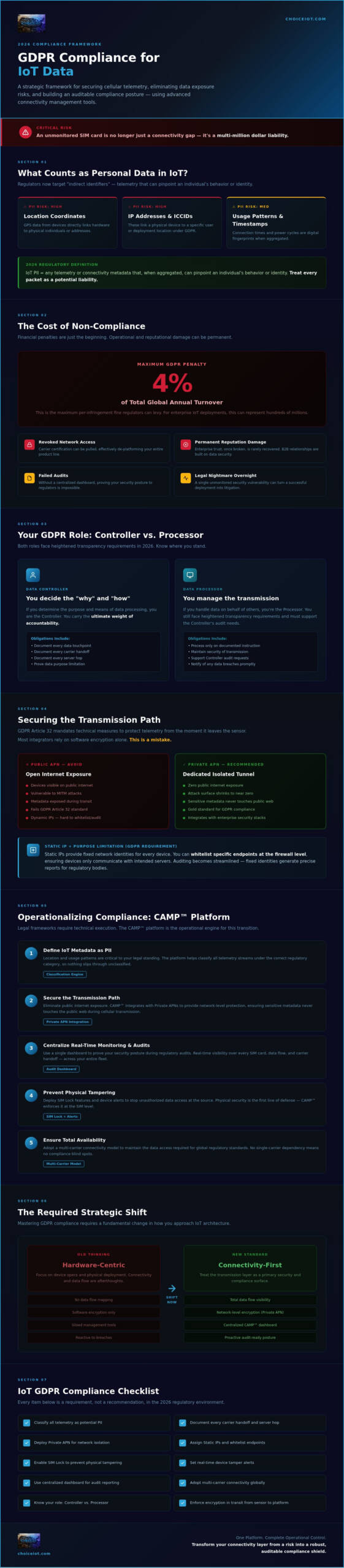
The distinction between a Data Controller and a Data Processor is critical for IoT integrators. If you determine the purpose and means of data processing, you’re the Controller. You carry the ultimate weight of accountability. If you manage the transmission on behalf of others, you’re the Processor. Both roles now face heightened transparency requirements. You must document every touchpoint. Every carrier handoff. Every server hop.
What Constitutes Personal Data in IoT?
Telemetry isn’t anonymous. Metadata reveals identity. Location coordinates, connection timestamps, and power consumption cycles are digital fingerprints. Regulators now target “indirect identifiers” with high precision. IP addresses and ICCIDs fall squarely under this lens. They link a physical device to a specific user or location. In the 2026 regulatory environment, IoT PII is defined as any telemetry or connectivity metadata that, when aggregated, can pinpoint an individual’s behavior or identity. High-performance compliance requires treating every packet as a potential liability.
The Risk of Non-Compliance
The financial stakes are staggering. Regulators maintain the authority to levy fines up to 4% of total global annual turnover. For B2B solution providers, the secondary damage is often worse. Massive fines. Revoked network access. Broken trust. Losing carrier certification can effectively de-platform your entire product line. Reputational damage in the enterprise space is often permanent. Mastering gdpr compliance for iot data requires a shift from hardware-centric thinking to a connectivity-first strategy. You need a centralized dashboard to prove your security posture during an audit. Without it, you’re flying blind.
Securing the Transmission Path: The Role of Private APNs
Security isn’t an afterthought. It’s the foundation. GDPR Article 32 mandates “Security of Processing,” requiring technical measures to protect telemetry from the moment it leaves the sensor. Most integrators rely on software encryption alone. This is a mistake. The transmission path itself is a primary vulnerability. Public APNs leave your devices exposed to the open internet. They’re visible. They’re targets. A Private APN changes the math. It creates a dedicated, private tunnel between your device and your core infrastructure. No public exposure. No external pings. Just secure, isolated data flow.
Encryption in transit is non-negotiable. When data travels toward the CAMP™ platform, it must be shielded from interception. A Private APN provides this network-level layer of protection. It ensures that sensitive metadata never touches the public web. This is the gold standard for gdpr compliance for iot data. It removes the risk of data leaks during the most vulnerable stage of the lifecycle: cellular transmission.
Private APN as a Compliance Shield
Closed networks provide total isolation. By creating a private environment for your telemetry, you effectively eliminate the threat of man-in-the-middle (MITM) exploits. The attack surface shrinks to nearly zero. These environments integrate directly with your existing enterprise security stacks, allowing you to apply consistent policies across both wired and wireless assets. Efficiency meets security. You gain the ability to manage thousands of devices with the same rigor as a local server room.
Static IP and Purpose Limitation
GDPR requires “Purpose Limitation,” meaning data should only flow to authorized destinations. Static IPs facilitate this by providing fixed network identities for every device in your fleet. You can whitelist specific endpoints at the firewall level. This ensures your devices only communicate with your intended servers. Auditing becomes a streamlined process. You can track data flows using these fixed identities to generate precise reports for regulatory bodies. For a deep dive into the technical implementation, see our Private APN for IoT: 2026 Guide to Secure Connectivity. To simplify this entire architecture, consider how a centralized connectivity management platform can automate these security protocols for you.
Operationalizing Compliance with the CAMP™ Platform
Legal frameworks require technical execution. The CAMP™ platform provides the operational engine for this transition. Real-time visibility isn’t a luxury. It’s the foundation of data mapping. If you can’t see the data, you can’t audit it. Manual logs are obsolete. They’re prone to error and impossible to scale. Automated reporting replaces guesswork with hard data. It generates the precise usage and performance logs required for gdpr compliance for iot data audits. One Platform. Complete Operational Control. This is the standard for modern enterprise connectivity.
Monitoring Data Movement in Real-Time
Proactive monitoring is the first line of defense. The CAMP™ dashboard tracks data usage thresholds with pinpoint accuracy. Proactive notifications alert you to unauthorized spikes immediately. This prevents “Bill Shock” while identifying potential data exfiltration. If a device shows suspicious patterns, use the Remote Network Reset feature. You can mitigate a breach from your desk. No on-site visits. No delayed responses. Rapid deployment of security measures is now a standard operational protocol that empowers your IT team.
Physical Security and SIM Integrity
Physical security remains a significant vulnerability in cellular IoT. A stolen device is a potential entry point into your network. SIM Lock and Security features bind the SIM to authorized hardware. If the SIM is moved, the link breaks. This stops data hijacking before it starts. Device Change Alerts function as your early warning system. They detect when a SIM is tampered with, providing a critical breach indicator for your gdpr compliance for iot data strategy. The platform maintains a full history of support notes and diagnostic data. This creates a transparent, auditable trail for regulators. You don’t just say you’re compliant. You prove it through centralized automation.
Ready to streamline your regulatory strategy? Explore how the CAMP™ platform provides complete operational control over your IoT deployments.
Future-Proofing Your IoT Strategy for Global Compliance
Compliance is a moving target. 2026 standards require a shift from reactive fixes to proactive infrastructure. Multi-carrier redundancy is now essential. It ensures data availability, a core pillar of GDPR. If a single carrier fails, your visibility vanishes. You lose control. Redundancy keeps the audit trail alive. It protects your reputation and your bottom line. Reliable connectivity is the pulse of a compliant ecosystem. Without it, you’re exposed.
Scaling globally adds layers of complexity. Regional data sovereignty laws vary. You need a connectivity partner capable of navigating these shifts without re-engineering your hardware. Integrating GDPR principles into the carrier device certification process ensures that security is baked in, not bolted on. This reduces friction during deployment and speeds up your time to market. High-performance growth requires a foundation that anticipates regulatory shifts before they happen.
Choosing the Right Connectivity Partner
Risk mitigation starts with the right foundation. A complete connectivity partner offers more than just SIMs. They provide the tools to manage them. Evaluate platforms based on automation and API capabilities. You need a system that integrates with your existing workflows. For a detailed breakdown of what to look for, consult our IoT Connectivity Management Platform: The 2026 Strategic Guide. Total visibility is the only way to ensure gdpr compliance for iot data at scale. Don’t settle for a provider that only offers a connection; find a partner that offers control.
Next Steps for Solution Providers
Start with a Data Protection Impact Assessment (DPIA) specifically for your connectivity layer. Identify where your data touches the public web. The transition from public endpoints to secure Private APNs should be your immediate priority. It’s the most effective way to harden your transmission path. Gdpr compliance for iot data is an operational challenge that requires a unified solution. One Platform. Complete Operational Control. Reach out to Choice IoT today to secure your deployment for the years ahead.
Secure Your Connectivity, Protect Your Growth
Achieving gdpr compliance for iot data is no longer a legal hurdle to clear. It’s a strategic advantage to leverage. Massive scale. Minimal risk. Total visibility. By shifting security to the connectivity layer, you eliminate vulnerabilities before they reach your application. You’ve seen how Private APNs and Static IP security create a hardened transmission path. You understand how physical safeguards like SIM Lock and Device Change Alerts stop tampering. Multi-carrier redundancy ensures your data remains available for audit. Centralization is the final piece of the puzzle.
The CAMP™ platform provides the real-time visibility needed to audit every packet and verify every connection. It replaces manual guesswork with automated, auditable control. One Platform. Complete Operational Control. This is the foundation of a resilient, global IoT deployment. Build with confidence. Deploy with speed. Your data is secure.
Secure your IoT data and achieve total operational control with Choice IoT.
Frequently Asked Questions
Is IoT data considered personal data under GDPR?
Yes. Telemetry often contains indirect identifiers like location data, timestamps, and power consumption patterns. IP addresses and ICCIDs are also considered personal data because they link a device to a specific user or location. Aggregated metadata can pinpoint individual behavior with high accuracy. In 2026, regulators treat almost all IoT telemetry as PII. Treating all device traffic as sensitive is the safest way to maintain compliance.
How does a Private APN help with GDPR compliance?
A Private APN isolates your cellular traffic from the public web. It directly addresses GDPR Article 32 requirements for Security of Processing at the network level. By creating a closed tunnel, you eliminate exposure to external threats and unauthorized pings. This setup ensures that sensitive data never touches the open internet. It provides a robust, technical layer of protection that satisfies the most stringent regulatory standards for data in transit.
What are the consequences of a data breach in an IoT deployment?
Financial penalties are severe. Regulators can issue fines up to 4% of your total global annual turnover. Reputational loss in the B2B space is often permanent. You risk losing network access and carrier certifications if your deployment is deemed insecure. Achieving gdpr compliance for iot data is the only way to avoid these liabilities. A breach doesn’t just cost money; it can effectively de-platform your entire product line.
Can I use SIM Lock features to satisfy GDPR security requirements?
Yes. SIM Lock is a vital physical security measure. It binds your SIM to a specific, authorized device. If a SIM is removed or tampered with, the connection is instantly suspended. This prevents data hijacking at the source. Regulators look for these proactive technical measures during audits. Using SIM Lock alongside Device Change Alerts demonstrates that you have total operational control over your hardware assets and their associated data.
How does the CAMP™ platform assist with data auditing?
CAMP™ provides the real-time visibility and automated reporting needed to satisfy audit requirements. It centralizes every connection, alert, and data spike into a single dashboard. You can export detailed logs showing exactly how and where your data is flowing. This eliminates the errors associated with manual data mapping. It provides the verifiable proof required for gdpr compliance for iot data. One Platform. Complete Operational Control.
What is the role of the IoT connectivity provider in GDPR?
Your provider acts as the Data Processor for your transmission path. They must offer technical safeguards like Private APNs and Static IPs to protect the data they carry. A reliable partner doesn’t just provide a connection. They provide a management layer like the CAMP™ platform. This allows you to monitor usage, set alerts, and troubleshoot issues. Their role is to ensure the infrastructure supports your legal and operational requirements.