

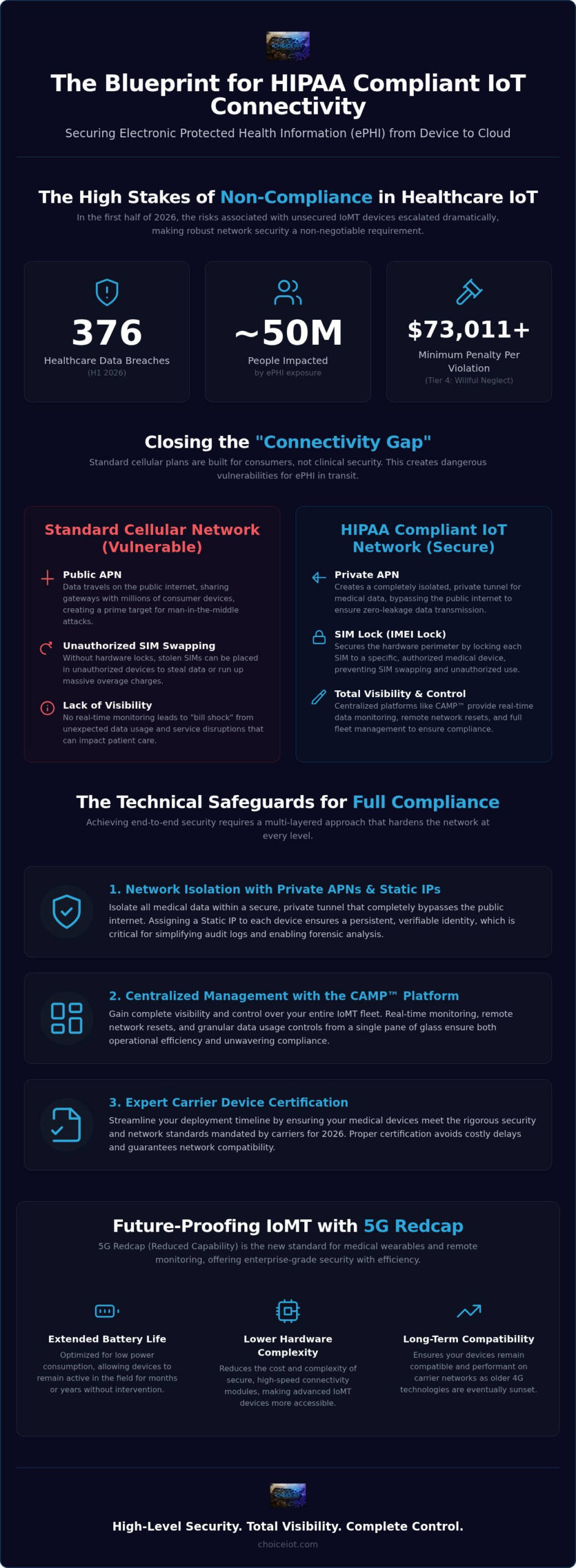
With 376 healthcare data breaches impacting nearly 50 million people in the first half of 2026, your network is your biggest liability. Achieving HIPAA compliant IoT connectivity requires more than just a secure device. It demands a hardened network layer. You’re likely managing thousands of remote sensors across multiple carriers. The lack of visibility is stressful. The risk of a Tier 4 penalty, now starting at $73,011 per violation, is even worse. We understand the pressure to keep patient data isolated and secure.
This guide provides the technical blueprint to master the network safeguards required for full compliance. You’ll learn how to achieve zero-leakage data transmission and maintain centralized control over every SIM in your fleet. We’ll explore Private APNs, mandatory 2026 encryption standards, and how to use the CAMP™ platform to streamline your operations. It’s time to replace logistical friction with a high-performance, certified infrastructure. High-level security. Total visibility. Complete control. We’ll show you how to build a network that protects your patients and your bottom line.
Key Takeaways
- Learn how Private APNs and Static IPs isolate medical data to eliminate the security vulnerabilities of standard cellular plans.
- Bridge the “connectivity gap” by implementing HIPAA compliant IoT connectivity that secures ePHI throughout the entire data transmission path.
- Gain total visibility into your IoMT fleet with the CAMP™ platform, enabling real-time management and remote network resets.
- Secure your hardware perimeter using SIM Lock features to ensure data only flows through authorized, certified medical devices.
- Streamline your deployment timeline by utilizing expert Carrier Device Certification services to meet rigorous 2026 security standards.
The Connectivity Gap in IoMT HIPAA Compliance
Standard cellular plans are built for consumer convenience, not clinical security. This creates a dangerous “Connectivity Gap” in many healthcare deployments. While your hardware might be encrypted, the data path often remains exposed to the public internet. The Health Insurance Portability and Accountability Act (HIPAA) mandates the protection of electronic Protected Health Information (ePHI) both at rest and in motion. In 2026, technical safeguards are no longer “addressable” suggestions. They’re mandatory requirements. Failing to secure the network layer means failing your audit.
The cost of non-compliance has never been higher. As of 2026, the Office for Civil Rights (OCR) has increased enforcement significantly. A single violation involving willful neglect now carries a minimum penalty of $73,011. If the breach persists, annual penalties can reach a staggering $2,190,294 per violation category. Beyond the fines, reputational damage in the healthcare sector is often permanent. Patients trust you with their lives; they expect you to protect their data.
Understanding ePHI in Cellular Deployments
What qualifies as ePHI in a remote monitoring environment? It’s more than just a patient’s name. It’s heart rates, blood glucose levels, and GPS coordinates tied to a specific medical device ID. If this data travels over a standard public network, it’s vulnerable. Achieving HIPAA compliant IoT connectivity requires a Business Associate Agreement (BAA) with your connectivity provider. This ensures the network infrastructure itself is legally and technically bound to federal privacy standards. Without a BAA, your cellular carrier is a liability, not an asset.
Common Vulnerabilities in Healthcare IoT
Public APNs are playgrounds for man-in-the-middle attacks. Without network isolation, your data is visible to anyone on the same gateway. Unauthorized SIM swapping is another critical threat. A stolen SIM can lead to data theft or massive overages that disrupt service. Consider these primary risks:
- Man-in-the-middle attacks: Interception of ePHI on public-facing gateways.
- SIM Swapping: Criminals move your SIM to unauthorized hardware to bypass security.
- Usage Blind Spots: Lack of real-time monitoring leads to “bill shock” and sudden service outages.
These aren’t just IT headaches. They’re compliance failures. Total visibility. Hardened security. Rapid deployment. You need a network that provides all three without compromise.
Technical Safeguards: Private APNs and Secure Transmission
Most security strategies fail at the transport layer. You secure the device. You secure the cloud. But what about the space between? Achieving HIPAA compliant IoT connectivity requires a hardened network pipe that eliminates public internet exposure. Standard carrier encryption is insufficient for 2026 mandates. You need network-level encryption that exceeds basic protocols. It’s about creating a perimeter that extends from the device to your data center.
Static IP addresses add a critical layer of traceability. They ensure every clinical device has a persistent, verifiable identity on your network. This simplifies audit logs. It makes forensic analysis possible. Following the technical standards of the HIPAA Security Rule means implementing controls that prevent unauthorized access during transmission. Traceability is not optional; it is a foundational requirement for clinical integrity.
Why Your Deployment Needs a Private APN
Public APNs are inherently risky. They share gateways with millions of consumer devices. A Private APN creates a completely isolated tunnel for your medical data. It bypasses the public internet entirely. This ensures data sovereignty. You control the routing. You dictate the security parameters. For a deep dive into implementation, read our guide on Why Your IoT Deployment Needs a Private APN. It is the only way to ensure zero-leakage data transmission.
The Role of 5G Redcap in 2026 Healthcare
5G Redcap (Reduced Capability) is the new standard for IoMT. It provides enterprise-grade security without the high power consumption of full 5G. This is vital for Remote Patient Monitoring (RPM) wearables. Redcap offers several key advantages for healthcare integrators:
- Extended Battery Life: Optimized for devices that need to stay in the field for months.
- Lower Complexity: Reduces the hardware cost of secure, high-speed modules.
- Future-Proofing: Ensures your devices remain compatible as 4G networks eventually sunset.
Securing your data path shouldn’t be a logistical hurdle. You can partner with a connectivity expert to design a Private APN that fits your specific healthcare use case. This proactive approach removes friction and secures your clinical reputation.
Managing Compliance at Scale with CAMP™
Scale is the enemy of security. Managing thousands of medical devices via manual spreadsheets is a liability that leads to massive fines. You need an automated management layer to maintain HIPAA compliant IoT connectivity across your entire fleet. The CAMP™ platform provides that foundation. It’s a single-pane-of-glass interface for every medical SIM in your deployment. Real-time visibility. Instant control. No blind spots. It turns a logistical nightmare into a streamlined operation.
Security at the SIM level is your first line of defense. CAMP™ introduces SIM Lock features that automatically tether a SIM to a specific piece of authorized medical hardware. If a SIM is removed or placed in an unauthorized device, the connection drops instantly. You receive a device change alert the moment it happens. This prevents data theft and unauthorized network access. Best of all, the platform generates automated, audit-ready compliance logs. You get the documentation you need without the manual labor.
Eliminating the Visibility Gap
Detecting anomalous behavior is critical for patient safety. CAMP™ monitors data usage patterns in real time to identify potentially malicious activity. If a sensor starts transmitting outside its normal parameters, you’ll know. Intelligent alerts prevent service interruptions for critical care devices by flagging issues before they cause a timeout. For a deeper look at these capabilities, explore our guide on Centralized IoT Connectivity Management with CAMP™. It’s the “Choice PT” for healthcare integrators who value total network transparency.
Remote Troubleshooting and Operational Control
Hospital environments are sensitive and restrictive. On-site visits are expensive, slow, and disruptive. The Remote Network Reset feature allows your team to resolve connectivity issues directly from the CAMP™ dashboard. It reduces maintenance costs and keeps life-critical devices online. This level of control is essential for maintaining HIPAA compliant IoT connectivity in remote monitoring scenarios. The platform also handles the entire SIM lifecycle, from initial activation to secure decommissioning. You maintain total control of your network perimeter without ever leaving your desk.
Ready to secure your IoMT fleet and eliminate the stress of manual management? Contact Choice IoT at sales@choiceiot.com or call 1-888-565-0774 to deploy the CAMP™ platform today.
Choice IoT: Your Partner for Secure Healthcare Connectivity
Connectivity is the lifeblood of modern medicine. When patient lives depend on real-time data, network downtime isn’t an option. Choice IoT functions as the complete connectivity partner for healthcare integrators. We provide the infrastructure that makes HIPAA compliant IoT connectivity achievable at scale. By offering multi-carrier flexibility, we ensure 100% uptime for life-critical IoMT applications. If one carrier fails, your devices stay connected. Reliability. Redundancy. Resilience.
Integration should be invisible. We provide zero-friction connectivity through robust APIs. These tools allow you to sync the CAMP™ platform directly with your healthcare ERP or clinical management systems. This automation removes the manual overhead of managing thousands of SIMs. It bridges the gap between technical infrastructure and business operations. Your team stays focused on patient care. We handle the network pipe.
Carrier Device Certification for IoMT
Bringing new medical hardware to market is a gauntlet. The certification process with major carriers is notoriously complex and time-consuming. Choice IoT streamlines this path. We offer expert Carrier Device Certification services to help you navigate the technical requirements of top-tier networks. Our team ensures your hardware performs optimally across all major cellular providers. We reduce your time-to-market. We eliminate the guesswork. You get a certified, high-performance solution ready for clinical deployment in weeks, not months.
Next Steps for Healthcare Solution Providers
Building a secure architecture requires precision. Don’t leave your compliance to chance with standard consumer-grade plans. Consult with our experts to design a custom, secure network architecture that meets 2026 HIPAA compliant IoT connectivity standards. We’ll help you implement the Private APNs, Static IPs, and management layers discussed in this guide. Take control of your data path today.
Ready to see the difference total visibility makes? Request a comprehensive demo of the CAMP™ platform’s security features. See how SIM locking and real-time alerts can protect your clinical reputation. Contact Choice IoT at 1-888-565-0774 or email us at sales@choiceiot.com to start your deployment. Secure connectivity. Simplified management. Total control.
Hardening Your IoMT Infrastructure for 2026 and Beyond
Security in healthcare isn’t a static target; it’s a moving perimeter. You’ve seen how standard cellular plans leave your ePHI exposed and why network isolation is the only path forward. By implementing Private APNs and Static IPs, you create a zero-leakage environment that satisfies 2026 technical safeguards. The CAMP™ platform then adds the management layer you need for scale. One platform. Complete operational control. It eliminates the visibility gap that leads to audit failures and security breaches.
Your mission is patient care; our mission is the infrastructure that makes it possible. From expert Carrier Device Certification to multi-carrier redundancy, we remove the friction of large-scale deployments. Achieving HIPAA compliant IoT connectivity doesn’t have to be a logistical burden. It’s a strategic advantage that protects your patients and your reputation. Secure your IoMT deployment today with Choice IoT and build your future on a foundation of total control. You have the tools to succeed; now it’s time to deploy them.
Frequently Asked Questions
Is cellular IoT connectivity inherently HIPAA compliant?
Standard cellular IoT connectivity is not inherently HIPAA compliant because it typically routes data through public internet gateways. Achieving HIPAA compliant IoT connectivity requires a hardened network layer that includes data isolation and encryption. You also need a Business Associate Agreement (BAA) with your provider. Choice IoT provides the necessary Private APNs and Static IPs to meet these technical safeguards, ensuring your clinical data never touches the vulnerable public internet.
What is the role of a Private APN in healthcare IoT security?
A Private APN acts as an isolated network tunnel that completely bypasses the public internet. It ensures your medical data travels over a private, secure path directly to your data center. This isolation eliminates the risk of man-in-the-middle attacks and unauthorized gateway access. By using a Private APN, healthcare integrators maintain total data sovereignty and control over network routing; this is essential for meeting 2026 HIPAA Security Rule mandates.
Can Choice IoT help with carrier device certification for medical devices?
Yes, Choice IoT provides expert Carrier Device Certification services to streamline the path to market for your hardware. Navigating carrier requirements is often a complex, multi-month process. We manage the technical hurdles and ensure your medical devices perform optimally across all major cellular networks. This service reduces deployment delays and ensures your clinical solutions are ready for immediate use. Our goal is to remove the friction of hardware integration.
How does the CAMP™ platform prevent unauthorized SIM usage?
The CAMP™ platform prevents unauthorized usage through its SIM Lock and Security feature. This tool automatically tethers each SIM card to a specific, authorized medical device. If a SIM is removed or inserted into an unauthorized tablet or modem, the connection is instantly suspended. You receive an immediate alert through the dashboard. This proactive security layer stops data theft and prevents financial surprises caused by criminals using your data plans for non-clinical purposes.
Do I need a Static IP for my remote patient monitoring devices?
Static IP addresses are highly recommended for remote patient monitoring (RPM) deployments to ensure reliable, traceable communication. Unlike dynamic IPs that change frequently, a Static IP provides a persistent identity for every clinical device on your network. This simplifies remote troubleshooting and forensic auditing. It’s a key component of achieving HIPAA compliant IoT connectivity because it allows your central servers to maintain a consistent, verifiable connection with patient wearables at all times.
What happens if a medical IoT device is stolen or tampered with?
If a device is stolen or tampered with, the CAMP™ platform provides instant remediation through Device Change Alerts. You’ll know the moment the hardware perimeter is breached. You can then use the platform to suspend the SIM remotely or perform a Remote Network Reset to clear the connection. These tools ensure that even if physical hardware is compromised, your network remains secure. This level of operational control minimizes the risk of data leakage.