

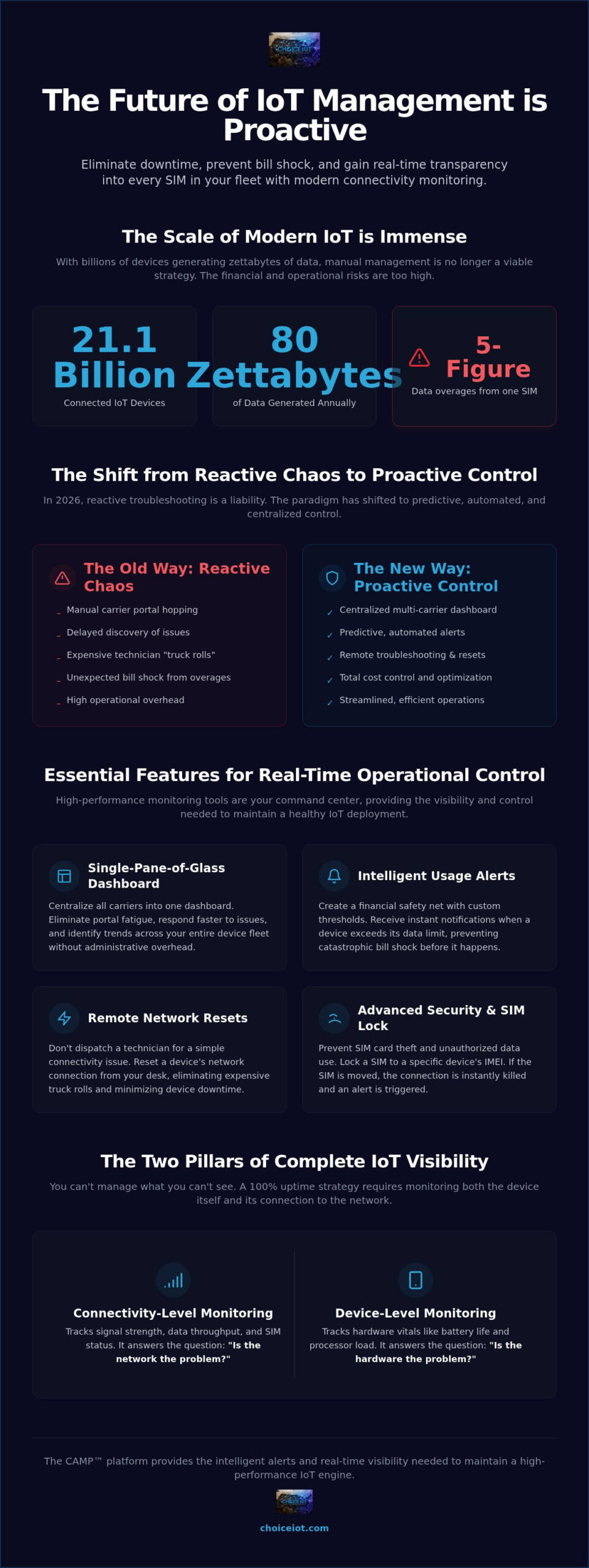
A single unmonitored SIM card can trigger a five-figure data overage before your morning coffee is cold. It’s the silent killer of IoT ROI. You’ve likely felt the friction of manual carrier portal hopping just to verify if a device is online. It’s inefficient. It’s risky. And with 21.1 billion devices now generating nearly 80 zettabytes of data annually, it’s a strategy that doesn’t scale. By implementing advanced iot connectivity monitoring tools, you transform your deployment from a series of fires to put out into a streamlined, high-performance engine. Total operational control is no longer a luxury. It’s a requirement for survival in a $12 billion management market.
We agree that visibility shouldn’t be this difficult. This guide promises to show you how to eliminate downtime, prevent bill shock, and gain real-time transparency into every SIM in your fleet. We will preview the essential features of the 2026 connectivity landscape, including the transition to the GSMA SGP.32 eSIM standard and the necessity of automated usage alerts. You’ll learn how to leverage centralized dashboards and remote troubleshooting capabilities to keep your operations lean, secure, and fully optimized.
Key Takeaways
- Learn how to centralize multi-carrier deployments into a single dashboard to eliminate portal fatigue and streamline management.
- Discover why modern iot connectivity monitoring tools are essential for identifying “zombie” devices and preventing catastrophic data overages.
- Master remote troubleshooting techniques, such as Remote Network Resets, to resolve connectivity issues without dispatching expensive technicians.
- Understand the shift from reactive troubleshooting to proactive operational control required for 2026 IoT deployments.
- Explore how the CAMP™ platform provides the intelligent alerts and real-time visibility needed to maintain a high-performance IoT engine.
The Evolution of IoT Connectivity Monitoring Tools in 2026
The paradigm of the Internet of Things (IoT) has shifted. In 2026, reactive troubleshooting is a liability. It’s too slow. It’s too expensive. Modern iot connectivity monitoring tools have evolved into proactive control centers. They don’t just report failures; they predict them. This shift requires deep integration between hardware telemetry and carrier data. You can’t manage what you can’t see. Real-time visibility is the bedrock of scalability. It bridges the gap between application performance monitoring (APM) and the underlying network layer. APM tells you if the app is slow. Connectivity management tells you why.
Connectivity-Level vs. Device-Level Monitoring
Monitoring the “pipe” is distinct from monitoring the “product.” Device-level monitoring tracks battery life or processor load. Connectivity-level monitoring focuses on the signal strength, data throughput, and SIM status. You need both for a 100% uptime strategy. If a device stops reporting, is the hardware dead or is the network congested? Without iot connectivity monitoring tools, you’re guessing. Guessing leads to truck rolls. Truck rolls lead to wasted capital. By monitoring the connectivity layer, you identify network issues before they impact the end-user experience.
The Rise of 5G Redcap and Advanced Monitoring
The rollout of 5G Redcap is a defining trend for 2026. It fills the gap for mid-speed devices that don’t need full 5G bandwidth but require its efficiency. Monitoring these devices requires specialized platforms. Security is equally critical. Private APNs allow for isolated, secure data transmission. They provide a closed loop for monitoring sensitive traffic. This level of control is vital for global deployments. For a deeper look at scaling these networks, consult The Ultimate Guide to Multi-Carrier IoT SIM Cards. Centralized visibility across multiple carriers ensures that 5G Redcap deployments remain secure and cost-effective. Total control depends on having a single source of truth for every byte of data transmitted.
Essential Features for Real-Time Operational Control
Efficiency is the baseline for 2026 deployments. Managing a fleet across multiple carriers often leads to portal fatigue. Switching tabs to check SIM status is a relic of the past. High-performance iot connectivity monitoring tools consolidate these disparate data streams into a single pane of glass. This centralization isn’t just about convenience. It’s about speed. When you can see every device on one dashboard, you respond faster. You identify trends sooner. You maintain total operational control without the administrative overhead of legacy systems.
Intelligent alerts act as your financial safety net. Don’t wait for the monthly bill to discover a data spike. Set custom thresholds that trigger instant notifications. If a device exceeds its limit, you know immediately. Pair these alerts with a Remote Network Reset capability. If a device hangs, don’t send a technician. Reset the connection from your desk. This feature eliminates expensive truck rolls and minimizes downtime. Implementing an end-to-end IoT monitoring system ensures that every component, from the SIM to the cloud, remains visible and manageable.
Automated Troubleshooting and Diagnostics
Built-in diagnostic tools reduce your reliance on carrier support queues. You shouldn’t have to wait on hold to verify a network attachment. Modern iot connectivity monitoring tools provide full history support notes and real-time session data. You see exactly when a device last communicated and why it failed. Automation APIs take this further. They integrate your connectivity data directly with your CRM or ERP. This synchronization ensures your support team has the data they need before the customer even calls. If you want to streamline these workflows, Choice IoT provides the integrated tools necessary to automate your operational lifecycle.
Security Monitoring: SIM Lock and Device Change Alerts
Security is a fundamental requirement. Thieves often target IoT hardware to harvest SIM cards for unauthorized data use. SIM Lock features prevent this. By locking a SIM to a specific IMEI, you ensure it only works in your authorized hardware. If the SIM is moved, the system detects it instantly and kills the connection. This level of control is essential for maintaining secure cellular apn compliance. It ensures your data remains within your private network boundaries. Real-time tracking of device changes provides an extra layer of enterprise-grade security that protects both your hardware and your bottom line.
Solving the Two Biggest IoT Pains: Bill Shock and Downtime
Operational friction often hides in the shadows of a large-scale deployment. “Zombie” devices, SIMs that continue to draw data without providing utility, drain budgets silently. Unmonitored data spikes can erase profit margins in a single billing cycle. Effective iot connectivity monitoring tools eliminate these blind spots. They transform raw usage data into a defensive shield for your bottom line. By identifying anomalies in real time, you move from reactive damage control to proactive financial management. Total control means seeing every byte before it becomes a cost center.
Reducing “truck rolls” is the most immediate way to cut operational costs. Dispatching a technician to power-cycle a remote gateway is an expensive solution to a simple software hang. Remote connectivity management allows you to diagnose and fix these issues from a central location. Predictive analytics take this further. By analyzing historical usage patterns, the system identifies devices trending toward failure. You fix the connection before the service drops. This predictive approach ensures your infrastructure remains resilient without the need for constant manual intervention.
Preventing Bill Shock with Usage Thresholds
Set custom notifications to trigger when a SIM hits specific percentages of its data cap. Don’t wait for the carrier to send a bill. Automated suspension rules protect you from runaway costs. If a device is compromised or malfunctions, the system kills the connection instantly. Exportable reporting allows for deep-dive audits. You see exactly which devices are performing and which are liabilities. This level of transparency allows you to optimize data plans across your entire fleet, ensuring you only pay for the connectivity you actually use.
Maximizing Uptime in Critical Infrastructure
Uptime is non-negotiable for enterprise applications. Ensuring fixed wireless connectivity for business stays active requires constant failover monitoring. You need to know a device is down before your client does. Proactive notifications alert your team the moment a heartbeat is missed. Static IPs play a crucial role here. They provide persistent, monitorable connections that simplify remote access and troubleshooting. When combined with iot connectivity monitoring tools, these features create a robust environment where downtime is minimized and performance is guaranteed.
Stop overpaying for unmonitored data and start maximizing your uptime. Contact Choice IoT to secure your deployment with the CAMP™ platform today.
Centralizing Your Deployment with the CAMP™ IoT Platform
Managing a global deployment requires more than a generic network tracker. You need a purpose-built engine. Choice IoT’s CAMP™ platform provides exactly that: One Platform. Complete Operational Control. While generic IT tools lack deep carrier integration, CAMP™ bridges the gap between hardware and the network. It is the definitive choice for iot connectivity monitoring tools because it speaks the language of the SIM. Solution providers prefer this single dashboard because it eliminates the friction of multi-carrier management. No more juggling logins. No more fragmented data. One source of truth.
White-label opportunities empower resellers and integrators to own the customer relationship. You provide the visibility. You provide the control. We provide the infrastructure. This partnership model allows you to scale without the overhead of building a proprietary management suite. We also streamline the hardware side through carrier device certification. We ensure your hardware is ready for the network before it leaves the warehouse. This reduces deployment delays. It ensures immediate connectivity upon activation. It removes the friction from your supply chain.
Why CAMP™ is the Choice for Solution Providers
Scalability is built into the architecture. Our modular monitoring handles fleets ranging from 10 to 10,000+ devices with the same level of precision. Integration with multi carrier iot sim cards ensures global reach without sacrificing local performance. Did you know? Our educational series helps partners master every feature of the platform, from advanced diagnostics to automated usage alerts. We don’t just provide a tool. We provide the expertise to optimize your entire connectivity lifecycle. It is a partner-first approach to digital infrastructure.
Getting Started: Deployment and API Integration
Automation is the key to lean operations. Our robust API allows you to activate SIMs, change plans, and trigger resets directly from your existing software stack. You reduce manual work. You eliminate human error. Centralized reporting provides the exportable data needed for high-level audits and performance tracking. This is how you master your deployment. It is time to move beyond reactive management. Take full control of your IoT ecosystem. Contact our team at 1-888-565-0774 or email sales@choiceiot.com to schedule a demo and see the CAMP™ platform in action.
Master Your Operational Future with CAMP™
IoT reliability is no longer a matter of chance. It’s a matter of strategy. By integrating advanced iot connectivity monitoring tools, you’ve moved beyond the era of manual portal management and reactive troubleshooting. You now possess the power to predict downtime before it impacts your end-users. You’ve established a financial safety net that catches data spikes before they become liabilities. Total operational control is the new standard for enterprise success.
The CAMP™ platform serves as your engine for this transformation. It’s more than a dashboard. It’s a comprehensive command center. Real-time visibility for every device and SIM ensures you stay ahead of the curve. Remote Network Reset capability eliminates the need for costly site visits. Choice IoT stands as the complete connectivity partner, ready to help you navigate the complexities of 2026 and beyond. We provide the mastery; you provide the vision.
Ready to see the difference total control makes? Request a Demo of the CAMP™ IoT Platform today. Your deployment deserves a foundation that is as ambitious as your growth. Let’s build a more resilient future together.
Frequently Asked Questions
What are the most important metrics to track in an IoT monitoring tool?
Signal strength (RSSI/RSRP), data throughput, and network attachment status are the most critical metrics to track. You should also monitor latency and SIM status to identify performance bottlenecks in real time. Tracking session history allows you to detect intermittent failures before they lead to a total outage. Operational efficiency depends on these real-time data points to maintain a high-performance connectivity engine across your entire enterprise fleet.
How do IoT monitoring tools prevent unexpected data overage charges?
Proactive iot connectivity monitoring tools prevent overages by setting automated usage thresholds. You can configure the system to send instant alerts when a SIM reaches a specific percentage of its data cap. If a device malfunctions and triggers a data spike, the platform can automatically suspend the connection. This financial safety net protects your margins and eliminates the risk of bill shock at the end of the month.
Can I reset my IoT devices remotely if they lose connectivity?
Yes, you can perform a Remote Network Reset to re-establish a connection without a physical site visit. This command forces the SIM card to re-register with the carrier network, often resolving software hangs or session drops in seconds. It is a vital tool for reducing expensive truck rolls and maintaining uptime in critical infrastructure. Remote resets give you total operational control from a centralized dashboard without the need for manual intervention.
Is it possible to monitor SIM cards from different carriers in one dashboard?
Centralizing multi-carrier deployments into a single pane of glass is a core feature of the CAMP™ platform. You don’t have to waste time hopping between different carrier portals to verify device status. One dashboard provides a unified view of every SIM, regardless of the network provider. This consolidation simplifies reporting and ensures that your alert policies remain consistent across your entire global deployment, regardless of how many carriers you use.
How does a Private APN improve the monitoring and security of my IoT fleet?
A Private APN isolates your data traffic from the public internet, creating a secure gateway for your devices. This isolation allows iot connectivity monitoring tools to provide cleaner data analysis without interference from external traffic. It also enables advanced security features like SIM locking and IP filtering. You gain a higher level of transparency and control over your network boundaries, ensuring that every byte of data remains secure and monitorable.
What is the difference between device monitoring and connectivity management?
Device monitoring tracks the health of the hardware, including battery life, CPU load, and firmware stability. Connectivity management focuses on the communication layer, such as SIM status, data usage, and network signal strength. You need both for a 100% uptime strategy. While device monitoring tells you if the hardware is powered on, connectivity management tells you if the device is actually capable of transmitting its data to the cloud.