

A dead zone isn’t just a connectivity gap. It’s a drain on your bottom line. Every time a remote device drops off the grid, your operational costs spike. When weighing single carrier vs multi carrier iot, the decision usually comes down to a trade-off between perceived simplicity and actual resilience. You shouldn’t have to choose between a stable connection and a manageable budget. Reliability is the only metric that matters at scale.
We know the logistical stress of “bill shock” and the high cost of manual truck rolls for simple resets. You’ve likely felt the pressure of unpredictable overages or regional coverage gaps. This 2026 strategic guide reveals the critical operational differences between single and multi-carrier architectures to help you optimize for reliability. We’ll show you how to secure total control over your deployment without the traditional friction of network management.
We’ll analyze the power of centralized management through the CAMP™ platform, the necessity of 100% uptime, and the path to predictable data costs. It’s time to move beyond basic connectivity. Let’s build a foundation for high-performance growth.
Key Takeaways
- Identify the operational risks of single-carrier dependencies and how multi-carrier SIMs provide automatic failover to maintain 100% uptime.
- Evaluate your specific deployment geography and “Cost of Failure” to choose the architecture that maximizes long-term ROI.
- Understand the critical trade-offs between single carrier vs multi carrier iot when eliminating regional dead zones through unified network footprints.
- Centralize your entire device ecosystem within the CAMP™ platform to gain total visibility and prevent unpredictable bill shock.
- Reduce field service expenses by leveraging remote network resets and intelligent alerts for real-time operational control.
Understanding Single Carrier vs. Multi-Carrier IoT Connectivity
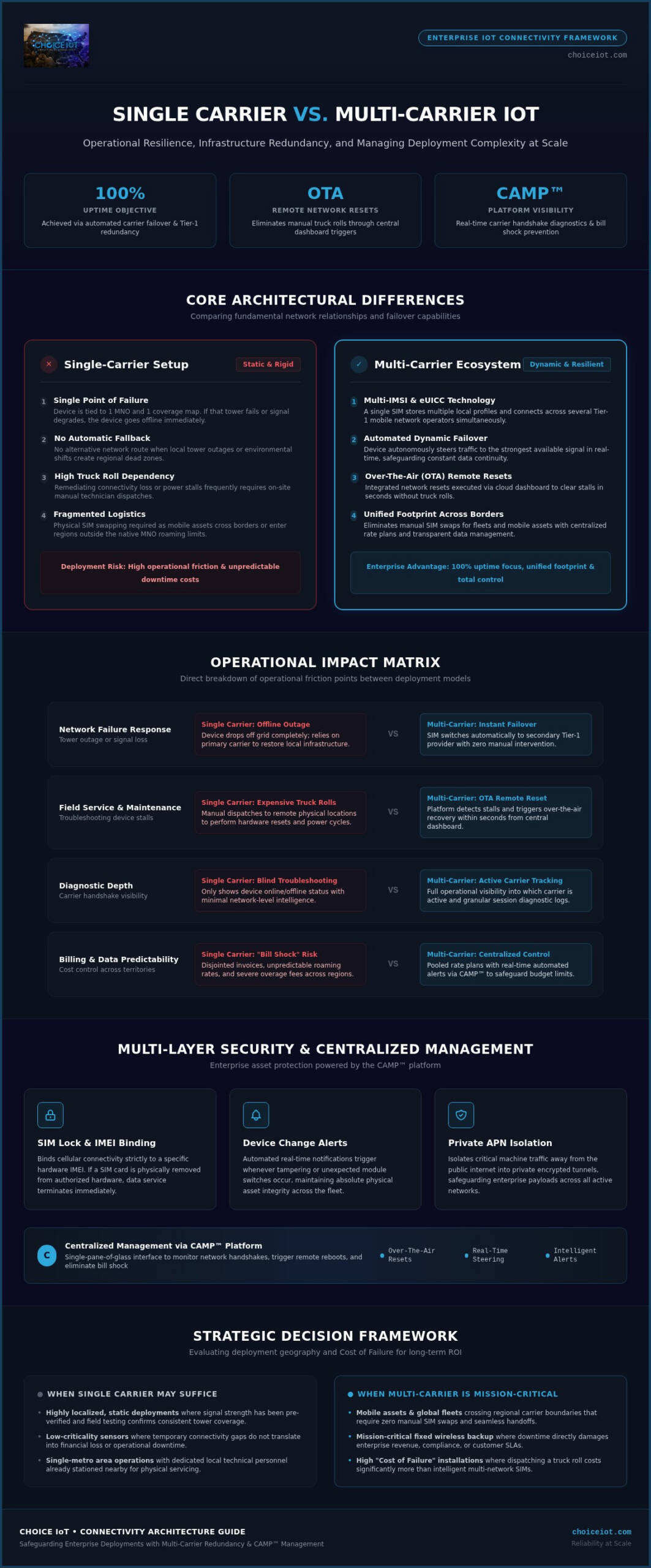
Connectivity is the lifeblood of any Internet of Things connectivity strategy. Choosing the wrong architecture creates a ripple effect of technical debt. When evaluating single carrier vs multi carrier iot, the distinction begins with the relationship between the device and the Mobile Network Operator (MNO). A single-carrier setup relies on one MNO, one coverage map, and one point of failure. If that specific tower goes down or the signal degrades, your device is offline. There is no fallback.
Multi-carrier IoT changes the equation. It provides access to multiple networks through a single SIM using Multi-IMSI or eUICC technology. Modern deployments in 2026 utilize sophisticated steering mechanisms. These allow devices to prioritize the strongest available signal in real time. The one size fits all approach is failing. Modern enterprises comparing single carrier vs multi carrier iot find that redundancy is the only way to safeguard uptime across diverse geographies. It’s about resilience. It’s about total control.
The Single Carrier Environment
Traditional cellular models are built on static relationships. Your hardware is locked to a single provider’s infrastructure and their specific roaming agreements. It’s a rigid system. It works best for highly predictable, localized static deployments where signal strength has been pre-verified. However, the risks are significant. Regional outages or shifting environmental factors can create dead zones. Fixing these often requires manual hardware intervention. Truck rolls are expensive. Downtime is worse.
The Multi-Carrier Ecosystem
Dynamic network switching defines this ecosystem. One SIM provides access to multiple Tier-1 providers. This is the gold standard for mobile assets, global fleets, and mission-critical fixed wireless backup. Multi-IMSI technology plays a vital role here. It enables seamless cross-border connectivity by storing multiple local profiles on a single chip. It eliminates the logistical nightmare of swapping SIM cards as devices move. You get a unified footprint. You get a foundation for high-performance growth.
Key Operational Differences: Reliability, Coverage, and Redundancy
Coverage is the most immediate differentiator in any deployment. Single-carrier setups often suffer from geographic gaps. One provider’s weak spot is a total loss of signal for your device. Multi-carrier footprints aggregate several major networks into one resilient stream. If a primary tower goes offline, the SIM failovers to a secondary provider. This ensures data continuity without user intervention. It provides a level of uptime that single-network architectures cannot match.
Operational visibility changes with multi-network access. You need tools to see which carrier is active and why. It isn’t enough to know a device is offline. You must understand the specific carrier handshake. This diagnostic depth is vital when comparing single carrier vs multi carrier iot performance. It transforms blind troubleshooting into a data-driven process. You gain the ability to manage complex deployments with the same ease as a local setup.
Eliminating the ‘Truck Roll’ with Remote Management
Manual resets are an operational sinkhole. Sending staff to remote locations for a power cycle is inefficient. In 2026, Remote Network Reset features enable over-the-air (OTA) recovery. Using the CAMP™ platform, you can trigger these resets from a central dashboard. Automated triggers can even detect stalls and fix them in seconds. This reduces downtime and protects your bottom line. You stop paying for travel and start paying for performance.
Security and Asset Protection
Security is often overlooked in multi-network discussions. SIM Lock technology binds connectivity to a specific IMEI. If a SIM is removed, the service terminates instantly. Device Change Alerts provide real-time notifications of potential tampering. For those seeking advanced IoT connectivity, Private APN integration adds another shield. It keeps your data isolated from the public internet. This level of protection ensures your assets remain secure regardless of which network they use. You get total control over your hardware and your data.
Strategic Decision Framework: Which Architecture Fits Your Deployment?
Selecting the right architecture is a strategic pivot point for any enterprise. It’s a calculated move to mitigate risk. When analyzing single carrier vs multi carrier iot, geography is your first filter. Static, localized sensors in a pre-tested area might tolerate a single network. Regional or global deployments cannot afford that gamble. They need the flexibility to shift as conditions change.
Calculate your “Cost of Failure” before committing. What does sixty minutes of downtime cost your operation? If you are running mission-critical systems, that number is likely higher than the marginal cost of redundant connectivity. Data usage patterns also dictate the choice. High-bandwidth fixed wireless requires different uptime guarantees than low-data sensor monitoring. As you scale, your need for carrier diversity grows. You must plan for growth, not just current capacity.
Use Case: Fleet Management and Logistics
Assets move at high velocity. They cross carrier boundaries constantly. A single-carrier dependency creates blind spots in your supply chain. Multi-carrier is non-negotiable for real-time visibility. By leveraging multi carrier iot sim cards, you ensure global roaming without the need for manual profile swaps. It keeps your fleet connected across every border. You get total visibility. You get operational peace of mind.
Use Case: Fixed Wireless for Enterprise Backup
Retail POS systems and remote offices require 100% uptime. Traditional fiber is vulnerable to physical cuts and local outages. Choosing fixed wireless connectivity for business provides a robust secondary layer. For medium-speed industrial applications, 5G Redcap offers a cost-effective balance of performance and power. It’s about building a fail-safe environment. Control your uptime. Control your costs.
Ready to optimize your connectivity? Consult with Choice IoT today to build a resilient, multi-carrier deployment tailored to your scale.
Managing Multi-Carrier Complexity with Choice IoT and CAMP™
Managing a diverse network shouldn’t be a burden. It should be an advantage. The “One Platform” promise is about removing friction from your daily operations. When you compare single carrier vs multi carrier iot, the management layer is the ultimate deciding factor for ROI. Choice IoT centralizes everything. One dashboard. Total visibility. Complete operational control. We simplify the complex so you can focus on growth.
Preventing “bill shock” is a core priority. We provide Intelligent Alerts and custom data thresholds to stop overages before they impact your margin. Operational efficiency is built into our DNA. Automate your SIM activations. Change plans instantly via our Open API. Choice IoT functions as a complete connectivity partner for VARs and integrators. We provide the foundation. You provide the innovation.
CAMP™: Complete Operational Control
Visibility is power. The CAMP™ platform provides real-time insights into every device in your fleet. It doesn’t matter which underlying carrier is currently active. You see the data usage. You control the connection status. Built-in diagnostics allow your team to troubleshoot issues directly. Bypass carrier support wait times. Fix problems in seconds. This is how you scale wholesale SIM management without increasing your headcount.
Transitioning to a Multi-Carrier Strategy
Moving from a single-carrier silo to a unified multi-network architecture requires a clear roadmap. It starts with hardware readiness. We help you secure carrier device certification services to ensure your equipment is optimized for Tier-1 networks. Leveraging Choice IoT’s expert support makes the execution seamless. You gain the resilience of a single carrier vs multi carrier iot strategy without the traditional logistical hurdles. It’s time to take total control of your deployment.
Future-Proofing Your Connectivity Strategy
Deploying at scale requires more than just a connection. It requires a strategy that anticipates failure and automates recovery. When comparing single carrier vs multi carrier iot, the choice isn’t just about coverage maps. It’s about operational control. Multi-carrier architectures eliminate the risk of regional blackouts by providing automatic failover to secondary networks. This ensures your data keeps moving even when a primary tower fails. Reliability is no longer a luxury; it is a requirement.
True efficiency comes from managing this complexity through a single pane of glass. With the CAMP™ platform, you gain real-time visibility and the power of Remote Network Reset functionality. Truck rolls eliminated. Bill shock prevented. You protect your bottom line with Intelligent Alerts that stop overages before they impact your margin. You don’t have to manage these hurdles alone. We provide the tools to keep you in total command of your deployment.
Get One Platform for Complete Operational Control-Contact Choice IoT Today. We are ready to help you build a deployment that is reliable, scalable, and fully optimized for the demands of 2026. Your growth starts with a resilient foundation.
Frequently Asked Questions
Is multi-carrier IoT more expensive than single-carrier?
Multi-carrier solutions often provide a higher return on investment by eliminating the hidden costs of downtime and physical maintenance. While a single-carrier plan might appear cheaper initially, it lacks the resilience needed for mission-critical deployments. Factor in the expense of sending technicians to remote sites for manual resets. The multi-carrier model becomes the more economical choice. Reliability is the priority. You pay for uptime and operational peace of mind.
Does a multi-carrier SIM connect to all networks at once?
No, a multi-carrier SIM typically connects to one network at a time. It uses intelligent steering to prioritize the strongest available signal based on your specific location. If the primary network signal drops, the SIM automatically initiates a failover to a secondary carrier. This process ensures your device remains online without manual intervention. Seamless connectivity. Robust performance. It provides the benefits of multiple networks through a single, managed hardware component.
What is the difference between Multi-IMSI and eUICC for IoT?
Multi-IMSI technology stores several international mobile subscriber identities on one SIM, allowing the device to switch between networks locally. eUICC is a more flexible standard that allows you to download and manage network profiles over-the-air. Both technologies are essential for global deployments. They allow businesses to avoid the logistical nightmare of physical SIM swaps. Choosing between them depends on your specific hardware requirements and the long-term scalability of your deployment.
How do I prevent data overages on a multi-carrier plan?
Preventing overages requires real-time visibility into your data consumption. When comparing single carrier vs multi carrier iot solutions, the management platform is your best defense against bill shock. The CAMP™ platform allows you to set Intelligent Alerts based on custom data-usage thresholds. You receive proactive notifications before a device exceeds its limit. Total visibility. Predictable costs. This level of automation ensures your monthly expenses remain stable as your fleet grows.
Can I use a Private APN with a multi-carrier SIM card?
Yes, you can integrate a Private APN to ensure secure data transmission across multiple carrier networks. This creates a private tunnel for your traffic, keeping it off the public internet. Choice IoT provides this feature to enhance the security of your multi-carrier deployment. It’s a critical requirement for industries handling sensitive data or mission-critical infrastructure. Combining a Private APN with multi-network flexibility gives you the ultimate balance of security and reliability.
What happens if a carrier goes down in a multi-network deployment?
If a carrier experiences an outage, your multi-carrier SIM will automatically search for the next strongest available network. This failover process is seamless and prevents prolonged downtime. In a single carrier vs multi carrier iot comparison, this is the most significant operational advantage. You gain 100% connectivity uptime. Redundancy is built-in. Your deployment is no longer dependent on the health of a single provider’s infrastructure or regional tower status.