

A single lost connection can paralyze an entire IoT deployment. You’ve spent months engineering your hardware. If you can’t reach your devices during a critical update, that effort is wasted. The choice between static ip vs dynamic ip is about more than just network addresses. It’s a decision about the fundamental architecture of your security and remote management strategy. High-performance fleets require high-performance connectivity. Reliable. Secure. Scalable.
Managing thousands of SIMs across fragmented networks is a logistical nightmare. You need to know your hardware is reachable, regardless of network resets or carrier handoffs. This article ensures you can select the right configuration to maintain secure remote access and achieve predictable connectivity costs. We’ll break down the technical trade-offs and provide a clear decision framework for your next deployment. Total control. Zero friction.
Key Takeaways
- Identify why fixed addresses are the gold standard for maintaining uninterrupted remote access to deployed hardware.
- Evaluate the technical trade-offs of static ip vs dynamic ip to choose the right architecture for inbound M2M communication.
- Learn how to secure your IoT fleet by layering Static IPs within a Private APN to prevent public-facing vulnerabilities.
- Discover how to eliminate the “management nightmare” of IP tracking using the centralized CAMP™ IoT Platform.
- Establish a clear decision framework to balance connectivity costs with the need for high-performance reliability.
IP Fundamentals: The Core Difference Between Static and Dynamic
Every connected device requires a digital fingerprint to communicate across the web. This identifier, or IP address, dictates how data packets find their destination. When architecting an IoT fleet, the choice between static ip vs dynamic ip determines your long-term operational overhead. It is the difference between a permanent street address and a rotating hotel room number. To build a robust network, you must understand IP address fundamentals and how they impact device reachability. Connectivity is the foundation. Complexity is the enemy.
The fundamental trade-off centers on consistency versus resource efficiency. Dynamic addresses are built for temporary sessions. Static addresses are built for infrastructure. For an enterprise, choosing the wrong one can lead to “ghost devices” that are powered on but entirely unreachable from your central management console.
How Dynamic IP Assignment Works
Most cellular networks rely on Dynamic Host Configuration Protocol (DHCP) to manage their address pools. Under this system, a carrier assigns an IP address to a device for a temporary window known as a lease. Once the lease expires or the device reconnects, the address returns to the pool and a new one is issued. Carriers prefer this method for consumer mobile plans because it maximizes resource efficiency. The industry is currently shifting toward IPv6 to handle the massive growth of IoT, with US adoption rates exceeding 56 percent according to 2026 data from SixMap. However, dynamic pools remain the default for standard cellular connections.
This constant recycling creates a discoverability gap. If your central server needs to push a command to a remote sensor, it cannot find the device if the IP changed an hour ago. Dynamic assignment works for smartphones. It fails for industrial management. When your hardware is deployed in a remote field, you cannot afford to lose the ability to ping that device directly. Searching for a new IP across thousands of SIMs is a manual nightmare you should avoid.
The Mechanics of Static IP Reservation
Static IPs bypass the uncertainty of rotating addresses. Instead of requesting a new identifier every time it wakes up, the device maintains a dedicated slot on the network. The gateway recognizes this specific reservation and ensures data packets always reach the correct hardware. This creates a permanent home for your data. A Static IP is a non-rotating identifier assigned for the duration of a device’s lifecycle. This consistency is vital for M2M (machine-to-machine) communication where direct inbound access is required.
Predictability drives scalability. By utilizing a fixed identifier, you eliminate the need for complex “heartbeat” scripts designed just to report a device’s current location. You gain the ability to initiate communication at any time. This is the gold standard for secure, reliable IoT. Understanding the static ip vs dynamic ip divide is the first step toward a deployment that stays connected, stays visible, and stays under your control. Permanent addresses. Reliable access. Total control.
Technical Comparison: Static vs. Dynamic IP Performance
Performance benchmarks define your ROI. When you analyze static ip vs dynamic ip performance, the distinction is clear: one is built for mobility, the other for infrastructure. Dynamic IPs rely on a cycle of assignment and expiration. This forces devices to re-authenticate and re-establish their presence on the network periodically. For a consumer smartphone, this is invisible. For an industrial gateway, it is a potential point of failure. Reliability is not a luxury. It is a requirement.
Stability is the primary differentiator. Static IPs eliminate the risk of connection drops during IP refreshes. To assign specific IP addresses allows you to bypass the instability of DHCP leases. You gain direct inbound communication. No middlemen. No relay servers. Just a clean, persistent link to your remote hardware. While dynamic IPs require less manual configuration at the start, they demand more robust software logic to handle address changes. Static IPs require more upfront setup but deliver long-term simplicity.
Connectivity and Uptime Comparisons
Legacy M2M applications often struggle with dynamic environments. Many older systems are hardcoded to look for specific endpoints. When a carrier rotates a dynamic IP, the link snaps. Even in modern deployments, the “re-registration lag” can disrupt operations. This is the latency period where a device negotiates a new address and updates your central server. It creates a window of invisibility that can last from seconds to minutes.
Ensuring real-time IoT device monitoring demands an unchanging identifier. Without it, your dashboard might report a device as offline simply because its address is in flux. High-performance monitoring requires high-performance addressing. You cannot manage what you cannot find.
Cost Analysis for Enterprise Deployments
Budgeting for IoT involves more than just the monthly data plan. Static IPs typically involve a one-time activation fee and a recurring monthly surcharge. This is a premium service. Carriers treat fixed addresses as a limited resource. However, focusing only on the line-item cost is a mistake. You must look at the total cost of ownership.
The hidden costs of dynamic IPs are often found in software complexity and field maintenance. Dynamic environments require robust retry logic and “find-me” scripts to keep the server updated. If these scripts fail, you face manual resets or expensive site visits. One truck roll costs more than years of static IP fees. Balancing your budget means weighing these operational risks against the upfront cost of a Static IP Address. Predictable costs. Reliable uptime. Scalable growth.
The IoT Imperative: Why Static IPs Rule M2M Communication
Machine-to-machine (M2M) communication requires a level of precision that consumer-grade networking can’t match. When weighing static ip vs dynamic ip for industrial use, the decision often centers on visibility. Most IoT devices are programmed to send data on a schedule. This “heartbeat” is fine for simple telemetry, but it’s a liability for mission-critical systems. If you need to reach a device outside of its scheduled window, you need a fixed identifier. Immediate access. Zero lag. Total transparency.
Diagnostic efficiency is another core advantage. Troubleshooting a remote device is significantly faster when its “phone number” never changes. Technicians don’t have to hunt for a current IP address in a rotating pool. They simply connect. Legacy systems, such as older Programmable Logic Controllers (PLCs), often lack the intelligence to navigate changing network environments. For these devices, a static IP isn’t just a preference. It is a technical requirement for survival.
- Inbound Communication: Initiate commands, updates, and pings at any time without waiting for the device to wake up.
- VPN Compatibility: Secure tunnels require fixed endpoints to maintain encryption and persistent connectivity.
- System Reliability: Eliminate the risk of connection failures in legacy hardware that cannot handle address rotation.
Case Study: Remote Industrial Gateways
Consider a field technician at a central Network Operations Center (NOC) who needs to push an emergency patch to a remote router. If that router is on a dynamic IP, the technician is blind. They must wait for the device to report its new location. In high-stakes environments, this delay is unacceptable. Modern fixed wireless connectivity for business relies on static addressing to ensure that critical infrastructure remains reachable 24/7. It provides the stability required for real-time control and monitoring. Empower your team with the tools to respond instantly.
When Dynamic IP is Sufficient for IoT
Not every deployment requires the “gold standard” of a fixed address. Simple asset trackers that only initiate outbound calls to report location can often function on dynamic assignments. This is a cost-saving strategy for non-critical telemetry where real-time inbound access isn’t required. Some integrators attempt to use Dynamic DNS (DDNS) as a workaround for changing IPs. This often fails in enterprise IoT. DDNS adds another layer of software that can break, creating a management nightmare across thousands of SIMs. If your data is critical, the workaround isn’t worth the risk. Choose stability over complexity.
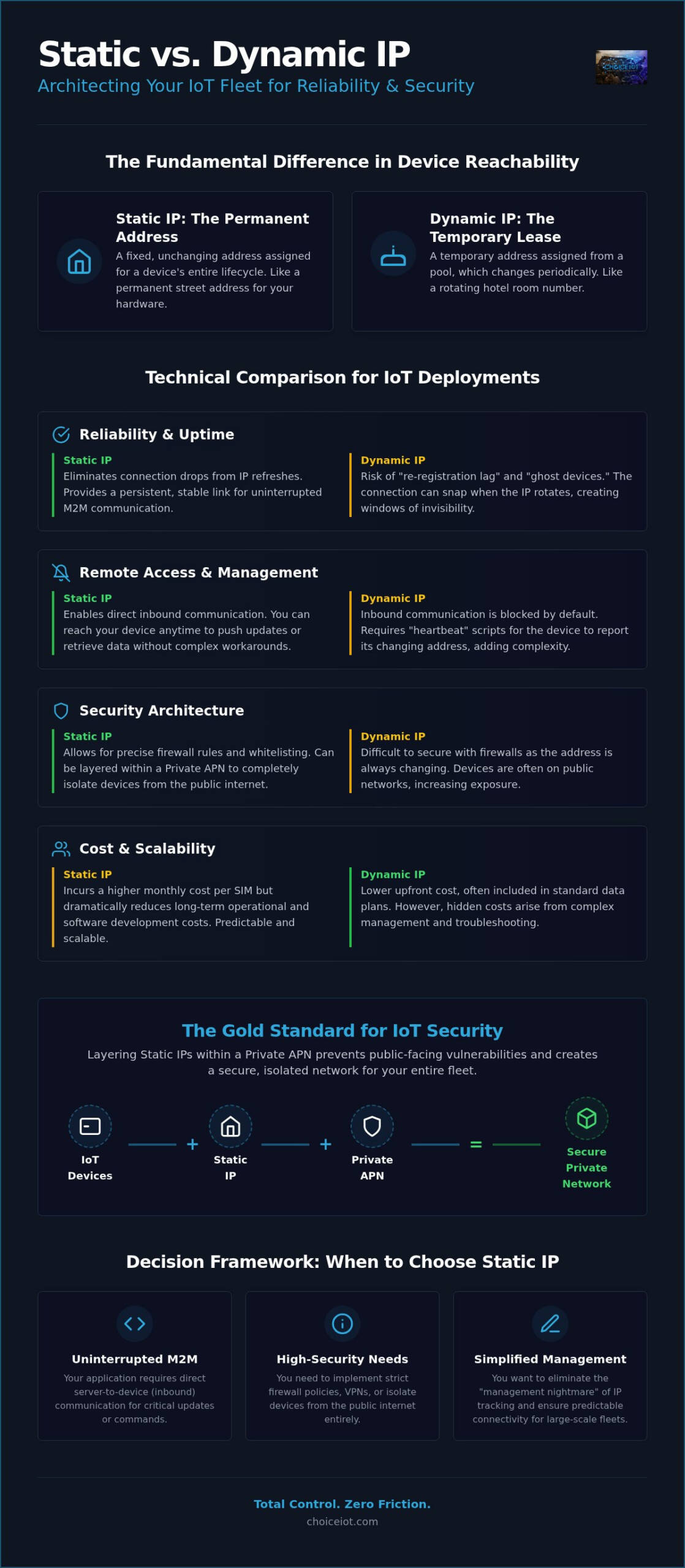
Security and Infrastructure: Private APN vs. Public IPs
Security is the silent killer of IoT deployments. While we’ve discussed the operational benefits of static ip vs dynamic ip, the security implications are even more critical. A common misconception is that static IPs are inherently less secure because they provide a fixed target for hackers. This is only true in the “Public IP Trap.” If your static IP sits on the open web, it is vulnerable to brute force attacks and port scanning. You wouldn’t leave your front door wide open in a crowded city. Don’t do it with your hardware.
The solution isn’t to switch to dynamic addresses. It’s to change the network architecture. Static IPs allow for precise end-to-end encryption and simplified certificate management. They facilitate compliance with industry standards by ensuring that every data transmission follows a predictable, auditable path. Secure. Transparent. Compliant.
Layering Security with Private APN
A Private APN acts as a “walled garden” for your fleet. It effectively hides your devices from the public internet. When you layer a static IP within a Private APN, you get the best of both worlds: reachability and invisibility. This architecture ensures that only authorized users within your private network can communicate with your hardware. It reduces the attack surface to near zero. No public exposure. No unauthorized pings.
This security model works in perfect synergy with multi carrier iot sim cards. You maintain a consistent security posture regardless of which carrier the device is currently using. Whether your hardware is on a local tower or roaming globally, the private tunnel remains intact. It is a unified defense strategy for a fragmented world. The technical debate of static ip vs dynamic ip often overlooks the role of this critical network layer.
M2M Authentication Protocols
Authentication is the gatekeeper of your data. Static IPs enable robust whitelisting, where your server only accepts incoming data from a specific list of known identifiers. This creates a hard barrier against spoofing. Dynamic IPs make enterprise-grade firewall rules nearly impossible to maintain. If your device’s address changes every 24 hours, your firewall becomes a moving target. It creates holes in your security perimeter. Managing these rules for thousands of devices is a manual nightmare that leads to human error. Protect your infrastructure by deploying a secure Private APN today. Controlled access. Hardened endpoints. Reliable defense.
Streamlining the Choice: How Choice IoT Simplifies Management
Scaling an IoT fleet from ten devices to ten thousand introduces massive operational complexity. The decision between static ip vs dynamic ip is only the first step. The real challenge lies in the day-to-day oversight of those addresses. Managing thousands of individual IPs shouldn’t require thousands of manual spreadsheets. You need a centralized hub that provides total visibility. Streamlined. Efficient. Scalable.
Choice IoT removes the friction from large-scale deployments. We provide the infrastructure and the expertise to navigate carrier device certification and complex network configurations. Whether your hardware requires the persistence of a fixed address or the resource efficiency of a dynamic one, we offer the flexibility to provision both within a single account. High-performance connectivity meets enterprise-grade management.
Centralized Management with the CAMP™ Platform
Visibility is the antidote to operational chaos. The CAMP™ platform serves as your command center, providing real-time insights into every IP assigned to your fleet. You can monitor data usage and connection status in a single pane of glass. This level of granularity is essential for maintaining network health and optimizing performance. No more guessing. Just data.
Cost control is a primary concern for any growing business. An iot connectivity management platform prevents bill shock by setting automated alerts and usage caps. You gain the power to automate the deployment of static IP SIM cards, reducing the time from procurement to field activation. Rapid deployment. Predictable costs. Total control.
Next Steps for Your Deployment
Choosing the right architecture requires a deep understanding of your application’s data flow. Does your hardware need to be reached instantly from a central server? Or is it a simple sensor that only pushes data outbound? Assessing your fleet’s communication needs is the critical next step. You don’t have to navigate these technical waters alone. Expert guidance is a click away.
Consult with Choice IoT to design a custom connectivity architecture that balances security, reliability, and cost. We help you evaluate the static ip vs dynamic ip trade-offs specific to your industry and hardware requirements. Empower your deployment with a solution built for the future. Request a demo of the CAMP™ platform today to see how we simplify IP tracking and fleet management. Better connectivity starts here. Your success is our mission.
Architecting a Future-Proof IoT Infrastructure
Successful IoT deployments demand more than just hardware. They require a connectivity strategy that prioritizes uptime and security. The fundamental choice between static ip vs dynamic ip isn’t just about network addresses; it’s about the long-term reachability and stability of your remote assets. Static IPs provide the fixed identifiers necessary for seamless M2M communication and diagnostic efficiency. When you layer these addresses within a Private APN, you eliminate public vulnerabilities while maintaining total control. Reliable access. Hardened defense. Scalable growth.
Complexity shouldn’t be a barrier to your expansion. You need tools that simplify the logistical stress of tracking thousands of endpoints. Our CAMP™ Platform offers one-click IP management, while multi-carrier SIMs ensure global reliability across any network. You gain enterprise-grade security and streamlined operations in one unified ecosystem. High-performance connectivity. Zero friction. Total visibility.
Secure your IoT fleet with Choice IoT’s Static IP and Private APN solutions today. Build your infrastructure on a foundation of reliability and move forward with the confidence of a partner who has already solved the industry’s toughest hurdles. Your deployment is ready to scale.
Frequently Asked Questions
Is a static IP safer than a dynamic IP for IoT devices?
Static IPs are not inherently safer and can actually increase risk if exposed to the public internet. A fixed address on the open web is a permanent target for brute force attacks and unauthorized scans. To secure your fleet, you must layer a static IP within a Private APN. This creates a secure “walled garden” that hides your devices from public visibility while maintaining the remote reachability your deployment requires.
Does a static IP improve internet speed for M2M connectivity?
A static IP does not directly increase raw data throughput or bandwidth speeds. Your connection speed is determined by your hardware, signal strength, and the local carrier network. However, a static IP improves the perceived performance of M2M connectivity by eliminating the “re-registration lag” associated with dynamic address refreshes. You avoid the latency of address renegotiation, ensuring your real-time data flow remains consistent and uninterrupted.
How do I get a static IP for my cellular IoT SIM cards?
You obtain a static IP by partnering with a specialized IoT connectivity provider rather than a consumer carrier. Providers like Choice IoT provision these addresses at the SIM level during the activation process. Once your SIM is configured with a static profile, the address remains assigned for the duration of the device’s lifecycle. You can manage these assignments and monitor status through a centralized platform like CAMP™ for total fleet visibility.
Can I use a dynamic IP with a VPN for my remote sensors?
Using a dynamic IP with a VPN is technically possible but highly unreliable for enterprise IoT deployments. Most secure VPN tunnels require a fixed endpoint to maintain encryption and persistent connectivity. If the IP changes, the tunnel collapses and must be rebuilt. You would need complex “find-me” scripts or Dynamic DNS to re-establish the link, which adds unnecessary software overhead. For mission-critical sensors, static IPs are essential.
What is the cost difference between static and dynamic IPs in IoT?
Static IPs carry a higher total cost of ownership compared to standard dynamic assignments. You typically face a one-time activation fee and a recurring monthly surcharge per SIM for the fixed address. Dynamic IPs are usually included in standard data plans at no extra cost. However, the premium for a static IP is an investment in reliability. It prevents the hidden costs of downtime, lost remote access, and expensive field maintenance visits.
What happens to my IoT device when a dynamic IP address changes?
When a dynamic IP changes, your device must re-authenticate with the network, causing a temporary connection drop. If your central server attempts to push a command or update during this window, the device will be unreachable. The device essentially becomes a “ghost” until it sends a new heartbeat to report its updated location. This instability can break legacy M2M applications that rely on persistent, direct links to hardware.
Is a static IP required for remote access to a cellular router?
Yes, a static IP is required if you need direct, inbound remote access to a cellular router. Without a fixed address, you cannot “call” the router from your central office; you would be forced to wait for the router to initiate an outbound connection. For field technicians who need to push patches or troubleshoot hardware in real-time, a fixed identifier is essential. It ensures the router is always reachable regardless of its location.
Can I switch from dynamic to static IP after my devices are deployed?
You can switch from dynamic to static IP, but it often requires a SIM profile update or a new SIM card entirely. Carriers manage static addresses differently than dynamic pools, so the transition isn’t always a simple software toggle. It’s best to plan your static ip vs dynamic ip strategy before deployment. This avoids the logistical nightmare of updating thousands of devices already in the field and ensures your fleet remains scalable.