

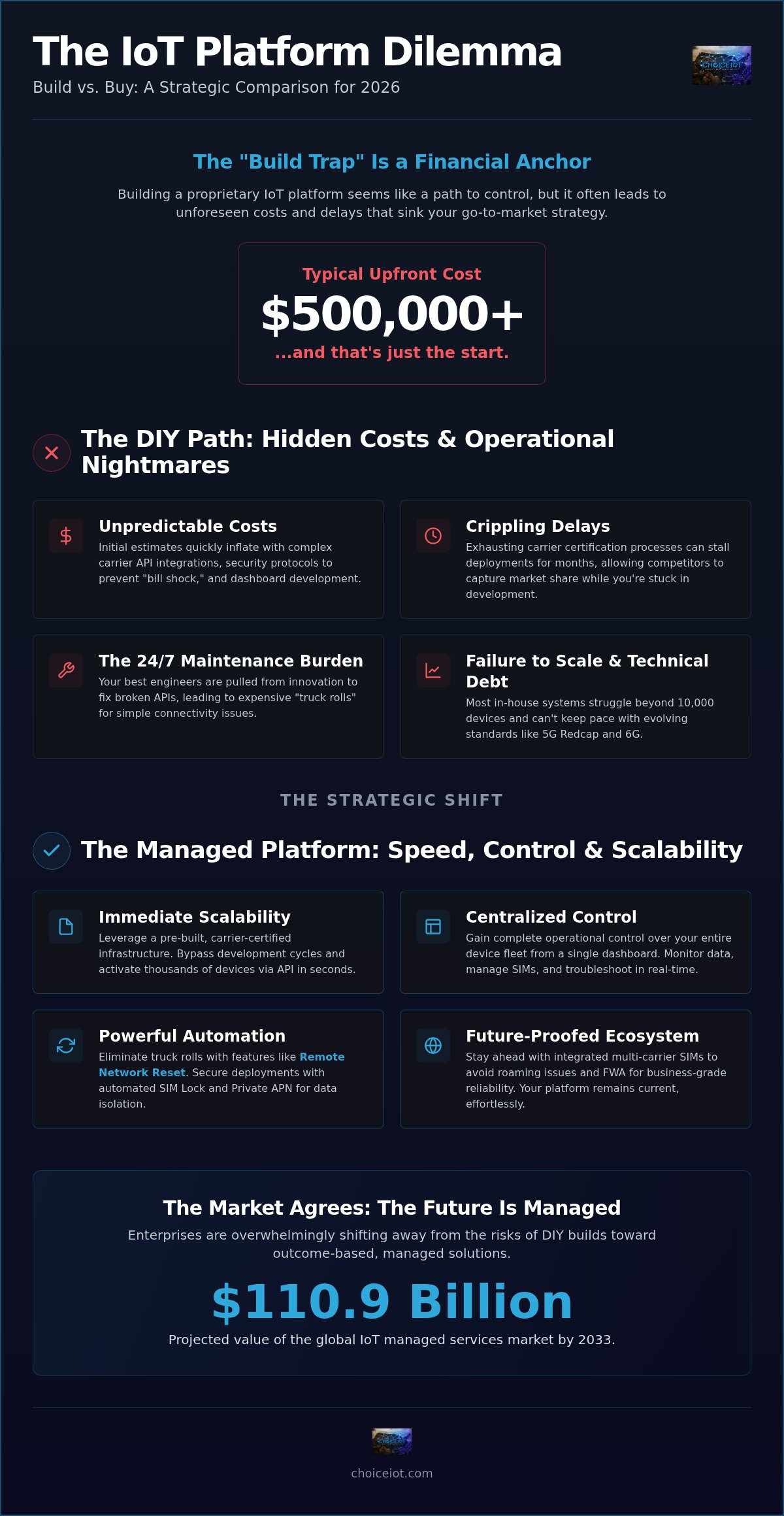
Building your own IoT platform in 2026 isn’t a competitive advantage; it’s a $500,000 anchor that drags down your speed to market. While the appeal of proprietary control is strong, the reality involves unpredictable development costs and exhausting carrier certification delays. You want a system that scales immediately. You need a framework that’s already proven. Exploring alternatives to building your own iot platform allows your team to bypass the technical debt of custom stacks while maintaining the granular control your enterprise requires.
It’s natural to prioritize total ownership of your data and devices. You demand security. You need visibility. But managing multi-carrier relationships and patching security vulnerabilities in a custom build is a constant drain on your best engineers. We’ll show you how to trade that complexity for true operational leverage. This guide breaks down seven strategies to achieve faster time-to-market using managed connectivity alternatives. Discover how to gain centralized visibility and essential features like Remote Network Reset without the DIY headache. It’s time to move from manual management to a streamlined, high-performance infrastructure. One platform. Complete operational control.
Key Takeaways
- Identify why enterprise-grade custom builds often fail due to high development costs and the relentless burden of 24/7 maintenance.
- Evaluate strategic alternatives to building your own iot platform that provide immediate scalability and carrier-certified infrastructure.
- Secure your deployment at the network level with automated SIM Lock features and real-time device change alerts.
- Eliminate costly truck rolls and manual troubleshooting by leveraging the Remote Network Reset capability within the CAMP™ platform.
- Achieve centralized visibility and complete operational control over your entire device fleet without the technical debt of a DIY stack.
The High Cost of DIY: Why Building Your Own IoT Platform Often Fails
Choosing to develop a proprietary stack often leads to a “build trap” that consumes your engineering budget. Many enterprises underestimate the 24/7 maintenance requirement. It’s a relentless demand. Strategic alternatives to building your own iot platform allow you to shift from defensive maintenance to offensive growth. Engineering talent is expensive. Don’t waste it on infrastructure. Your best developers should be innovating, not fixing broken API calls to a carrier’s legacy system.
Technical debt accumulates fast. By 2026, 5G Redcap is the standard; 6G is already on the horizon. Custom platforms struggle to keep pace with these shifting hardware and network standards. Carrier device certification is another massive hurdle. It can stall your deployment for months. You don’t have that time. When you build in-house, you’re responsible for every certification, every security patch, and every network update across multiple carriers.
Hidden Development Costs You Haven’t Budgeted For
API integration with multiple global carriers is a moving target. Standards shift; protocols evolve. You also need robust security protocols to prevent “bill shock” from data overages. One rogue device can drain a budget in hours. Building a user-friendly dashboard for non-technical staff adds another layer of complexity. These costs aren’t one-time expenses. They’re recurring drains on your capital.
Operational Friction: The Maintenance Nightmare
Managing SIM lifecycles manually is a recipe for error. Without a dedicated iot connectivity management platform, your team is stuck in administrative loops. DIY stacks lack features like Remote Network Reset; this leads to expensive truck rolls for simple connectivity issues. Most in-house systems fail to scale past 10,000 devices. They lack the automation needed for enterprise growth. Exploring alternatives to building your own iot platform is the only way to maintain operational agility in a crowded market.
Strategic Alternatives to Building Your Own IoT Platform
Building an IoT platform from scratch is a legacy mindset. Modern enterprises prioritize speed and reliability over proprietary code. When evaluating alternatives to building your own iot platform, the focus must shift toward established ecosystems that offer immediate operational leverage. These solutions provide the infrastructure you need without the multi-year development cycle. Total control. Zero code. Instant scale. By adopting a managed approach, you utilize a high-performance engine that is already optimized for the 2026 landscape.
The global IoT managed services market is projected to grow to $110.9 billion by 2033. This growth reflects a massive industry shift. Companies are moving away from the “build” trap and toward outcome-based models. Key alternatives include Connectivity Management Platforms (CMPs), white-label management services, and managed IoT SIM providers. These options allow you to focus on your core product while experts handle the connectivity layer.
Managed Connectivity Platforms (CMP)
A CMP serves as the central nervous system of your deployment. It provides one dashboard for all devices, SIMs, and data usage. Provisioning shouldn’t be a manual task. A robust CMP allows you to activate thousands of devices via API in seconds. Real-time visibility is non-negotiable for 2026 deployments. If you can’t see a device failing in real-time, you’re losing revenue. These platforms offer the transparency needed to manage large-scale fleets with a lean team.
Integrated Connectivity Ecosystems
Fragmented tools create friction. Integrated ecosystems solve this by combining hardware, software, and network access into a unified stack. Utilizing multi carrier iot sim cards is a core part of this strategy. These SIMs avoid roaming issues by switching networks based on signal strength, not just geography. Security is built-in, not bolted on. Integrating a private apn for iot ensures your data remains isolated from the public internet. This level of protection is difficult and expensive to replicate in a DIY build.
Fixed Wireless Access (FWA) integrations also provide business-grade reliability for stationary assets, ensuring your platform remains connected regardless of local infrastructure limits. The CAMP™ platform offers this level of sophisticated, ready-to-deploy infrastructure. Stop managing vendors and start managing your business. You can consult with a connectivity expert to see how these alternatives fit your specific use case.
Security and Scalability: The Operational Benefits of Managed Platforms
Security in 2026 is a zero-sum game. You’re either protected at the network layer or you’re exposed. Choosing alternatives to building your own iot platform is a strategic move to insulate your business from the vulnerabilities of custom-coded stacks. DIY platforms are often the weakest link. They lack the native, carrier-grade security features that managed ecosystems provide out-of-the-box. Total visibility. Immediate response. Complete operational control.
Managed platforms offer SIM Lock and Security features that automatically prevent unauthorized usage. If a SIM is removed from a sensor and placed in a rogue device, the connection drops instantly. You get a Device Change Alert before the data overage even begins. Intelligent alerts allow you to set custom thresholds for every SIM in your fleet. No bill shock. No surprises. Just predictable operational costs and a secure perimeter.
Proactive Security vs. Reactive Patching
Custom platforms require constant, manual patching. It’s a race you’ll eventually lose. Managed alternatives provide Static IPs and Private APNs without the infrastructure overhead. This isolates your traffic from the public internet entirely. It’s security by design. The impact on long-term ROI is clear: zero unauthorized data usage and significantly reduced engineering hours spent on security maintenance.
Scaling Globally Without the Headaches
Deploying across major cellular networks requires a scalable iot connectivity solution that handles the heavy lifting of carrier integration. Whether you’re utilizing 5G Redcap for low-power sensors or high-bandwidth 5G for industrial video, a managed platform streamlines the process. APIs handle activations and plan changes in real-time. You don’t need a team of specialists to manage carrier relationships; the platform does it for you.
Operational efficiency is about more than just data. It’s about uptime. The CAMP™ platform includes the Remote Network Reset feature, allowing you to fix connectivity issues from your desk. It eliminates costly truck rolls. It saves time. It keeps your fleet online. To see how these security and scaling features can transform your deployment, you can explore the CAMP™ platform today.
Choice IoT and CAMP™: The Complete Connectivity Alternative
Choice IoT provides the infrastructure to stop building and start deploying. The CAMP™ platform is the definitive answer for enterprises seeking alternatives to building your own iot platform. It delivers one platform and complete operational control. You don’t need a massive internal dev team to manage a global fleet. We’ve already built the engine. You just need to turn the key. It’s a partnership designed for speed, reliability, and total transparency.
Operational efficiency hinges on uptime. The CAMP™ platform features real-time diagnostics and troubleshooting tools that provide instant resolution for connectivity hurdles. A standout feature is the Remote Network Reset. It’s a game changer. This capability allows you to reboot a device’s connection from your dashboard, eliminating costly truck rolls and manual site visits. Customizable reporting and analytics further empower your team. Use data-driven insights to optimize usage and scale your deployment with confidence.
Why CAMP™ Beats a Custom-Built Platform
Automation is the core of CAMP™. Manage SIM activations, suspensions, and plan changes through a centralized interface without manual carrier intervention. Our robust API ensures seamless integration with your existing CRM or ERP systems. It’s built for your workflow. Beyond the technology, you gain a partner-first approach. You get expert technical support from people who understand the 2026 IoT landscape. We solve the hurdles so you can focus on your product.
Getting Started with Choice IoT
Success starts with a certified device. We streamline your deployment with professional carrier device certification services to prevent network-side delays. For stationary assets, achieving 100% uptime is possible through fixed wireless connectivity for business. This ensures business-grade reliability where traditional wireline fails. The market is moving fast. Don’t let technical debt hold you back. Exploring alternatives to building your own iot platform is the first step toward a leaner, more profitable operation. Contact our team at 1‑888‑565‑0774 to see CAMP™ in action.
Scale Your IoT Operations Without the Technical Debt
The decision to build or buy defines your operational agility for the next decade. DIY development often results in rigid infrastructure that fails to adapt to rapid shifts like 5G Redcap support. By choosing alternatives to building your own iot platform, you eliminate the maintenance burden. You focus on core innovation. You gain a high-performance engine designed for 2026 and beyond. Real-time visibility. Total control. Instant scalability.
Modern connectivity management requires more than just data flow. It requires automated security and intelligent uptime tools. The CAMP™ platform delivers a real-time visibility dashboard and the essential Remote Network Reset feature to keep your fleet online. No truck rolls. No manual troubleshooting. Stop managing technical debt and start managing growth. Request a CAMP™ Platform Demo Today to see how we simplify the complex. Your deployment deserves a foundation built for performance. Let’s build it together.
Frequently Asked Questions
Is it cheaper to build or buy an IoT platform?
Buying is significantly more cost-effective for most enterprises. Development of a mid-scale custom platform can cost between $50,000 and $150,000; enterprise-grade systems often exceed $500,000. Annual maintenance typically adds 15% to 25% of the initial cost. Choosing alternatives to building your own iot platform eliminates these capital expenditures and the ongoing burden of specialized engineering salaries. You gain a proven infrastructure without the financial volatility.
What are the main risks of building a custom IoT platform?
The primary risks include technical obsolescence and security vulnerabilities. Custom builds often lack the agility to support emerging standards like 5G Redcap. You also face carrier certification delays that can stall deployments for months. Without native network-level security features like SIM Lock, your deployment is exposed to unauthorized data usage. These risks lead to spiraling budgets and missed market opportunities. A managed platform mitigates these hurdles from day one.
How does an IoT connectivity management platform reduce operational costs?
It centralizes control and automates labor-intensive tasks. Features like Remote Network Reset eliminate costly truck rolls by allowing you to fix connectivity issues from a dashboard. Automated provisioning and intelligent data alerts prevent “bill shock” from rogue devices. By streamlining these processes, you reduce the headcount required to manage thousands of devices. You move from reactive troubleshooting to proactive, data-driven management. Efficiency is the core benefit.
Can a managed platform be customized for my specific industry needs?
Yes, modern managed platforms offer deep customization through robust APIs. You can integrate the CAMP™ platform directly with your existing CRM or ERP systems. This allows for tailored workflows, specialized reporting, and custom alert thresholds. You get the stability of a pre-built engine with the flexibility to meet unique industrial requirements. It’s the best of both worlds. Control remains in your hands while we handle the underlying complexity.
What is the difference between an IoT hub and a connectivity management platform?
An IoT hub focuses on data ingestion and cloud integration; a connectivity management platform (CMP) manages the cellular network layer. Cloud hubs don’t handle SIM lifecycles, Private APNs, or carrier certifications. A CMP provides real-time visibility into signal strength and data usage at the network level. While hubs manage what the device says, a CMP like CAMP™ manages how the device stays connected. Both are essential, but they serve different functions.
How do I transition from a DIY platform to a managed solution like CAMP™?
Transitioning is a structured process focused on minimizing downtime. We start by auditing your current device fleet and data usage patterns. Using our API, we integrate CAMP™ with your existing software stack to ensure continuity. We then migrate your connectivity to our multi-carrier SIMs. This process replaces fragmented DIY tools with a unified interface. It’s the most effective of the alternatives to building your own iot platform to achieve total operational control.