

What if your IoT fleet’s greatest operational vulnerability isn’t your device hardware, but the single carrier contract locked inside it? Zero network lock-in. Uninterrupted field performance. Exploring the strategic benefits of carrier agnostic sim cards reveals an immediate path to operational resilience. Juggling disjointed carrier portals, balancing separate data pools, and dispatching expensive field technicians just to swap offline SIMs drains technical resources and halts momentum.
You already know that tying mission-critical deployments to one cellular provider invites unacceptable outage risks and coverage dead zones. In this guide, you’ll discover how carrier agnostic SIM cards eliminate network lock-in, slash deployment downtime, and streamline enterprise IoT operations at scale. We examine how automated network switching, simplified single-SKU logistics, and centralized platform visibility provide reliable, uninterrupted connectivity across every regional market.
Key Takeaways
- Maximize operational uptime by understanding how non-steered cellular switching delivers the core benefits of carrier agnostic sim cards across regional boundaries.
- Eliminate expensive site maintenance visits and protect field revenue through automated, multi-carrier failover that connects to the strongest available signal.
- Evaluate connectivity providers using strict technical benchmarks, prioritizing transparent carrier agreements and secure routing via Private APN infrastructure.
- Accelerate large-scale rollouts with a structured migration framework and carrier device certification support that ensures seamless hardware validation.
What Are Carrier Agnostic SIM Cards and How Do They Work?
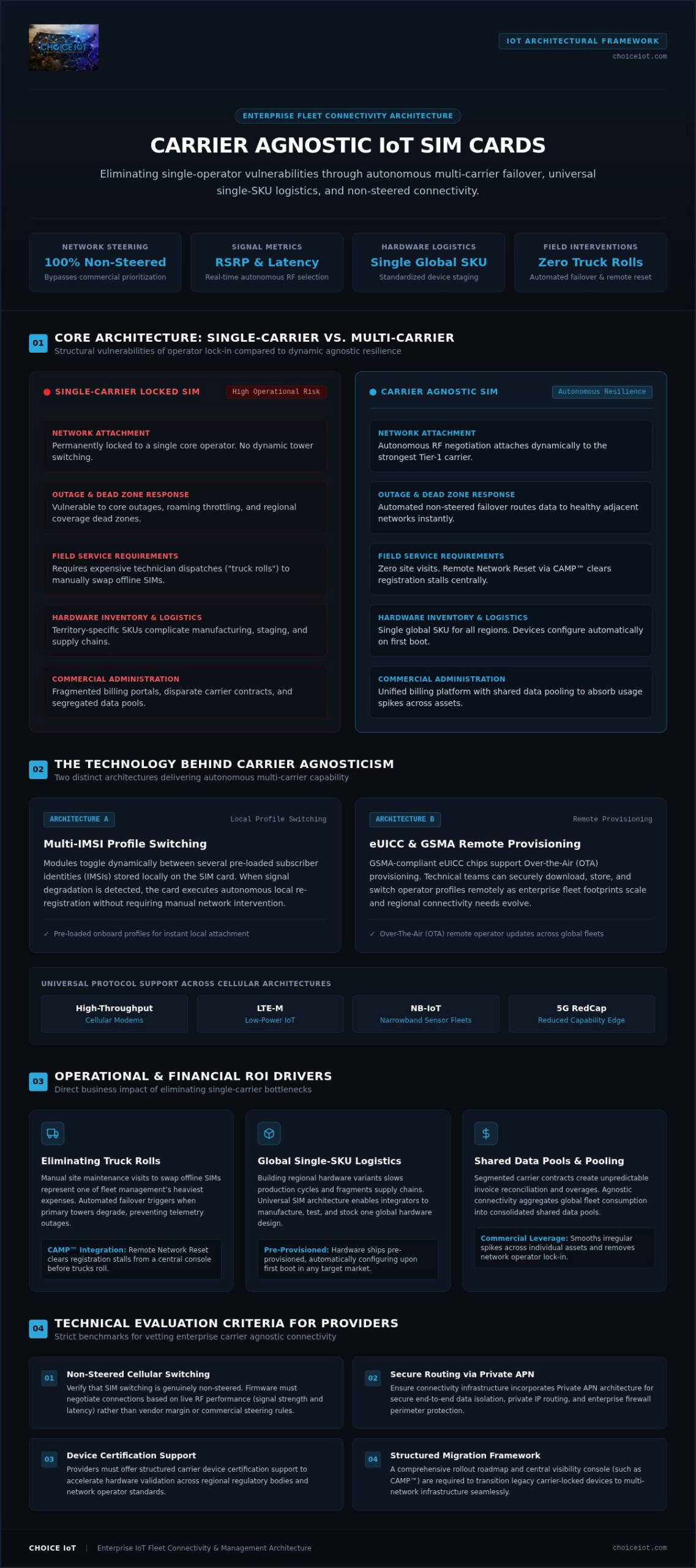
Carrier agnostic SIM cards are non-steered, multi-network cellular modules engineered to connect dynamically across multiple tier-one carriers. Traditional SIMs remain permanently locked to a single operator’s core network. That leaves connected devices vulnerable to restrictive roaming agreements and regional dead zones when local towers degrade. In contrast, agnostic connectivity decouples hardware from specific operator infrastructure. The primary benefits of carrier agnostic sim cards stem from autonomous network negotiation; the SIM scans available cellular towers and attaches directly to the provider delivering the strongest signal metrics, such as RSRP and low latency. For enterprise IoT deployments, this automated failover transforms volatile edge devices into resilient, always-on endpoints.
Single-Carrier Limitations vs. Multi-Carrier Independence
Single-carrier contracts introduce structural vulnerabilities to distributed IoT fleets. Carrier core outages, regional coverage blackouts, and roaming throttling quickly disrupt critical operations. Managing separate carrier inventories, territory-specific SKUs, and fragmented billing portals turns field logistics into an administrative nightmare. Multi-carrier independence eliminates this operational friction. One hardware design. Universal geographic deployment. Devices gain absolute freedom from local infrastructure monopolies, shifting networks on demand to maintain uninterrupted data transmission.
The Technology Behind Network Agnosticism: eUICC and Multi-IMSI
Two distinct architectures drive modern carrier agnosticism: multi-IMSI profile switching and GSMA-compliant remote provisioning. Multi-IMSI modules toggle between several pre-loaded subscriber identities stored locally on the card. Alternatively, an eUICC chip supports Over-the-Air (OTA) provisioning to download, store, and switch operator profiles as operational needs evolve. Both approaches enable autonomous local registration without field intervention.
- Universal Protocol Support: Seamless integration across high-throughput cellular modems, low-power LTE-M, NB-IoT, and 5G Redcap architectures.
- Intelligent Signal Negotiation: Device firmware evaluates real-time RF performance, bypassing artificial commercial steering to select the healthiest local network.
Operational and Financial Benefits of Carrier Agnostic SIMs
Carrier agnosticism reduces total cost of ownership by eliminating carrier lock-in, automating network failover, and standardizing global inventory under unified management. Unplanned field dispatches quickly compound operational debt. When a localized cellular outage strikes, devices reliant on a single provider go dark, freezing revenue and halting telemetry. Non-steered failover eliminates this threat by instantly rerouting connections to viable adjacent networks. Real-time resilience. Continuous telemetry. The financial benefits of carrier agnostic sim cards become clear when organizations stop absorbing the costs of downtime and start scaling predictably.
Eliminating Costly Truck Rolls Through Network Redundancy
Manual site interventions remain one of the heaviest hidden expenses in fleet management. Dispatching technicians to replace unresponsive, carrier-locked SIM cards across remote installations drains technical resources and stalls field operations. Deploying multi carrier iot sim cards safeguards fleets by triggering automated failover the instant primary tower signals degrade. Platform-level tools like CAMP™ also provide Remote Network Reset capabilities, clearing network registration stalls from a central console before a truck roll is ever scheduled.
Optimizing Hardware Production with a Single Global SKU
Manufacturing regional hardware variants slows production cycles and complicates supply chains. Universal SIM architecture allows integrators to build, test, and stock a single hardware SKU for deployment across any geography. Warehouses standardize device staging, while units ship pre-provisioned directly to end customers. Field devices configure automatically upon first boot, accelerating time-to-market without complex hardware redesigns.
Consolidated Billing and Eliminating Contract Lock-In
Fragmented billing structures generate administrative drag. Managing disparate carrier contracts, misaligned invoice cycles, and segregated data pools forces finance teams to resolve unpredictable overage fees manually. Agnostic connectivity aggregates fleet usage into shared data pools, smoothing out irregular spikes across individual assets. Decoupling hardware from network operators restores commercial leverage, giving enterprises complete operational freedom. For teams ready to simplify multi-network logistics, partnering with Choice IoT delivers the unified platform and multi-carrier infrastructure required to scale without friction.
Key Criteria for Evaluating Carrier Agnostic Connectivity Providers
Transitioning to multi-network connectivity requires strict technical vetting. Surface-level carrier partnerships often mask restrictive steering rules and delayed support workflows. The true operational benefits of carrier agnostic sim cards rely entirely on unsteered core architecture, direct tier-one carrier relationships, and robust infrastructure. Evaluating prospective providers on technical capabilities rather than marketing promises ensures long-term deployment viability.
True Non-Steered Access vs. Preferred Roaming Lists
Many connectivity vendors disguise standard consumer roaming as true carrier agnosticism. Steered profiles force devices to connect to an operator’s lowest-cost wholesale roaming partner, ignoring degraded signal conditions. Modems cling to unstable connections, causing dropped data packets and crippling latency. True enterprise-grade agnosticism ensures unthrottled, signal-metric switching based solely on network health, keeping mission-critical devices connected to the strongest signal available.
Enterprise Security: Private APN, Static IPs, and SIM Lock
Industrial fleets require isolated network perimeters that standard roaming simply doesn’t offer. Routing cellular traffic through a private apn for iot segregates sensitive data transfers entirely from the public internet. Pairing private APNs with Static IP addressing enables secure two-way diagnostics and remote debugging. Hardware security is just as critical. SIM Lock features automatically disable cards if removed from authorized endpoints, while Device Change Alerts flag physical tampering instantly.
Management Platform Usability and Automation Capabilities
Multi-network connectivity becomes unmanageable without centralized fleet intelligence. Fragmented carrier portals reintroduce the operational blind spots enterprises want to eliminate. A modern iot connectivity management platform must provide deep operational transparency: real-time data monitoring, automated usage thresholds, and rapid remote remediation tools like network resets. To gain complete visibility and eliminate carrier fragmentation across your deployments, partner with Choice IoT to deploy unified multi-carrier connectivity backed by enterprise-level control.
Deploying and Managing Agnostic SIMs: A Strategic Implementation Plan
Rolling out multi-network hardware demands a deliberate rollout strategy. Without a structured phased rollout, edge modems risk misconfiguration, carrier rejection, or premature disconnection. Realizing the full operational benefits of carrier agnostic sim cards requires systematic validation, automated fleet-wide provisioning, and consolidated dashboard oversight. Following a phased deployment roadmap safeguards uptime and accelerates rollouts across thousands of endpoints.
Phase 1: Pilot Testing, Hardware Validation, and Certification
Stress-test edge hardware across diverse geographic zones with disparate tower densities. Engineers must observe modem firmware behavior during forced network drops, monitoring reconnection latency and profile attach handshakes. Hardware compliance is paramount. Leveraging Carrier Device Certification support ensures your modem and antenna configurations pass stringent tier-one operator standards before field deployment, preventing mass-registration blacklists later.
Phase 2: Fleet Provisioning and Operational Integration
Integrate cellular lifecycle controls directly into core internal workflows via open REST APIs. Eliminate human error by automating activation triggers, billing groups, and automated suspension rules upon initial field packet transmission. Implement real-time threshold alerts to identify abnormal data usage immediately, mitigating bill shock from rogue sensor transmissions. Teams planning broad multi-region expansions can leverage scalable iot connectivity solutions to ensure their provisioning logic easily accommodates rapid asset growth.
Phase 3: Centralized Operations with Choice IoT CAMP™
Portal sprawl introduces costly operational blind spots. Managing multi-carrier deployments through the CAMP™ platform eliminates administrative friction by uniting every endpoint under one intuitive console. One platform. Complete operational control.
- Execute Remote Network Resets: Clear frozen baseband connections remotely to re-initiate tower handshakes without site visits.
- Unified Diagnostics: Track real-time signal metrics, individual carrier attachments, and aggregated data consumption across all deployments.
- Automated Tamper Defense: Enforce SIM Lock configurations and receive immediate Device Change Alerts if physical modules are removed from certified hardware.
To end carrier lock-in, protect operational uptime, and unify your cellular infrastructure under a single management pane, deploy carrier agnostic connectivity with Choice IoT today.
Scale Your IoT Fleet with Complete Carrier Independence
Single-carrier limitations don’t have to dictate your operational reliability or field margins. Leveraging the core benefits of carrier agnostic sim cards replaces fragmented vendor portals and expensive truck rolls with automated network failover and streamlined single-SKU hardware logistics.
Choice IoT provides the foundation modern solution providers need to scale with total confidence. Through the CAMP™ single-pane management dashboard, your team gains real-time fleet visibility, proactive usage alerts, and instant Remote Network Reset capabilities to resolve unresponsive field nodes in seconds. Protect sensitive edge traffic using dedicated Private APN architectures and hardware-level SIM Lock controls, while accelerating time-to-market through our direct carrier device certification support.
Eliminate regional dead zones, break free from single-carrier vulnerability, and run your connected operations on your own terms. Take complete control of your IoT fleet with Choice IoT and ensure guaranteed connectivity across every deployment.
Frequently Asked Questions
Can carrier agnostic SIM cards connect to 5G and LTE-M networks simultaneously?
No, a single cellular modem radio can only attach to one active radio access technology at a time. However, carrier agnostic SIMs support multi-mode modems that dynamically negotiate between high-speed 5G, 5G Redcap, and low-power LTE-M based on regional tower availability. If a primary 5G connection degrades, the SIM allows the hardware to step down to LTE-M seamlessly without dropping carrier connectivity entirely.
How does a carrier agnostic SIM choose which mobile network to connect to?
The SIM card selects networks through autonomous signal evaluation rather than artificial commercial steering. On boot or during connection drops, the cellular baseband scans local RF bands. It measures key operational metrics like Reference Signal Received Power (RSRP) and signal quality. The SIM attaches to the carrier offering the healthiest RF profile, ensuring your deployment bypasses degraded infrastructure and connects to the strongest available link.
Will switching to carrier agnostic SIMs require redesigning our existing IoT hardware?
In almost all cases, no hardware redesign is necessary. These modules comply with standard 2FF, 3FF, and 4FF form factors, as well as MFF2 embedded footprints. As long as your existing modems support standard cellular frequency bands, you can simply insert the new card. One of the core benefits of carrier agnostic sim cards is hardware consistency, allowing you to deploy a single device architecture across any operating territory.
What happens if a carrier agnostic SIM experiences a tower outage in the field?
The SIM executes an immediate failover protocol without requiring technician intervention. When the connected cell tower goes dark or packet transmission drops below acceptable operational thresholds, the modem detaches and initiates a rapid RF scan. It registers with the next best tier-one operator within seconds. Centralized platforms like CAMP™ also allow administrators to trigger a Remote Network Reset if baseband firmware stalls during handshakes.
Is data transmission on a carrier agnostic SIM as secure as single-carrier private lines?
Yes, enterprise-grade agnostic SIMs match and often exceed single-carrier security standards. Deployments can route all multi-carrier traffic through a dedicated Private APN, establishing an isolated network tunnel completely segregated from the public internet. Coupled with Static IP addressing, hardware-level SIM Lock, and automated Device Change Alerts within the CAMP™ platform, your data payload remains encrypted, private, and fully protected against unauthorized hardware transfers.
How do carrier agnostic SIM cards prevent unexpected data billing shock?
They eliminate billing shock by pooling data across your entire multi-carrier fleet instead of siloing consumption by individual operator contracts. High-volume devices automatically draw from low-usage assets, balancing seasonal spikes across a unified data allocation. When paired with automated usage threshold alerts and real-time consumption tracking in CAMP™, the operational benefits of carrier agnostic sim cards include total financial predictability and complete spend control.