

Most IoT initiatives fail to cross the chasm between a successful prototype and a global rollout because they treat scaling as a hardware volume challenge rather than an operational one. It’s a hard reality. Success requires a strategic shift when scaling iot from pilot to production to ensure your infrastructure doesn’t buckle under its own weight. You’ve likely felt the friction of manual SIM activations taking too long or the looming threat of bill shock from unpredictable data overages. When a remote device hangs, the high cost of a truck roll can instantly erase your margins. You need a system to manage thousands of units with the same ease as your first fifty.
We understand the logistical stress of unmanaged public IPs and the security risks they invite. This guide helps you master the transition with a robust connectivity framework designed for 2026. You’ll learn how to leverage the CAMP™ platform for real-time visibility, utilize Private APNs to secure your data, and automate your workflow to eliminate manual errors. We’ll preview the essential steps to achieve total operational control, from carrier certification to remote network resets. Efficiency is the priority. Growth is the result. Zero friction. Total control.
Key Takeaways
- Avoid “Pilot Purgatory” by shifting focus from hardware volume to operational management, replacing manual spreadsheets with automated connectivity workflows.
- Ensure global reliability by transitioning to multi-carrier IoT SIMs and evaluating 5G Redcap for high-performance industrial applications.
- Centralize control using the CAMP™ platform to achieve real-time visibility and perform remote network resets without expensive on-site visits.
- Master the transition of scaling iot from pilot to production by deploying a step-by-step connectivity framework that prevents bill shock and unauthorized data usage.
- Safeguard your margins with automated security features like SIM Lock and device change alerts that protect assets in any deployment environment.
Bridging the Gap: Why IoT Pilots Fail to Scale
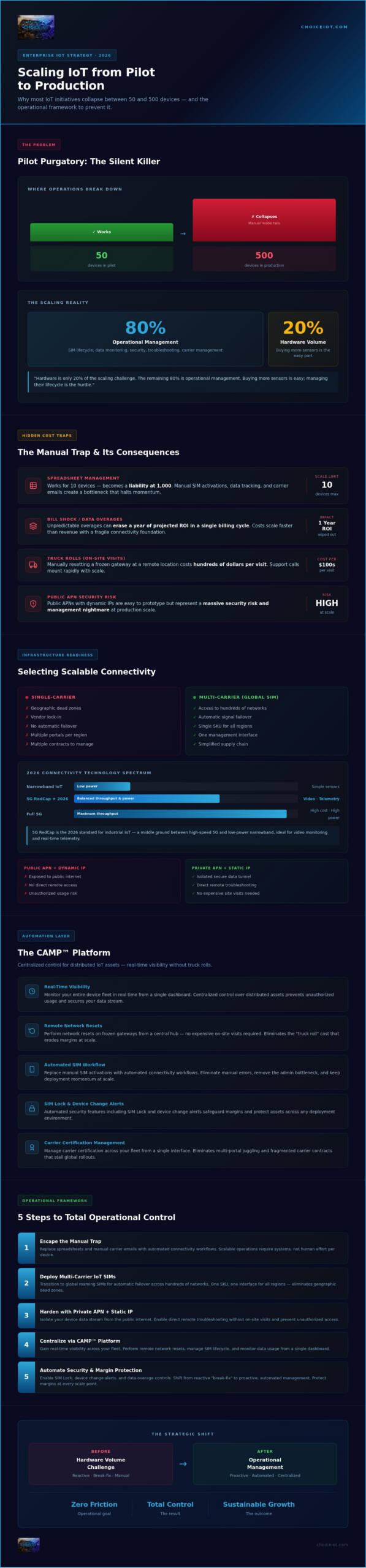
Pilot Purgatory is the silent killer of enterprise innovation. In the context of connectivity logistics, it’s the point where manual processes meet exponential growth and inevitably fail. Most organizations prove their technical concept with fifty devices, only to watch their operational model collapse at five hundred. Success in a lab environment doesn’t translate to field reliability without a strategic shift. When scaling iot from pilot to production, you’re no longer testing if the sensor works; you’re testing if your team can manage the deployment without drowning in administrative debt.
The “Manual Trap” is the most common hurdle. Spreadsheets work for ten devices. They are a liability for a thousand. Managing SIM activations, tracking data usage, and troubleshooting connectivity via manual emails to carriers creates a bottleneck that halts momentum. Hidden costs quickly emerge. Data overages, or “bill shock,” can erase a year of projected ROI in a single billing cycle. Support calls mount. Every “truck roll” to manually reset a frozen gateway in a remote location costs hundreds of dollars. These costs scale faster than your revenue if your connectivity foundation is fragile.
The Connectivity Management Bottleneck
Fragile pilot setups often rely on public APNs and dynamic IPs. While these are easy to deploy for a prototype, they represent a massive security risk and a management nightmare at scale. Expanding across regions introduces carrier fragmentation, forcing your team to juggle multiple portals and contracts. The Internet of Things (IoT) requires a unified approach to survive the transition to the field. Scalable Connectivity is centralized control over distributed assets. Without this centralization, you lack the visibility needed to prevent unauthorized usage or secure your data stream.
Operational Control vs. Hardware Volume
Hardware is only 20% of the scaling challenge. The remaining 80% is operational management. Buying more sensors is easy; managing their lifecycle is the hurdle. A single, unified dashboard is mandatory for multi-carrier deployments to ensure consistent performance across different networks. Utilizing scalable iot connectivity solutions provides the foundation for sustainable growth. True success when scaling iot from pilot to production means moving from a reactive “break-fix” mindset to a proactive, automated management style. Efficiency is the priority. Control is the result.
Infrastructure Readiness: Selecting Scalable Connectivity
Selecting the right connectivity foundation is the difference between a seamless rollout and an operational nightmare. When scaling iot from pilot to production, your infrastructure must be built for resilience. A single-carrier approach often creates geographic dead zones and vendor lock-in. By contrast, multi-carrier IoT SIM cards provide the redundancy required for mission-critical deployments. They ensure that if one network fails, your devices automatically switch to the strongest available signal. This level of uptime is non-negotiable for enterprise-grade applications.
For industrial use cases, 5G Redcap is emerging as the 2026 standard. It offers a middle ground between high-speed 5G and low-power narrowband options. It provides the throughput needed for video monitoring or real-time telemetry without the excessive hardware costs or power consumption of full-scale 5G. Pair this with Static IP addresses to enable direct remote access. This allows your technical team to troubleshoot devices from a central hub, eliminating the need for expensive site visits. Control is centralized. Costs are contained.
Multi-Carrier vs. Single-Carrier Strategies
Relying on one carrier is a gamble. Global roaming SIMs eliminate this risk by providing access to hundreds of networks through a single SKU. This simplifies your supply chain. You don’t need to manage different SIMs for different countries or regions. Instead, you manage your entire fleet through one interface. For a deeper dive into these benefits, explore The Ultimate Guide to Multi-Carrier IoT SIM Cards. It’s about maintaining a single point of truth for global connectivity.
Hardening the Network with Private APN
Public internet access is a liability for production devices. Private APNs create a secure, isolated tunnel for your data, shielding your hardware from the vulnerabilities of the public web. This setup also simplifies device configuration at scale. Every unit connects to a private gateway, ensuring consistent security protocols across the entire fleet. To understand the technical requirements for 2026, consult the 2026 Guide to Private APN for IoT. Implementing these layers of protection early prevents catastrophic security breaches later. You can view our full suite of secure connectivity options to see how these tools integrate into your roadmap.
How to Automate IoT Operations with CAMP™
Successful scaling iot from pilot to production requires moving beyond manual monitoring. You cannot manage five thousand devices using the same methods you used for fifty. The CAMP™ platform serves as your operational engine. It provides the centralized control necessary to maintain uptime without inflating your headcount. Efficiency is the priority. Automated management is the method. By shifting to a platform-first approach, you eliminate the friction that typically stalls large-scale rollouts.
The transition to automated operations follows a logical sequence for 2026 deployments:
- Centralize Visibility: Consolidate every carrier and device into a single CAMP™ dashboard. One login. Total oversight.
- Implement Real-Time Visibility: Monitor data consumption and connection status as it happens. Stop reacting to old data.
- Leverage Automation: Execute bulk SIM activations and plan changes across your entire fleet instantly. Speed is a competitive advantage.
- Deploy Remote Network Resets: Resolve connectivity hangs from your desk. Eliminate the need for physical intervention.
Eliminating Manual Work with APIs
Manual data entry is a scalability killer. By integrating the CAMP™ API into your existing CRM or ERP, you turn connectivity into software-defined infrastructure. This allows you to automate the SIM lifecycle from the moment a device leaves the warehouse to its final activation at the end-user site. APIs transform static connectivity into a dynamic, software-defined infrastructure that responds to business needs in real-time. No more manual spreadsheets. No more human error. Your business systems now talk directly to the network, ensuring that every device is provisioned correctly every time.
Remote Troubleshooting and Network Resets
Did you know? Remote Network Reset can eliminate 80% of routine maintenance visits. Most connectivity issues are resolved by a simple power cycle or network re-registration. CAMP™ allows you to perform these actions remotely. Built-in diagnostics help your team identify whether a problem is carrier-side or device-side before you ever consider sending a technician. This proactive approach keeps your margins high. It keeps your field teams focused on high-value tasks rather than basic troubleshooting. You can explore the CAMP™ platform features to see how automation simplifies your deployment. Control your infrastructure. Scale with confidence.
Commercial Sustainability: Securing Margins in Production
Commercial success when scaling iot from pilot to production hinges on rigorous margin protection. High deployment volumes amplify minor inefficiencies into major financial liabilities. Data overages are not an inevitable cost of business. They are a sign of inadequate oversight. To maintain commercial sustainability, your team must move beyond reactive billing reviews to proactive, automated cost management. Efficiency is the priority. Profitability is the outcome.
Proactive Data Management
Preventing “Bill Shock” requires more than just monitoring; it requires automated enforcement. Intelligent Alerts allow you to set custom usage thresholds that trigger automatic suspensions or plan upgrades. This identifies “runaway” devices before they generate massive invoices. Advanced iot connectivity management platforms act as a financial safeguard by providing granular reporting and analytics. This data allows you to optimize your data plans based on actual usage patterns rather than theoretical estimates. You gain total control over your operational spend. No surprises. Just results.
Security as a Cost-Saver
Security is often viewed as an expense, but in a production environment, it is a critical cost-saving measure. SIM Lock and Security features prevent unauthorized usage if a device is stolen or tampered with. If a SIM is moved to a different piece of hardware, the system detects the change instantly. Device Change Alerts provide real-time notifications to maintain deployment accuracy and prevent fraudulent data consumption. Reducing liability is essential. By utilizing Private APN and Static IP configurations, you shield your network from external threats that could drive up data costs through malicious traffic. Control your assets. Protect your bottom line.
Long-term ROI also depends on Carrier Device Certification. Ensuring your hardware is certified by the carriers you utilize prevents forced disconnects and ensures optimal network performance. This certification process, combined with the CAMP™ platform’s visibility, creates a robust ecosystem ready for global expansion. Scaling iot from pilot to production is a marathon, not a sprint. Your commercial framework must be built to last. Zero friction. Total transparency.
Master Your Global IoT Rollout
Transitioning from a prototype to a massive fleet requires a fundamental shift in strategy. You’ve seen why manual processes fail and how infrastructure choices like Private APNs and 5G Redcap secure your future. Success in 2026 isn’t just about hardware; it’s about the platform that manages it. When scaling iot from pilot to production, your ability to automate connectivity determines your long-term profitability. You need a foundation that eliminates friction and provides total visibility into every remote asset.
The CAMP™ platform delivers the control you need to succeed. It offers Real-Time Visibility across all carriers, allowing you to detect issues before they impact your bottom line. Use Remote Network Reset functionality to eliminate costly truck rolls and leverage API-driven automation to sync connectivity with your enterprise systems. Don’t let operational complexity stall your growth. Deploy with confidence. Control your margins. Scale without limits.
Scale your IoT deployment with the CAMP™ platform; Contact Choice IoT today to secure your connectivity roadmap. Your roadmap is ready. It’s time to build.
Frequently Asked Questions
What is the biggest challenge when moving from IoT pilot to production?
The primary hurdle when scaling iot from pilot to production is the transition from hardware validation to operational management. While a pilot focuses on whether the sensor works, production focuses on whether the business can manage thousands of units efficiently. Manual processes like using spreadsheets for SIM tracking or emailing carriers for activations quickly become bottlenecks. You need a centralized platform to automate these workflows. Efficiency is the priority. Control is the result.
How can I prevent data overage charges (bill shock) in a large deployment?
You prevent unpredictable overages by implementing Intelligent Alerts within the CAMP™ platform. These tools allow you to set custom data-usage thresholds for every SIM in your deployment. When a device reaches a specific limit, you receive a proactive notification or can trigger an automatic suspension. This visibility stops “runaway” devices before they generate massive invoices. Real-time monitoring replaces reactive billing reviews. You maintain total financial control over your global fleet.
Is a Private APN necessary for scaling my IoT solution?
A Private APN is essential for production-grade security and operational stability. It moves your data traffic off the public internet and into a secure, isolated tunnel. This prevents unauthorized access to your devices and simplifies network configuration at scale. By using a Private APN alongside Static IP addresses, your technical team can securely access and troubleshoot remote assets without exposing them to the vulnerabilities of the open web. Security becomes a scalable asset.
How do I manage multiple carriers without using multiple platforms?
You manage global deployments through a single interface by utilizing multi-carrier IoT SIM cards and the CAMP™ dashboard. Instead of juggling separate portals for every network provider, you consolidate your entire fleet into one point of truth. This approach provides real-time visibility across all carriers simultaneously. It simplifies your supply chain by using a single SKU for multiple regions. One platform. Complete operational control. No more fragmented management or administrative debt.
Can I reset my IoT devices remotely if they lose connection?
Yes, the CAMP™ platform includes a Remote Network Reset feature designed specifically for this purpose. It allows you to re-establish connectivity for a hanging device without dispatching a technician for a “truck roll.” This capability can eliminate approximately 80% of routine maintenance visits. You perform the reset directly from your dashboard, ensuring high uptime while keeping your field service costs low. It’s a critical tool for maintaining remote industrial assets with minimal friction.
How does the CAMP™ platform simplify scaling for VARs and integrators?
The CAMP™ platform empowers VARs and integrators by providing a single environment for end-to-end connectivity management. It streamlines the lifecycle of a deployment through API-driven automation for bulk activations and plan changes. Integrators can sync connectivity data directly with their CRM or ERP systems, reducing manual administrative debt. This centralization allows you to scale your service offerings without significantly increasing your internal headcount or operational overhead. Control is centralized. Growth is simplified.