
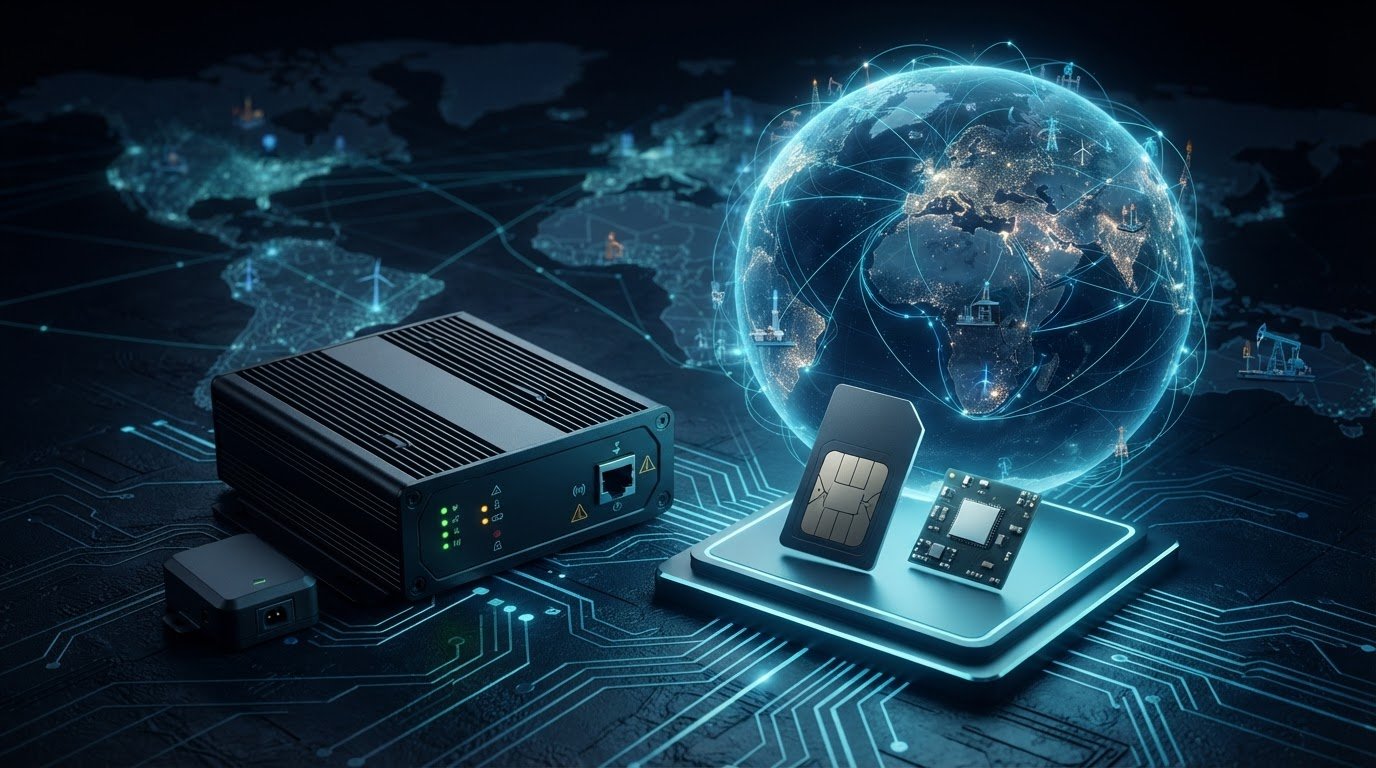
The most expensive component in your connected hardware isn’t the modem or the battery; it’s the plastic card that forces an avoidable technician dispatch. When scaling enterprise fleets, deciding between esim vs physical sim for iot devices quickly shifts from a minor hardware spec into a massive operational commitment. You already know the friction points. Carrier lock-in threatens to strand thousands of remote assets, harsh field environments compromise traditional SIM trays, and unbudgeted truck rolls rapidly erode your deployment margins.
You don’t have to balance uptime against operational complexity. This enterprise guide reveals whether eSIM or physical SIM architecture delivers the lowest total cost of ownership and maximum reliability for your fleet. We’ll walk through the concrete architectural criteria dividing plastic form factors, soldered MFF2 chips, and GSMA SGP.32 eUICC capabilities, giving you a blueprint to eliminate bill shock and manage connectivity through a unified operational lens.
Key Takeaways
- Removable plastic form factors offer low initial procurement costs, but soldered MFF2 architectures provide superior physical resilience in high-vibration and extreme-temperature environments.
- Evaluating esim vs physical sim for iot devices requires measuring total lifecycle impact, where the upfront savings of plastic cards can be wiped out by a single field service dispatch.
- Deployment mobility dictates architecture: static regional endpoints often thrive on standard physical cards, while international transit assets require over-the-air localization to navigate regulatory permanent roaming bans.
- Unified fleet management bridges the architectural divide, giving you single-dashboard visibility, automated usage alerts, and remote reset capabilities across mixed card generations.
Architectural Breakdown: Physical Form Factors vs eUICC Capabilities
Most hardware design debates stumble on a basic misconception. Teams conflate physical packaging with software architecture. When analyzing esim vs physical sim for iot devices, you must decouple the silicon package from the provisioning intelligence running on it.
Demystifying Form Factors: 2FF, 3FF, 4FF, and Soldered MFF2
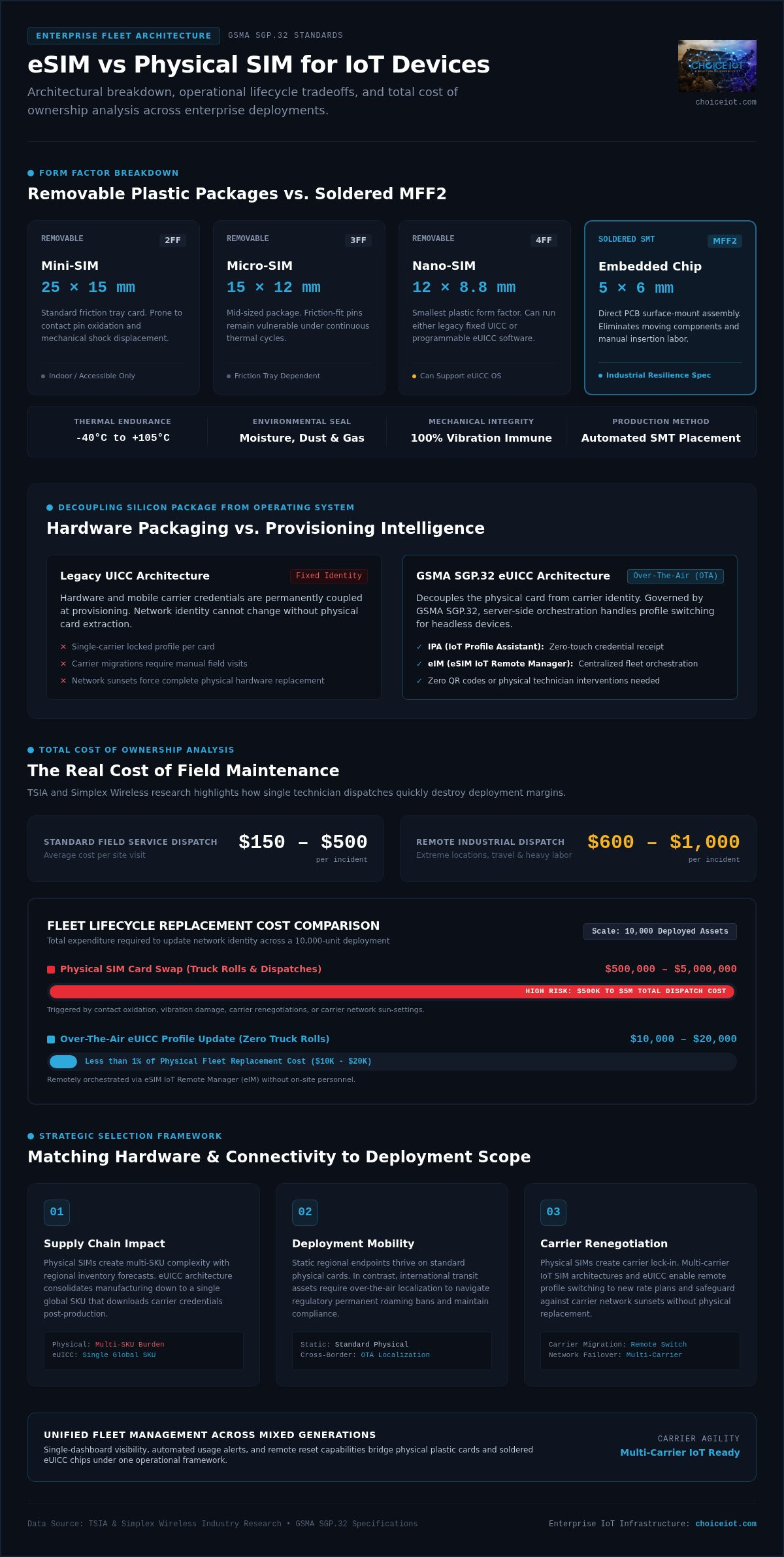
Standard UICC cards rely on removable plastic packages: 2FF (Mini, 25x15mm), 3FF (Micro, 15x12mm), and 4FF (Nano, 12×8.8mm). They snap into friction trays. That mechanical design works fine for accessible indoor deployments, but industrial environments expose fatal weaknesses.
Heavy machinery, agricultural telemetry, and automotive gateways introduce continuous shock and thermal cycling. Trays flex. Copper pins oxidize. Removable cards shake loose, cutting off communication without warning.
The soldered MFF2 (Machine-to-Machine Form Factor 2) chip solves this point of failure. Measuring just 5x6mm, it mounts directly to the printed circuit board during automated surface-mount assembly. Soldered MFF2 architecture delivers clear operational advantages:
- Environmental resilience: Hermetically sealed against moisture, dust, and corrosive gases.
- Thermal endurance: Operates reliably across extreme temperature bands from -40°C to +105°C.
- Vibration immunity: Eliminates moving parts and contact friction points entirely.
- Production efficiency: Standard SMT pick-and-place lines populate chips automatically, removing manual card insertion labor.
A soldered MFF2 chip is purely a physical package. It can hold a locked, single-carrier UICC profile, or it can host modern eUICC intelligence.
The Role of eUICC in Remote Profile Management
The operational agility comes from eUICC (Embedded Universal Integrated Circuit Card). eUICC is an operating system capability, not a physical chip shape. A plastic 4FF card can run eUICC software, while a soldered MFF2 chip can run legacy, fixed-carrier UICC firmware.
eUICC enables Over-The-Air (OTA) profile switching. Consumer smartphones rely on user interaction to scan activation QR codes, but enterprise IoT requires zero-touch, server-driven automation. Governed by the GSMA SGP.32 standard, an IoT Profile Assistant (IPA) and eSIM IoT Remote Manager (eIM) push, activate, or swap carrier credentials across remote, headless fleets without field intervention. Decoupling hardware from network identity protects your hardware investment from early obsolescence.
ESIM vs Physical SIM: Operational Tradeoffs and Total Cost Analysis
Procurement spreadsheets rarely reflect real field costs. Looking strictly at the initial bill of materials makes standard plastic cards seem like an obvious win. Evaluating esim vs physical sim for iot devices through a total lifecycle lens, however, tells a different story.
Logistics, Manufacturing, and Supply Chain Impact
Physical cards introduce multi-SKU friction. Building devices destined for regional markets forces assembly lines to juggle distinct, pre-provisioned carrier cards. Inventory balloons. An integrated eUICC architecture collapses manufacturing complexity down to a single global SKU. Hardware ships unprovisioned and downloads carrier credentials over the air post-production, eliminating regional component forecasting.
Field Maintenance, Truck Rolls, and Reliability
A single technician dispatch completely destroys your margin. Research from TSIA and Simplex Wireless indicates that average field service dispatches range from $150 to $500 per site visit, with remote industrial locations reaching $600 to $1,000 when factoring travel and labor. That makes swapping out failed plastic cards in a fleet of 10,000 units cost anywhere from $500,000 to $5,000,000, compared to $10,000 to $20,000 for remote eUICC profile updates. Contact oxidation and vibration damage routinely force those physical site visits.
Field maintenance isn’t just about component failures; it’s about network agility. The following comparison breaks down how these architectural choices impact your ongoing operations:
- Carrier contract renegotiations: Physical SIMs leave you locked to a provider. eUICC allows seamless remote switching to new rate plans.
- Carrier sun-settings: Migrating network technologies on standard UICC cards requires manual physical replacement across every deployed endpoint.
- Fleet recovery: Leveraging a resilient Multi-Carrier IoT SIM setup prevents connectivity loss by enabling flexible network access directly out in the field.
Endpoint Security: Physical Theft vs Tamper-Proof Chips
Unattended plastic cards invite theft. Field units installed in remote kiosks, utility cabinets, and solar arrays are vulnerable to physical extraction. Bad actors pop the tray, pull the SIM, and abuse data pools on personal smartphones, generating thousands of dollars in unexpected charges.
Soldered MFF2 chips make unauthorized physical removal nearly impossible without destroying the printed circuit board. For socketed deployments where plastic cards remain necessary, automated platform-level security becomes mandatory. IMEI-lock controls automatically detect hardware extraction and instantly quarantine suspect endpoints, neutralizing rogue device pairing before overages occur.
Strategic Selection Framework: Matching Deployments to SIM Architecture
Engineering teams often default to new technology without auditing real operational demands. Deciding between esim vs physical sim for iot devices requires balancing asset mobility, deployment lifespan, and regional compliance.
When Physical SIMs Deliver the Optimal Solution
Stationary hardware rarely demands over-the-air carrier switching. For static commercial environments like fixed wireless for business, point-of-sale terminals, and secondary failover routers, technicians already handle the primary installation. The SIM tray remains accessible.
Short-lifecycle deployments under three years rarely justify the engineering lead time required for eUICC integration. For these deployments, enterprise-grade multi carrier iot sim cards deliver immediate multi-network redundancy. You gain autonomous coverage fallback across tier-one carriers right out of the box, completely bypassing eUICC software complexity.
When eSIM Architecture Is Mission-Critical
Harsh environments demand zero physical dependency. When sensors are potted in resin, buried underground, or integrated into subsea telemetry, physical card replacement is out of the question. Soldered silicon is the only viable option.
Strict telecom regulations also make eUICC mandatory for international tracking fleets. Regulatory agencies in Brazil, Turkey, and Saudi Arabia heavily restrict permanent roaming, disconnecting foreign SIM cards that operate continuously beyond 90 days. eUICC enables remote profile downloads, localizing device identity to native carriers without touching the hardware.
Deployments engineered for ten-year lifecycles also depend on eUICC agility. As carriers sunset legacy networks and refarm spectrum, remote provisioning updates network credentials over the air, protecting your capital investment against sudden cellular phase-outs.
Match your architecture to your operational reality. To architect a resilient connectivity foundation tailored to your fleet lifecycle, partner with Choice IoT today.
Centralizing Fleet Control: Unified Management Across Any SIM Type
Enterprise deployments are rarely homogenous. Your fleet likely balances legacy plastic cards in fixed routers alongside soldered chips in industrial telemetry. Managing esim vs physical sim for iot devices shouldn’t mean toggling between fragmented carrier portals. Operational efficiency requires a single glass pane.
Real-Time Visibility and Proactive Data Monitoring
Carrier silos destroy visibility. Swapping between disparate operator accounts introduces reporting delays and hides impending billing overages. Leveraging a unified iot connectivity management platform like CAMP™ consolidates every endpoint under a single operational view.
Live fleet consumption audits show you exactly which assets are transmitting. Intelligent threshold alerts flag abnormal bandwidth consumption in real time, triggering automated plan escalations before overages hit the ledger. Complete control replaces billing blind spots.
Operational Automation and Endpoint Security
Field diagnostics shouldn’t require sending service personnel to the installation site. When an endpoint experiences a dropped data session or cellular registration loop, rolling a truck burns capital. CAMP™ integrates automated Remote Network Resets to re-establish dropped sessions over the air, clearing edge stalls without manual intervention.
Protecting deployed hardware demands deep SIM-level governance. To secure both physical plastic and embedded chips against tampering, configure active platform controls:
- Automated SIM Lock: Cryptographically binds the SIM profile to an authorized device IMEI. If an unauthorized party removes the card, the platform isolates the profile immediately.
- Instant Device Change Alerts: Flags unexpected hardware migrations within seconds, neutralizing consumer data siphon attempts before costs accumulate.
- Secure Data Routing: Pairs endpoints with a private apn for iot to isolate mission-critical device traffic completely from the public internet.
- Unified Lifecycle Controls: Activates, pauses, or decommissions both physical cards and eUICC profiles through standardized open APIs.
Unified architecture removes operational friction. Whether your hardware relies on standard cards or embedded silicon, centralized governance keeps your fleet secure, connected, and profitable.
Future-Proof Your Deployment Architecture
Evaluating esim vs physical sim for iot devices isn’t an either-or compromise. It’s about aligning connectivity hardware with real-world operational lifecycles. Standard plastic cards remain a dependable, budget-friendly foundation for static commercial endpoints. For rugged, inaccessible, or international assets, soldered eUICC chips deliver unmatched physical resilience and regulatory protection.
Long-term fleet profitability hinges on centralized control. Instead of juggling disparate carrier portals, enterprise integrators need unified operational governance. Choice IoT’s CAMP™ IoT Platform delivers real-time visibility across all major carrier networks in a single interface. Built-in Remote Network Resets clear stubborn connection stalls without dispatching technicians, while integrated SIM Lock security instantly isolates unauthorized hardware swaps.
Eliminate bill shock and simplify fleet management. Gain Total Control Over Your IoT Connectivity with CAMP™ and scale your connected enterprise with complete operational confidence.
Frequently Asked Questions
Is an eSIM inherently more reliable than a physical plastic SIM in IoT hardware?
Yes, in harsh mechanical and thermal environments, eSIM hardware like soldered MFF2 chips delivers superior reliability over plastic SIMs. Plastic cards rely on friction contacts inside mechanical trays. Continuous vibration, shock, and thermal cycling loosen connections or corrode metal pins over time. Soldered chips mount directly to the circuit board, eliminating moving parts. In static indoor deployments, standard plastic SIM cards offer comparable network uptime without the added manufacturing complexity.
Can an IoT device switch cellular networks automatically with a physical SIM card?
Yes, an IoT device can switch networks automatically using a multi-carrier physical SIM card. Multi-carrier SIMs store multiple network access credentials or leverage roaming agreements directly on traditional UICC plastic. When the active cellular connection degrades, the modem automatically negotiates with alternate partner carriers. This architecture provides multi-network redundancy out of the box, giving enterprises automated failover across top-tier networks without needing the software infrastructure required for over-the-air eUICC profile switching.
What is the practical difference between an MFF2 chip and an eUICC SIM?
The practical difference is that MFF2 refers to the physical surface-mount hardware package, whereas eUICC refers to the software capability that allows remote profile switching. Comparing esim vs physical sim for iot devices often causes confusion here. An MFF2 chip is soldered silicon that can host either standard, locked UICC software or dynamic eUICC operating systems. Conversely, eUICC software can run on traditional 4FF plastic cards, enabling over-the-air carrier updates on socketed hardware.
How does permanent roaming regulation affect the choice between eSIM and physical SIM?
Permanent roaming regulations make eUICC architecture practically mandatory for long-term deployments in countries that ban continuous foreign SIM usage. Regulators in nations like Brazil, Turkey, and Saudi Arabia heavily restrict foreign roaming profiles operating beyond 90 to 180 days, often blacklisting non-compliant IMSIs. A standard physical roaming SIM risks sudden disconnection. With eUICC capabilities, fleets can remotely download and activate a compliant local carrier profile over the air, ensuring continuous uptime without physically replacing the hardware.
Can I manage physical SIM cards and eSIM profiles from the same connectivity platform?
Yes, you can manage both physical plastic cards and modern eSIM profiles within a single connectivity management interface. Resolving the debate between esim vs physical sim for iot devices doesn’t require segmenting your operational workflows. Centralized tools like Choice IoT’s CAMP™ platform unify heterogeneous fleets under one pane of glass. Integrators can monitor real-time data consumption, configure automated threshold alerts, trigger Remote Network Resets, and adjust rate plans across all card generations without toggling between multiple carrier portals.
What happens if an unauthorized party removes a physical IoT SIM from a field device?
If unprotected, an unauthorized party can insert the stolen SIM into a secondary device and consume pooled enterprise data for personal use. Unattended assets like kiosks and smart utility meters face genuine physical extraction risks. To mitigate this vulnerability, platforms like CAMP™ feature automated SIM Lock and Device Change Alerts. The system cryptographically binds the SIM profile to the authorized modem IMEI. If the card moves to an unauthorized device, the platform instantly isolates the profile, preventing catastrophic data theft.