
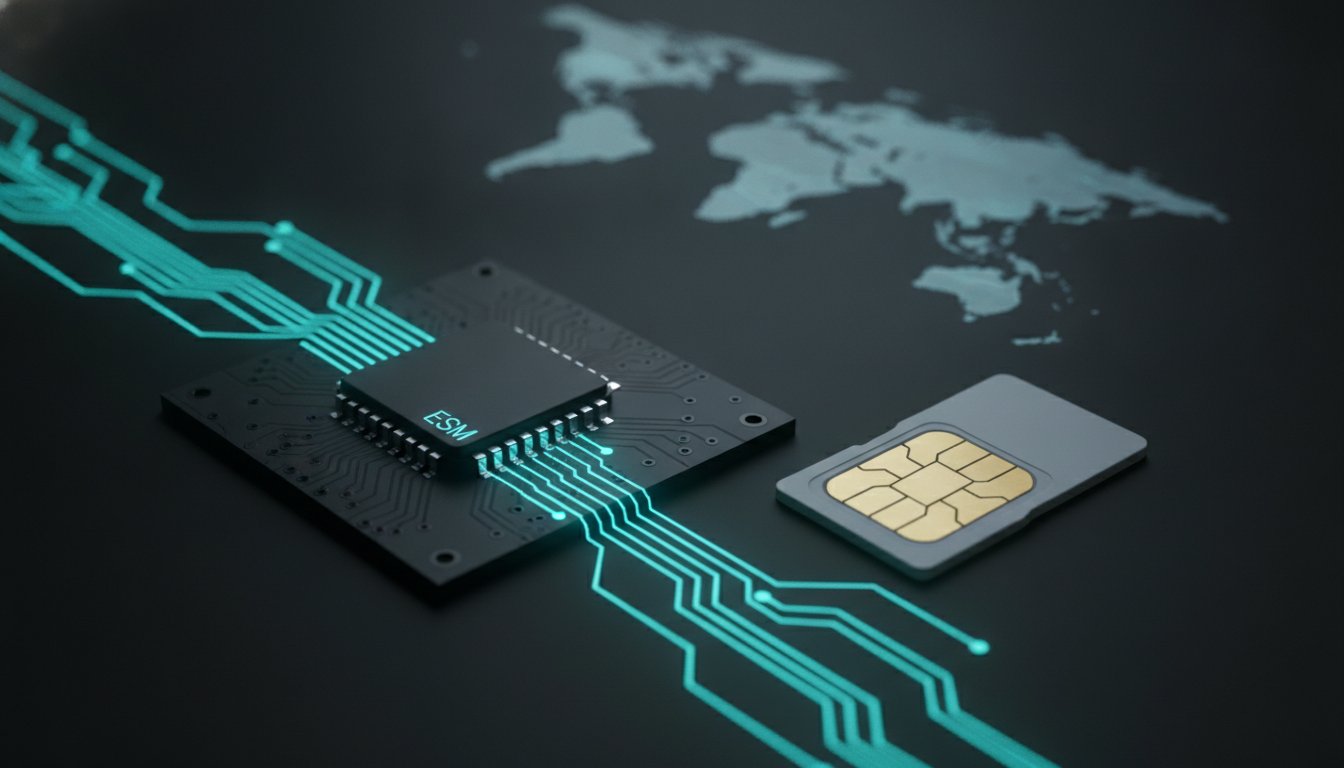
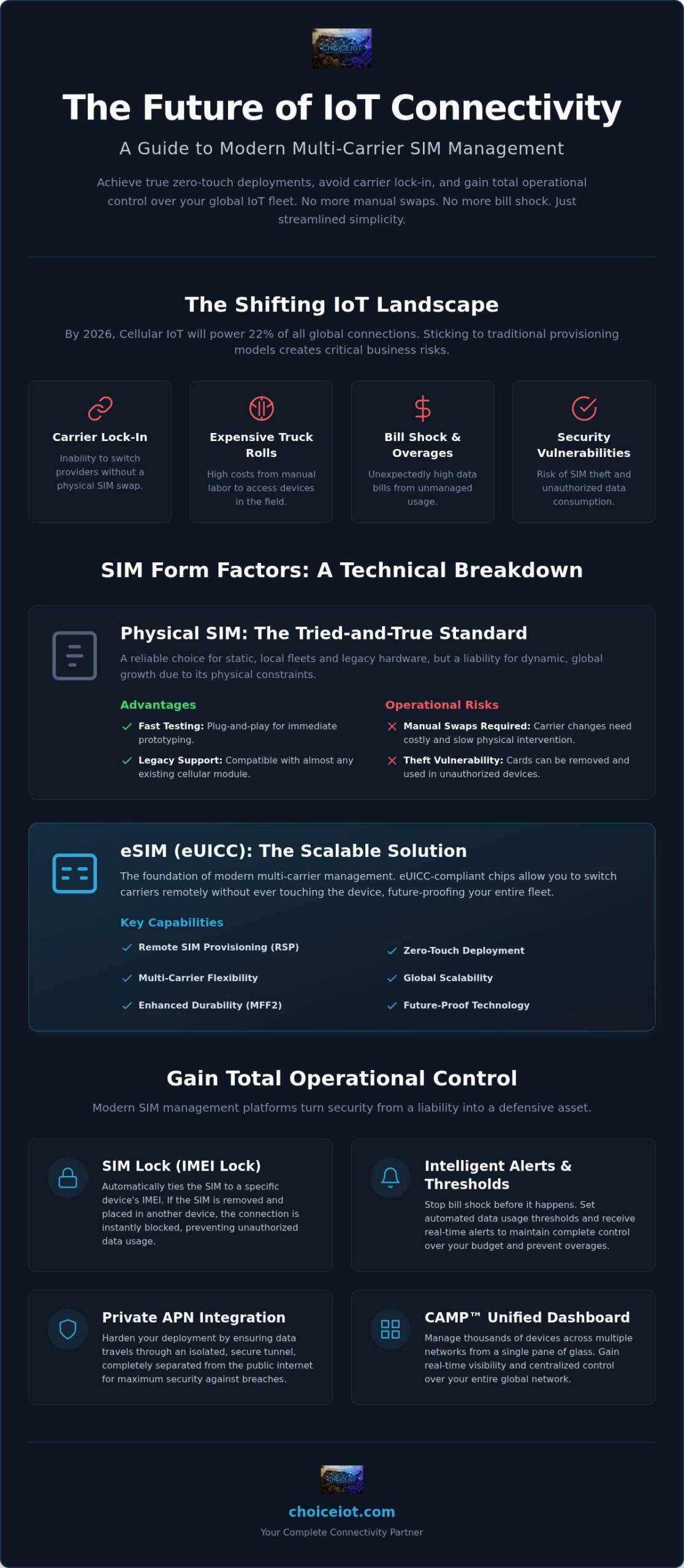
The physical SIM card isn’t obsolete yet, but the manual labor required to manage it is. In a 2026 landscape where cellular IoT accounts for 22% of all global connections, sticking to traditional provisioning models is a recipe for carrier lock-in and expensive truck rolls. You need agility. You need total operational control. Managing thousands of devices across different regions often feels like a logistical nightmare of overage fees and security vulnerabilities. It’s a drain on resources you can’t afford.
This guide compares modern form factors and explores how a sophisticated multi-carrier sim management strategy ensures your deployment remains secure and cost-effective. We’ll show you how to master remote provisioning to achieve true zero-touch deployments. No more manual swaps. No more bill shock. Just streamlined simplicity. Zero-touch deployments. Unified control. Scalable growth.
We’ll break down the shift to the GSMA SGP.32 standard, the impact of the EU Data Act, and why 5G RedCap is the new middle-tier powerhouse for industrial sensors. By the end, you’ll have a clear roadmap for centralized connectivity that scales as fast as your business does.
Key Takeaways
- Compare MFF2 embedded chips against traditional plastic SIMs to choose the right form factor for your specific hardware needs.
- Optimize your workflow with multi-carrier sim management to avoid carrier lock-in while maintaining global network flexibility.
- Secure your IoT fleet using SIM Lock features and Remote Network Resets to stop unauthorized data usage instantly.
- Stop bill shock before it happens by setting Intelligent Alerts and automated data thresholds during the provisioning process.
- Gain total operational control with the CAMP™ platform for real-time visibility across every device in your global network.
IoT SIM Provisioning 101: Comparing eSIM and Physical Form Factors
Provisioning is more than just activation. It is the tactical process of loading and managing network profiles to ensure your devices communicate across borders. Whether it’s done manually or over-the-air (OTA), provisioning bridges the gap between your physical hardware and global connectivity. In the context of multi-carrier sim management, this step determines your operational agility. Get it right, and you scale. Get it wrong, and you’re locked into a single provider with no exit strategy.
The choice between physical cards and embedded chips dictates your long-term maintenance costs. While the hardware might look similar, the underlying logic is fundamentally different. One offers familiarity; the other offers total flexibility.
Physical SIM: The Tried-and-True Standard
The traditional plastic SIM remains a staple for localized deployments and small-scale testing. It offers universal compatibility with legacy IoT modules and older hardware. Initial hardware costs are typically lower. However, the hidden costs are significant. Every carrier change requires a manual swap. This means costly truck rolls, logistical delays, and physical access to every unit in the field. It is a reliable choice for static, local fleets but a liability for dynamic, global growth.
- Fast testing: Plug and play for immediate prototyping.
- Legacy support: Works with almost any existing cellular module.
- Operational risk: High potential for carrier lock-in and manual labor costs.
ESIM and Remote SIM Provisioning (RSP)
Modern eSIM technology changes the math. By using eUICC-compliant chips, you can switch carriers without ever touching the device. This capability is the foundation of effective multi-carrier sim management at scale. Remote SIM Provisioning (RSP) allows you to push new profiles Over-the-Air (OTA) in seconds. This future-proofs your fleet against carrier price hikes, network sunsets, or regulatory changes in foreign markets. For global deployments, RSP is non-negotiable. It allows you to provision local network profiles at the device’s final destination, ensuring compliance and peak performance. Total flexibility. Zero physical contact. Rapid deployment.
ESIM vs. Physical SIM for IoT Devices: A Technical Breakdown
Hardware selection determines your failure rate in the field. While physical cards in 2FF, 3FF, and 4FF sizes are standard, the MFF2 embedded form factor is built for extreme resilience. Your choice impacts more than just the assembly line; it dictates how you handle security and long-term maintenance. In 2026, software-defined profiles are rapidly outpacing manual logistics as the preferred method for scaling global fleets.
Hardware Integration and Durability
MFF2 chips are soldered directly onto the device’s circuit board. This design offers superior resistance to high-frequency vibration and extreme temperatures, making it the default for industrial sensors and automotive tracking. Physical SIMs remain useful for rapid hardware troubleshooting. You can swap a card to rule out module failure in seconds. As 5G Redcap gains traction for mid-tier devices, the choice often depends on the module’s footprint and the expected environmental stress on the hardware.
Security and Theft Prevention
Security is where multi-carrier sim management becomes a defensive asset. A significant risk for physical SIMs is theft. An unauthorized user can pull a card from a remote gateway and use it for personal data consumption, leading to massive overages. Modern platforms mitigate this risk through SIM Lock. This feature automatically ties the SIM to the device’s specific IMEI. If the SIM is removed and placed in another device, the connection drops instantly. Total protection. Zero manual intervention.
You can further harden your deployment by integrating a private APN for IoT. This ensures your data travels through an isolated tunnel, separated from the public internet. When coupled with real-time Device Change Alerts, you gain a robust defense against physical breaches. This level of oversight helps you spot anomalies before they turn into expensive security incidents. It’s about maintaining a high-performance engine that’s both powerful and secure.
Operational control requires centralized visibility regardless of the form factor you choose. Managing thousands of units across multiple networks is impossible without a unified dashboard. If you’re looking to eliminate friction in your next deployment, exploring a centralized management platform is the logical next step for your business.
Provisioning at Scale: Managing Lifecycles and Preventing Bill Shock
Managing a handful of devices is simple. Managing ten thousand is a strategic challenge. Effective multi-carrier sim management requires a proactive lifecycle strategy that starts before the first packet of data is sent. Scaling without a framework leads to bill shock, where unexpected overage fees erode your margins. You must automate activations and plan changes via a centralized dashboard to maintain speed while eliminating manual error. Control. Visibility. Scalability.
Intelligent Alerts and Usage Control
Prevention starts with Intelligent Alerts. During initial provisioning, you must define usage thresholds for every device in your fleet. These safety limits act as a digital circuit breaker. If a device malfunctions and begins a runaway data session, the system triggers an automated suspension or notification instantly. This protects you from carrier overages and potential security breaches. For a deeper look at pricing structures and data pooling, read more on multi carrier iot sim cards. Real-time visibility. Automated protection. Total cost control.
Remote Diagnostics and Troubleshooting
Connectivity hangs are inevitable, but truck rolls shouldn’t be. A critical tool in your provisioning arsenal is the Remote Network Reset capability. This allows you to clear network-side issues and re-establish a connection from your desk. You skip the carrier support queue and the expensive site visit. Integrating these tools into iot connectivity management platforms centralizes your operations. You monitor real-time diagnostics to identify runaway devices before billing cycles end. You gain access to a full history of support notes for every SIM in your fleet. Instant resolution. No carrier calls. Maximum uptime.
Effective multi-carrier sim management turns connectivity from a logistical burden into a competitive advantage. You need a partner that provides the tools to automate these lifecycles and protect your bottom line. Ready to gain complete operational control? Explore the CAMP™ platform today.
Streamlining Your Deployment with CAMP™: The Complete Connectivity Partner
The CAMP™ platform is the engine behind efficient multi-carrier sim management. It consolidates fragmented network data into a single, high-performance dashboard. Instead of juggling multiple carrier portals, you gain a unified view of your entire global fleet. This centralization is the essential foundation for any business aiming for scale and reliability. One platform. Complete operational control. Total transparency.
Choice IoT provides the infrastructure that allows you to access major networks through a single interface. This flexibility ensures that your devices always have the strongest possible connection, regardless of their location. By removing the friction of manual carrier negotiations, you can focus on what matters most: growing your business and serving your customers.
Centralized Visibility and Automation
Choice IoT provides a single-dashboard view for all devices and real-time data usage. This level of transparency allows you to spot trends and anomalies before they impact your bottom line. To further reduce manual administrative work, the platform features an open API. This allows for seamless integration with your existing CRM and ERP systems, ensuring that your connectivity data flows where it’s needed most. You can automate SIM activations and suspensions, moving away from spreadsheets and toward a software-defined future. Rapid deployment. Automated efficiency. Reduced friction.
Why Choice IoT is the Strategic Partner for Integrators
Integrators and VARs face unique hurdles in 2026. You need more than just a vendor; you need a partner that understands the complexities of scalable iot connectivity solutions. Choice IoT offers white-label options, allowing you to manage your customers’ connectivity under your own brand. This builds equity in your business while we handle the technical heavy lifting in the background.
Beyond standard connectivity, we provide specialized features like Private APNs and Static IPs for hardened enterprise security. Did you know that carrier device certification can often be the longest bottleneck in a deployment? Our experts provide direct, friendly guidance to navigate these certifications, ensuring your hardware hits the market on schedule. We focus on continuous education for our partners’ success, positioning ourselves as the complete connectivity partner for large-scale fleets. Sophisticated. Powerful. Ready to integrate.
Future-Proof Your Connectivity Strategy
The choice between eSIM and physical SIM cards is more than a hardware decision; it’s a commitment to your fleet’s future agility. While form factors dictate physical durability, your management platform determines your operational success. Implementing a robust multi-carrier sim management strategy ensures that your deployment remains scalable and secure as you expand into new markets. Total operational control is finally within reach.
The CAMP™ platform provides the real-time visibility you need to manage your lifecycle effectively. By utilizing Intelligent Alerts to prevent data overages and the Remote Network Reset capability to eliminate expensive truck rolls, you turn connectivity into a strategic advantage. You don’t have to navigate the complexities of 2026 IoT provisioning alone. Contact Choice IoT to streamline your SIM provisioning today and build your deployment on a foundation of transparency and high performance. Your global expansion starts with a single, unified view.
Frequently Asked Questions
What is the main difference between eSIM and physical SIM provisioning?
Provisioning for physical SIMs is a manual process requiring physical card insertion or replacement. In contrast, eSIM provisioning uses Over-the-Air (OTA) technology to download and activate network profiles digitally. This eliminates the need for manual handling. While physical SIMs are tied to a single carrier profile at the factory, eSIMs allow for dynamic profile management. This difference is fundamental for achieving multi-carrier sim management at scale without expensive truck rolls.
Can I switch carriers remotely with a physical IoT SIM card?
You cannot switch carrier profiles remotely with a standard physical SIM card. Physical SIMs are hard-coded to a specific mobile network operator. Changing the carrier requires a physical swap of the plastic card in every device. This is why many integrators migrate to eUICC-compliant eSIMs. With an eSIM, you can push new carrier profiles digitally. This flexibility prevents carrier lock-in and protects your deployment from future network sunsets or unexpected price changes.
How do I prevent bill shock in a large-scale IoT deployment?
Preventing bill shock requires setting Intelligent Alerts and automated data thresholds during the initial provisioning phase. You should configure the CAMP™ platform to send notifications or suspend lines when devices exceed pre-defined usage limits. Real-time visibility into data consumption allows you to identify runaway devices before the billing cycle ends. This proactive approach ensures your operational costs remain predictable. Automated alerts. Real-time monitoring. Total cost control. It’s about maintaining full oversight.
Is eSIM more secure than a physical SIM for industrial IoT?
eSIMs offer a higher level of physical security because they are soldered directly onto the device’s circuit board. This prevents unauthorized removal and theft. However, physical SIMs can be secured using SIM Lock features that tie the card to a specific device IMEI. If the SIM is moved, the connection drops instantly. Both form factors benefit from a Private APN, which isolates your data from the public internet for enterprise-grade security and peace of mind.
What is Remote Network Reset and why does my IoT deployment need it?
Remote Network Reset is a diagnostic tool that clears network-side connectivity hangs from a central dashboard. It re-establishes the device’s connection without requiring a physical site visit. This is essential for maintaining uptime in remote or hard-to-reach locations. Instead of waiting for carrier support or dispatching a technician, you resolve the issue instantly. It’s a critical component of multi-carrier sim management that reduces maintenance costs and improves overall fleet reliability.
Does Choice IoT support 5G Redcap for new IoT devices?
Choice IoT supports 5G Redcap for mid-tier IoT devices requiring a balance of performance and power efficiency. This technology is ideal for industrial sensors and wearables that need 5G benefits without the high cost of full-scale 5G modules. As of 2026, 5G Redcap is a fast-growing segment of the cellular IoT market. We provide the carrier certifications and multi-carrier SIMs necessary to integrate this standard into your next enterprise deployment. Sophisticated. Powerful. Ready to integrate.