

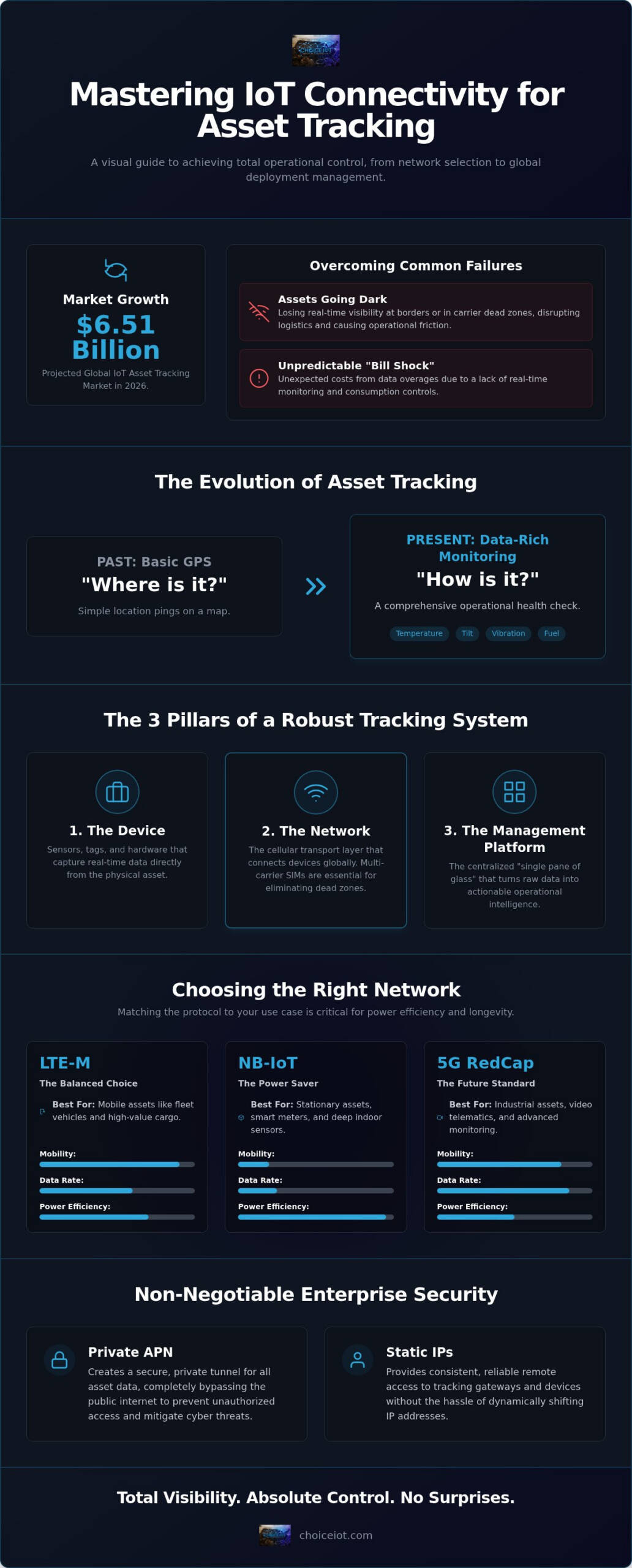
With the global IoT asset tracking market projected to reach $6.51 billion in 2026, the pressure to scale has never been higher. Yet, nearly 40% of industry revenue is tied to transportation and logistics sectors that still suffer from the same old failures: assets going dark at borders and unpredictable “bill shock” from data overages. You know the frustration of losing real-time visibility just when it matters most. Assets going dark. Unforeseen costs. Operational friction. Reliable iot connectivity for asset tracking is the heartbeat of your operation, but it shouldn’t be your biggest source of stress.
You need a system that works as hard as your hardware. This guide will help you master the complexities of global tracking and teach you how to maintain total operational control over every deployment. We’ll explore the shift toward 5G RedCap, the benefits of multi-carrier roaming, and how the CAMP™ platform centralizes your management into a single pane of glass. It’s time to move beyond reactive troubleshooting. We’ll show you how to secure seamless connectivity, predictable monthly costs, and the real-time device health data required for a high-performance fleet. Total visibility. Absolute control. No surprises.
Key Takeaways
- Understand the transition from basic GPS to data-rich remote monitoring to gain deep operational insights beyond simple location tracking.
- Identify the optimal network for your deployment by evaluating the performance trade-offs between LTE-M, NB-IoT, and 5G Redcap.
- Centralize your management with the CAMP™ platform to eliminate “bill shock” and maintain real-time visibility over every SIM in your fleet.
- Scale with confidence by using automation and APIs to integrate iot connectivity for asset tracking into your existing enterprise ERP and CRM workflows.
What is IoT Connectivity for Asset Tracking?
IoT connectivity for asset tracking is the wireless foundation that links physical assets to digital management software. It’s the invisible bridge. In the past, tracking meant simple GPS coordinates on a map. Today, it has evolved into data-rich remote monitoring. We’re no longer just asking “where is it?” We’re asking “how is it?” Modern telemetry provides insights into temperature, tilt, vibration, and fuel consumption. This shift transforms a basic location ping into a comprehensive operational health check.
To build a robust system, you must align three pillars:
- The Device: Sensors and tags that capture real-time data.
- The Network: The transport layer, where cellular connectivity remains the gold standard for mobile assets due to its ubiquitous coverage.
- The Management Platform: The centralized hub that turns raw data into operational intelligence.
Effective Asset tracking requires more than just a signal; it requires a persistent, reliable connection that doesn’t fail when a vehicle crosses a state line or a national border. Without the right connectivity layer, your hardware is just an expensive paperweight.
The Necessity of Multi-Carrier IoT SIMs
Single-carrier plans are a liability for mobile deployments. When an asset moves into a carrier’s dead zone, the data stops. The visibility vanishes. This is where multi carrier iot sim cards become essential. These SIMs don’t settle for one provider. They use “steering” technology to automatically find and connect to the strongest available signal. It’s about redundancy. It’s about ensuring 100% uptime regardless of geography. If one tower fails, the device switches. Instantly. This eliminates the logistical nightmare of regional connectivity gaps.
Connectivity vs. Management: Why You Need Both
Raw data is a commodity. Anyone can sell you a SIM card. The real value lies in how you manage that connectivity. “Dumb” SIMs provide a link but offer no visibility into device health or data consumption. You’re flying blind until the bill arrives. Smart iot connectivity for asset tracking pairs the data plan with a management layer. This “single pane of glass” approach allows you to monitor every device in real-time. You gain control. You prevent overages. You transform a basic data plan into a strategic operational asset that scales with your business needs.
Choosing the Right Network: LTE-M, NB-IoT, and 5G Redcap
Network selection defines the operational lifespan of your deployment. It isn’t just about signal strength. It’s about power efficiency and longevity. Low Power Wide Area Networks (LPWAN) are the foundation for long-battery life tracking. These protocols ensure devices last years, not weeks. Matching the right network to your specific iot connectivity for asset tracking use case is critical for enterprise success. You need a protocol that aligns with your data frequency and mobility requirements.
High-Bandwidth vs. Low-Power Connectivity
LTE-M is the balanced choice for fleet management and moving assets. It supports seamless handovers between cell towers as vehicles move at highway speeds. Conversely, NB-IoT is optimized for massive sensor arrays and deep indoor penetration. Think of heavy machinery in reinforced concrete warehouses or underground utility monitors. A technical IoT-based asset tracking system often leverages these protocols to maximize battery life while maintaining consistent data reporting.
5G Redcap (Reduced Capability) is the new standard for 2026. It fills the gap between low-power LPWAN and high-speed 5G. It’s designed for industrial assets that require medium speed and high reliability without the power drain of a full 5G modem. Future-proof. Scalable. Powerful. It provides the necessary bandwidth for video telematics and advanced driver monitoring systems that older protocols can’t support.
Securing Data with Private APN and Static IPs
Security is a non-negotiable requirement for enterprise deployments. A private apn for iot creates a secure tunnel for asset data, bypassing the public internet entirely. A Private APN is the essential barrier between IoT assets and the public internet. This isolation prevents unauthorized access and mitigates cyber threats before they reach your infrastructure.
Static IPs provide the final layer of operational control. They allow for consistent remote access to tracking gateways without the hassle of shifting IP addresses. No connectivity hurdles. Just direct, reliable communication. If you’re ready to secure your global fleet, integrating these tools into your connectivity strategy is the first step toward total operational control.
Achieving Operational Control with CAMP™
Operational control isn’t a luxury. It’s a requirement for scaling. The iot connectivity management platform, CAMP™, serves as the centralized brain for your entire deployment. It provides a single pane of glass to view every SIM and device in your fleet. No more toggling between carrier portals. No more fragmented data. You get real-time visibility into signal strength, data consumption, and connection status from one dashboard. This level of transparency is essential for maintaining iot connectivity for asset tracking across diverse geographies.
One of the most powerful features is the Remote Network Reset. In the past, a frozen device in a remote location meant a “truck roll”—sending a technician to manually reboot the hardware. CAMP™ is the ultimate truck-roll killer. You can reset the network connection remotely from the platform, saving thousands in operational costs. Security is equally robust. SIM Lock ensures that if a device is stolen, the SIM cannot be used in unauthorized hardware. This protects your data and your budget from malicious use.
Preventing Bill Shock with Intelligent Alerts
Unpredictable costs destroy margins. CAMP™ uses Intelligent Alerts to stop “bill shock” before it starts. You can set custom data-usage thresholds for every device. If a sensor exceeds its limit, the platform triggers a proactive notification or automates a SIM suspension. It acts as a fail-safe. You don’t have to wait for the end of the month to discover a runaway device. You maintain total control over your monthly spend without constant manual monitoring.
Diagnostics and Troubleshooting at Scale
Resolving connectivity issues shouldn’t require an hour on hold with carrier support. CAMP™ provides built-in diagnostic tools that let your team troubleshoot directly from the platform. You can view the full connection history and support notes for every asset. This allows for long-term management and faster resolution times. Device Change Alerts add another layer of protection. If a SIM is moved to unauthorized hardware, you receive an instant notification. It’s about total awareness and rapid response.
Ready to eliminate operational friction? Explore the CAMP™ platform and take total control of your global connectivity.
Scaling Your Asset Tracking Strategy for 2026
Moving from a pilot program to a global rollout is the ultimate test for your infrastructure. Many organizations hit a wall. Manual processes that worked for ten devices fail at ten thousand. To succeed, you need a scalable iot connectivity solution designed for enterprise volume. This means moving beyond manual SIM management and embracing end-to-end automation.
Carrier device certification is a critical, often overlooked step in this phase. Without it, your new hardware may face connectivity delays or network rejection. It’s a deployment killer. Ensuring your devices are certified across major carriers guarantees a smooth transition from warehouse to field. Reliable iot connectivity for asset tracking depends on this technical foundation.
API Integration for Seamless Operations
Scale demands speed. Manual data entry is a bottleneck. By integrating CAMP™ APIs directly with your CRM or ERP systems, you automate the entire lifecycle. Activations. Suspensions. Plan changes. Everything happens in real-time. This integration turns raw usage data into actionable business insights. You stop managing SIMs and start managing your business. IT teams spend less time on tickets and more time on optimization. It’s about reducing the manual workload while increasing operational accuracy.
The Choice IoT Advantage: Beyond the SIM
Choice IoT is more than a provider. We are your Complete Connectivity Partner. Our mission is to remove every hurdle between your hardware and your data. For VARs and integrators, this partner-first approach means having an authoritative expert in your corner. We handle the complexities of multi-carrier roaming and network security so you don’t have to. One platform. Complete operational control.
Ready to see the difference? Contact Choice IoT today for a comprehensive demo of the CAMP™ platform and secure your strategy for 2026.
Secure Your Global Operational Control
Scaling a global fleet requires more than just hardware; it requires a sophisticated foundation. You’ve seen how selecting the right network layer, from LTE-M to the emerging 5G Redcap, ensures your assets remain visible and your batteries stay charged. However, visibility is only half the battle. True iot connectivity for asset tracking demands a centralized brain to manage the complexities of multi-carrier roaming and secure data tunnels. It’s about moving from reactive troubleshooting to proactive management.
By leveraging the CAMP™ platform, you gain one platform for complete operational control. You can eliminate the logistical nightmare of “truck rolls” with the Remote Network Reset feature and maintain real-time visibility into every device and SIM across your entire deployment. No more bill shock. No more border-crossing blackouts. Just streamlined, secure, and highly scalable operations. The path to enterprise-grade efficiency is within reach.
Remove the friction from your infrastructure and focus on your core business growth. Take control of your IoT connectivity with Choice IoT today. Your assets are moving. Ensure your connectivity keeps up.
Frequently Asked Questions
How do I prevent data overages in my asset tracking deployment?
You prevent data overages by setting custom usage thresholds within the CAMP™ platform. Intelligent Alerts notify you the moment a device exceeds its typical data profile. You can even automate SIM suspension to stop runaway costs instantly. This proactive approach to iot connectivity for asset tracking ensures your monthly bill remains predictable. You don’t have to monitor thousands of devices manually; the system manages the limits for you.
What is the difference between a standard SIM and a Multi-Carrier IoT SIM?
A standard SIM’s locked to a single carrier, creating coverage gaps when assets move. A Multi-Carrier IoT SIM uses steering technology to connect to the strongest available signal across multiple providers. This ensures 100% uptime as assets cross regional or national borders. It eliminates “dead zones” that plague single-carrier plans. You gain global reliability without the need to manage multiple carrier contracts or swap physical hardware.
Can I reset an IoT device’s connection remotely?
Yes, you can re-establish a connection without sending a technician to the site. The Remote Network Reset feature in the CAMP™ platform allows you to trigger a fresh handshake between the device and the cellular tower. This is a critical truck-roll killer for remote deployments. It resolves common connectivity hang-ups instantly from your dashboard. It saves time, reduces operational expenses, and ensures your assets stay visible in real-time.
How does a Private APN improve asset tracking security?
A Private APN improves security by creating a private, encrypted tunnel between your assets and your corporate network. It effectively bypasses the public internet, making your devices invisible to external threats. This isolation prevents unauthorized access and cyberattacks. When combined with Static IPs, you gain a secure, direct link to your tracking gateways. It’s the essential barrier for any enterprise-grade iot connectivity for asset tracking strategy.
What happens if an IoT SIM is stolen from a tracking device?
If a SIM is stolen, features like SIM Lock and Device Change Alerts protect your budget. SIM Lock ensures the card only functions within its designated hardware. If someone inserts it into a different device, the connection’s instantly blocked. You receive a real-time notification of the unauthorized change. This prevents malicious data usage and “bill shock” while allowing you to deactivate the SIM remotely before any financial damage occurs.
Is 5G Redcap necessary for asset tracking in 2026?
5G Redcap’s becoming essential for 2026 deployments that require a balance of speed and battery life. While LTE-M and NB-IoT handle simple sensors, 5G Redcap supports high-bandwidth applications like video telematics and advanced driver monitoring. It provides a future-proof path as older networks eventually sunset. It offers lower latency and higher reliability for industrial assets that need more throughput than traditional low-power wide-area networks can provide.