

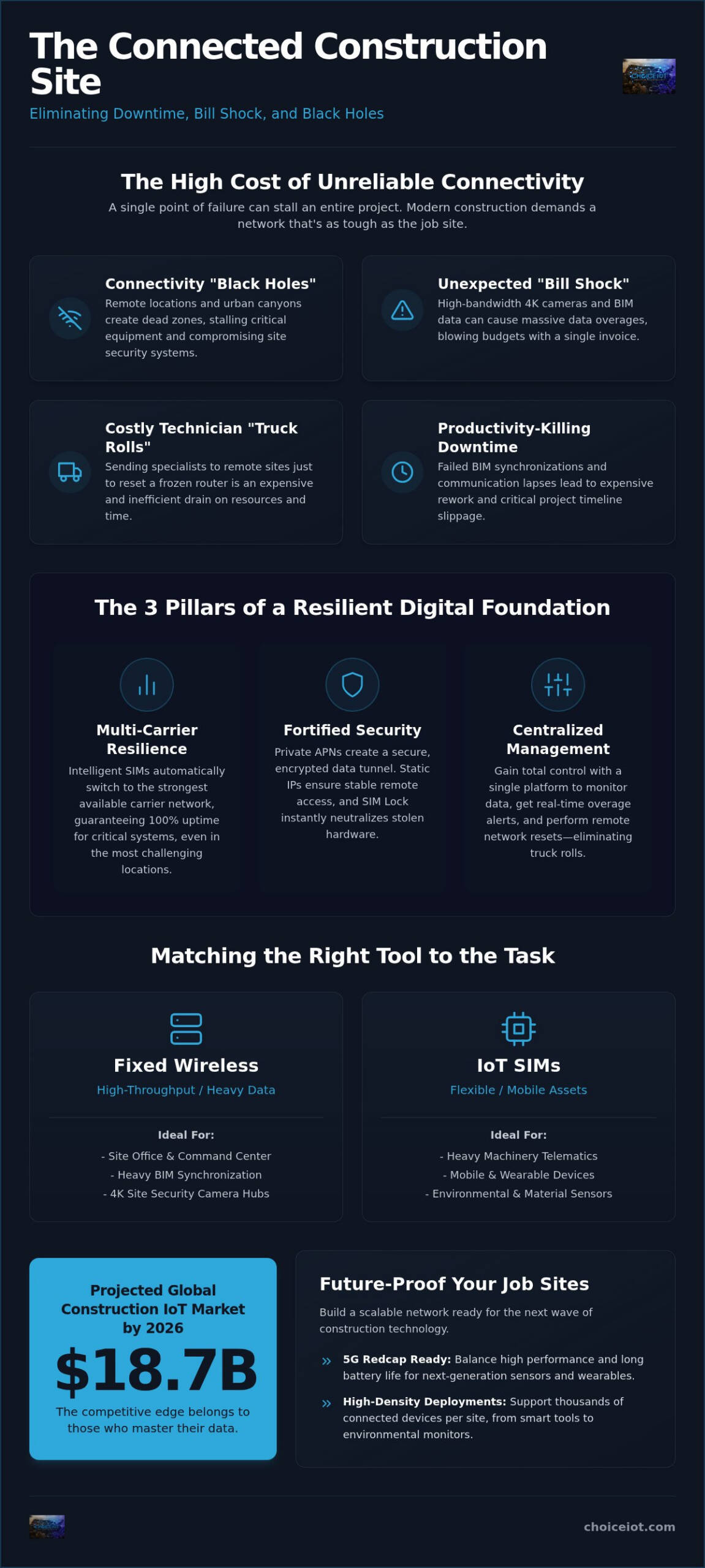
A single “connectivity black hole” on a remote job site can cost more in project delays and technician truck rolls than the entire annual budget for your network infrastructure. It’s a high-stakes environment where a dropped signal means stalled equipment and compromised security. Reliable iot connectivity for construction sites is no longer a luxury; it’s the heartbeat of the modern build. You’ve likely felt the sting of “bill shock” from high-bandwidth 4K cameras or the drain of sending a specialist just to reset a frozen router. It’s frustrating. It’s inefficient. Most importantly, it’s avoidable.
You deserve a network that works as hard as your crew. We’ll show you how to eliminate downtime and prevent data overages using multi-carrier resilience and centralized management. Total visibility. Predictable costs. Zero friction. This article previews the shift toward intelligent, managed connectivity that keeps your site online and your budget on track. With the global construction IoT market projected to reach $18.7 billion by 2026, the competitive edge belongs to those who master their data. Discover how to build a digital foundation that stands up to the toughest conditions.
Key Takeaways
- Eliminate “connectivity black holes” by leveraging multi-carrier failover to ensure 100% uptime for critical BIM and site security systems.
- Stop “bill shock” before it happens with real-time data visibility and automated alerts that prevent unexpected overages from high-bandwidth devices.
- Master the technical stack for robust iot connectivity for construction sites, integrating secure hardware with private APNs for a resilient digital foundation.
- Reduce operational overhead by utilizing remote network resets, fixing connectivity issues instantly without the high cost of a technician truck roll.
- Future-proof your job sites by preparing for 5G Redcap and high-density sensor deployments that drive long-term scalability and project efficiency.
Overcoming the “Connectivity Black Hole” on Modern Construction Sites
Modern construction sites are data hubs. Every piece of equipment, from excavators to site sensors, relies on a steady stream of information. This is the Industrial Internet of Things (IIoT) in action. It’s the backbone of Building Information Modeling (BIM), real-time telematics, and high-definition site security. Yet, many projects still rely on consumer-grade hotspots. These devices fail in industrial conditions. They overheat. They drop connections. They simply can’t handle the metal and concrete interference typical of a job site. When connectivity drops, the “Disconnected Site” penalty hits. Productivity stalls. Project timelines slip. Profit margins shrink. You need a foundation built for the field, not the living room. Reliable iot connectivity for construction sites requires industrial-grade fixed wireless and multi-carrier intelligence.
The High Stakes of Site Downtime and BIM Synchronization
BIM synchronization requires massive data throughput. If your site team is working off an outdated model because the sync failed, you’re looking at expensive rework. Precision matters. Real-time site monitoring and 4K security cameras demand consistent, high-capacity bandwidth that standard mobile plans can’t provide. Transitioning to fixed wireless connectivity for business ensures your site has the dedicated pipe needed for heavy data lifting. It eliminates the lag that disrupts coordination and compromises site safety. Fast deployment. Zero lag. Total control.
Why Multi-Carrier Resilience is Non-Negotiable
Construction happens in remote locations and urban canyons. Both environments create carrier “dead zones.” Relying on a single network is a gamble your project shouldn’t take. If one tower goes down or signal strength fluctuates, your operations stop. Using multi carrier iot sim cards solves this by providing universal coverage. These SIMs automatically switch to the strongest available network based on site location. It means immediate deployment readiness. You don’t have to wait for a specific carrier to upgrade a tower. You deploy, you connect, and you stay online regardless of the site’s geography. It’s about building resilience into the very first day of the project.
Building a Secure and Scalable Construction IoT Architecture
Building a scalable architecture for iot connectivity for construction sites requires more than just hardware. It’s a three-pillar stack: Carrier Device Certification for hardware, resilient Multi-Carrier IoT SIMs, and the CAMP™ IoT Platform. Security can’t be an afterthought. It must be baked into the foundation. Construction sites are prime targets for data breaches and hardware theft. Protecting sensitive Building Information Modeling (BIM) files and site telemetry is critical. You need a system that’s secure by design. A resilient digital foundation for iot connectivity for construction sites ensures that every sensor and camera remains an asset, not a liability.
Securing Site Data with Private APN and Static IPs
Standard internet connections expose your devices to the public web. A Private APN changes the game. It creates a secure, encrypted tunnel for your project data, shielding it from external threats. Pair this with a Static IP Address. This allows your IT team to maintain consistent remote access to on-site servers and NVRs without the headache of changing addresses. Research in IoT in Geotechnical Monitoring highlights how real-time safety data depends on these stable, secure connections. For extra physical security, the CAMP™ platform includes a SIM Lock feature. If a router is stolen, the SIM is automatically disabled. It prevents unauthorized usage instantly. It’s total control over your digital perimeter.
Fixed Wireless vs. IoT SIMs: Choosing the Right Payload
Not all site data is equal. A site office with twenty engineers needs a different solution than a concrete moisture sensor. Fixed Wireless Connectivity provides the heavy-duty throughput needed for office operations and BIM syncing. Conversely, IoT SIMs are better suited for mobile assets like telematics on heavy machinery. Matching the data plan to the use case prevents waste. The same principles that govern industrial M2M connectivity apply here: aligning your network architecture to specific device payloads eliminates waste and maximizes performance. 5G Redcap balances performance and battery life for site sensors. This technology is specifically designed for medium-speed applications. It’s ideal for leak detection and environmental monitoring where high speed isn’t necessary, but reliability is essential. By utilizing this, you optimize energy consumption without sacrificing the data flow needed for project management. If you’re ready to secure your site’s digital footprint, you can explore our managed connectivity solutions to find the right fit for your next project.
Strategic Management: Eliminating “Bill Shock” and Truck Rolls
Deploying iot connectivity for construction sites is only the first step. The real challenge lies in long-term operational management. Hidden costs often lurk in the form of data overages and unnecessary technical site visits. A high-bandwidth 4K camera or a misconfigured sensor can quickly drain a data pool, leading to massive “bill shock” at the end of the month. Traditional reactive troubleshooting is expensive and slow. You need a proactive approach that turns raw connectivity into a managed asset. Centralized visibility is the key to maintaining project margins while scaling across multiple job sites.
Real-Time Visibility with the CAMP™ Platform
Managing multiple carriers and hundreds of devices shouldn’t require a dozen different logins. A single dashboard for all site devices provides the transparency needed to control costs. Through the CAMP™ platform, you can set Intelligent Alerts to trigger at 75%, 90%, and 100% of data usage. This allows your team to adjust plans or investigate high-usage devices before overages occur. Advanced reporting tools transform usage data into actionable insights. You can identify which sites are most efficient and which require optimization. It’s about total awareness. Instant control. Scalable growth.
Remote Network Reset: Saving the Project Schedule
The “Truck Roll” is a silent killer of construction budgets. Sending a specialized technician to a remote site just to push a reset button on a frozen router can cost upwards of $500 in labor and travel. It’s a waste of time and money. Remote Network Reset functionality allows your IT team to fix connectivity issues directly from the home office. One click restores the connection. No travel required. Additionally, Device Change Alerts keep your deployment records accurate. If hardware is swapped or moved between sites, you’ll know instantly. This prevents inventory loss and ensures that your iot connectivity for construction sites remains organized and efficient. The same carrier-agnostic approach that eliminates truck rolls on job sites also applies to iot connectivity for fleet management, where remote resets and real-time visibility are equally critical for keeping mobile assets online. If you want to stop overpaying for site visits and data waste, contact Choice IoT today to streamline your operations.
Future-Proofing Construction Sites with Choice IoT
Future-proofing your job site is about more than today’s signal. It’s about a resilient foundation that evolves as your projects grow. Choice IoT functions as a Complete Connectivity Partner. We provide the infrastructure needed to move from a single pilot site to a national fleet of connected projects. The roadmap for 5G Redcap is a game-changer. It enables high-density sensor networks for leak detection and environmental monitoring without the power drain of traditional 5G. This ensures your iot connectivity for construction sites remains efficient as you integrate more advanced automation. You don’t just need a provider. You need a partner that masters the complexity so you can focus on the build.
Scalability for VARs and Solution Providers
Integrators and VARs face unique hurdles when scaling. Carrier Device Certification is the first step. It ensures your hardware is approved and ready for immediate deployment. Choice IoT supports white-label management. This allows resellers to offer a premium, branded experience through the CAMP™ platform. This modularity isn’t limited to the job site. You can leverage these same systems to scale into other sectors, such as IoT connectivity for kiosks. One platform. Multiple industries. Infinite possibilities. Fast deployment. National scale. Absolute reliability.
Next Steps: Deploying Your Site Connectivity
Starting your audit is simple. Focus on your current friction points to see where you’re losing money. A robust digital foundation for iot connectivity for construction sites starts with a clear understanding of your requirements. Use this checklist to evaluate your current setup:
- Identify current dead zones and carrier limitations across your project map.
- Review historical data overage costs and “bill shock” events from high-bandwidth devices.
- Calculate manual reset frequency and total truck roll expenses for remote site maintenance.
Once you’ve identified these gaps, consult with a Choice IoT expert to design a custom plan. We’ll help you build a digital foundation that eliminates downtime and secures your project data. If you’re ready to lead the industry, it’s time to Partner with Choice IoT for your next construction deployment. Build faster. Build smarter. Build with confidence.
Mastering the Connected Job Site
Reliable iot connectivity for construction sites is the difference between a project that finishes on time and one that drains your profit through downtime and rework. You’ve seen how a resilient digital foundation transforms complex site logistics into a streamlined, automated operation. By moving away from consumer-grade solutions and embracing industrial-grade architecture, you eliminate the “black holes” that stall progress and compromise data integrity.
The path forward is built on total visibility and cost control. The CAMP™ Platform provides the operational control you need to manage multiple carriers from a single dashboard. Combined with multi-carrier SIMs for 100% site coverage and remote network reset functionality to eliminate costly truck rolls, your team can focus on building rather than troubleshooting. It’s about empowering your crew with the tools they need to succeed in a data-driven industry.
It’s time to secure your digital perimeter and scale your operations with confidence. Contact Choice IoT to Secure Your Construction Site Connectivity and start building on a foundation that won’t let you down. Your next project deserves a network that is as robust as the structures you create.
Frequently Asked Questions
What is the best type of internet for a remote construction site?
Fixed Wireless Connectivity is the superior choice for remote locations where fiber or cable infrastructure is unavailable. It offers high-speed, enterprise-grade internet that deploys in hours rather than weeks. For mobile assets or dispersed sensors, utilizing a Multi-Carrier IoT SIM ensures devices automatically latch onto the strongest signal available. This hybrid approach guarantees 100% uptime for critical site operations like BIM syncing and security monitoring.
How do I prevent data overage charges on my construction site IoT devices?
Prevent overages by using a centralized management dashboard like the CAMP™ platform. You can set Intelligent Alerts to notify your team when data usage hits 75% or 90% of the monthly limit. This allows for proactive plan adjustments before “bill shock” occurs. Real-time visibility into every SIM prevents high-bandwidth devices, such as 4K cameras, from silently draining your project budget through unauthorized or excessive usage.
Can I manage multiple cellular carriers on one platform?
Yes, the CAMP™ platform allows you to manage all your cellular carriers from a single, unified dashboard. This eliminates the need for multiple carrier portals and simplifies complex billing cycles. You gain total operational control over your entire iot connectivity for construction sites deployment. It streamlines activations, usage monitoring, and device management, regardless of which network the hardware is currently using at the job site.
What is a Private APN and why does my construction site need one?
A Private APN is a secure, encrypted tunnel that separates your site data from the public internet. Construction sites need this to protect sensitive project files and Building Information Modeling (BIM) data from external cyber threats. It ensures that your devices only communicate with your internal network. This layer of security is vital for maintaining project confidentiality and preventing unauthorized access to on-site machinery or servers.
How does a remote network reset save money on construction projects?
Remote network resets save money by eliminating the need for “truck rolls,” which are expensive technician visits to remote locations. Instead of spending $500 or more to have someone manually reboot a router, your IT team can trigger a reset instantly from the home office. This reduces site downtime and keeps the project schedule on track. It’s a high-impact way to lower operational overhead while maintaining peak performance.
Is 5G necessary for construction site IoT, or is 4G LTE enough?
4G LTE is often sufficient for basic asset tracking and low-data sensors. However, 5G is necessary for high-bandwidth needs like real-time video surveillance and high-speed BIM updates. 5G Redcap offers a strategic middle ground, providing reliable iot connectivity for construction sites with optimized battery life for medium-speed sensors. The choice depends on your specific payload requirements and the density of devices currently deployed on your job site.