

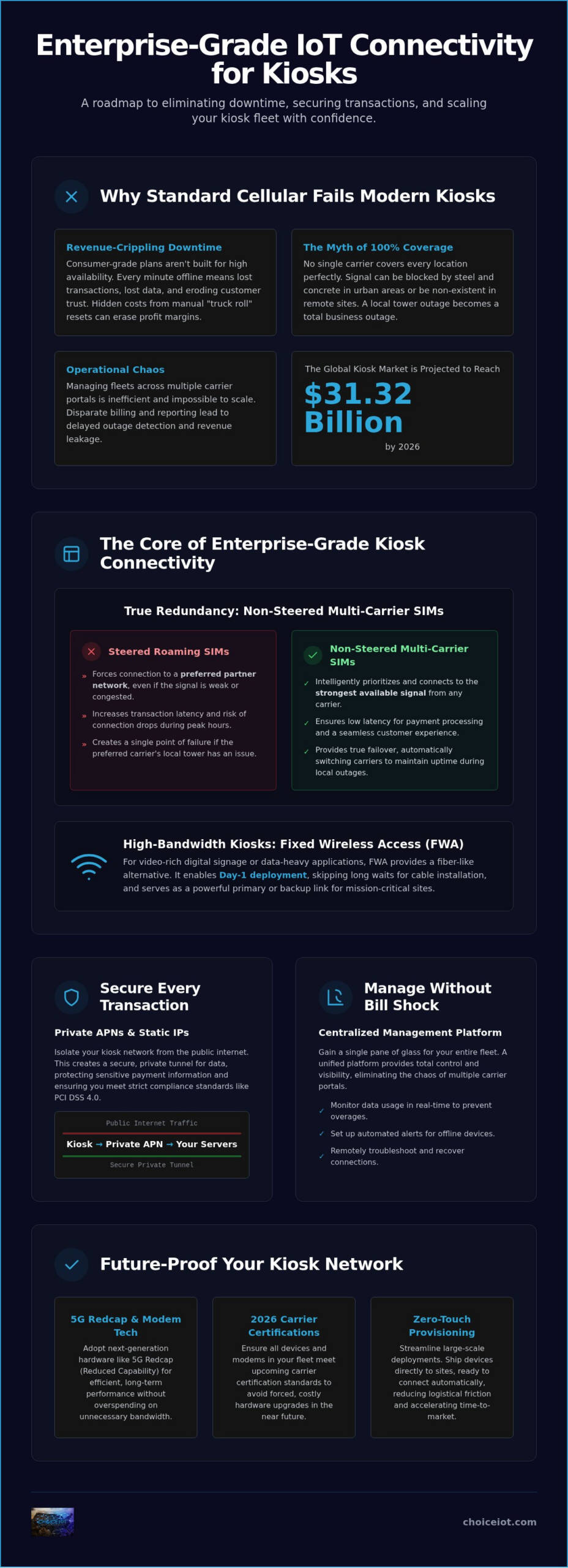
The global kiosk market is projected to reach $31.32 billion by 2026. This massive growth brings a critical challenge: a single dropped connection can paralyze revenue and erode customer trust in seconds. For many operators, standard iot connectivity for kiosks isn’t enough. It’s often the weak link in an otherwise robust deployment.
You’ve likely felt the sting of unexpected data overages or the complexity of managing a dozen different carriers. It’s a logistical drain. We understand that you need more than just a signal; you need a system that works without constant intervention. This guide shows you how to eliminate downtime and secure every transaction. We’ll cover the shift to PCI DSS 4.0 compliance, the advantages of private APNs, and how to gain centralized visibility over your entire fleet. Expect a roadmap for zero-touch deployment and predictable monthly costs. No more bill shock. No more security gaps. Just a high-performance engine for your business growth.
Key Takeaways
- Eliminate single-point-of-failure risks by leveraging multi-carrier redundancy and Fixed Wireless Access for maximum kiosk uptime.
- Secure sensitive payment data and maintain compliance by isolating your network from the public internet with Private APNs and Static IPs.
- Optimize iot connectivity for kiosks through centralized management platforms to prevent bill shock and monitor data usage in real time.
- Future-proof your hardware investments by adopting 5G Redcap and ensuring all devices meet 2026 carrier certification standards.
- Streamline large-scale deployments with zero-touch provisioning to reduce logistical friction and accelerate your time-to-market.
Why Standard Cellular Fails Modern Kiosk Deployments
Standard cellular connectivity is designed for mobile consumers. It’s built for flexibility, not for the rigid, high-availability demands of an Interactive kiosk. When you rely on consumer-grade data plans, you’re betting your revenue on a network that wasn’t built to prioritize your uptime. Revenue is the heartbeat of your deployment. Downtime is the cardiac arrest.
Downtime is expensive. It’s not just a technical glitch; it’s a direct hit to your bottom line. Every minute a kiosk sits offline, you lose transactions. You lose customer trust. You lose data. Beyond the immediate financial loss, the “Truck Roll” trap creates a massive drain on resources. Sending a technician to a remote site for a simple manual reset is a logistical failure. These hidden costs of manual troubleshooting can quickly erase the profit margins of an entire deployment. Reliable iot connectivity for kiosks requires a strategy that eliminates the need for physical intervention. You need a system that heals itself. The same truck roll problem plagues other industries — operators managing iot connectivity for construction sites face identical challenges when a dropped signal forces a specialist visit to a remote job site. Enterprises running remote hardware at scale face this same burden, which is why industrial m2m connectivity strategies built around zero-touch provisioning and automated failover have become essential for eliminating costly manual resets across distributed deployments.
The Myth of 100% Single-Carrier Coverage
No single carrier can guarantee total coverage across every zip code. Network congestion during peak retail hours can throttle throughput just when you need it most. Urban environments present unique challenges. Steel, concrete, and low-emissivity glass act as signal shields. A signal that looks “good enough” on a handheld device often fails when trapped inside a metal kiosk enclosure. Failover is non-negotiable. Without a multi-carrier approach, a single local tower outage becomes a total business outage. You need the ability to switch providers instantly when performance dips. Reliability isn’t a luxury; it’s a requirement.
Operational Friction in Manual Management
Managing a fleet through multiple carrier portals is a recipe for chaos. Disparate billing cycles and inconsistent data reporting make it impossible to scale efficiently. Delayed detection is the primary driver of revenue leakage. If you don’t know a device is offline until a customer complains, you’ve already lost. Unattended retail connectivity is a specialized infrastructure requirement designed to maintain persistent, secure, and self-healing data links without human intervention. To succeed, you must move away from reactive troubleshooting. You need a centralized system that provides real-time visibility and automated recovery. High performance requires high visibility. Efficiency isn’t just about speed. It’s about total control over every node in your network.
Essential Components of Enterprise-Grade Kiosk Connectivity
Enterprise-grade iot connectivity for kiosks is a balance of hardware capability and network intelligence. You can’t rely on a single pipe anymore. You need a redundant architecture that adapts to local conditions in real time. This begins with the SIM and extends to the modem and the management layer. High-performance deployments require a foundation built on resilience and total visibility. It’s about moving from a “functional” connection to a “persistent” one.
Multi-Carrier Redundancy vs. Roaming SIMs
Integrators often confuse standard roaming with true multi-carrier redundancy. Steered roaming forces a connection to a preferred partner, even if that signal is weak or congested. Non-steered multi carrier iot sim cards prioritize the strongest available signal across all networks. This is critical for maintaining low latency during payment processing. Latency isn’t just a technical metric; it’s a customer experience metric. If your SIM is stuck on a congested network, the transaction hangs. Customers walk away. Non-steered SIMs provide the agility needed to stay on the fastest available path regardless of local carrier outages.
Leveraging Fixed Wireless for High-Bandwidth Kiosks
Standard cellular is great for basic transactional data. However, video-rich kiosks or interactive digital signage demand more throughput. Fixed wireless connectivity for business offers a high-bandwidth alternative that rivals fiber. It enables Day-1 deployment, skipping the weeks-long wait for physical cable installation. It’s the ideal primary link for data-heavy applications or a robust backup for mission-critical sites. This speed allows you to scale rapidly without the logistical friction of traditional wired infrastructure.
Your hardware must support this network flexibility. Choosing modems that cover global bands ensures your fleet is ready for any market. With eUICC technology, you can localize connectivity profiles over the air without physical SIM swaps. This simplifies IoT integration and management within complex retail environments. Carrier device certification is the final piece of the puzzle. It ensures your hardware is recognized and authorized by the network, preventing unexpected blocks. Adopting 5G Redcap for 2026 deployments provides the perfect balance of performance and power efficiency for iot connectivity for kiosks. Transitioning to a more resilient model doesn’t have to be complex. You can streamline your operations with a unified platform.
Securing Kiosk Transactions: Private APNs and Static IPs
Public internet is a liability. Every transaction on an open network is a target for interception. For enterprises, securing iot connectivity for kiosks isn’t just a technical preference. It’s a legal and operational mandate. You need a dedicated, isolated network architecture to protect sensitive payment data and maintain brand integrity. Don’t leave your revenue exposed to the public web. You need a fortress, not just a connection.
The Role of Private APN in Data Integrity
A Private APN functions as a secure, private gateway between your kiosks and your data center. It effectively removes your devices from the public web. This isolation is your first line of defense against Distributed Denial of Service (DDoS) attacks. By using a Private APN, you gain the ability to implement custom routing and firewalling at the network level. You control exactly where the data goes. This level of reliable connectivity for automated retail ensures that transaction traffic never mingles with general internet noise. Secure data tunnels. Enhanced integrity. Simplified architecture. It makes large-scale deployments easier to defend and manage across global markets.
Remote Management via Static IP
Dynamic IP addresses are a hurdle for remote maintenance. If a kiosk’s IP changes every time it reconnects, your management platform loses its target. Static IP addresses provide a persistent, unchanging identity for every node. Persistent access. Real-time control. This is essential for secure Machine-to-Machine (M2M) communication and robust iot connectivity for kiosks. With a static IP, your team can initiate remote troubleshooting, push firmware updates, and verify device health without delay. It eliminates the need for expensive on-site visits. You get total visibility. You get immediate recovery capabilities when performance dips.
In 2026, the full enforcement of PCI DSS 4.0 standards is in effect. These regulations demand stricter authentication and enhanced web application security for any device handling payment card data. A Private APN combined with Static IPs provides the infrastructure necessary to meet these requirements. It creates the secure environment required for encrypted data transmission. It restricts access to authorized users only. Security is the foundation of scale. Without it, your deployment is a risk. With it, it’s a high-performance asset that builds consumer trust through every interaction. Protect your data. Protect your reputation.
Managing Large-Scale Kiosk Fleets Without Bill Shock
Scaling a kiosk deployment from a dozen units to several thousand introduces exponential complexity. Without centralized control, your operational costs will spiral. Managing iot connectivity for kiosks through individual carrier portals is inefficient. It’s a manual process that invites human error. You need a single pane of glass to maintain total visibility over every node in your network. Centralization is the only way to ensure predictable margins. High-performance deployments require high-precision management.
The CAMP™ Platform Advantage
The iot connectivity management platform provided by Choice IoT, known as CAMP™, eliminates the friction of multi-carrier management. It centralizes diverse carrier data into one intuitive interface. Provisioning a new batch of SIMs takes seconds. De-provisioning is just as fast. For VARs and solution providers, white-labeling these capabilities adds immediate value to your service offering. You get customizable reporting that simplifies client billing. You get real-time ROI analysis. CAMP™ isn’t just a tool; it’s the engine behind your scaling strategy. Total control. Simplified billing. Rapid deployment.
Strategies to Prevent IoT Bill Shock
A “runaway” device can consume gigabytes of data in hours due to a software loop or a security breach. This leads to bill shock. Data pooling is your first line of defense. By pooling data across your entire fleet, high-usage kiosks are offset by those with lower consumption. This flattens your monthly costs. Automated alerts are the second layer. You shouldn’t find out about an overage when the invoice arrives. You need to know the moment a threshold is crossed. Proactive monitoring is the difference between a profitable month and a financial disaster.
To secure your margins, follow this “Bill Shock Prevention” workflow:
- Define Usage Baselines: Analyze historical data to set realistic monthly caps for each kiosk type.
- Implement Data Pooling: Aggregate data across all active SIMs to absorb spikes from individual units.
- Set Multi-Stage Thresholds: Configure automated alerts at 75%, 90%, and 100% of the data cap.
- Enable Real-Time Notifications: Ensure alerts are sent immediately via SMS or email to your operations team.
- Automate Suspension: Set “kill switches” for devices that exhibit anomalous data behavior to prevent catastrophic overages.
Real-time monitoring allows you to catch issues before they become financial liabilities. This proactive approach transforms iot connectivity for kiosks from a variable expense into a predictable utility. Efficiency is about removing friction. Control is about having the right data at the right time. Ready to take command of your fleet? Explore the CAMP™ platform today and eliminate bill shock for good.
Future-Proofing Your Kiosk Network for 2026 and Beyond
Strategic foresight is the difference between a legacy system and a scalable asset. As we move through 2026, the technological landscape is shifting. 4G LTE networks are approaching their sunset phases. Relying on aging infrastructure is a risk to your long-term ROI. Future-proofing your iot connectivity for kiosks requires adopting standards that balance performance, longevity, and hardware costs. You need a roadmap that accounts for the next decade of connectivity. Don’t build on a foundation that’s scheduled for demolition.
Scaling from a pilot of ten units to a fleet of ten thousand demands architectural discipline. It requires a partner that understands the nuances of carrier relations and hardware integration. Choice IoT functions as your behind-the-scenes expert. We provide the infrastructure. You provide the growth. Our systems are built to absorb the complexities of global scaling, allowing you to focus on your core business. Efficiency. Reliability. Mastery. These are the pillars of a future-proof deployment.
Why 5G Redcap is the New Kiosk Standard
5G Redcap, or Reduced Capability, is the bridge to the future. It fills the gap between high-speed 5G and legacy 4G LTE. For kiosks, full-scale 5G is often overkill and prohibitively expensive. Redcap offers a streamlined alternative. It provides the low latency and massive capacity of 5G with lower power consumption. Reduced hardware complexity. Lower device costs. It ensures your network longevity as 4G sunsets accelerate. By adopting 5G Redcap today, you insulate your deployment against future network shifts. It’s the logical choice for high-performance, cost-effective iot connectivity for kiosks.
Navigating Carrier Device Certification
Network stability begins with certified hardware. Carriers are becoming stricter about which modules are allowed on their bands. An uncertified device is a liability. It can be blocked without warning, causing catastrophic downtime. Carrier device certification ensures your hardware is optimized for specific network protocols. It guarantees compatibility. It protects your uptime. Choice IoT facilitates this certification process for our partners, removing the technical hurdles that often stall deployments. We bridge the gap between hardware manufacturers and network operators. Stability is the standard. Control is the outcome.
Success in the kiosk market requires a partner that has already solved the industry’s most complex hurdles. From multi-carrier redundancy to the CAMP™ platform, we provide the essential foundation for your success. Eliminate the logistical stress of connectivity management. Secure your transactions. Scale with total confidence. Partner with Choice IoT for your next kiosk deployment and master the technical essentials of the 2026 landscape.
Command Your Kiosk Network with Confidence
Success in 2026 demands a shift from reactive troubleshooting to proactive management. Reliability isn’t just about signal strength. It’s about redundancy. Integrating iot connectivity for kiosks with multi-carrier SIMs ensures your revenue stream remains uninterrupted. You need total visibility. The CAMP™ platform provides the single pane of glass required to monitor data in real time and eliminate bill shock before it starts. Efficiency. Control. Scalability. Security isn’t optional; Private APNs and Static IPs are the foundation of a PCI-compliant, enterprise-grade network.
Choice IoT is the strategic partner you need to navigate these technical complexities. We offer the expertise and infrastructure to scale your deployment from a pilot to a global fleet. Leverage our multi-carrier redundancy for 99.9% uptime and rely on our expert support for VARs and integrators. Don’t let connectivity be your bottleneck. It’s time to build a high-performance engine for your business. Get a Custom Kiosk Connectivity Quote Today and secure the future of your automated retail network. Your growth starts with a stable foundation.
Frequently Asked Questions
What is the best IoT connectivity for kiosks?
Multi-carrier cellular connectivity with non-steered redundancy is the industry standard for maximizing uptime. It allows your devices to switch networks based on signal quality rather than carrier preference. This ensures transactions process smoothly even during local tower outages or peak network congestion. Reliability is the foundation of customer trust.
How much data does a typical kiosk use per month?
Data usage varies significantly based on the kiosk’s specific function. A simple transactional kiosk might consume 100MB to 500MB per month, while those supporting video-rich content or digital signage can exceed 10GB. Implementing data pooling across your entire fleet is the most effective way to manage these fluctuations and avoid unexpected overage charges.
How do I secure payment transactions on a cellular kiosk?
Secure transactions require isolating your traffic from the public internet using a Private APN and Static IP. This architecture creates an encrypted tunnel directly to your data center. It’s a critical component for maintaining PCI DSS 4.0 compliance and protecting sensitive customer payment information from interception or cyberattacks. Security is a mandate, not an option.
Can I use a standard consumer SIM card for my kiosk business?
No. Consumer SIMs lack the enterprise-grade security and management features required for professional deployments. They often fail in high-interference environments and don’t support Private APNs or Static IPs. Professional iot connectivity for kiosks relies on specialized SIMs designed for persistent, mission-critical data links and centralized management.
What happens if the primary cellular network goes down?
A robust system uses multi-carrier redundancy to automatically failover to the next strongest available network. This transition happens in seconds, preventing service interruptions and lost revenue. For high-bandwidth sites, Fixed Wireless Connectivity can serve as a powerful primary or secondary link to ensure consistent 99.9% uptime across your entire deployment.
Is 5G necessary for self-service kiosks?
Full 5G is not always mandatory, but 5G Redcap is becoming the strategic standard for 2026. It offers the longevity of 5G with lower hardware costs and power consumption than full-scale 5G. It’s the ideal choice for future-proofing iot connectivity for kiosks as 4G LTE sunsets approach. Efficiency meets longevity.
How does a Private APN improve kiosk security?
A Private APN acts as a virtual private gateway that removes your kiosks from the public web. It prevents DDoS attacks and unauthorized access by restricting network entry to specific, authenticated devices. This isolation is essential for maintaining a secure, closed-loop environment. It protects your data and your brand reputation simultaneously.
What is the CAMP™ platform and how does it help with kiosks?
CAMP™ is a centralized IoT connectivity management platform that provides total visibility over your entire kiosk fleet. It allows you to provision SIMs in seconds, monitor data usage in real time, and set automated alerts to prevent bill shock. It simplifies the complexity of managing multiple carriers through a single, intuitive pane of glass.