

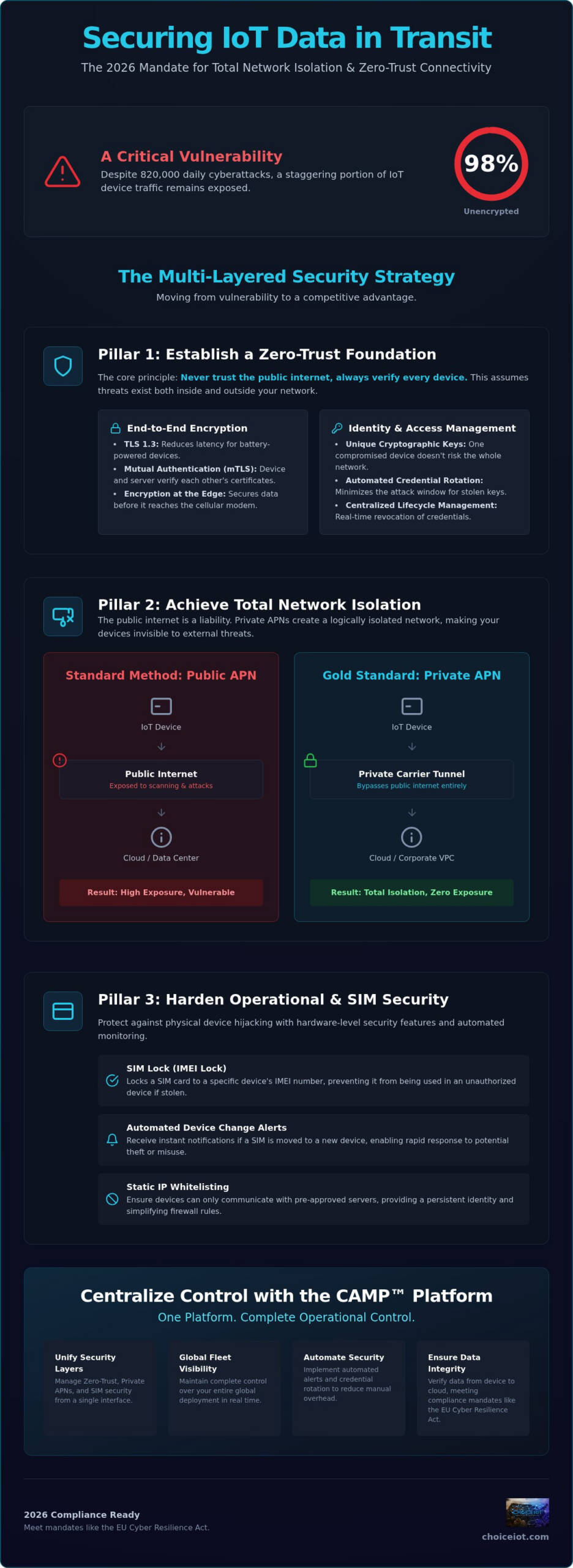
Did you know that 98% of all IoT device traffic remains unencrypted despite the 820,000 cyberattacks occurring every single day? In 2026, a single intercepted packet can trigger a regulatory nightmare under the EU Cyber Resilience Act. Securing iot data in transit isn’t just a technical hurdle anymore. It’s a core business requirement. You’re likely feeling the pressure of managing thousands of remote SIMs while trying to prevent man-in-the-middle attacks. It’s a complex, high-stakes environment where one weak link can compromise your entire infrastructure.
We understand the logistical stress of maintaining visibility across a global fleet. This checklist provides the roadmap you need to move beyond basic encryption toward total network isolation. You’ll master the multi-layered strategies required to protect your data from unauthorized access using Private APNs and zero-trust connectivity. We’ll show you how to implement automated security alerts and verify data integrity from the device to the cloud. One platform. Complete operational control. Let’s build a foundation that turns security from a vulnerability into a competitive advantage.
Key Takeaways
- Implement a Zero-Trust framework that eliminates reliance on the public internet by verifying every device identity at the network edge.
- Discover why Private APNs are the gold standard for securing iot data in transit by creating logically isolated tunnels for your traffic.
- Protect against physical device hijacking with SIM-level security features, including SIM Lock and automated Device Change Alerts.
- Leverage the CAMP™ platform to unify your security layers, providing one platform and complete operational control over global deployments.
- Meet 2026 compliance mandates like the EU Cyber Resilience Act by maintaining verified data integrity from device to cloud.
Establishing a Zero-Trust Foundation for IoT Data
In 2026, data in transit refers to the vulnerable journey every packet takes from a remote sensor to a gateway, through the cellular network, and finally into your cloud environment. Securing iot data in transit requires a shift from perimeter-based defense to a Zero-Trust architecture. This mandate is simple: never trust the public internet and always verify every device identity before a single byte is accepted. This approach assumes that threats exist both inside and outside the network at all times.
Standard TLS/SSL configurations often fall short in high-stakes industrial deployments. While they provide basic privacy, they don’t solve the problem of device spoofing or sophisticated hijacking. True secure data transmission in a modern IoT ecosystem demands a multi-layered approach that starts at the hardware level. Relying solely on software-level encryption leaves gaps that attackers can exploit during the initial connection phase.
End-to-End Encryption Protocols
Efficiency meets security with TLS 1.3. This protocol reduces handshake latency, which is critical for battery-powered devices that need to transmit data and return to sleep mode quickly. However, the real upgrade for 2026 is Mutual Authentication (mTLS). This ensures that both the device and the server verify each other’s certificates. We also recommend encryption at the edge. By securing data before it even hits the cellular modem, you eliminate the risk of “cleartext” exposure within the local hardware environment.
Identity and Access Management (IAM) for IoT
Forget shared passwords or group credentials. Every device must be provisioned with unique cryptographic keys. If one sensor is compromised, your entire network isn’t at risk. Automated credential rotation is the next step. This minimizes the window of opportunity for attackers to utilize stolen keys. Managing these keys is central to securing iot data in transit across thousands of endpoints. For maximum efficiency, integrate your device identities directly with your iot connectivity management platform. This centralization allows for real-time revocation and lifecycle management, ensuring you maintain complete operational control over your global fleet.
Securing the Network Layer: Private APNs and Isolation
The public internet is a liability for enterprise IoT. Every device connected via a standard public APN is essentially a sitting duck for automated scanning and brute-force attempts. Securing iot data in transit requires moving beyond basic encryption and toward total network isolation. By utilizing a Private APN, you create a logically isolated network that exists entirely separate from the public web. This makes your devices invisible to external threats. No public IP means no target for hackers. Total invisibility. Zero exposure. Absolute control.
Bypassing the public internet isn’t just a security preference; it’s a performance mandate. When your data stays within a private carrier tunnel, you eliminate the unpredictable hops of the public web. This aligns with government recognized IoT cybersecurity best practices regarding network segmentation. Deploying a Private APN for IoT is the most efficient way to achieve this level of infrastructure-level isolation.
Private APN Architecture
A Private APN routes your data directly from the cellular network to your corporate data center or cloud VPC. This architecture removes the need for resource-heavy client-side VPNs on every sensor. It reduces latency by stripping away the encryption overhead required for public tunnels. You can also customize firewall rules at the carrier level. This allows you to restrict traffic to specific authorized IPs, ensuring that even if a device is physically compromised, it can only communicate with your designated servers. It’s a streamlined approach to high-performance security.
The Security Value of Static IPs
Static IPs provide a persistent identity for every device in your fleet. This is critical for Machine-to-Machine (M2M) authentication where a changing IP would break the security handshake. Unlike dynamic IPs, which are recycled and often scanned by malicious actors, a static IP within a private network simplifies your whitelist and blacklist configurations. It enables reliable two-way communication without exposing the device to the open web. This persistent connectivity is a foundational element of a mature security posture. If you’re looking to eliminate the friction of dynamic networking, consider how Static IP solutions can stabilize your remote deployments.
Operational Security Checklist: SIM Integrity and Monitoring
Encryption and private tunnels are essential, but they don’t stop a physical breach. If a device is stolen, the SIM becomes a gateway for unauthorized access. Securing iot data in transit requires a robust layer of operational monitoring that starts at the hardware level. You need total visibility into every connection attempt. A single dashboard is no longer a luxury. It’s a requirement for managing thousands of remote endpoints efficiently. Total visibility. Zero guesswork. Absolute integrity.
Intelligent alerts transform passive monitoring into active defense. By defining usage thresholds, you can detect anomalies before they escalate into full-scale breaches. Automation is the key. Your system should trigger immediate suspensions when patterns deviate from the norm. This proactive stance is the only way to stay ahead of the 820,000 daily cyberattacks targeting IoT devices in 2026. It’s about maintaining control when you aren’t physically present at the site.
SIM Lock and Device Integrity
Physical security is often the weakest link in a deployment. SIM Lock prevents unauthorized usage by binding a specific SIM to a single authorized IMEI. If an attacker moves that SIM to a rogue router, the connection is instantly severed. Device Change Alerts provide real-time notification of these movements. This prevents data theft and protects your organization from the “bill shock” of high-bandwidth consumption on stolen credentials. It’s your last line of defense against hardware tampering.
Remote Diagnostics and Response
Security fixes shouldn’t require expensive field visits. Remote Network Reset allows you to clear suspicious connectivity states directly from your management interface. This eliminates costly truck rolls and drastically speeds up your incident response time. By analyzing real-time usage reports, you can identify compromised devices early. Maintaining a full history of support notes and diagnostic data is also essential for forensic audits under the NIS2 Directive. Secure your fleet with advanced SIM-level security features to gain total operational control.
Centralizing Control with the CAMP™ Platform
Fragmented security is the primary cause of breaches in large-scale deployments. Managing disparate systems for network isolation, SIM integrity, and data encryption leads to visibility gaps that attackers exploit. You can’t secure what you can’t see. Centralizing your operations is the final, critical step in securing iot data in transit. The CAMP™ platform provides the unified architecture necessary to manage these layers from a single pane of glass. One Platform. Complete Operational Control.
Simplifying scalable iot connectivity solutions requires more than just connectivity. It requires a dashboard that bridges the gap between carrier-level data and enterprise security requirements. By integrating security automation directly into your existing CRM or ERP systems through open APIs, you remove the friction of manual configuration. Total transparency. Zero friction. Absolute reliability.
Real-Time Visibility and Reporting
Real-time visibility is your most powerful diagnostic tool. The CAMP™ platform allows you to monitor data usage thresholds as they happen. If a device exceeds its expected profile, you’ll know instantly. This isn’t just about cost management; it’s about spotting the subtle anomalies that signal a man-in-the-middle attack or a compromised gateway. Detailed performance reports ensure you maintain compliance with strict security SLAs. You turn raw connectivity data into actionable security insights. Knowledge is power. Visibility is protection.
Automation and API Integration
Manual intervention is a security risk. Human error in configuration accounts for a significant portion of preventable breaches. By automating security workflows, you ensure that every device follows your exact security policy from the moment it’s activated. The CAMP™ platform enables automated activation, suspension, and plan changes based on real-time alerts. This streamlines multi carrier iot sim cards management across diverse global networks. You manage multiple carriers through one interface. You ensure consistent security standards regardless of the underlying network provider. Efficiency drives security. Automation ensures scale.
Future-Proofing Your IoT Infrastructure for 2026
The landscape of IoT security in 2026 demands a shift from reactive patching to proactive infrastructure design. You’ve seen how a Zero-Trust foundation and Private APN isolation remove the public internet’s inherent risks. By implementing SIM-level protections like SIM Lock and Device Change Alerts, you ensure physical tampering doesn’t lead to a network-wide breach. These layers aren’t just technical preferences. They’re essential components for securing iot data in transit while maintaining regulatory compliance.
Efficiency comes from centralization. The CAMP™ platform offers One Platform and Complete Operational Control, allowing you to manage global deployments without fragmented visibility. You get SIM-level security features included and expert support for Carrier Device Certification to streamline your time-to-market. Don’t let logistical complexity stall your growth. Secure Your IoT Deployment with a Private APN from Choice IoT today. You’ve built a powerful solution. Now, give it the robust foundation it deserves.
Frequently Asked Questions
What is the most secure way to transmit IoT data in 2026?
The most secure method involves combining a Private APN with a Zero-Trust architecture to isolate traffic from the public internet entirely. This infrastructure-level isolation makes your devices invisible to external scans and automated attacks. When you couple this with mTLS and unique device credentials, you create a hardened environment. This multi-layered strategy is currently the gold standard for securing iot data in transit against sophisticated man-in-the-middle threats.
How does a Private APN improve IoT data security compared to a VPN?
A Private APN provides infrastructure-level isolation without the resource overhead of client-side VPN software. While VPNs create an encrypted tunnel over the public web, a Private APN removes the device from the public web altogether. This significantly reduces the attack surface and eliminates the latency associated with repetitive VPN handshakes. It simplifies management by applying firewall rules at the carrier level, ensuring consistent security policies across massive global fleets.
What happens if someone steals a SIM card from my IoT device?
If you have SIM Lock enabled, the stolen SIM becomes useless as soon as it’s removed. This feature binds the SIM to a specific device IMEI, preventing it from establishing a connection in unauthorized hardware. Without this protection, a thief could exploit your data plan or gain access to your internal corporate network. With the CAMP™ platform, you get an instant alert, allowing you to suspend the line or perform a remote reset immediately.
Can I monitor IoT data security in real-time across multiple carriers?
You can monitor your entire fleet through the CAMP™ platform, which provides a single dashboard for real-time visibility across all network providers. This allows you to track data usage patterns and set automated thresholds to flag anomalies instantly. Centralized monitoring is vital for securing iot data in transit within global deployments. It eliminates the need to manage multiple carrier portals. You gain one platform and complete operational control over your connectivity.
Why is mTLS essential for securing data in transit?
Mutual Transport Layer Security (mTLS) is essential because it requires both the device and the server to verify each other’s identity. Traditional TLS only verifies the server, which leaves the system vulnerable to rogue devices attempting to spoof your sensors. In 2026, mTLS is a foundational part of any Zero-Trust mandate. It prevents unauthorized hardware from injecting data into your cloud environment, ensuring that only authenticated devices can communicate with your servers.
How do Device Change Alerts prevent IoT data breaches?
Device Change Alerts provide immediate notification the moment a SIM is moved to unauthorized hardware. This real-time visibility allows you to detect physical theft or tampering before an attacker can exploit the network connection. By pairing these alerts with automated suspension workflows, you effectively mitigate the risk of data exfiltration and bill shock. It’s a critical operational layer that protects your infrastructure from local breaches that software-only security measures often miss.