

In a 2026 industrial landscape where 46 percent of all data is generated by IoT devices, a three second latency spike isn’t just a delay; it’s a systemic failure. You’ve likely dealt with the fallout of unpredictable cellular timeouts or carrier tower congestion that degrades your real-time sensor reporting. Legacy communication protocols often add unnecessary overhead, draining batteries and inflating data costs without delivering the speed your operations demand. Achieving effective iot network latency optimization requires moving beyond simple device code to address the underlying cellular infrastructure.
It’s time to stop guessing why your endpoints are lagging and start enforcing deterministic, sub-second performance. This guide delivers actionable strategies to eliminate routing hops between your devices and enterprise cloud servers. We’ll explore how Private APNs, 5G RedCap, and the CAMP™ platform provide the diagnostic visibility needed to solve anomalies without sending technicians into the field. Centralized control. Rapid deployment. Reduced friction. You’ll gain the technical mastery to build a high-performance network that scales as fast as your business does.
Key Takeaways
- Isolate the exact drivers of round-trip time by breaking down latency into distinct radio transmission, core routing, and application processing layers.
- Minimize payload architecture overhead and eliminate packet fragmentation by transitioning from legacy formats to efficient serialization like Protocol Buffers or CBOR.
- Streamline cellular paths and achieve true iot network latency optimization by routing traffic through dedicated Private APNs and leveraging 5G RedCap infrastructure.
- Gain continuous visibility into endpoint performance and eliminate expensive technician truck rolls by utilizing the CAMP™ platform’s remote network reset capabilities.
Understanding IoT Network Latency: Root Causes and Performance Thresholds
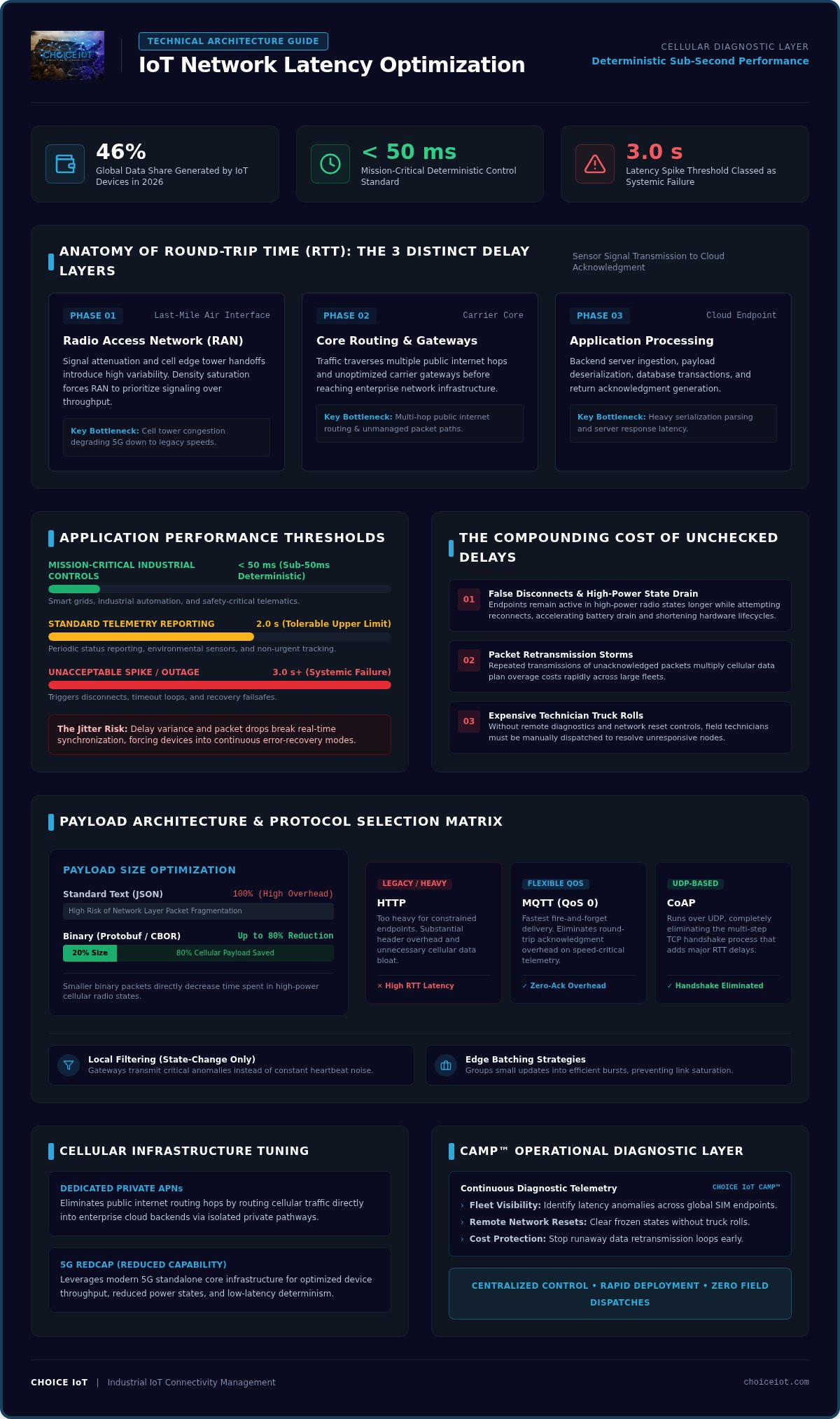
IoT network latency isn’t just a metric; it’s the pulse of your deployment. In technical terms, it represents the round-trip time (RTT) required for a sensor signal to travel to the cloud and receive an acknowledgment. Understanding Latency (engineering) requires breaking the journey into three distinct phases: radio transmission across the cellular air interface, core routing through carrier gateways, and backend application processing. Every millisecond added at these stages reduces the responsiveness of your entire system.
True iot network latency optimization starts by recognizing that not all delays are created equal. While a simple telemetry sensor might tolerate a two second delay, mission-critical industrial controls require sub-50ms deterministic performance. Steady latency is often manageable. However, jitter, the variance in delay, and packet drops are operational killers. They trigger unpredictable behavior that breaks real-time synchronization and forces applications into recovery modes.
Radio Access Network (RAN) vs Core Network Bottlenecks
The “last mile” is often the most volatile part of the journey. Signal attenuation and tower handoffs at the cell edge introduce significant variability. Within the carrier core, delays mount when traffic traverses multiple public internet hops before reaching your enterprise server. Round-trip time degrades sharply during high-density cell tower saturation as the Radio Access Network prioritizes signaling over data throughput. These bottlenecks can turn a high-performance 5G link into a sluggish connection that resembles legacy 3G speeds.
The Operational Cost of Unchecked Millisecond Delays
Small delays compound into massive failures. When latency spikes, applications often trigger false disconnects or timeouts. This forces devices to stay in high-power states longer as they attempt to re-establish connections, which accelerates battery drain and shortens hardware lifecycles. Even worse, packet retransmission storms can occur. These storms multiply cellular data plan overage costs rapidly as the same data is sent repeatedly. In sectors like smart grids or telematics, these delays aren’t just expensive; they’re safety risks. You need visibility into these anomalies. Tools like the CAMP™ platform provide the diagnostic layer necessary to identify these spikes before they cause a system-wide shutdown. Efficiency demands control. Control requires data.
Optimizing Communication Protocols and Device Payload Architecture
Data efficiency is the silent partner of speed. Even the fastest 5G link buckles under the weight of poorly architected payloads and chatty protocols. True iot network latency optimization requires a rigorous audit of how your devices pack and ship data. Text-heavy formats like JSON might be human-readable, but they’re cellular data killers. They introduce unnecessary transmission overhead and increase the risk of packet fragmentation at the network layer. Direct. Precise. Optimized.
Protocol Selection: MQTT, CoAP, and Lightweight M2M vs HTTP
Standard HTTP is too heavy for constrained endpoints. Modern deployments favor MQTT or CoAP. MQTT offers flexibility with Quality of Service (QoS) levels, allowing you to balance delivery guarantees against speed. QoS 0 is the fastest, providing fire and forget delivery without the round-trip overhead of acknowledgments. For even lower overhead, the Constrained Application Protocol (CoAP) runs over UDP, eliminating the multi-step TCP handshake process that adds significant RTT. A comprehensive survey on low-latency communication highlights how these protocol choices directly impact real-time responsiveness. Scaling these protocols effectively requires an iot connectivity management platform to monitor telemetry across the fleet.
Payload Compression and Edge Preprocessing Strategies
Stop sending raw data strings. Binary serialization formats like Protocol Buffers (Protobuf) or CBOR reduce payload size by up to 80 percent compared to JSON. Smaller packets mean faster transmission and less time spent in high-power radio states. This is a fundamental pillar of iot network latency optimization. Edge preprocessing further slashes latency by filtering data locally. Gateways should only transmit state changes or critical anomalies rather than constant heartbeat telemetry. Edge batching prevents carrier network link saturation by grouping small updates into single efficient bursts. If your current fleet is struggling with lag, you might need a carrier-grade connectivity partner to help refine your architecture.
Cellular Infrastructure Tuning: Private APNs, Multi-Carrier Routing, and 5G RedCap
Your network architecture is the physical path your data follows. If that path includes the public internet, you’ve already lost the battle for speed. Public internet gateways introduce unpredictable peering point delays and routing detours that fluctuate by the minute. True iot network latency optimization requires a shift to carrier-grade infrastructure that bypasses the chaos of public traffic. Direct. Secure. Deterministic.
Bypassing Public Hops with Private APN and Dedicated Interconnects
Public APNs are inherently volatile. They force your device traffic through multiple external hops before reaching your cloud environment. By deploying a private apn for iot, you establish a direct interconnect between the carrier core switch and your private VPC. This eliminates NAT renegotiation delays and public routing overhead. Establishing dedicated IPsec tunnels ensures your data never touches the open web, providing a clear, low-latency pipeline for mission-critical telemetry.
Eliminating Tower Congestion with Multi-Carrier Redundancy
Cellular tower load is a localized problem. A single congested tower can induce massive transmission jitter and RTT spikes for every device in its range. You can’t control the tower, but you can control the connection. Utilizing multi carrier iot sim cards allows your endpoints to dynamically switch to a less congested local carrier. This fallback mechanism maintains ultra-low RTT thresholds even in high-density environments. Static IP addressing further stabilizes these sessions by preventing the delay associated with fresh IP assignments during carrier handoffs.
Leveraging 5G RedCap for Deterministic Response Times
As of mid-2026, 5G RedCap (Reduced Capability) has emerged as the mid-tier standard for enterprise deployments. It offers the low-latency benefits of 5G Standalone (SA) networks without the high power consumption of full-scale 5G modules. RedCap provides improved radio resource management and scheduling priority, ensuring your packets aren’t stuck behind consumer mobile traffic. To capitalize on this, ensure your proprietary hardware undergoes rigorous carrier device certification to meet these optimized network standards. The result is a high-performance system built for scale. Deploy carrier-grade infrastructure today to eliminate your deployment’s latency bottlenecks.
Operationalizing Latency Management: Continuous Diagnostics with CAMP™
Strategy without visibility is just hope. You’ve optimized your protocols and tuned your infrastructure, but the real world is messy. Carrier maintenance, local interference, and hardware glitches are inevitable. Effective iot network latency optimization requires a centralized command center to monitor, diagnose, and resolve issues in real time. You need total control over every endpoint. No exceptions.
Real-Time Fleet Visibility and Automated Performance Alerts
The CAMP™ dashboard provides granular, real-time insight into SIM status and traffic health across your entire global deployment. Stop digging through logs. Set custom behavioral thresholds to flag devices encountering communication lag before services fail. If a sensor exceeds your defined RTT limit, you’ll know instantly. Audit longitudinal reporting data to identify localized carrier degradation patterns. Spot trends. Act fast. Maintain peak performance.
Remote Network Resets and Diagnostics: Eliminating Truck Rolls
Connectivity stalls are expensive, but manual site visits are worse. When a device link lockups, trigger an over-the-air network reset directly via the CAMP™ interface. It’s fast. It’s efficient. It clears deadlocked sessions in seconds without a physical technician. Utilize built-in diagnostic histories to trace device performance trends across carrier updates. Resolving field connectivity stalls centrally saves significant operational budget. Fewer truck rolls. More uptime. Rapid resolution.
Automating Carrier Optimization via Open APIs
Scalability demands automation. Connect CAMP™ automation hooks into your internal ERP or Network Operations Center (NOC) dashboards using our open APIs. Automate plan switching, provisioning, or device suspension when hardware exceeds latency tolerances. This level of centralization ensures your network remains lean and responsive as you scale. Don’t let manual processes slow down your deployment. Explore the CAMP™ IoT Platform to streamline your fleet latency and regain total operational control.
Future-Proof Your Deployment with Deterministic Performance
Effective iot network latency optimization requires a strategic alignment of binary protocol efficiency, private infrastructure routing, and real-time operational visibility. By eliminating public internet hops through Private APNs and adopting 5G RedCap, you build a foundation for sub-second response times. The logistical stress of field failures disappears when you have total control. Sophisticated. Powerful. Ready to integrate.
Choice IoT provides the authoritative tools to maintain this precision. Our multi-carrier connectivity eliminates local tower congestion bottlenecks by allowing dynamic switching across networks. The CAMP™ platform serves as your single-pane-of-glass command center, offering real-time diagnostics across global deployments. If a session deadlocks, the Instant Remote Network Reset feature resolves link stalls without expensive technician truck rolls. You’ve mastered the theory; now deploy the solution. Take Complete Control of Your Fleet’s Latency with Choice IoT and the CAMP™ Platform. Your enterprise deserves a network as fast as its ambitions.
Frequently Asked Questions
What is an acceptable network latency threshold for cellular IoT devices?
Acceptable thresholds vary by application. Mission-critical controls in industrial automation require sub-50ms performance to ensure safety and synchronization. Standard telemetry and asset tracking typically function well within a 200ms to 500ms range. However, 5G URLLC targets as low as 1ms for ultra-responsive needs. Understanding these benchmarks is the first step toward effective iot network latency optimization. You must align your hardware capabilities with the specific requirements of your operational environment.
How does a Private APN reduce round-trip latency for IoT networks?
A Private APN reduces latency by creating a direct, dedicated path between the carrier core and your enterprise cloud. This architecture bypasses the public internet entirely, eliminating unpredictable routing hops and peering point congestion. By removing these traversal delays, you achieve more deterministic round-trip times. Choice IoT provides Private APN solutions that ensure your data stays on a secure, high-speed pipeline, effectively shortening the logical distance your packets must travel.
Can switching to MQTT from HTTP significantly decrease IoT response times?
Switching to MQTT significantly decreases response times by reducing packet overhead and maintaining persistent connections. Unlike HTTP, which requires a new handshake for every request, MQTT utilizes a lightweight publish-subscribe model. This is especially effective for small, frequent data transmissions where header size impacts speed. For even greater iot network latency optimization, consider CoAP over UDP to eliminate TCP handshake delays. Reducing this protocol bloat ensures your data reaches its destination with minimal processing lag.
What causes sudden latency spikes in deployed cellular IoT hardware?
Sudden spikes usually stem from local carrier tower congestion or signal attenuation at the cell edge. When a tower reaches capacity, it prioritizes signaling over data throughput, causing packets to queue. External factors like weather or physical obstructions can also degrade signal quality, forcing retransmissions. These retransmission storms multiply RTT and drain batteries. Monitoring these anomalies through the CAMP™ platform allows you to identify whether the issue is environmental or a carrier-specific routing failure.
How does 5G RedCap improve latency compared to LTE Cat-1 or Cat-M1?
5G RedCap leverages the 5G Standalone (SA) core to provide superior radio resource management and scheduling priority. While LTE-M is optimized for battery life, it often suffers from higher RTT during network handoffs. RedCap bridges this gap, offering the low-latency benefits of 5G without the high power penalties of full-scale modules. It provides a more stable, responsive connection for mid-tier applications that require faster response times than legacy LTE categories can provide today.
Can you resolve cellular IoT connectivity lag remotely without technician visits?
Yes. You can resolve connectivity lag and deadlocked sessions using the Remote Network Reset feature within the CAMP™ platform. This tool allows you to trigger an over-the-air reset of the SIM’s network registration, clearing transient routing errors instantly. It eliminates the need for expensive field technician truck rolls and manual hardware reboots. Centralized diagnostics provide the visibility needed to troubleshoot stalls centrally, ensuring your fleet remains operational with maximum uptime and minimal manual intervention.