

Recent reports confirm that 98% of all IoT device traffic remains unencrypted in 2026. This single vulnerability leaves your entire deployment exposed to the public internet; it is a risk no enterprise can afford. You already know that connectivity is a commodity, but without the right architecture, it becomes a liability. Deciding between a private apn vs public apn for iot is the most critical security choice you will make this year. Fear of unauthorized data usage shouldn’t dictate your roadmap. You need total control.
We agree that managing a global fleet is complex enough without worrying about SIM theft or bill shock. This guide promises to clarify the technical differences to help you secure your deployment and eliminate operational friction. Total visibility. Zero friction. We will preview the architectural benefits of private routing and show how Choice IoT and the CAMP™ platform provide the centralized management required for modern scale. It is time to move beyond basic access and build a fortress around your data.
Key Takeaways
- Identify why standard consumer APNs fail to meet enterprise requirements and how they expose your hardware to avoidable security vulnerabilities.
- Analyze the technical architecture of a private apn vs public apn for iot to isolate your device traffic from the public internet.
- Evaluate your deployment against 2026 regulatory standards to ensure your network architecture meets strict compliance mandates for data sensitivity.
- Leverage the CAMP™ platform to gain real-time visibility and operational control, including advanced features like Remote Network Reset and SIM Lock.
- Prevent unauthorized data usage and SIM theft by implementing custom routing and secure, fixed IP addressing across your entire IoT fleet.
Understanding the Gateway: What is an APN and Why Does it Matter for IoT?
An Access Point Name (APN) is the critical bridge between your IoT device and the cellular network. It functions as a digital gateway. It defines the network path. For enterprise deployments, this is not just a configuration setting; it’s a strategic control point. Deciding on a private apn vs public apn for iot determines whether your hardware is exposed to the open web or shielded within a secure, dedicated tunnel. Total control starts at the gateway. Without a tailored APN, you are operating on a network designed for smartphones, not sophisticated industrial sensors.
The Role of an Access Point Name (APN) in Cellular IoT
Technically, an APN consists of two primary components: the Network Identifier and the Operator Identifier. The Network Identifier specifies the external network your device wants to access. The Operator Identifier defines the specific carrier’s domain. Together, they tell the carrier exactly where to route your data packets. This routing dictates more than just connectivity. It influences Quality of Service (QoS) parameters. Proper APN settings ensure your devices don’t waste energy on repeated handshake attempts. Optimized routing preserves battery life. It reduces latency. It ensures your data reaches its destination with maximum efficiency.
Why Your Choice of APN Impacts Security and Scalability
Security at the edge is your first line of defense. Standard consumer APNs rely on shared gateways. They use dynamic IP addresses. This exposure is a magnet for unauthorized scans. In a large-scale deployment, “default” settings are a liability. They lead to hidden costs. They invite security breaches. By 2026, with an estimated 22.4 billion connected devices worldwide, the shift toward software-defined connectivity is non-negotiable. Businesses are moving away from rigid, carrier-managed services toward programmable platforms. A unified APN simplifies global management. It allows you to:
- Centralize Control: Manage multi-carrier fleets through a single gateway.
- Ensure Compliance: Meet strict data residency and encryption standards.
- Eliminate Friction: Avoid manual re-provisioning when switching carriers.
Choice IoT and the CAMP™ platform empower you to move beyond basic connectivity. We provide the infrastructure for a secure, scalable network architecture. You gain full visibility into device data. You prevent SIM theft. You eliminate the logistical stress of fragmented network management. The APN is the foundation of this control.
Public vs. Private APN: A Technical and Security Comparison
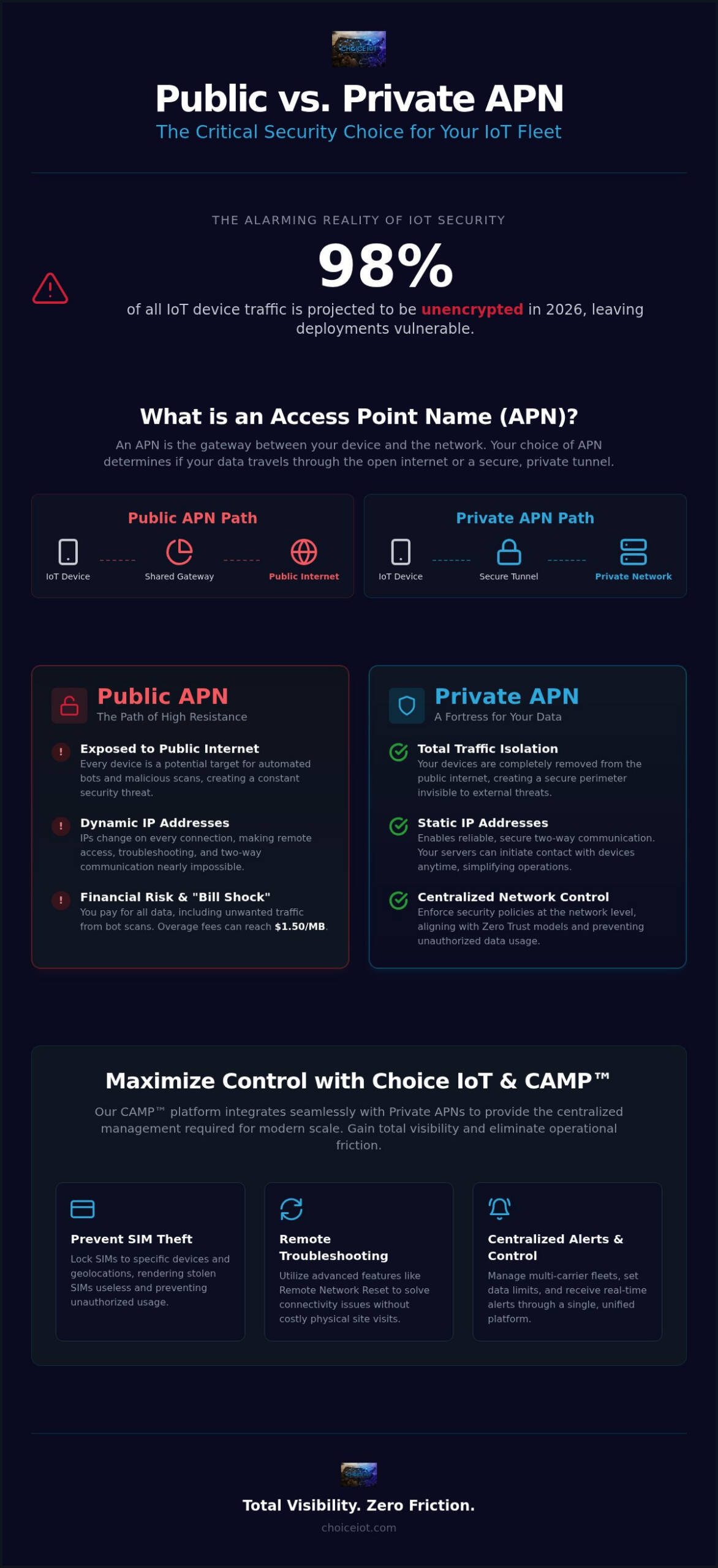
Choosing between a private apn vs public apn for iot is a choice between vulnerability and control. Public APNs are the path of least resistance. They use shared gateways. They assign dynamic IP addresses. Private APNs, conversely, provide a dedicated tunnel. They isolate your traffic. They offer a secure perimeter. Total isolation. Zero exposure. This technical distinction is the difference between a secure deployment and an easy target.
Public APNs: The Standard Path (and its Hidden Risks)
Public APNs expose your hardware to the open internet. Every public IP address is a target. Automated bots scan these addresses constantly. They attempt to exploit weak credentials or unpatched firmware. This inbound traffic isn’t just a security risk; it’s a financial one. You pay for the data these bots consume. In some pay-as-you-go models, overage fees can reach $1.50/MB. This leads to massive “bill shock.” Furthermore, dynamic IPs make remote troubleshooting nearly impossible. You can’t reach a device if its address changes every time it reconnects.
Private APNs: Dedicated Infrastructure for Mission-Critical Data
Private APNs remove your devices from the public eye. They facilitate total traffic isolation. You design the network. You set the rules. This infrastructure is the only way to implement Static IP Addresses for reliable two-way communication. It allows your central server to initiate contact with the device. It simplifies integration with your existing IT schema. By using a Private APN, you move security enforcement to the network level. This aligns with Zero Trust models. It protects the device even if its local security is compromised.
The cost-benefit analysis is clear. Upfront setup for a private network is a strategic investment. It eliminates the long-term expenses of data overages and security breaches. You trade the unpredictability of the public web for the calm assurance of a private tunnel. It’s about operational longevity. It’s about protecting your bottom line. Centralized control is no longer optional; it’s the foundation of a scalable IoT strategy.
Strategic Evaluation: Choosing the Right APN for Your IoT Use Case
Risk assessment is the first step in network design. It is not just about connectivity. It is about operational continuity. When evaluating a private apn vs public apn for iot, start with the sensitivity of your data. Compliance is a mandate, not a suggestion. Regulations like HIPAA, PCI, and GDPR require strict traffic isolation to protect user privacy. A private gateway simplifies this complexity. It centralizes your security posture. It allows you to future-proof your deployment with a Private APN for IoT, ensuring that as your fleet grows, your risk does not.
When a Public APN is Sufficient (Low-Risk Deployments)
Public APNs serve a specific purpose for non-critical hardware. They are suitable for environmental sensors in remote locations or basic consumer-facing gadgets. These use cases typically involve low-data, outbound-only communication. Security is less critical because the data itself carries little value to attackers. You can mitigate some risks on public networks with robust device-level encryption. However, you still lack control over the routing path. You remain vulnerable to the “bill shock” caused by automated bot traffic scanning the public gateway.
Critical Use Cases That Demand a Private APN
Mission-critical deployments require the absolute isolation of a private tunnel. In the medical field, telehealth systems must protect patient data while ensuring constant uptime. A connection failure or data breach is unacceptable. Industrial IoT (IIoT) monitors critical infrastructure where unauthorized access could lead to catastrophic failure. Fleet management also demands this level of security. You must secure telematics data across multi-carrier IoT SIM cards to maintain visibility and control. A private gateway ensures that regardless of which carrier your device hits, the data stays within your secure perimeter.
Centralizing your network through a private gateway removes the logistical stress of managing fragmented carrier relationships. It provides a single pane of glass for security enforcement. Ready to secure your deployment? Partner with Choice IoT to design a resilient network architecture tailored to your specific use case.
Maximizing Operational Control: Private APN Integration with Choice IoT CAMP™
The real power of a Private APN lies in its integration with a centralized management platform. Connectivity is just the beginning. True operational excellence requires a “One Platform” approach. When comparing a private apn vs public apn for iot, the decision often hinges on how much control you need over your fleet. Choice IoT provides this through the CAMP™ platform. This integration transforms your APN from a simple tunnel into a dynamic management tool. It enables advanced security features that are impossible on a public gateway. You gain total oversight. You eliminate uncertainty. Rapid deployment. Total control.
Real-Time Visibility and Intelligent Alerts
Managing thousands of devices requires a single-pane-of-glass dashboard. CAMP™ provides real-time visibility into all devices, SIMs, and data usage patterns. You can set custom data-usage thresholds to prevent overage surprises before they impact your bottom line. This proactive approach turns raw usage data into actionable business insights with CAMP™. You don’t just see the data; you control the flow. Intelligent alerts notify you the moment a device behaves unexpectedly. This allows for immediate intervention. No more guessing. No more bill shock.
Remote Management: Reset, Lock, and Secure Your SIMs
Operational friction often stems from physical maintenance requirements. Did you know? You can reset SIM connectivity remotely without an on-site visit. This Remote Network Reset capability eliminates costly truck rolls. It saves time. It reduces overhead. For added security, enabling the SIM Lock feature prevents unauthorized usage if your hardware is stolen or tampered with. If a SIM is moved to an unapproved device, the system alerts you instantly. You can also automate activations and plan changes via Open API integration. This level of automation is why the choice of a private apn vs public apn for iot is so significant for 2026 deployments. You aren’t just buying a network; you’re building a scalable, automated infrastructure. Centralization is the key to growth.
Secure Your Deployment with Operational Certainty
The decision between a private apn vs public apn for iot is a decision about business resilience. Public gateways leave your hardware exposed to automated threats and unpredictable data costs. In contrast, a private architecture provides the isolation required for modern compliance and security. It’s the difference between managing a crisis and managing a fleet. You don’t just need a secure tunnel; you need tools that eliminate operational friction and truck rolls. Total control starts with the right foundation.
Choice IoT empowers you with the CAMP™ platform for real-time visibility across every device. You gain the power of a Remote Network Reset to clear connectivity issues from your desk. Proactive defenses like SIM Lock and Device Change Alerts turn your network into a fortress. It’s time to stop reacting to vulnerabilities and start leading with a secure, scalable architecture. Take control of your IoT security—contact Choice IoT for a Private APN solution today. Build your network on a foundation of total control. Your growth depends on it.
Frequently Asked Questions
What is the primary difference between a public and private APN?
The primary difference lies in network isolation. A public APN connects your device to a shared gateway exposed to the open internet. A private APN creates a dedicated, secure tunnel between your IoT device and your internal network. This isolation removes your hardware from the public eye. It prevents unauthorized scans. It ensures your data remains within a controlled environment. For enterprise scale, this technical separation is the foundation of a secure architecture.
Does a private APN improve IoT device battery life?
Yes, a private APN can significantly improve battery life by filtering out unnecessary network noise. Public gateways subject devices to constant pings from automated bots and background internet traffic. These packets force devices to wake up and process data, draining power. Private routing ensures your device only wakes for legitimate communication. It reduces handshake overhead. It maximizes the longevity of battery-powered sensors in the field. Efficiency meets longevity.
Is a private APN necessary for 5G Redcap deployments?
5G Redcap (Reduced Capability) is designed for mid-tier IoT applications that require balanced performance. While it connects over public gateways, a private APN is highly recommended for these deployments in 2026. Redcap devices often monitor industrial or medical systems where exposure is a risk. Using a private tunnel ensures these 5G devices benefit from enterprise-grade security. It bridges the gap between cost-efficiency and total data protection.
Can I switch from a public APN to a private APN after deployment?
You can switch, but the complexity depends on your hardware and provisioning method. Traditional SIMs require manual configuration or terminal access to update the APN string. However, with the 2026 shift toward the SGP.32 eSIM standard, remote over-the-air (OTA) updates make this transition seamless. When evaluating a private apn vs public apn for iot, it’s best to start private. This avoids the logistical stress of reconfiguring a dispersed fleet later.
How does a private APN help prevent IoT bill shock?
Private APNs eliminate bill shock by blocking unwanted inbound data. On a public gateway, you pay for every megabyte, including data consumed by malicious bots scanning your IP. These scans can quickly push a device into expensive overage tiers. A private setup ensures only authorized traffic reaches your SIM. Combined with the CAMP™ platform, you can set intelligent alerts and hard data caps. You stay in total control of your budget.
What is the role of a Static IP in a private APN setup?
A Static IP Address provides a persistent, unchanging identity for your device within the private network. This is critical for two-way communication. It allows your central server to initiate contact with the device at any time. Without a Static IP, you are limited to outbound-only communication. This makes remote troubleshooting and real-time polling impossible. In a private apn vs public apn for iot comparison, Static IPs are the key to reliable management.