

In the world of mission-critical communications, your Push-to-Talk hardware is only as reliable as the network management behind it. You’ve likely invested in high-performance devices only to face the frustration of dropped calls in low-coverage zones or unpredictable data overages that blow your budget. It’s a common struggle. Relying on standard consumer-grade cellular plans often leads to security vulnerabilities on public networks. Finding the right IoT Connectivity for POC & Two way radios shouldn’t feel like a gamble. We understand that seamless communication is the backbone of your operations. Reliable. Secure. Scalable.
This article shows you how to optimize your deployments with secure, multi-carrier connectivity and centralized control. You’ll discover how to achieve nationwide coverage and real-time visibility into every byte of data used by your fleet. We’ll explore how a Private APN hardens your network security while the CAMP™ platform streamlines your entire operation. From eliminating on-site visits via Remote Network Reset to leveraging multi-carrier IoT SIMs for maximum uptime, we’re covering the essentials of robust PoC infrastructure. It’s time to move beyond basic connectivity and embrace a solution built for professional performance.
Key Takeaways
- Learn why transitioning from traditional RF infrastructure to nationwide LTE/5G networks is essential for modern, high-performance communications.
- Understand the critical technical requirements for IoT Connectivity for POC & Two way radios, focusing on ultra-low latency and multi-carrier redundancy.
- Discover how to harden your network security using a Private APN to protect sensitive enterprise voice data from public cellular vulnerabilities.
- Gain total operational control over your fleet through the CAMP™ platform, enabling real-time visibility and remote management from a single interface.
- Find out how partnering with a complete connectivity expert simplifies scaling and ensures 100% uptime for mission-critical PoC deployments.
Beyond RF: Why PoC Connectivity is the Future of Critical Comms
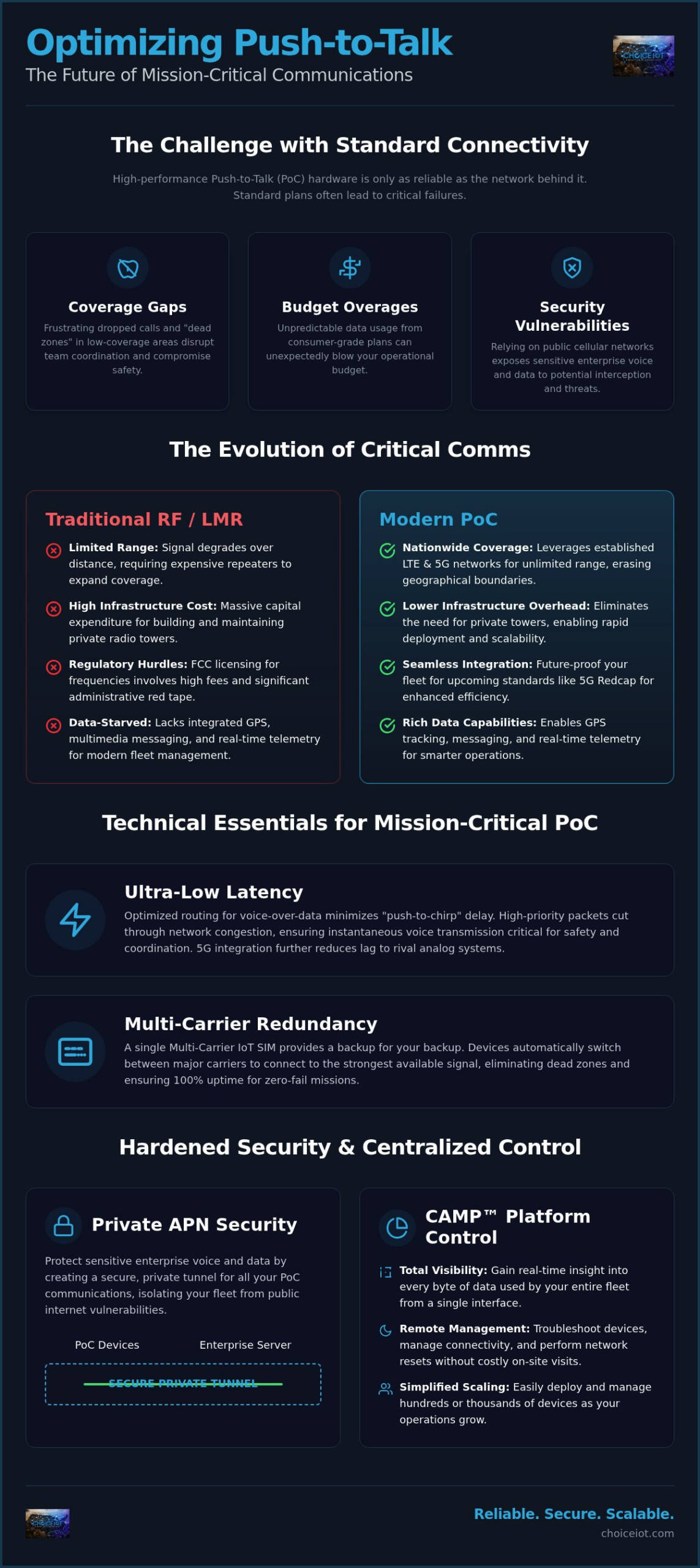
The shift from traditional Radio Frequency (RF) to broadband is a fundamental pivot in enterprise communication. Push-to-Talk over Cellular (PoC) leverages established LTE and 5G networks to mimic the instantaneous nature of two-way radio functionality. It replaces expensive, localized RF towers with nationwide cellular infrastructure. For many businesses, this connectivity is the secret sauce. It transforms a standard Digital Mobile Radio (DMR) alternative into a high-performance tool with unlimited range. By prioritizing specialized IoT Connectivity for POC & Two way radios, organizations eliminate the massive capital expenditure of building private radio towers. Lower infrastructure overhead. Rapid deployment. Total scalability.
The Limitations of Traditional Two-Way Radios
Traditional LMR (Land Mobile Radio) systems face hard physical ceilings. Signal strength degrades quickly over distance. To expand coverage, you need repeaters. This adds cost and complexity. Then there’s the regulatory hurdle. FCC licensing for specific frequencies involves high fees and significant red tape. Beyond voice, these systems are often data-starved. They lack integrated GPS tracking, multimedia messaging, and the real-time telemetry required for modern fleet management. Fixed range. High maintenance. Limited utility.
How PoC Solves the Distance Gap
PoC technology effectively erases geographical boundaries. By utilizing multi-carrier iot sim cards, devices can bridge dead zones by switching to the strongest available signal. This ensures instant group communication across state lines or international borders. There’s no need for new hardware sites. You leverage existing cellular towers for immediate deployment. This transition ensures that IoT Connectivity for POC & Two way radios provides the resilience and reach that legacy RF simply cannot match. Seamless integration. Reliable uptime. Global reach.
Did you know? Transitioning to PoC allows your team to communicate across the country as easily as across the street, all while future-proofing your fleet for upcoming standards like 5G Redcap.
Technical Essentials for Reliable Push-to-Talk over Cellular
Rugged hardware is only half the battle. The invisible layer of connectivity dictates the actual user experience in the field. High-performance voice transmission requires more than just a basic signal; it demands ultra-low latency. In mission-critical scenarios, a delay of even a few hundred milliseconds disrupts coordination and compromises safety. This is why IoT Connectivity for POC & Two way radios differs from standard consumer mobile data. It isn’t about high bandwidth for streaming video. It’s about high-priority data packets that cut through network congestion. Instantaneous. Reliable. Direct.
Looking ahead, the industry is preparing for the 5G Redcap standard. Expected to be a mainstay for PoC radio models by 2026, Redcap offers the perfect middle ground for enterprise comms. It provides mid-speed throughput with extreme power efficiency. This ensures radios stay connected longer without sacrificing the real-time response times required for professional use. It’s a strategic shift toward smarter, leaner data utilization.
Latency and Voice Quality in PoC
Jitter and packet loss are the primary enemies of clear communication. When data packets arrive out of order or fail to reach the device, audio becomes robotic or unintelligible. Optimized routing is essential to combat this. You need a network architecture designed specifically for voice-over-data to minimize the “push-to-chirp” delay. 5G integration significantly reduces this lag, providing a near-instantaneous connection that rivals traditional analog systems. Clear audio. Zero lag. Total clarity.
Multi-Carrier Redundancy for Zero-Fail Missions
True reliability means having a backup for your backup. In rural or dense industrial environments, a single carrier’s signal can fade without warning. Multi-carrier redundancy solves this by enabling automatic switching between major providers. A single Multi-Carrier IoT SIM can access multiple networks, ensuring your team never hits “dead air.” This level of resilience is non-negotiable for emergency response and high-stakes logistics. If you want to ensure your fleet stays online regardless of location, implementing robust network management is the first step toward a fail-safe deployment.
Management and Security: Optimizing Your PoC Fleet
Deploying rugged hardware is only the first step. The real challenge lies in maintaining total operational control over a distributed fleet. Relying on fragmented carrier portals won’t work for professional deployments. You need a centralized iot connectivity management platform to gain real-time visibility. This level of oversight ensures that your IoT Connectivity for POC & Two way radios remains functional, cost-effective, and secure. Visibility is your best defense against downtime. Manage with confidence.
Security is equally critical. A private apn for iot is non-negotiable for enterprise communications. It creates a private tunnel for your voice traffic, effectively isolating it from the public internet. This prevents eavesdropping and protects sensitive data from external threats. Pairing this with a Static IP Address allows for dedicated device addressing and reliable remote access. It’s about building a foundation of trust. Secure. Private. Dedicated.
Hardening Your Radio Network
Hardening goes beyond simple encryption. Use features like SIM Lock to ensure your data plans stay with the intended hardware. It prevents “plan poaching” where SIMs are stolen for consumer use. Implement Device Change Alerts for instant notification if a radio is tampered with or a SIM is swapped. These tools create a robust security posture that protects your bottom line. You don’t just want connectivity; you want a hardened network that resists external interference and internal misuse.
Operational Control with CAMP™
The CAMP™ platform provides the ultimate operational advantage for PoC integrators. Monitor data usage across 1,000+ radios from one unified dashboard. Real-time visibility matters. Use intelligent alerts to set custom thresholds and prevent iot bill shock before it impacts your budget. If a device encounters a connectivity glitch, the Remote Network Reset feature allows you to fix it from your office. This eliminates costly “truck rolls” and on-site visits. Control every aspect of your deployment with ease. Partner with Choice IoT to streamline your fleet management today.
Scaling Your Deployment with Choice IoT and CAMP™
Scaling a PoC operation requires more than just buying more radios. It demands a partner that understands the intersection of hardware and network protocols. Choice IoT serves as “The Complete Connectivity Partner” for PoC solution providers, offering the infrastructure needed to grow without friction. By leveraging the CAMP™ platform, you gain complete operational control over your entire fleet. This is the foundation of high-performance IoT Connectivity for POC & Two way radios. Centralized. Automated. Scalable.
Carrier Certification and Deployment
Hardware is only as good as its network access. Choice IoT facilitates rapid Carrier Device Certification on major networks, ensuring your new PoC radio models are approved and ready for field use. This significantly reduces your time-to-market. Instead of wrestling with carrier bureaucracies, you can focus on deployment. We simplify the supply chain with pre-provisioned SIMs, making out-of-the-box connectivity a reality for your end users. Fast deployment. Zero headaches.
The Partner Advantage
For Value-Added Resellers (VARs) and integrators, the advantage lies in technical integration. Our automation and API tools allow you to integrate connectivity data directly into your existing dispatch software. This creates a seamless workflow for your operations team. You also gain access to white-label opportunities. This allows you to offer a branded experience to your clients, positioning your business as a full-service provider. It’s about ownership. Control. Brand loyalty.
Diagnostic tools within the CAMP™ platform reduce your reliance on slow carrier support channels. Features like Remote Network Reset and real-time usage monitoring empower you to solve issues in seconds rather than days. You’re not just buying data; you’re gaining direct access to expert support for complex multi-carrier deployments. Ready to secure your fleet? Contact sales@choiceiot.com today to build a fail-safe foundation for your IoT Connectivity for POC & Two way radios.
Future-Proof Your Mission-Critical Communications
Transitioning from legacy RF to broadband infrastructure eliminates range constraints and high overhead. It is a strategic move toward total scalability. High-performance IoT Connectivity for POC & Two way radios requires more than just a signal. It demands ultra-low latency and multi-carrier redundancy for zero-fail performance. Managing these distributed deployments doesn’t have to be complex when you have the right tools. Control. Security. Reliability.
The CAMP™ platform provides real-time visibility across your entire fleet from a single dashboard. Secure Private APN and Static IP options harden your network against external threats while protecting sensitive voice data. Remote Network Reset technology ensures you can resolve connectivity glitches instantly without costly on-site visits. This is the foundation of a modern, resilient communication strategy. Get Complete Operational Control with Choice IoT and transform your communication backbone today. Your team deserves the reliability of a professional-grade network. Let’s build a foundation that scales with your ambition.
Frequently Asked Questions
What is the difference between PoC and traditional two-way radios?
Traditional two-way radios rely on localized Radio Frequency (RF) infrastructure and repeaters, which limits their range to specific geographic areas. Push-to-Talk over Cellular (PoC) utilizes existing nationwide LTE and 5G networks to provide unlimited coverage. It mimics the instantaneous voice transmission of analog radios while adding advanced data capabilities like GPS tracking and multimedia messaging. By leveraging cellular towers, businesses avoid the high capital expenditure of building and maintaining private radio towers.
Do I need a specific SIM card for PoC radios?
You should use specialized IoT SIM cards rather than standard consumer mobile plans. Professional IoT Connectivity for POC & Two way radios requires high-priority data routing and specialized network configurations to ensure low latency. Using a Multi-Carrier IoT SIM allows your devices to switch between major providers automatically. This ensures your radios stay connected in areas where a single carrier’s signal might fail, providing the resilience required for mission-critical communications.
How much data does a Push-to-Talk radio use per month?
Data consumption varies based on talk time and secondary features like GPS polling. Most PoC devices use between 100MB and 500MB of data per month for standard voice operations. Voice traffic is highly compressed to minimize bandwidth while maintaining audio clarity. However, if your radios use multimedia messaging or high-frequency location tracking, usage can increase. Monitoring this through a centralized platform prevents unexpected overages and ensures your fleet stays within budget.
Can I manage PoC connectivity for multiple carriers in one place?
You can manage your entire fleet through the CAMP™ platform. It provides a single, unified dashboard to monitor devices across multiple carriers simultaneously. You don’t have to log into separate carrier portals to check data usage or provision new SIMs. This centralized approach gives you complete operational control. You can set intelligent alerts, perform remote network resets, and view real-time diagnostics for every radio in your deployment from one location.
Is Push-to-Talk over Cellular secure enough for public safety?
PoC is highly secure when implemented with enterprise-grade network features. By using a Private APN, you isolate your voice traffic from the public internet, creating a secure tunnel for communication. This prevents eavesdropping and unauthorized access. Adding features like SIM Lock and static IP addresses further hardens the network. These security measures, combined with end-to-end encryption, make IoT Connectivity for POC & Two way radios a reliable choice for public safety and sensitive enterprise operations.
What happens if a PoC radio moves to an area with poor coverage?
If a radio enters a low-coverage zone, a Multi-Carrier IoT SIM will automatically search for and switch to the strongest available signal from other major providers. This redundancy eliminates “dead air” and ensures 100% uptime in rural or dense industrial environments. If a connection glitch occurs, you can use the Remote Network Reset feature in the CAMP™ platform to re-establish the link without needing the physical device in hand.